Mont Blanc Quartzite Kitchen Countertop
Mont
Blanc quartzite kitchen countertop is a natural stone surface quarried
primarily in Brazil. Quartzite forms when quartz-rich sandstone is subjected to
intense heat and pressure, causing the quartz grains to recrystallize into a
dense, interlocking structure.
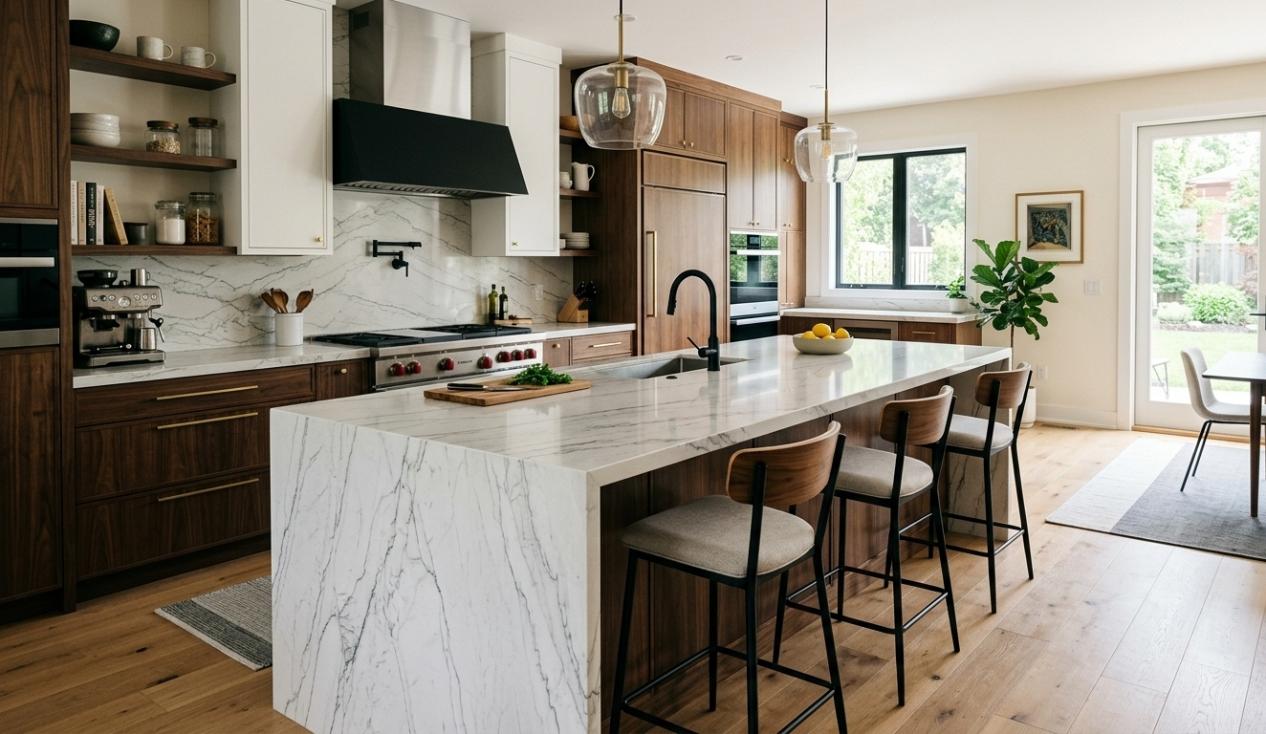
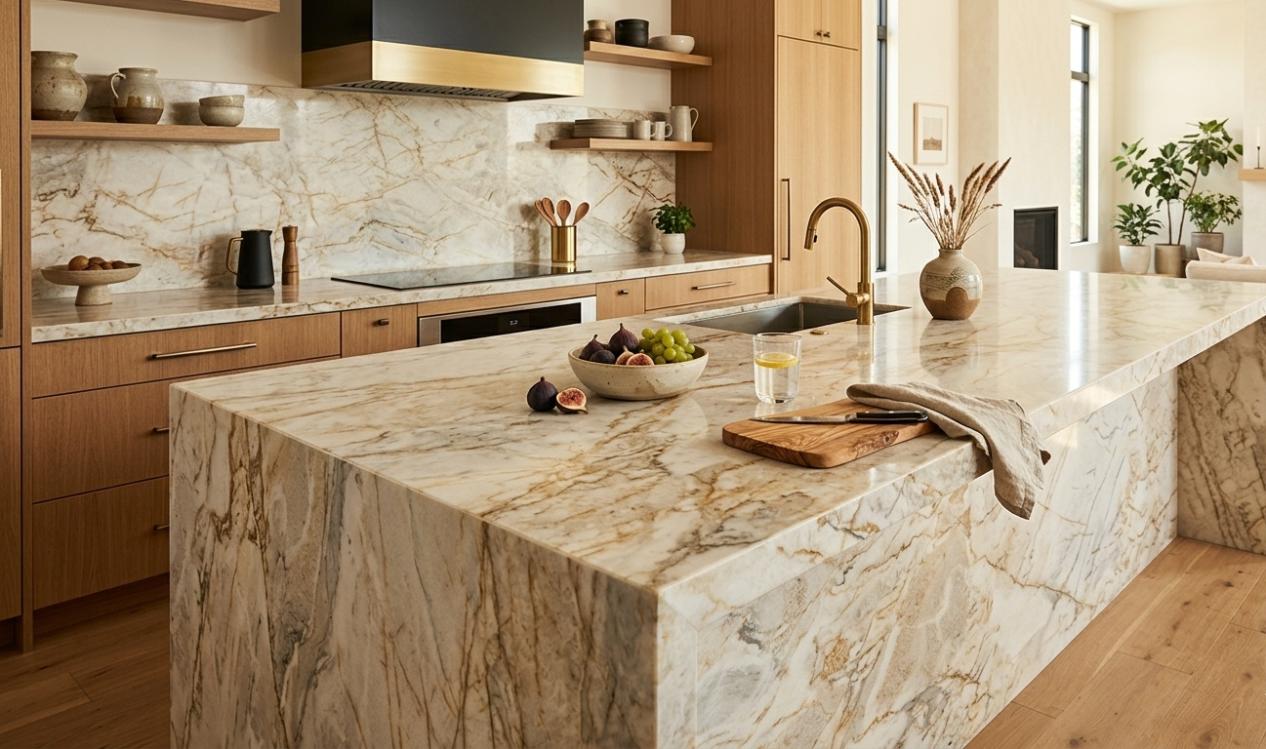
Mont Blanc presents a creamy white to soft gray base with subtle veining in gray and taupe; some slabs show hints of gold depending on mineral composition. It registers at 7 on the Mohs hardness scale, with industry sources citing a range of 7 to 8 for this variety specifically, making it significantly harder than marble and more resistant to scratching, heat, and etching.
What Makes Mont Blanc Quartzite a Standout Kitchen Surface
Mont Blanc quartzite distinguishes itself through physical properties that hold up well under daily cooking conditions.
Its interlocking crystalline structure produces a surface that withstands heat from cookware and resists knife scratches. It does not etch when exposed to common kitchen acids the way marble or dolomite does, citrus juice, vinegar, and wine leave no dull spots or permanent marks on the surface. This resistance to etching is one of the primary reasons Mont Blanc quartzite is chosen over marble for active kitchen use.
The Aesthetic Versatility of a Mont Blanc Quartzite Kitchen Countertop
Mont Blanc does not lock a kitchen into a single style. Its milky white surface brings brightness to a room while the gray and taupe veining adds enough movement to keep the countertop from reading as flat or plain.
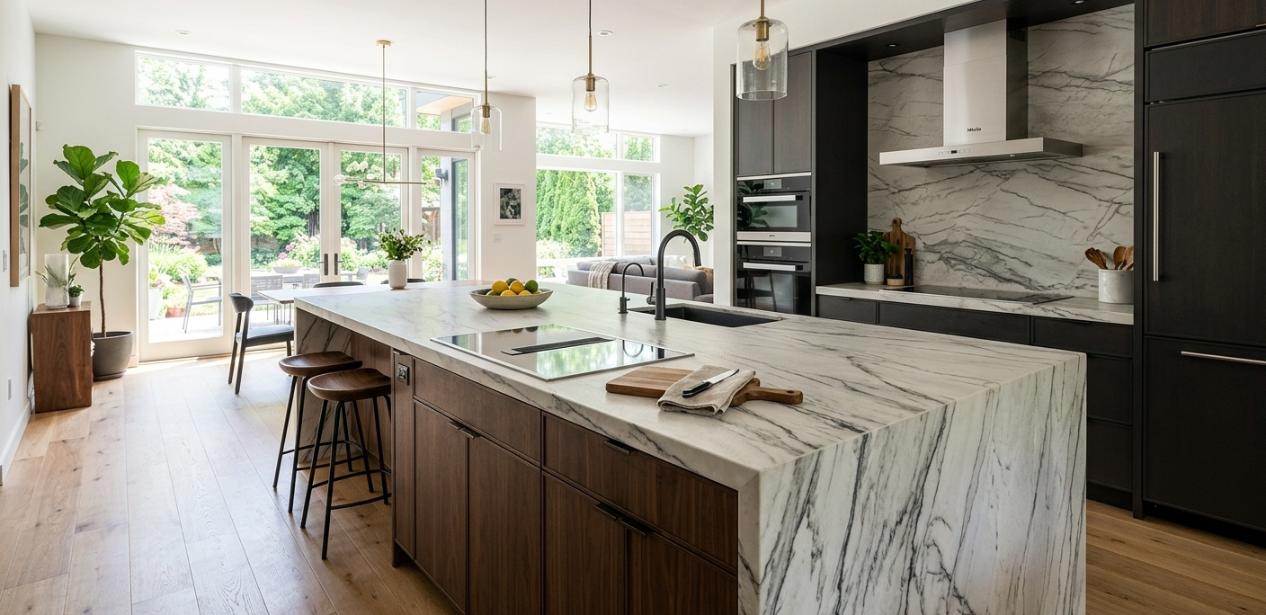
The stone integrates equally well with deep navy cabinetry, classic white shaker doors, warm wood tones, or modern flat-front panels. Its neutral palette allows fixtures and cabinetry to lead the design without competition. In open-concept kitchens, it works across both perimeter counters and a contrasting island without appearing repetitive.
Slabs are available in 2 cm (¾ inch) and 3 cm (1¼ inch) thicknesses. Finish options include polished, which enhances natural depth and luster; honed, which delivers a matte look; and leathered, which adds subtle texture and conceals minor surface wear. For large islands and extended countertop runs, bookmatched slabs, where two consecutive cuts from the same block are mirror-polished to align the veining symmetrically, produce a cohesive, uninterrupted pattern across the surface. Beyond the kitchen, Mont Blanc quartzite is also used for fireplace surrounds, where its heat-tolerant composition and neutral veining make it a natural fit for a focal wall application.
Transform Your Space
Nova Tile and Stone carries Mont Blanc quartzite slabs across all four showroom locations in Reno, Sacramento, Minden, and Fernley. Seeing the stone in person, against actual lighting, flooring samples, and cabinet finishes, is the most reliable way to confirm whether a specific slab suits your kitchen. Veining patterns, tonal depth, and surface texture vary from slab to slab, and viewing full-size slabs in context makes a difference that photos cannot replicate.
Our team can walk you through available inventory, finish options, and thickness selections. Visit any of our four showrooms to get expert guidance tailored to your kitchen layout and design direction.
Frequently Asked Questions
Yes. Mont Blanc quartzite kitchen countertop is well-suited for daily use. It is hard, heat-tolerant, and resistant to scratching and etching from kitchen acids, properties that matter on a surface used every day. It registers at 7 on the Mohs hardness scale, with industry sources citing 7 to 8 for this variety specifically. Its creamy white and gray tones complement a wide range of cabinet colors and kitchen styles, from transitional to contemporary.
Yes. Although Mont Blanc is a true quartzite, it has a more open stone structure and absorbs liquids more readily than denser quartzite varieties. A penetrating impregnating sealer should be applied before first use, after the stone has fully dried post-installation. The need for resealing is best determined by the water bead test: when water stops beading and begins absorbing into the surface, resealing is due. A stone fabricator can recommend specific products suited to your slab.
Both stones share a similar appearance, white to soft gray backgrounds with veining, but they perform very differently. Marble rates around 3 on the Mohs hardness scale and etches on contact with kitchen acids. Mont Blanc quartzite rates at 7 to 8 and does not etch from the same substances. For kitchens that see regular cooking activity, quartzite requires less protective care than marble.
Mont Blanc quartzite is available in polished, honed, and leathered finishes. A polished finish brings out the stone's depth and natural sheen. A honed finish produces a matte, understated surface. A leathered finish adds texture and tends to conceal minor marks from everyday use. Honed surfaces are slightly more porous than polished ones and may require more attentive sealing.
Yes. Mont Blanc quartzite works well across both applications. For large islands, bookmatched slabs, where consecutive cuts from the same block are aligned to create a mirror image of the veining, produce a symmetrical pattern that works particularly well on wide surfaces. Slab sequencing should be discussed with your fabricator or showroom before finalizing your selection.
Discover Our Showrooms
Reno, NV
Sacramento, CA
Fernley, NV
Minden, NV
Looking for immediate assistance?
Give us a call!
775-374-6682
(Available Mon-Fri 7:30am - 4:00pm PST)
Unlike most customer service lines, ours connects you with real people.
When
you call, just press 1 for online shopping support, or 2 for local shopping support!