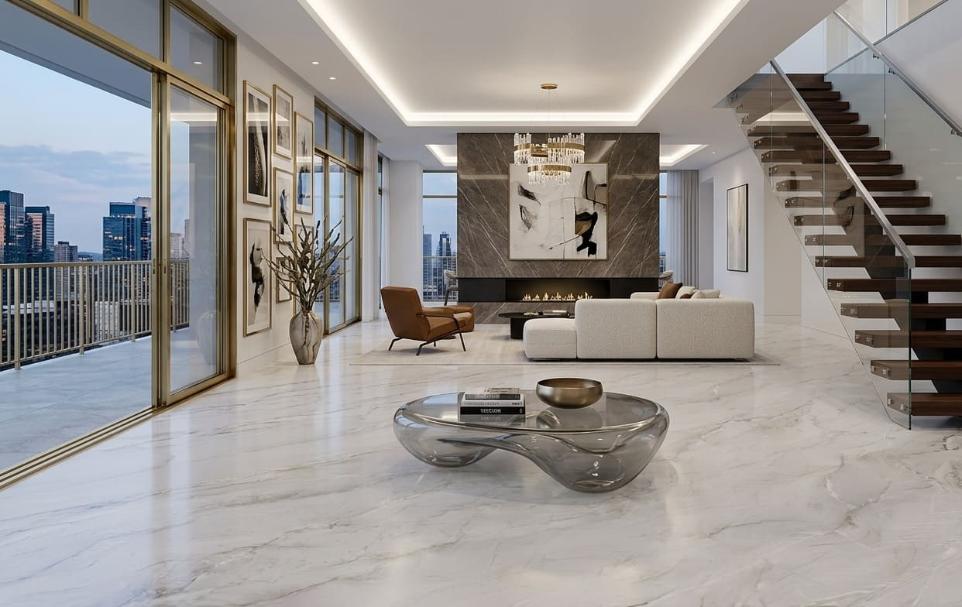
Durability and Performance
The strength of Mont Blanc quartzite comes from the interlocking quartz crystals formed during metamorphism. This internal structure produces a dense, hard surface that holds up well under sustained use without losing its surface integrity over time, a quality that makes it suitable for both residential floors and commercial environments where durability is a primary requirement.
That same density also makes the stone perform reliably outdoors. Its resistance to UV rays means prolonged sun exposure will not cause fading or discoloration, making it a practical option for covered patios, outdoor entertaining areas, and pool surrounds, where other natural stones may degrade more quickly. For outdoor installations specifically, a honed or leathered finish is generally preferred over polished, as the added surface texture reduces slip risk underfoot.
For interior floors, the choice of finish shapes both the appearance and the maintenance profile of the surface. A polished finish enhances the stone's natural luster and brings out the veining in full detail. A honed finish produces a matte, low-sheen surface that conceals minor wear more effectively, making it a practical choice for busy interior floors. A leathered finish adds subtle texture while preserving the stone's natural tones.
Design Versatility Across Interior Styles
The same qualities that make Mont Blanc quartzite durable also make it exceptionally adaptable in design. Its neutral color palette, creamy white with soft grey veining, works equally well as a foundation for modern, transitional, and classic spaces. In open-concept living areas, the stone's understated character lets other design elements, furniture, architectural details, artwork, remain the visual focus. Some homeowners extend the material from the floor to a Mont Blanc quartzite accent wall to create a seamless, continuous stone effect that adds depth without introducing a competing element.
In bathrooms, this flooring creates a calm, spa-like atmosphere. The serene tones and gentle veining introduce sophistication, while the stone's resistance to humidity and frequent cleaning makes it well-suited to that environment.
In entryways and hallways, where foot traffic is heaviest, the surface retains its appearance in conditions where softer flooring materials tend to show wear. Its hardness resists the scuffing and scratching that accumulate in spaces with constant daily use.