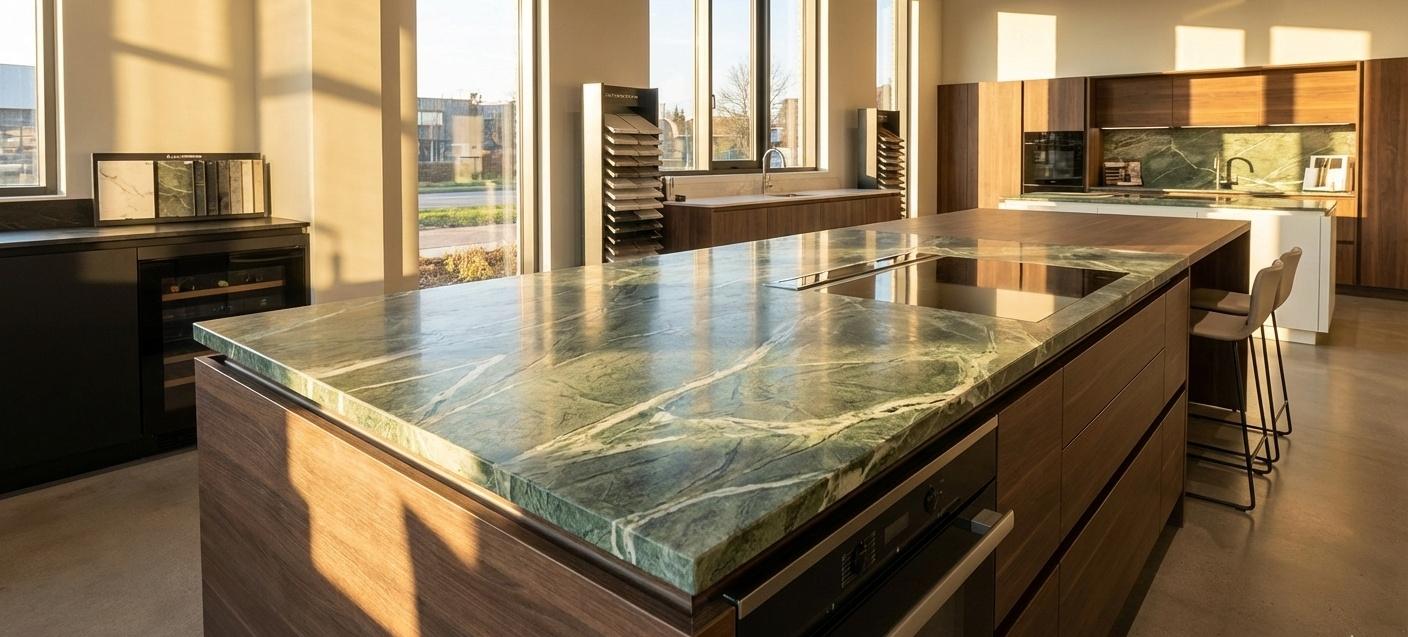
Green Dolomite Countertop slabs bring a rare combination of striking color and natural character to any kitchen or bathroom remodel. As a natural stone slab, green dolomite features a distinctive pattern with soft, flowing veining that ranges from deep forest tones to lighter jade-like hues. Available in polished, honed, and leathered finishes, these large-format slabs are a refined choice for kitchen islands, countertops, and bathroom vanities where visual impact and long-term durability both matter. Before choosing a surface, it is worth reading Choosing the Right Natural Stone Slab For Your Countertop to understand how different stone types compare for your specific project.
What Sets a Green Dolomite Countertop Apart from Other Natural Stone Options
Dolomite is a calcium magnesium carbonate mineral, denser than marble and naturally more resistant to everyday etching. Each green dolomite slab comes in large-format sizes designed for seamless countertop runs, which reduces visible seams on kitchen islands and vanity tops. The polished finish amplifies the stone's natural color depth and reflectivity, while honed delivers a softer matte appearance, and leathered adds tactile texture with a subtle, sophisticated sheen. Unlike standard subway tile backsplash layouts that work through repetitive gridwork, a full dolomite slab creates a single, uninterrupted visual statement that anchors the entire space.
RARE NATURAL STONE
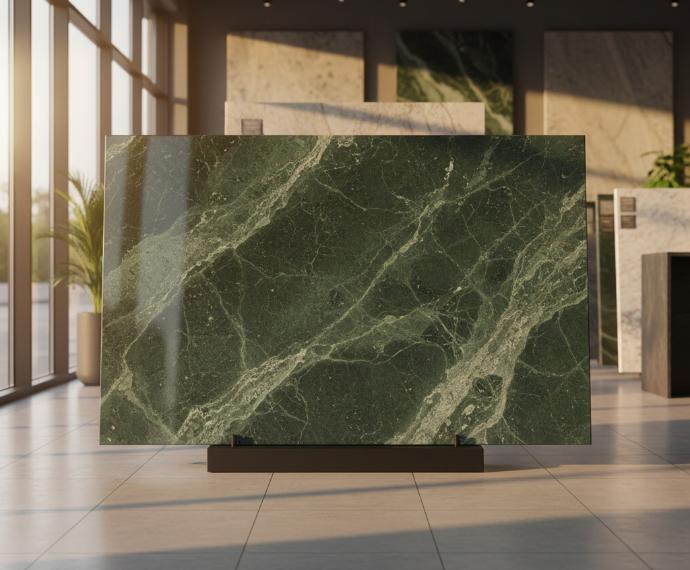
Green Dolomite Natural Stone Slab
A rare sedimentary gem displaying sage, moss, and forest greens woven with dynamic veining. Harder than marble, more forgiving than granite - an extraordinary surface for countertops, flooring, and statement walls.
PRODUCT OVERVIEW
What Is Green Dolomite?
Green Dolomite - traded under names such as Dolomite Verde, Verde Breccia Dolomite, and Anrochter Dolomit - is a sedimentary rock composed primarily of calcium magnesium carbonate (CaMg(CO3)2). Its captivating green coloration is the direct result of trace mineral inclusions, chiefly chlorite, serpentine, and cuprian dolomite (copper-bearing dolomite), that were incorporated during its multi-million-year formation in warm, shallow marine sedimentary basins.
TECHNICAL SPECIFICATION
ORIGIN
Germany · Italy · India
SEALING FREQUENCY
Once or twice per year
ETCHING RESISTANCE
Low–Moderate
(better than marble)
HEAT TOLERANCE
Good
(trivets recommended)
SLAB THICKNESS
2 cm & 3 cm
FINISH OPTIONS
Polished · Honed · Leathered
COLOR RANGE
Sage · Moss · Forest · Blue-Green
DENSITY
~2.84 g/cm³
MOHS HARDNESS
3.5 – 4.0
Fireplace Surrounds
Kitchen Countertops
Bathroom Vanities
Outdoor Kitchen
How Green Dolomite Adapts to Modern Kitchens, Islands, and Bathroom Vanities
Green dolomite pairs naturally with white and dark cabinetry, matte brass hardware, and warm wood tones, making it flexible across modern, transitional, and organic interior styles. On a kitchen island, a full-slab surface with book-matched veining creates a dramatic focal point that draws the eye immediately. In bathroom vanities, the same slab material can extend from the countertop surface to a feature wall panel, giving the space a seamless, spa-like continuity. The natural color variation within each slab also works beautifully as a waterfall edge detail on kitchen islands, adding architectural interest without requiring additional materials.
Why a Green Dolomite Countertop Is a Smart Long-Term Investment
Natural stone surfaces do not go out of style, and green dolomite is no exception. Its inherent hardness holds up well in high-traffic kitchen environments, resisting surface scratches and dents that tend to affect softer engineered materials over time. With routine sealing, the stone maintains its color richness and distinctive veining for decades, making it a surface that adds value to the home rather than requiring periodic replacement. Buyers looking for a luxury kitchen countertop or a statement bathroom vanity surface will find that dolomite consistently competes with premium alternatives at a strong value-to-quality ratio.
Frequently Asked Questions
Green dolomite is a naturally occurring sedimentary rock composed primarily of calcium magnesium carbonate. It forms over millions of years and is quarried in large slabs that are then cut and finished for use as countertops, vanities, and cladding. It is a true natural stone, not engineered or synthetic.
Yes. Dolomite is denser and harder than marble, which makes it more resistant to surface etching from mild acids. While it is not as hard as quartzite or granite, it performs reliably in kitchen environments when sealed properly and maintained with pH-neutral cleaners.
The right finish depends on how and where the surface will be used. Polished is ideal for kitchens and vanities where you want maximum color depth and easy cleaning. Honed is preferred in spaces where a softer, non-reflective look is desired. Leathered works well for kitchen islands where you want a textured, fingerprint-resistant surface.
Most dolomite countertops benefit from sealing once or twice per year, depending on usage frequency and the porosity of the specific slab. A simple water absorption test on the surface will tell you when resealing is needed.
Absolutely. Green dolomite works very well for bathroom vanities because its veining and color create a high-end look that complements a wide range of tile and fixture choices. When sealed correctly, it handles the moisture and cleaning products typical in bathroom environments without staining or deteriorating.
Ready to Bring Natural Stone Into Your Home?
Explore the full slab inventory, request a showroom visit, and speak with a design expert who knows natural stone inside and out. Nova Tile and Stone's dedicated natural stone countertop team is ready to help you choose, source, and plan your green dolomite project from start to finish. Book your free consultation today.