Brown Quartzite
A Natural Stone Built for Beauty and Durability
Brown quartzite is a natural metamorphic stone formed when quartz sandstone is transformed by intense heat and pressure beneath the earth's surface. It ranks between 7 and 8 on the Mohs hardness scale, which tends to place it above granite in hardness and generally above marble in overall durability. Its color ranges from warm caramel and tan to deep chocolate and reddish-brown, with cream or grey veining produced by iron oxide and trace minerals during formation.
Brown quartzite is known for its durability, scratch resistance, and heat resistance, and is available in multiple surface finishes appropriate for a range of interior and exterior applications. As a natural stone, these slabs generally benefit from periodic sealing to protect against liquid absorption.
What Makes Brown Quartzite a Distinctive Natural Stone
The identity of brown quartzite begins at the geological level. Sandstone buried under tectonic pressure recrystallizes over millions of years, fusing its quartz grains into a dense, interlocking mosaic. Minor amounts of iron oxide migrate during this transformation and account for the warm browns, rusts, and golden undertones that contribute to the stone's warm palette. Because slabs rarely undergo identical conditions during formation, the tonal range and veining patterns can vary considerably across a quartzite slab inventory, from lighter varieties such as cream quartzite to deeper, richer chocolates and rusts.
Unlike engineered surfaces, which reproduce patterns uniformly across production runs, each slab tends to be distinct in its veining movement and color depth. For this reason, selecting natural stone slabs in person is one of the most effective ways to understand what a specific slab can contribute to a space.
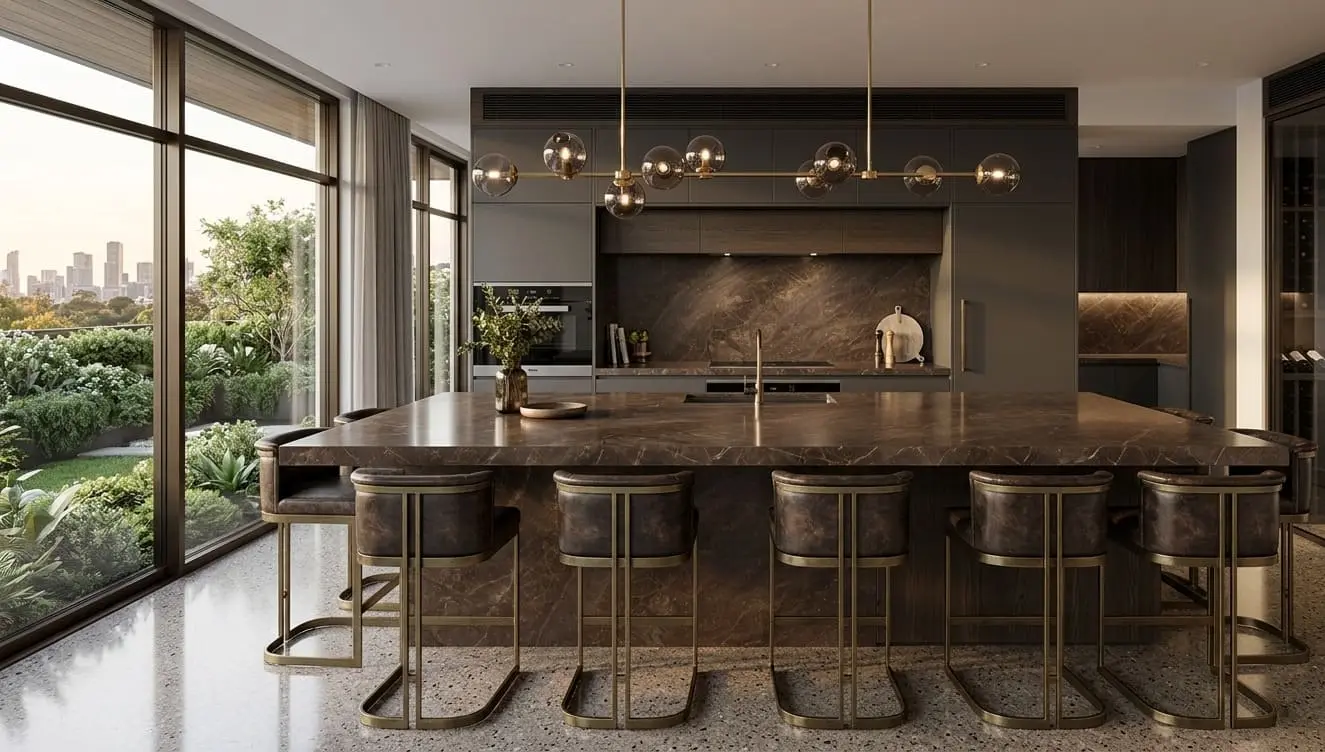
Where Earthy Warmth Meets Everyday Luxury
Polished Finish
Polished finish produces a high-gloss surface that can enhance the depth of the stone's brown and gold tones. The reflective quality can bring out contrast between the base color and the veining, making a polished finish a strong choice for countertops and feature walls where visual impact is the priority.
Honed Finish
Where a polished finish emphasizes gloss and depth, a honed finish removes the shine and delivers a smooth, matte surface with a softer, more understated appearance. It shows the same tonal range as polished but in a quieter, more diffused way, and is well-suited to flooring applications and bathroom vanities where a non-reflective surface is preferred.
Specialty Finishes
For a more aged character, brushed and antiqued treatments can soften edges and introduce a slightly weathered surface quality that tends to complement rustic, transitional, and organic modern interiors.
Leathered Finish
Leathered finish is created by running diamond-tipped brushes across a honed surface, removing softer mineral particles and producing subtle tactile texture across the face of the slab. This typically produces a low-sheen surface that tends to show fingerprints and water marks less readily than polished stone, and that can pair well with the organic depth of the stone.
Where to Use Quartzite Stone Slabs in Your Home and Outdoors
As a kitchen countertop surface, the stone's scratch-resistant composition is well suited to handle cutting, impact, and daily wear. That same thermal stability also makes it a considered choice for fireplace surrounds, where structural performance and heat resistance are priorities.
As a flooring material, quartzite is known to perform well in high-traffic areas. Its abrasion resistance makes it a well-suited choice for entryways, hallways, and living areas where foot traffic is frequent. That same abrasion resistance extends to wall cladding, where large-format natural stone slabs can add warmth and texture to a feature wall, typically with less upkeep than softer materials require.
Outdoors, quartzite's resistance to weathering and thermal variation makes it a practical option for patio surfaces, pool surrounds, and exterior wall cladding. Its tight metamorphic structure is generally well suited to freeze-thaw cycles and prolonged sun exposure, reducing the risk of surface degradation common in less stable materials.
How to Care for Your Natural Quartzite Stone Slabs
Quartzite is naturally porous to varying degrees, making a penetrating sealer generally advisable to help reduce liquid absorption and staining. It is worth noting that sealing is not designed to prevent etching from prolonged exposure to acidic substances. Resealing frequency typically falls between one and two years, depending on the specific stone, the finish, and the level of use the surface receives.
For routine cleaning, a mild pH-neutral cleaner and warm water applied with a soft cloth are generally sufficient. Acidic cleaners, abrasive scrubbing pads, and solvent-based products are best avoided, as they can degrade both the stone surface and the protective sealer over time. Beyond cleaning product choices, using trivets under hot cookware and cutting boards during food preparation can help preserve the surface finish and may extend the slab's serviceable life.
Explore Our Slab Guides and Inspiration
Frequently Asked Questions
Brown quartzite is a natural metamorphic rock composed predominantly of interlocking quartz crystals, with warm tones ranging from caramel and tan to deep chocolate. Its cream or grey veining results from iron oxide and trace minerals concentrated within the stone during formation. It ranks between 7 and 8 on the Mohs hardness scale and is often specified for countertops, flooring, wall cladding, fireplace surrounds, and outdoor surfaces.
Generally, yes. Brown quartzite registers between 7 and 8 on the Mohs hardness scale, while granite generally falls in the 6 to 7 range, suggesting quartzite may offer greater resistance to scratching and surface abrasion under equivalent conditions.
The warm brown, rust, and golden tones result from iron oxide and trace minerals that migrate and concentrate within the stone during the metamorphic process. The intensity and distribution of these tones vary by quarry and individual slab.
Yes. Quartzite is naturally porous, so a penetrating sealer is recommended to help protect against liquid absorption and staining. Resealing is generally advised every one to two years, depending on the stone's porosity and the level of use the surface receives.
Yes. Its dense crystalline structure is known to resist abrasion, moisture penetration, and temperature variation, making it a suitable option for patios, pool surrounds, and exterior wall cladding.
Transform Your Space
Nova Tile and Stone carries a curated selection of brown quartzite slabs available for viewing across four showroom locations in Reno, Sacramento, Minden, and Fernley. Each slab is selected with quality in mind, allowing clients to evaluate color, movement, and finish options in person. Visit any Nova Tile and Stone showroom to explore current slab inventory and speak with a knowledgeable team member about sourcing the right quartzite slab for your project.