Tile ratings are standardized measurements that indicate a tile's durability, slip resistance, water absorption, and appearance consistency. The most important tile ratings include PEI rating (wear resistance, scaled 0–5), DCOF rating (slip resistance, minimum 0.42 for wet areas), water absorption rate (under 0.5% for porcelain tile), and shade variation (V1–V4 for color consistency).
These specifications help homeowners and professionals determine where a tile can safely be installed and how it will perform over time. PEI ratings measure resistance to foot traffic abrasion, DCOF measures how slippery a surface is when wet, water absorption affects frost resistance and stain resistance, and V-ratings indicate how much color variation to expect between tiles.
Understanding how to read tile specifications ensures you select the right product for each application, whether that's a high-traffic kitchen floor, a wet bathroom, or an outdoor patio in a freezing climate. This guide explains each tile rating, what the numbers mean, and how to match specifications to your project requirements.
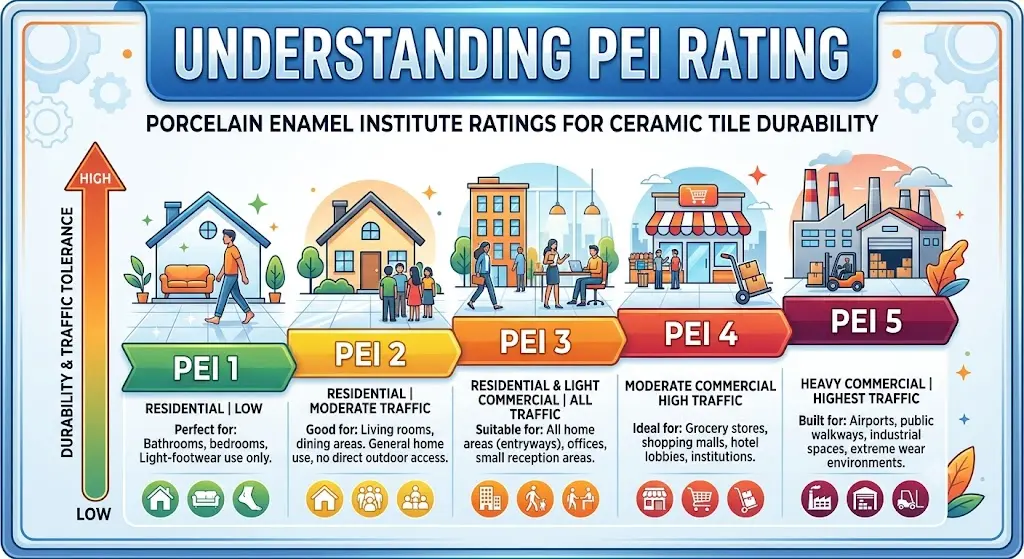
What Is PEI Rating?
| PEI Rating | Traffic Level | Recommended Use |
|---|---|---|
| PEI 0 | No foot traffic | Wall use only |
| PEI 1 | Very light | Bathroom walls, light-use floors |
| PEI 2 | Light | Bathrooms, bedrooms |
| PEI 3 | Moderate | Kitchens, living rooms, hallways |
| PEI 4 | Heavy | All residential, light commercial |
| PEI 5 | Extra heavy | Shopping malls, airports, commercial |
The PEI rating is one of the most important specifications to understand when shopping for glazed ceramic or porcelain tile. Developed by the Porcelain Enamel Institute, this rating measures a tile's resistance to abrasion and surface wear from foot traffic.
PEI ratings range from 0 to 5, with higher numbers indicating greater durability. The rating is determined through standardized testing where the tile's glazed surface is subjected to rotating abrasive materials that simulate years of foot traffic. The number of rotations the tile withstands before showing visible wear determines its classification.
PEI 0: Wall use only. These tiles cannot withstand any foot traffic and are designed exclusively for vertical surfaces like backsplashes and decorative wall accents.
PEI 1: Very light residential traffic. Suitable for bathroom walls and floors where soft footwear or bare feet are the norm. Not recommended for areas with direct outdoor access.
PEI 2: Light residential traffic. Appropriate for bathrooms, bedrooms, and other low-traffic residential spaces. Avoid using in kitchens or entryways.
PEI 3: Moderate traffic. This rating works for most residential applications including kitchens, living rooms, and hallways. It's the most common rating for home flooring projects.
PEI 4: Heavy traffic. Suitable for all residential areas plus light commercial spaces like small offices, restaurants, and retail stores.
PEI 5: Extra heavy traffic. Designed for high-traffic commercial and industrial environments including shopping malls, airports, and public buildings.
For most homeowners, tiles rated PEI 3 or PEI 4 provide the durability needed for everyday living. Matching the PEI rating to your room's traffic level prevents premature wear and extends your floor's lifespan.
Understanding Slip Resistance (DCOF)
| DCOF Value | Slip Resistance Level | Recommended Use |
|---|---|---|
| Below 0.42 | Low traction | Dry areas only, not recommended for wet |
| 0.42+ | Standard (minimum for wet areas) | Bathrooms, kitchens, entryways |
| 0.50+ | Good traction | Showers, pool surrounds |
| 0.60+ | High traction | Commercial kitchens, ramps |
Slip resistance is a critical safety consideration, especially for floors exposed to water or moisture. The tile industry measures slip resistance using the Dynamic Coefficient of Friction, commonly abbreviated as DCOF.
DCOF testing evaluates how much grip a tile surface provides when someone is walking across it. The test simulates real-world conditions by applying a slightly soapy water solution to the tile surface, then measuring the friction between the tile and a standardized sensor that mimics a shoe sole.
According to ANSI A326.3 standards, tiles intended for level interior floors that may get wet should have a minimum DCOF of 0.42. This threshold indicates the tile provides adequate traction for safe walking in wet conditions. However, it's important to understand that a DCOF of 0.42 represents a minimum recommendation, not a guarantee against slipping.
Several factors influence real-world slip resistance beyond the DCOF rating. Surface contaminants like soap, oil, or grease can reduce traction. Sloped surfaces require higher friction than level floors. Footwear type also affects grip, which is why shower floors often benefit from textured tiles or mosaics with additional grout lines for traction.
When selecting tile for bathrooms, kitchens, entryways, or outdoor spaces, look for DCOF ratings of 0.42 or higher. For shower floors and pool surrounds, consider textured finishes or smaller format tiles that provide more grout lines and increased grip.
You may also encounter R-ratings on European tiles. This ramp test rating ranges from R9 (lowest slip resistance) to R13 (highest). For wet residential areas, R10 or R11 tiles typically provide appropriate traction.
Tile Water Absorption Rates
| Classification | Absorption Rate | Tile Type | Recommended Use |
|---|---|---|---|
| Impervious | ≤0.5% | Porcelain | Indoor, outdoor, wet areas, freezing climates |
| Vitreous | 0.5% - 3% | High-quality ceramic | Indoor, covered outdoor, bathrooms |
| Semi-Vitreous | 3% - 7% | Standard ceramic | Indoor walls, light-traffic floors |
| Non-Vitreous | >7% | Wall tile | Wall applications only |
Water absorption measures the porosity of a tile's body and directly affects its durability, stain resistance, and suitability for different environments. This rating indicates what percentage of the tile's weight can be absorbed as water during standardized testing.
Tiles are classified into four categories based on water absorption:
Impervious (≤0.5%): These dense, non-porous tiles absorb almost no water. All true porcelain tiles fall into this category. Impervious tiles offer superior durability, stain resistance, and frost resistance, making them suitable for any indoor or outdoor application.
Vitreous (0.5% - 3%): Tiles in this range still perform well in most applications. Many high-quality ceramic tiles and some quarry tiles fall into this category. They're appropriate for bathrooms, kitchens, and covered outdoor areas in mild climates.
Semi-Vitreous (3% - 7%): These tiles have moderate porosity and work well for indoor walls and light-traffic floors. They're not recommended for wet areas or outdoor installations where freeze-thaw cycles occur.
Non-Vitreous (>7%): High absorption tiles are best limited to wall applications. Their porous bodies may not withstand heavy foot traffic or exposure to standing water.
Water absorption becomes especially important for outdoor tile installations in Northern Nevada and Northern California, where freezing temperatures can cause moisture trapped in porous tiles to expand and crack. For exterior applications, always choose impervious porcelain with water absorption under 0.5%.
The distinction between porcelain and ceramic tile comes down primarily to water absorption. Porcelain tiles must have absorption rates of 0.5% or less, while ceramic tiles typically range from 3% to 10% or higher.
What Is Shade Variation (V-Rating)?
| V-Rating | Variation Level | What to Expect |
|---|---|---|
| V1 | Uniform | Minimal differences, consistent color throughout |
| V2 | Slight | Subtle texture/pattern differences, cohesive look |
| V3 | Moderate | Noticeable color distribution differences tile to tile |
| V4 | Substantial | Random, unique differences, highly varied installation |
Shade variation ratings help you understand how much color and pattern difference to expect between individual tiles from the same production run. This V-rating system ranges from V1 to V4 and is particularly important when selecting tiles that mimic natural materials like wood or stone.
V1 - Uniform Appearance: Tiles show minimal variation from piece to piece. Colors and patterns remain consistent across the entire installation. This rating suits modern, minimalist designs where uniformity is desired.
V2 - Slight Variation: You'll notice subtle differences in texture or pattern, but the overall appearance remains cohesive. V2 tiles add visual interest without dramatic contrast.
V3 - Moderate Variation: Colors and patterns present on one tile indicate what you'll find on others, but the distribution varies significantly. A subtle accent color on one tile might be the dominant color on another. This variation creates dynamic, natural-looking installations.
V4 - Substantial Variation: Expect random differences from tile to tile. Each piece may display completely different tones or patterns. The final installation will be unique and highly varied, ideal for rustic or natural aesthetics.
Neither high nor low variation is inherently better. The right choice depends on your design vision. Wood-look and stone-look tiles often carry V3 or V4 ratings because natural materials exhibit inherent variation. Before installation, dry-lay tiles from several boxes to preview how the variation will look across your floor.
MOHS Hardness Scale for Tile
| MOHS Rating | Hardness Level | Tile Type | Recommended Use |
|---|---|---|---|
| 1-3 | Soft | Vinyl, wood, laminate | Not tile |
| 4 | Medium-soft | Marble, soft ceramic | Walls, backsplashes |
| 5-6 | Medium | Glazed ceramic | Light-traffic floors, walls |
| 7 | Hard | Glazed porcelain | All residential floors |
| 8-9 | Very hard | Unglazed porcelain | High-traffic, commercial |
While PEI measures wear from foot traffic, the MOHS hardness scale evaluates scratch resistance. This 1-to-10 scale indicates how well a tile's surface resists scratching from abrasive materials like sand, grit, or furniture.
The scale uses common minerals as reference points, with talc at 1 (softest) and diamond at 10 (hardest). Most glazed porcelain tiles rate between 5 and 7, while unglazed porcelain can reach 7 or 8. Ceramic tiles typically fall between 4 and 6.
For practical applications, wall tiles should have a MOHS rating of at least 4. Floor tiles in residential settings perform best at 5 to 7, depending on traffic levels. High-traffic areas or spaces where sand and grit are tracked in benefit from ratings of 6 or higher.
A tile's MOHS rating matters most in entryways, mudrooms, and kitchens where abrasive particles are common. If you live in areas with sandy soil or frequently wear outdoor shoes inside, prioritize tiles with higher scratch resistance.
Tile Breaking Strength
| Breaking Strength | Force Level | Tile Type | Recommended Use |
|---|---|---|---|
| Under 1,500 N | Low | Standard ceramic | Walls, low-traffic residential |
| 2,000+ N (~450 lbs) | Standard porcelain | Quality porcelain | Residential floors |
| 2,500+ N | High | Dense porcelain | High-traffic residential, light commercial |
| 3,500+ N | Commercial grade | Commercial porcelain | Heavy commercial, industrial |
Breaking strength measures the force required to crack or break a tile. This specification becomes important in areas subject to heavy loads, dropped objects, or point pressure from furniture legs.
Porcelain tiles typically exceed the industry standard of 2,000 Newtons (approximately 450 pounds of force), with many commercial-grade options reaching 3,500 Newtons or higher. Ceramic tiles generally have lower breaking strength due to their more porous composition.
For residential applications, standard porcelain tiles provide adequate strength for furniture, appliances, and everyday use. Commercial spaces, garages, or areas with rolling loads may require tiles specifically rated for heavy-duty applications.
Tile thickness also influences breaking strength. Thicker tiles generally withstand more force, though proper installation over a flat, well-prepared substrate matters just as much as the tile's inherent strength.
Frost Resistance
| Water Absorption | Frost Resistance | Outdoor Use |
|---|---|---|
| ≤0.5% (Impervious) | Frost resistant | Yes, all climates |
| 0.5% - 3% (Vitreous) | Limited | Covered areas only, mild climates |
| 3% - 7% (Semi-Vitreous) | Not frost resistant | No |
| >7% (Non-Vitreous) | Not frost resistant | No |
Frost resistance indicates whether a tile can withstand freeze-thaw cycles without cracking, spalling, or delaminating. This rating is essential for outdoor tile installations and unheated indoor spaces like garages or sunrooms.
Frost resistance relates directly to water absorption. When porous tiles absorb moisture and temperatures drop below freezing, the water expands and can fracture the tile body from within. Impervious tiles with absorption rates under 0.5% resist frost damage because they absorb minimal moisture.
For outdoor patios, walkways, and pool surrounds in climates with freezing winters, always verify that tiles are rated frost-resistant. This specification should appear on product documentation or specification sheets. When in doubt, choose porcelain tile with documented water absorption under 0.5%.
Conclusion
Understanding tile ratings transforms the shopping experience from guesswork into informed decision-making. Each specification serves a purpose: PEI ratings ensure durability under foot traffic, DCOF measurements promote safety on wet surfaces, water absorption determines suitability for different environments, and shade variation helps you achieve your desired aesthetic.
Before purchasing tile for your next project, identify the demands of your space. High-traffic areas need PEI 3 or higher. Wet areas require DCOF ratings of 0.42 or greater. Outdoor installations demand frost-resistant, impervious porcelain. By matching tile ratings to your application's requirements, you'll enjoy beautiful floors and walls that perform for years to come.
Ready to find the perfect tile for your project? Visit a Nova Tile and Stone showroom in Reno, Minden, Sacramento, or Fernley to see our selection and discuss your project with our design team.
If you work in the trades, apply for a trade account to access contractor pricing. Schedule a free design consultation or submit a quote request to get personalized recommendations based on your specific needs.
Frequently Asked Questions
What PEI rating do I need for kitchen floor tile?
Kitchen floors typically require a PEI rating of 3 or higher. Kitchens experience moderate to heavy foot traffic plus potential exposure to dropped items and spills. PEI 3 tiles handle regular residential traffic, while PEI 4 provides extra durability for busy households.
What does DCOF 0.42 mean on tile specifications?
A DCOF of 0.42 indicates the tile meets the minimum slip resistance standard for level interior floors intended to be walked on when wet. This measurement comes from standardized testing per ANSI A326.3. Higher DCOF values indicate better traction, which is especially important for bathrooms, kitchens, and entryways.
Can I use ceramic tile outdoors in areas with freezing temperatures?
Most ceramic tiles are not suitable for outdoor use in freezing climates because their higher water absorption makes them vulnerable to frost damage. For exterior applications in Northern Nevada or Northern California, choose porcelain tiles with water absorption under 0.5% that are specifically rated as frost-resistant.
What is the difference between PEI rating and MOHS hardness?
PEI rating measures resistance to surface wear from foot traffic, while MOHS hardness measures scratch resistance. A tile might have excellent PEI ratings for traffic but still scratch easily if its MOHS rating is low. Both specifications matter, especially in high-traffic areas where grit and sand are tracked in.
Should I choose V1 or V4 shade variation for wood-look tile?
For the most realistic wood-look installation, V3 or V4 shade variation is typically recommended. Natural wood displays significant color and grain variation, so higher V-ratings better replicate this authentic appearance. V1 or V2 tiles create a more uniform look that may appear less natural but suits contemporary design preferences.