If you have ever walked into a kitchen and felt completely stopped by a countertop, chances are a slab was responsible. There is something about a sweeping, uninterrupted surface drawn from a single piece of stone that commands attention in a way no other material quite manages. Yet for all their visual impact, a surprising number of homeowners and renovation planners are not entirely sure what a slab actually is, where it comes from, or how to choose the right one. This guide answers every question worth asking.
What Is a Slab, Exactly?
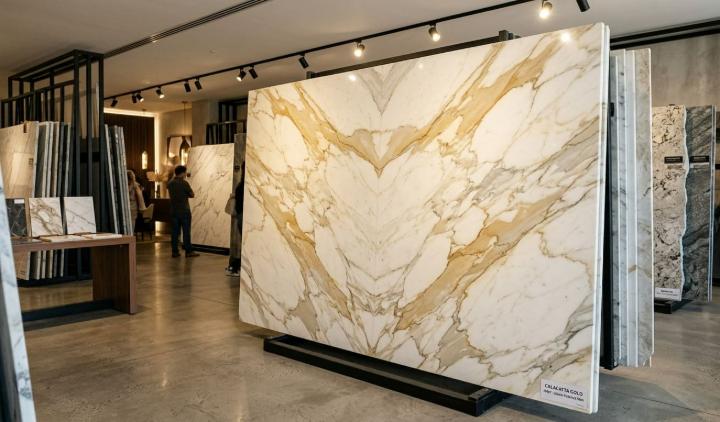
A slab is a large, continuous piece of stone or engineered material cut and shaped for use as a countertop, vanity surface, kitchen island top, wall cladding, or fireplace surround. Unlike individual tiles, which are set alongside one another with grout lines between them, a slab covers a wide area as a single unit, creating a seamless and visually uninterrupted surface.
What distinguishes a slab from other surfacing formats is its scale. That continuous expanse of material, with no breaks in the pattern and no visible joints running across the surface, is precisely what gives slab installations their signature sophistication. Think of a slab as the visual anchor of any room it occupies. In a kitchen, it tends to be the first thing a guest notices. In a bathroom, it sets the tone for the entire space.
Choosing the right one matters, which is why understanding the different categories is essential before making any decisions. Our stone slab collection covers a range of natural and engineered options worth exploring from the very start.
What Types of Slabs Are Available?
The slab category spans both naturally quarried materials and engineered alternatives, each with distinct visual qualities and performance characteristics. Here is a closer look at the options most commonly chosen for residential spaces.
Natural Stone Slabs
Natural stone slabs are extracted directly from quarries, which means every piece carries unique markings, veining patterns, and color movement that cannot be replicated. No two slabs are ever identical, and that individuality is a significant part of their enduring appeal.
Marble is one of the most celebrated surfacing materials in interior design, known for its cool tones, sweeping veins, and timeless elegance. It forms through a metamorphic process when limestone is subjected to intense pressure and heat deep within the earth's crust, resulting in a soft, luminous material rated between 3 and 4 on the Mohs hardness scale. Because it is primarily composed of calcite, marble is prone to both staining and etching when it comes into contact with acidic substances such as lemon juice, wine, or vinegar. Regular sealing helps guard against staining, but etching, which appears as dull spots on the surface, is a separate concern that requires careful everyday use. For homeowners who prize aesthetics above all else, marble remains a deeply compelling option.
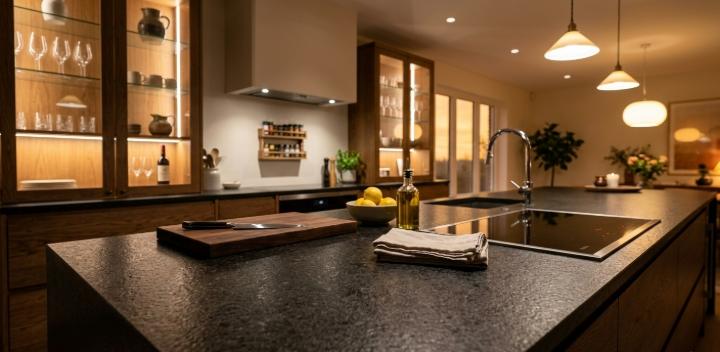
Granite has been a kitchen staple for decades, and its enduring popularity is well earned. Formed when molten magma cools slowly beneath the earth's surface, it is composed primarily of quartz, feldspar, and mica, and it rates between 6 and 7 on the Mohs hardness scale. This makes granite exceptionally resistant to scratching and heat, and it is available in an enormous range of color combinations, from deep charcoal and forest green to warm honey and burgundy tones. According to This Old House, granite remains one of the top-performing natural countertop materials because of its durability and relatively low maintenance requirements compared to other quarried stones.
Quartzite is a metamorphic rock formed when quartz-rich sandstone transforms under intense heat and pressure. It typically ranks around 7 on the Mohs hardness scale, although its properties can vary between slabs. This makes it one of the more scratch-resistant natural stones commonly used for countertops. Many homeowners choose quartzite because it can offer marble-like veining with greater durability.
Dolomite has been steadily gaining recognition as a compelling alternative to marble in contemporary interior design. It forms when limestone undergoes a chemical transformation through contact with magnesium-rich groundwater and rates between 3.5 and 4 on the Mohs hardness scale, making it only slightly harder than marble. While dolomite does offer a marginal improvement in scratch resistance over marble, it remains susceptible to etching from acidic substances and requires periodic sealing to maintain its surface. It typically appears in soft whites, warm creams, and light gray tones with elegant veining, making it a refined and organic-looking choice for spaces where a marble-adjacent aesthetic is desired. The breadth of these natural stone options available through our countertop and surface offerings reflects just how varied the quarried stone world genuinely is.
Engineered Stone Slabs
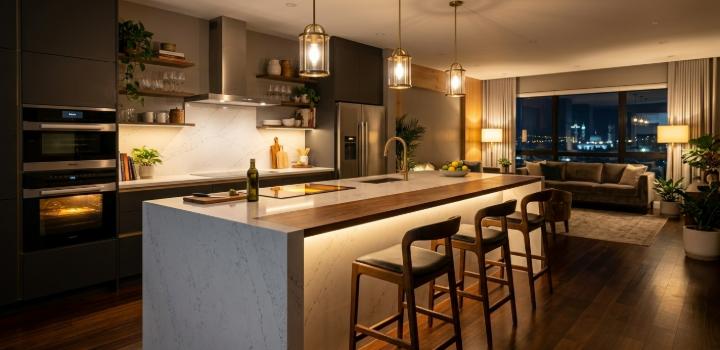
Engineered quartz is produced by combining ground natural quartz crystals with resin binders under high pressure. The manufacturing process creates a non-porous surface that resists staining, requires no sealing, and is available in a wide, consistent range of colors and patterns. Because this process allows for a level of quality control that nature cannot offer, quartz slabs are an excellent fit for homeowners who want a refined look with minimal upkeep demands. Fine Homebuilding notes in its guide to natural stone countertops that understanding material porosity is one of the most important factors when comparing natural and engineered options.
Porcelain Slabs
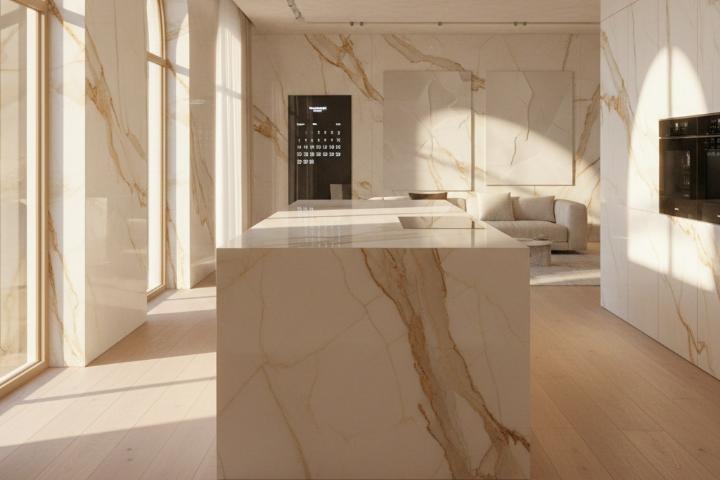
Porcelain slabs are manufactured from refined mineral materials fired at high temperatures. They are dense, non-porous, and available in consistent patterns that can resemble marble, concrete, or wood. Some porcelain products are suitable for outdoor applications, but UV resistance, frost resistance, slip resistance, finish, and installation requirements should be confirmed for the specific product. If you are considering porcelain for an upcoming project, submitting a slab quote request is a practical first step.
Why Choose a Slab Over Other Surfacing Formats?
The most straightforward answer is continuity. When a single piece of material spans an entire countertop or island, the result is clean, deliberate, and architecturally intentional. There are no grout lines to interrupt the eye, no pattern repetitions to manage, and no risk of misalignment between individual pieces.
For materials with dramatic veining, like marble or quartzite, the slab format allows that natural movement to sweep fully across the surface, creating visual impact that smaller formats simply cannot replicate. A vein that might be fragmented across dozens of tiles instead flows uninterrupted from one edge to the other, which is a genuinely different experience.
What Finishes Are Available for Stone Slabs?
Finish selection is an often-overlooked but genuinely important part of choosing a slab. The same material can look and feel completely different depending on whether it has been polished, honed, or given a leathered texture.
Polished finishes reflect light and intensify the color and veining of a stone, producing the glossy, mirror-like quality most commonly associated with marble countertops. Honed finishes are matte and soft to the touch, hiding everyday water spots and fingerprints more effectively, which makes them a practical and attractive choice for bathroom vanities. Leathered finishes offer a textured, slightly matte surface with more dimension than a honed one, and they work particularly well with darker granites and quartzites.
Understanding which finish suits both your lifestyle and design vision is part of selecting thoughtfully. The Natural Stone Institute's finish guide offers a helpful breakdown of how different surface treatments affect the look and long-term performance of quarried materials.
How Do You Choose the Right Slab for Your Project?
Selecting the right surfacing material involves far more than identifying a color or finish you find attractive. The way a space is used, how much natural light it receives, what other elements are present in the room, and how much ongoing maintenance you are realistically prepared to commit to all factor into the decision.
This is where professional guidance makes a meaningful difference. Our team offers free design consultations to walk you through material properties, help you visualize options within the context of your specific project, and answer questions before any final decision is made.
Because every natural stone slab is unique, viewing the actual piece in person provides a far more accurate impression than small samples or digital photos can convey. The full scale of the veining, the depth of the color, and the movement across the surface all read very differently at full size. Visiting our Reno showroom or our Minden location gives you that complete, in-person perspective before committing to a choice.
Conclusion
A slab is more than a practical surface. It is a design statement, a geological artifact, and often the defining element of a room's entire character. Whether you are drawn to the irreplaceable individuality of natural quartzite, the soft elegance of dolomite, the timeless appeal of marble, or the low-maintenance performance of porcelain, understanding what each material offers is the first step toward a choice you will feel confident about for years to come.
Nova Tile and Stone carries a curated range of slab options suited to a wide variety of design visions and practical needs. If you are ready to explore what the right surface could look like in your space, browsing our full slab inventory is a great place to begin.
Frequently Asked Questions
What is the difference between a slab and a tile for countertops?
A slab is a single, large piece of stone or engineered material that covers a wide surface with minimal to no seams, while a tile is a smaller individual piece installed alongside others with grout lines in between. Slabs are generally preferred for countertops, vanities, and kitchen islands because the seamless surface showcases the full visual character of the material, particularly in naturally veined stone where the pattern runs uninterrupted from one edge to the other.
Which slab material is best for a high-traffic kitchen?
Granite and quartzite are widely regarded as the most practical options for heavily used kitchen surfaces because of their hardness, heat resistance, and scratch resistance. Quartzite in particular offers a marble-like aesthetic with significantly greater durability, making it a popular choice for homeowners who want a visually sophisticated surface that handles daily demands without excessive maintenance.
Does every stone slab need to be sealed?
Not every slab requires sealing. Engineered quartz and porcelain generally do not require sealant, while the needs of natural stone vary by material and slab. Sealing may help reduce liquid absorption and staining, but it does not prevent etching, scratching, or chipping. Follow the supplier’s recommendations and evaluate the surface periodically rather than relying on a universal resealing schedule.
Can slabs be used in spaces other than kitchens?
Slabs can be used for bathroom vanities, shower walls, fireplace surrounds, outdoor kitchen surfaces, and full-height backsplashes. Suitability must be confirmed for the specific material and product based on moisture exposure, UV exposure, freeze-thaw conditions, thermal limits, finish, and installation requirements. Some porcelain products are approved for exterior use, but this should not be assumed for every porcelain slab.
Is it important to view a slab in person before purchasing?
Viewing a slab in person is strongly recommended, particularly for natural stone. Small samples and digital images often cannot convey the full scale of the veining, the depth of color, or the overall movement across the surface. Seeing the complete piece gives you a far more accurate sense of how it will read in your space and whether the natural variation works with the other elements in the room.