A waterfall countertop island is a kitchen design feature where the countertop material extends vertically down one or both sides of an island or peninsula, continuing from the horizontal work surface all the way to the floor. Also referred to as a waterfall edge island or waterfall kitchen island, the design creates the visual effect of a continuous, uninterrupted slab flowing downward like a cascade of water. The result is a clean, architectural form that turns the island into a focal point. Waterfall countertop islands are most common in modern, contemporary, and transitional kitchens, and can be executed in materials including quartzite, marble, granite, quartz, sintered stone, and large-format porcelain slabs. The format works on both islands and peninsulas, and can be applied to one side (single waterfall) or both sides (double waterfall) depending on the scale and layout of the space.
At our showrooms in Reno, Minden, Sacramento, and Fernley, we are a direct stone importer that helps homeowners and designers select stone slabs for waterfall applications. This guide covers everything you need to know before choosing your material, from the structural basics to finish options and long-term care.
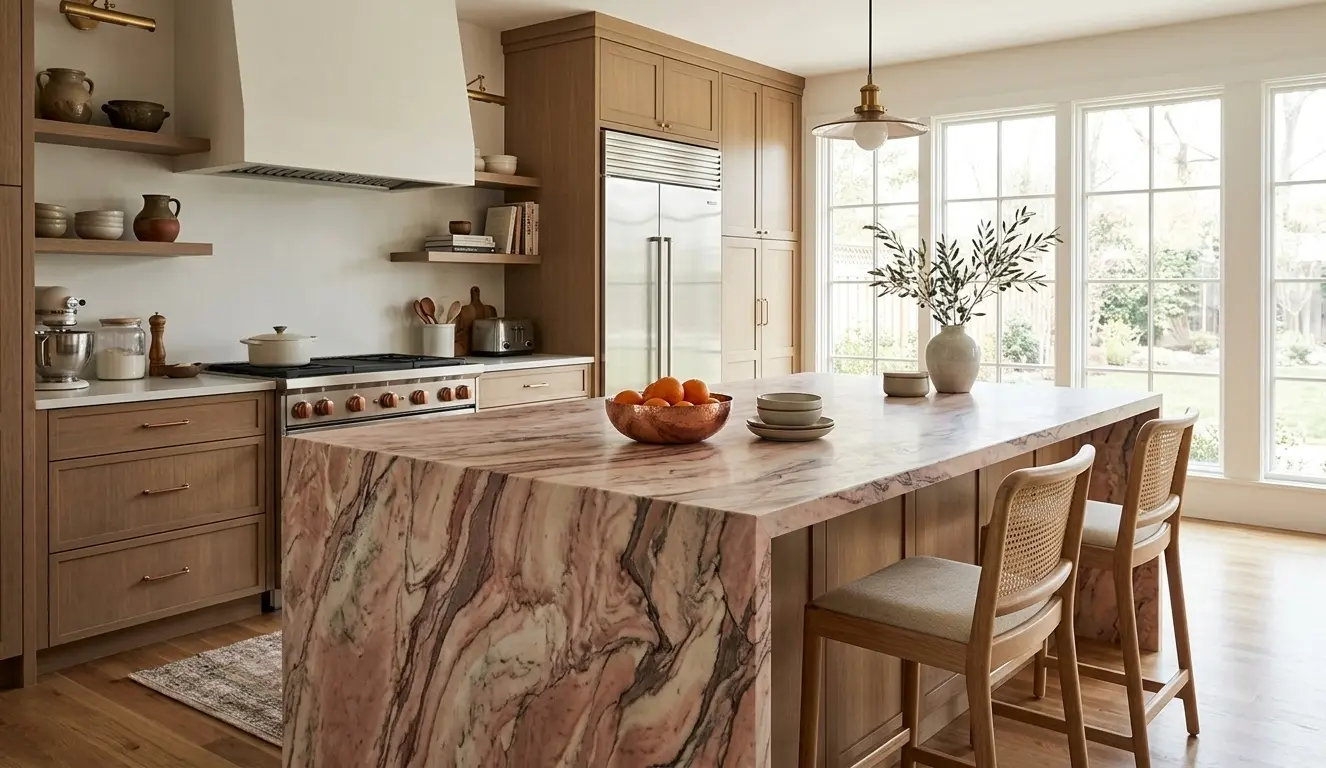
How a Waterfall Island Differs from a Standard Countertop
A standard kitchen island countertop sits flat across the top of the base cabinets and stops at the edge, with the cabinet sides finished in paint, wood paneling, or a decorative end panel. A waterfall island replaces that end panel with the countertop material itself, continuing the same stone surface from the top down to the floor.
The design has roots in mid-century modern architecture and gained mainstream popularity through social media and high-end kitchen photography. It has stayed in style because it solves a practical problem alongside the visual one: the vertical stone panel protects the sides of the island cabinetry from bags, chairs, and daily contact far better than painted wood.
A waterfall can be applied to one side of the island (single waterfall) or both sides (double waterfall). Single-sided is more common and typically faces the seating side where visual impact is highest. Double-sided creates a fully enclosed, monolithic form and requires more material.
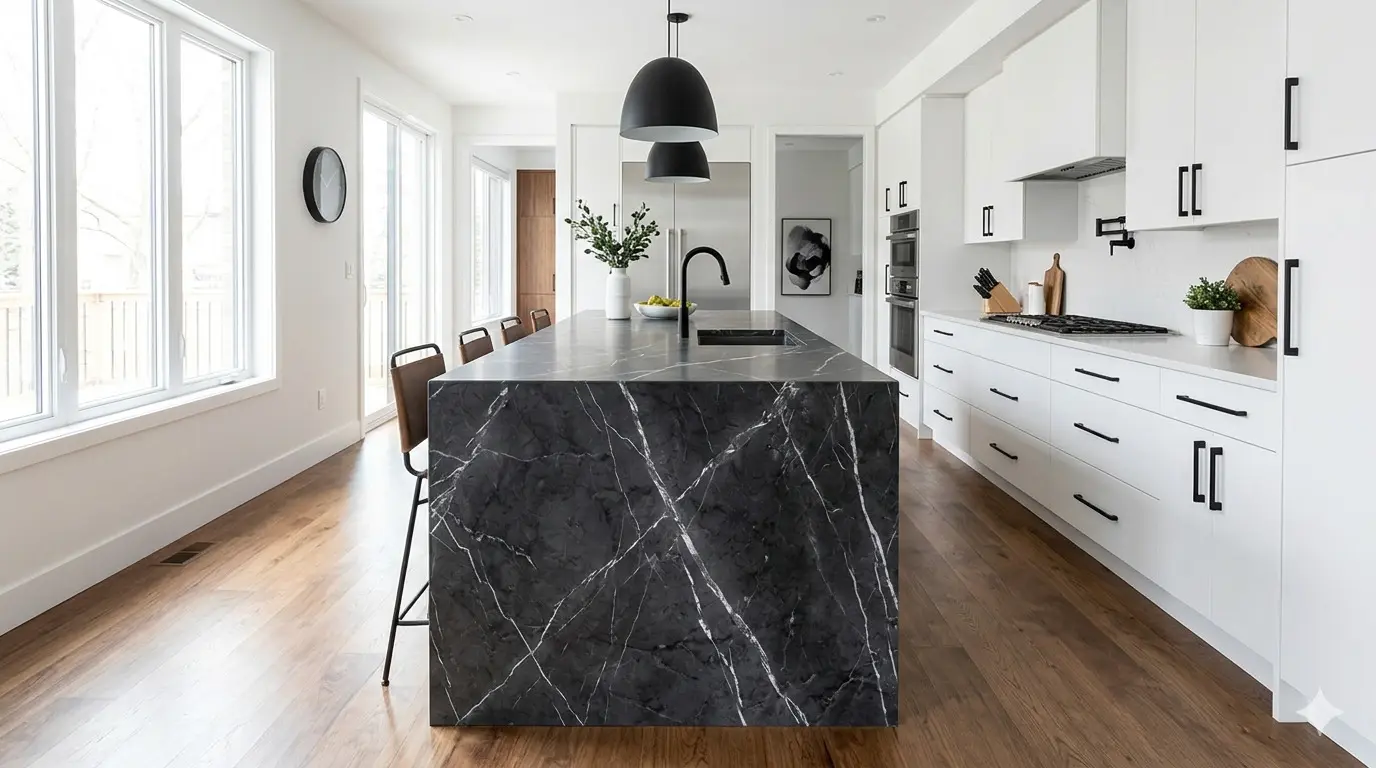
The Role of Veining: Standard vs. Vein-Matched Waterfall
One of the most important decisions in a waterfall island project is whether the veining wraps continuously from the top surface around the corner and down the side, or whether the joint simply meets cleanly without pattern alignment.
A standard waterfall features a clean joint between the horizontal top and the vertical side panel but does not require the veining to align across the corner. This approach works well with more uniform materials, solid colors, or stones with subtle, consistent movement.
A vein-matched waterfall is the more dramatic version. The stone's veining is aligned so it sweeps continuously from the top surface around the corner and down to the floor without interruption. When executed well, the island looks as though it was carved from a single massive block of stone. This technique draws on the same principle as bookmatched slabs and typically requires sourcing two slabs from the same bundle. Vein-matched installations require greater planning and careful slab selection, which is why visiting the stone yard in person is such an important step.
Best Materials for a Waterfall Countertop Island
The material you choose shapes both the visual impact and the long-term performance of your waterfall island. These are the most common options and what distinguishes each one.
Quartzite
Quartzite is one of the most popular natural stone choices for waterfall islands. It is a metamorphic rock that forms when sandstone is subjected to extreme heat and pressure, producing a stone denser and harder than most marbles. Quartzite resists heat and scratching well, and its organic veining makes it a compelling option for vein-matched waterfall applications. Varieties like Taj Mahal, with a warm ivory base and soft movement, read well on the vertical panel without being overwhelming. Quartzite requires periodic sealing as a natural porous stone, but proper care is straightforward.
Marble
Marble is a well-established choice for waterfall islands. The bold, sweeping veining found in Calacatta and Statuario varieties creates a dramatic cascading effect on the vertical panel, particularly in vein-matched designs. Marble is softer and more porous than quartzite or granite and is susceptible to etching from acidic substances, making it a better fit for lower-traffic islands or spaces where daily cooking prep is limited. A honed finish can help minimize the visibility of everyday surface contact in kitchens that see heavier use.
Granite
Granite is a hard, heat-resistant igneous stone that has been used in kitchen design for decades. Modern selections have moved away from heavily speckled varieties toward stones with flowing movement, soft neutrals, and subtle veining that works well in contemporary settings. Granite with strong linear veining produces a clear waterfall effect, and the stone's density means the vertical panel holds up well with minimal maintenance beyond routine sealing.
Sintered Stone
Sintered stone is processed through extreme heat and pressure from natural minerals and is one of the fastest-growing categories in large-format slab applications. It is available in formats large enough to accommodate a full-height waterfall without a seam, making it a strong choice for taller islands or open-concept kitchens. It is scratch-resistant, heat-proof, UV-stable, and requires no sealing, with options in concrete, stone, and textural finishes.
Quartz
Engineered quartz is one of the most practical choices for a waterfall island. Because its veining pattern is applied consistently across the slab during manufacturing, it can be matched cleanly across the corner joint without the same level of slab-sourcing precision that natural stone requires. Quartz is non-porous, scratch-resistant, and does not require sealing, making it a strong fit for high-use kitchen islands. It is available in a wide range of colors and patterns, including options that closely replicate the look of marble and quartzite. Homeowners and contractors should be aware of silica dust safety guidelines that apply when engineered stone is cut or fabricated.
Porcelain Slabs
Large-format porcelain slabs share many performance characteristics with sintered stone. Porcelain is non-porous, resistant to staining and heat, and available in large formats that minimize seaming on full-height waterfall panels. Its pattern is applied during manufacturing, producing consistent, repeatable veining that allows for cleaner pattern flow across the horizontal-to-vertical transition.
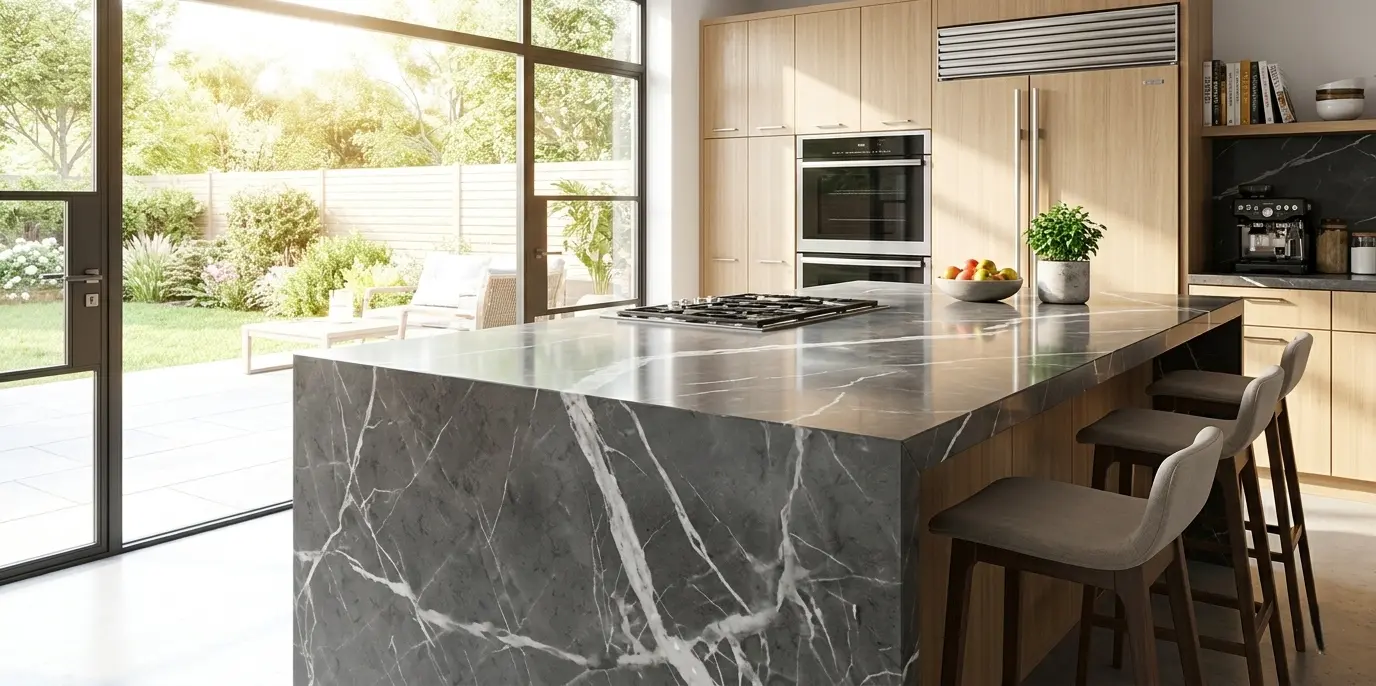
Design Considerations Before You Commit
A waterfall island is a permanent architectural feature, and a few planning decisions made early will have a significant impact on the finished result.
Island scale matters. Waterfall treatment works best on islands large enough to carry the visual weight of a continuous stone panel. Islands under six feet often read better with a standard overhang or decorative end panel. Larger, open-concept islands are where the format delivers its strongest impact.
Style fit. Waterfall islands are most at home in modern, contemporary, and clean transitional kitchens. In heavily traditional settings with raised-panel cabinetry and warm wood tones, the clean horizontal line can feel out of place.
Material selection and pattern. Stones with bold, consistent linear veining translate most effectively to waterfall applications. Highly mottled or irregular patterns can look fragmented when the panel wraps the corner. When reviewing slabs, mentally rotate the slab to visualize how the veining will read vertically. Our team at any of our four local showrooms can help you assess your options with the waterfall format in mind, and scheduling a design consultation is a practical way to get guidance before committing to a material.
Finish choice. Polished finishes emphasize stone movement and are a strong choice for vein-matched waterfalls where drama is the goal. Honed and leathered finishes create a softer, more tactile surface and are more forgiving of fingerprints and daily contact on high-use islands.
Caring for Your Waterfall Island
Maintenance requirements depend on the material. Natural stones including quartzite, marble, and granite benefit from periodic sealing, with frequency based on the stone's porosity and finish. A simple water bead test indicates whether resealing is needed. Honed and leathered finishes tend to be more porous and may need more frequent attention. Sintered stone, porcelain, and quartz do not require sealing and can be maintained with routine cleaning. For all natural stone, avoid harsh acidic cleaners and use stone-specific products to preserve the surface. For further reading, This Old House covers natural stone countertop care in detail, and Fine Homebuilding offers a guide on countertop material selection.
Seeing the Material Before You Decide
The veining across the top of the island becomes the focal point of the room, and how it transitions around the corner defines whether the finished piece reads as sculpted and intentional or disjointed. We carry a wide range of natural stone and engineered slabs across our showrooms, and our team regularly helps customers evaluate bundles and select material for waterfall applications. Submitting a slab quote request is a straightforward way to get started, and we also carry overstock slabs at reduced prices that can include materials well-suited to waterfall applications. Designers and contractors can apply for a trade account for access to preferred pricing across our full inventory.
Conclusion
A waterfall countertop island is one of the most impactful design moves in a modern kitchen renovation. It transforms a functional surface into a sculptural centerpiece, extends material continuously from the countertop to the floor, and protects the island cabinetry in the process. Whether you choose quartzite, marble, granite, quartz, sintered stone, or porcelain, the key is selecting a material with veining and finish that suits the format. Evaluating full slabs in person and understanding how the pattern reads vertically makes all the difference between a waterfall island that looks effortless and one that feels unplanned.
Frequently Asked Questions
What is a waterfall countertop island?
A waterfall countertop island is a kitchen design where the countertop material extends vertically down one or both sides of an island or peninsula, flowing from the top surface all the way to the floor. The continuous material creates the appearance of a single sculpted block rather than a counter sitting on top of a cabinet, and it is a defining feature of modern and contemporary kitchen design.
What materials work best for a waterfall island?
Quartzite, marble, granite, quartz, sintered stone, and large-format porcelain slabs are all strong candidates depending on the style and performance requirements of the project. Quartzite, quartz, and sintered stone are particularly well-suited because of their durability and consistent patterning. Marble creates the most dramatic visual effect for vein-matched applications but requires more careful maintenance in high-use kitchens.
What is the difference between a standard waterfall and a vein-matched waterfall?
A standard waterfall features a clean mitered joint where the horizontal top meets the vertical side panel, but the veining does not continue across the corner. A vein-matched waterfall aligns the stone's natural veining so it flows continuously from the top surface around the corner and down to the floor. Vein-matched installations require careful slab selection and typically involve sourcing two slabs from the same bundle, similar to the bookmatching technique.
Does a waterfall island work in a small kitchen?
The waterfall format delivers its strongest design impact on larger islands in open-concept spaces. Very small islands can feel proportionally heavy with a full waterfall treatment. If you are working with a compact layout, a partial waterfall that extends the stone down part of the side panel rather than the full height can achieve a similar effect without overwhelming the space. A showroom consultation can help you evaluate whether the format suits your specific kitchen dimensions.
How do you maintain a natural stone waterfall island?
Maintenance depends on the material. Natural stone waterfall islands in quartzite, marble, or granite benefit from periodic resealing, and frequency varies by stone type and finish. Honed and leathered surfaces tend to require more attention than polished ones. Sintered stone, porcelain, and quartz do not require sealing and can be maintained with routine cleaning using stone-safe products. Avoiding harsh acidic or abrasive cleaners applies to all natural stone surfaces.