Few natural stones can match quartzite when it comes to combining beauty with real, lasting durability. It has the sweeping veins and luminous surface of marble, the toughness to outlast almost anything you put against it, and an origin story forged deep inside the earth. Whether you are planning a showstopping kitchen countertop, a feature wall that stops guests in their tracks, or an outdoor living space built to weather every season, quartzite tends to deliver. It looks extraordinary, and it holds up that way.
What Is Quartzite?
Quartzite is a 100% natural metamorphic rock formed when quartz-rich sandstone is buried deep within the Earth's crust and subjected to extreme heat and pressure over millions of years. That process fuses individual sand grains into a dense, interlocking crystalline structure, producing a stone that is generally harder than granite and often carries the elegant, veined appearance most people associate with marble. Quartzite slabs are categorized by their mineral composition, which produces a vast array of colors and patterns ranging from neutral whites that closely mimic marble to rare, vibrant exotic varieties that feel genuinely one of a kind.
It typically rates around 7 on the Mohs scale, making it highly resistant to scratches and physical wear. Natural quartzite can handle high temperatures from hot cookware without scorching or cracking, and true quartzite tends to resist etching, so acidic substances like lemon juice or vinegar that would dull the surface of marble often leave quartzite unaffected. Its compact structure also limits water absorption, though most varieties still benefit from periodic sealing to prevent deep staining over time. Natural quartzite is also UV-stable, holding its color and surface integrity in direct sunlight, making it a dependable choice for outdoor kitchens, pool surrounds, and patios.
Types of Quartzite
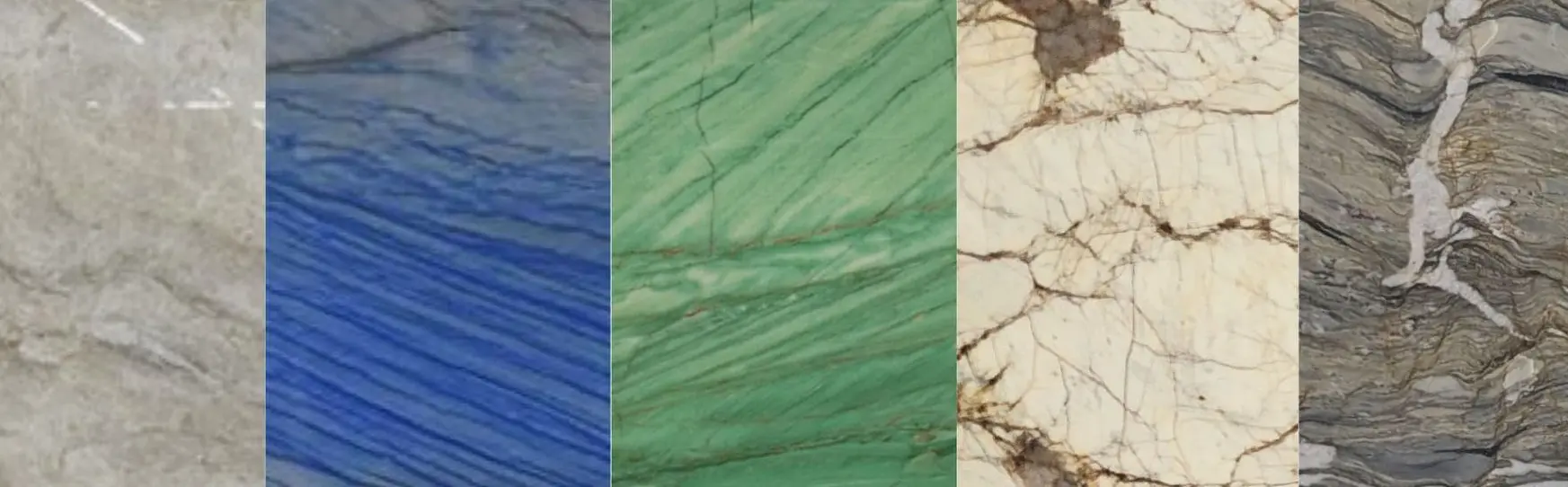
Walk into any serious stone showroom and you will quickly realize that quartzite is not a single stone. It is a family of stones, each shaped by its own geological conditions, mineral composition, and corner of the earth. The creamy warmth of Taj Mahal and the electric blue of Macaubas both carry the quartzite name, yet they could not look more different. That range is part of what makes quartzite so compelling to work with. Here is a closer look at some of the most sought-after types available today and what makes each one worth knowing. If you already have a material in mind, you can request a slab quote for quartzite options directly from our team to get current availability and pricing.
Taj Mahal Quartzite
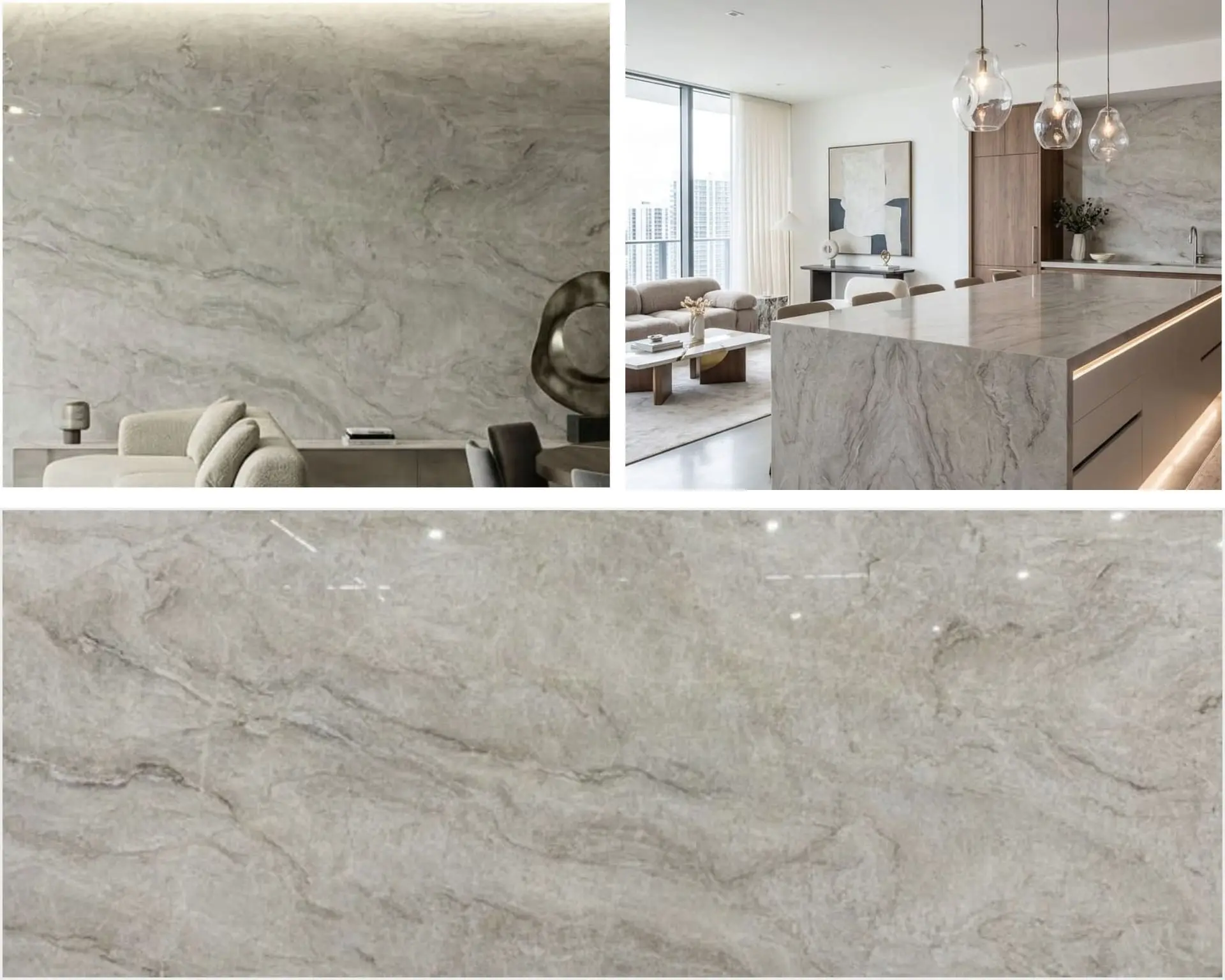
Taj Mahal quartzite is a 100% natural white quartzite quarried in Brazil, prized for its soft ivory background, warm gold and gray veining, and durability that rivals and often surpasses granite. The stone takes its name from the mausoleum in Agra, India, commissioned in 1631 by the Mughal emperor Shah Jahan as an eternal tribute to his beloved wife Mumtaz Mahal, who died giving birth to their fourteenth child. More than 20,000 workers labored for over two decades to complete it, and the result was designated a UNESCO World Heritage Site in 1983. The mausoleum was clad in Makrana marble from Rajasthan, not quartzite, but the stone that bears its name was chosen as a tribute to that same luminous, enduring beauty.
Quarried exclusively from Uruoca, Brazil, and considered one of only two truly authentic quartzites, Taj Mahal reads warm and luminous in natural light, pairs well with dark walnut cabinetry and lighter tones alike, and works as comfortably in a traditional kitchen as in a contemporary bathroom. As a white quartzite slab, it delivers the marble look without the maintenance concerns, and that practical elegance is a large part of why it has become one of the most requested natural stones in the luxury market.
Mont Blanc Quartzite
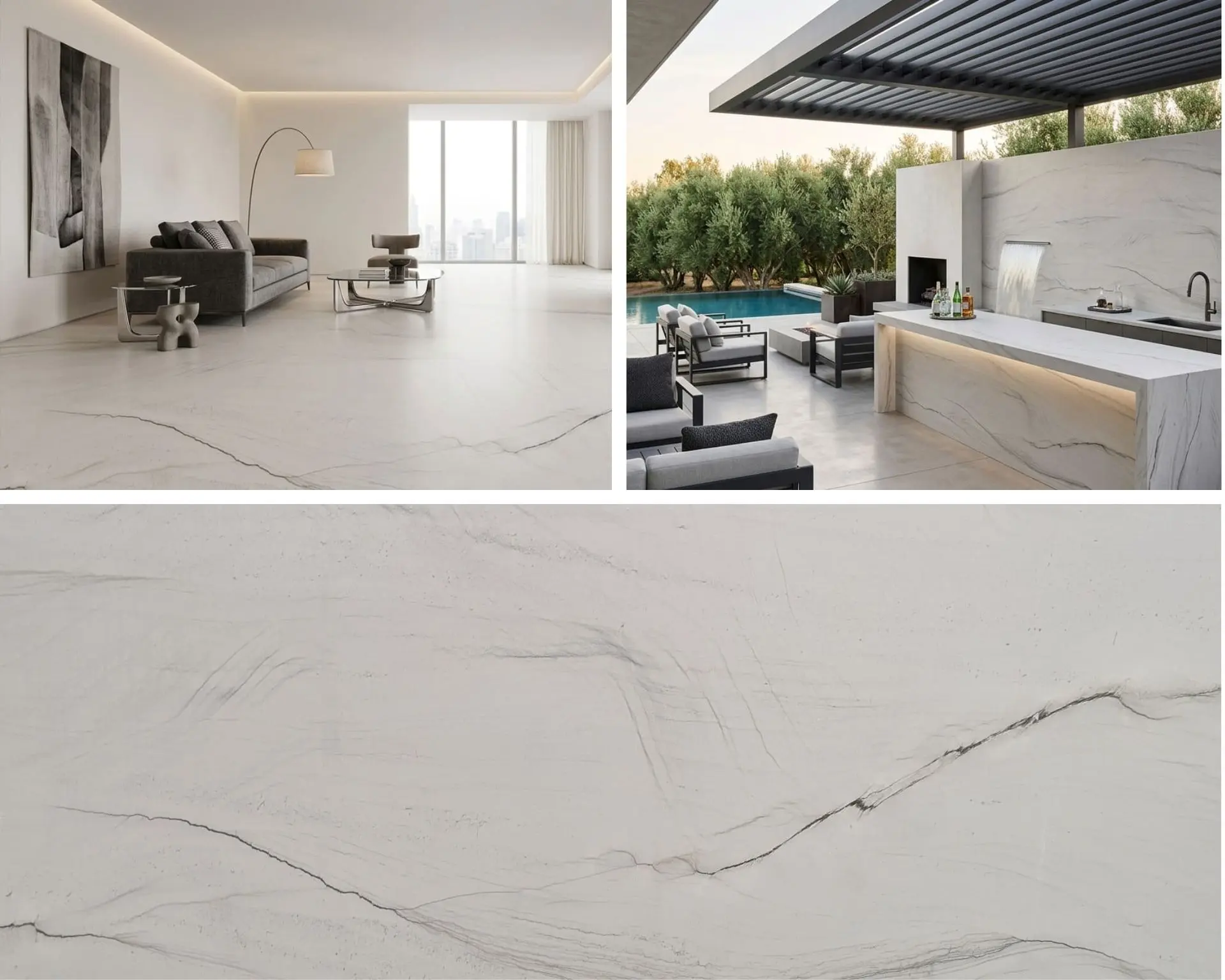
Mont Blanc quartzite is a premium white quartzite quarried in Brazil, known for its soft white to light gray background and subtle charcoal veining. Its name comes from the highest peak in Western Europe at 4,808 meters, a mountain that has captured the imagination of explorers and artists for centuries. The first recorded ascent in 1786 by Jacques Balmat and Dr. Michel-Gabriel Paccard marked the birth of modern mountaineering, and in 1816 Percy Bysshe Shelley composed his famous ode "Mont Blanc: Lines Written in the Vale of Chamouni," describing the peak as a symbol of nature's sublime power. A quartzite named after all of that carries a certain weight, and the stone earns it. Cool and composed on the surface, with a depth and presence that builds the longer you spend time with it.
Much harder than marble despite their visual similarities, Mont Blanc quartzite holds up in kitchen countertop applications without risk of scratching or etching. Book-matching, where consecutive slabs are cut to mirror each other, is particularly effective with this stone, creating a symmetry on large feature walls and kitchen islands that is difficult to achieve with most other materials. You can see this effect in person at our Reno showroom where Mont Blanc quartzite slabs are available for viewing.
White Macaubas Quartzite
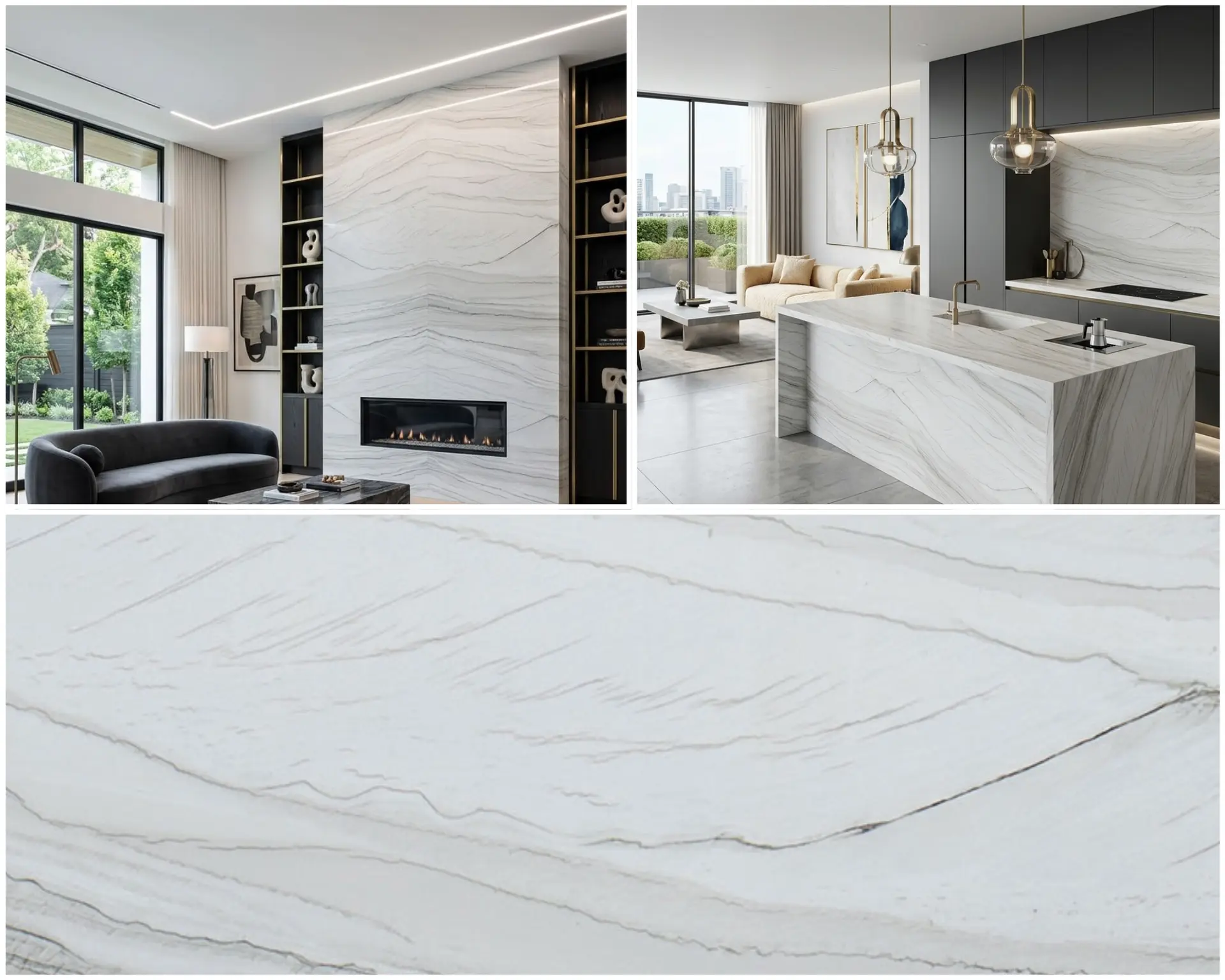
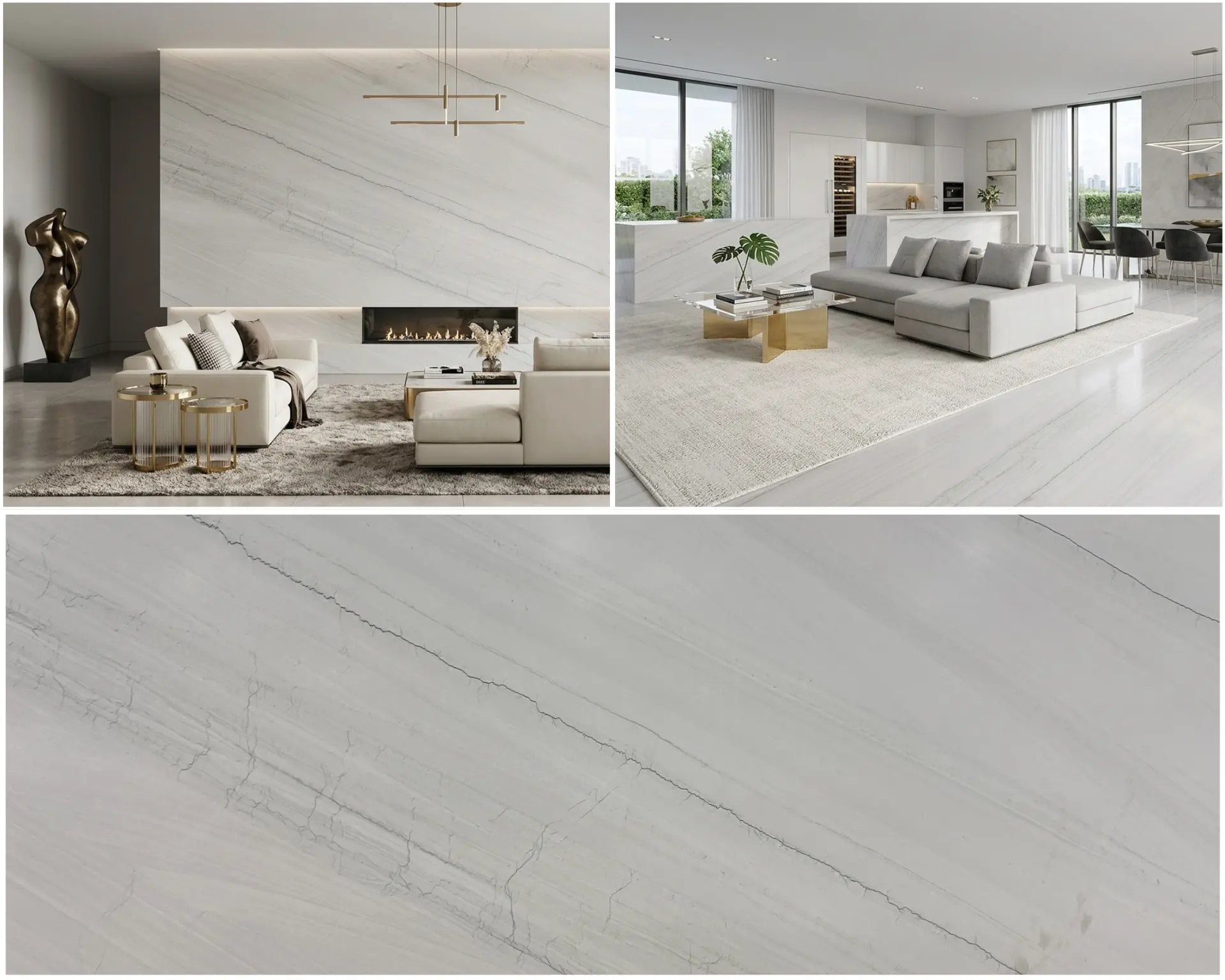
White Macaubas quartzite is a natural white quartzite quarried in Brazil, distinguished by its cool, luminous white background and bold horizontal veining in charcoal, light gray, and occasional earthy gold. It comes from the same mineral-rich Macaubas region in Bahia that produces Blue Macaubas, sharing that stone's geological density while moving in an entirely different aesthetic direction. Where most white quartzite varieties carry soft, flowing veins, White Macaubas moves with a graphic, directional energy that feels distinctly architectural, earning its place in large-format applications like waterfall edge countertops, sweeping backsplashes, and floor-to-ceiling feature walls. These dramatic directional patterns are best appreciated in full slabs, which you can explore by shopping locally at our four showrooms.
Sea Pearl Quartzite
Sea Pearl quartzite is a natural gray quartzite quarried in Brazil, also known as Madre Perla, Spanish for "Mother of Pearl." The name fits. The stone's surface genuinely resembles the shimmering iridescence of sea pearls, with a soft gray base and subtle flowing veins that shift between silver, white, and faint hints of green depending on the light. Rather than pulling focus, Sea Pearl quartzite settles into a space and elevates everything around it without announcing itself, making it the ideal choice for contemporary interiors where clean lines and a muted palette define the direction.
Mercury Gray Quartzite
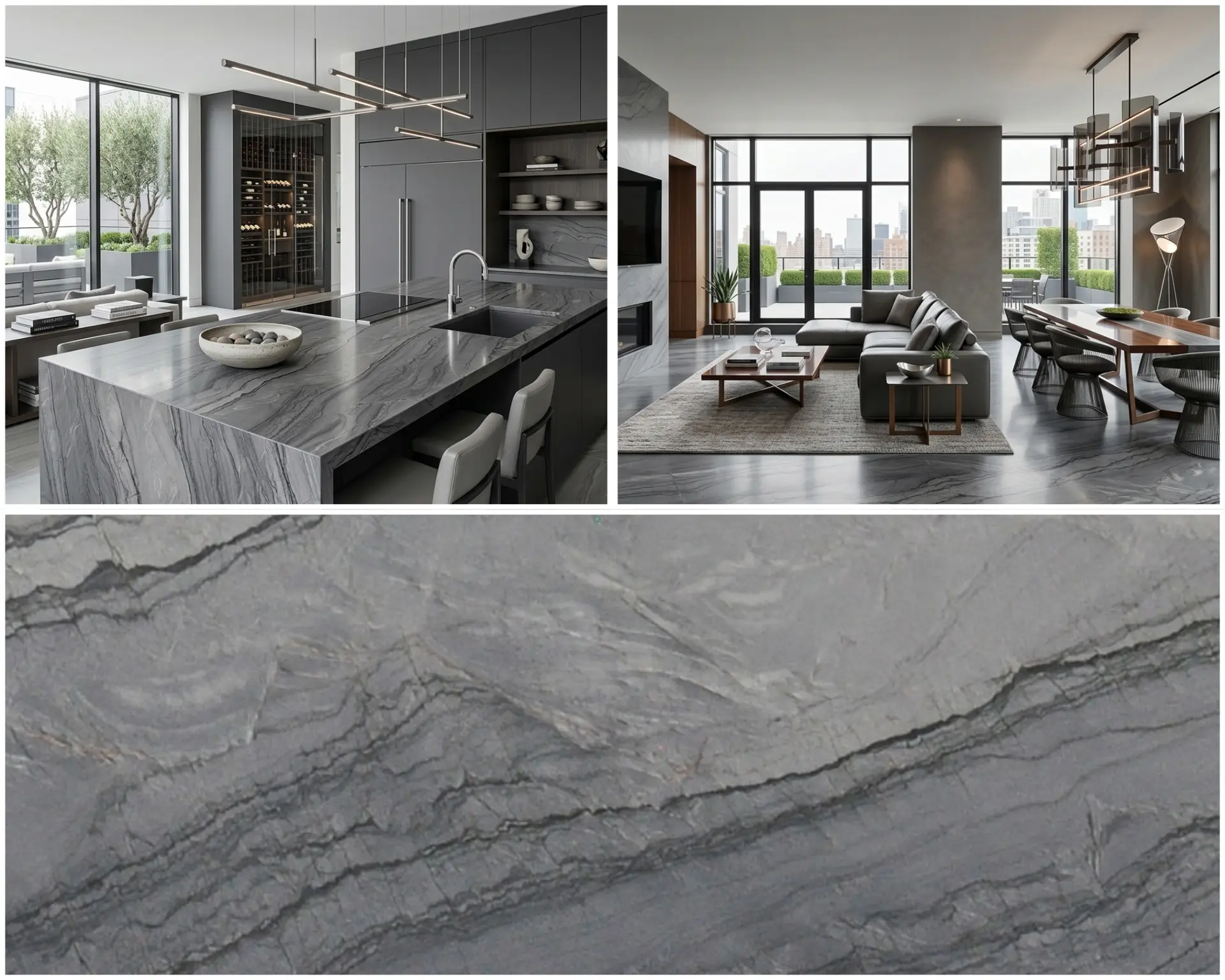
Mercury Gray quartzite is a natural gray quartzite quarried in Brazil, characterized by a deep silver base with charcoal, near-black, and white tones moving across the surface in dynamic, layered veining. Like the liquid metal it references, this Brazilian quartzite feels fluid and alive, never quite reading the same from one angle to the next. It sits at the darker, more atmospheric end of the gray quartzite spectrum, holding its own against light cabinetry where contrast creates definition, and working just as confidently alongside dark graphite or walnut tones where it creates a seamless, enveloping effect that feels considered rather than cautious. Design professionals sourcing materials for these applications can apply for a trade account to access Mercury Gray quartzite and other premium slabs through our showroom.
Blue Macaubas Quartzite
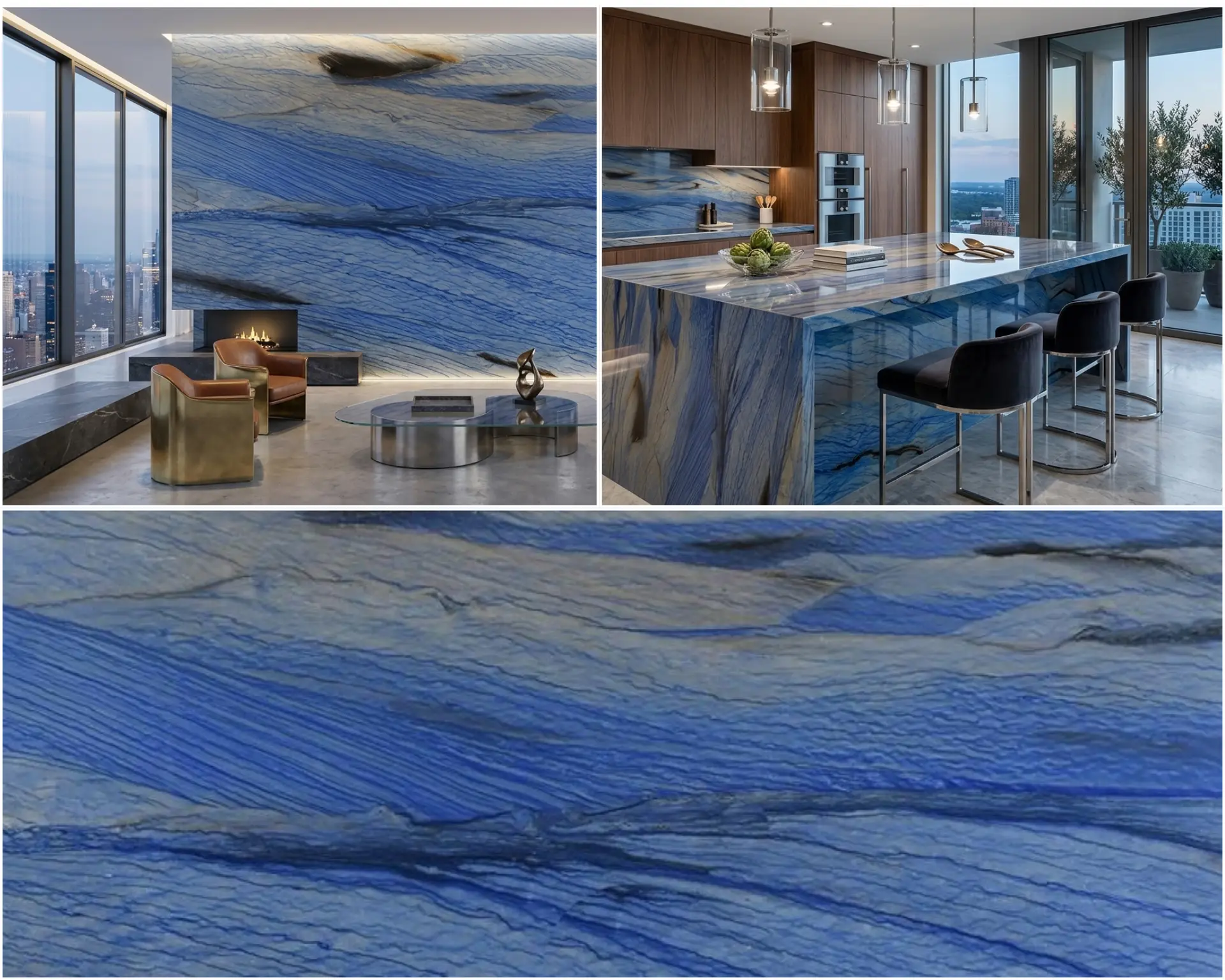
Blue Macaubas quartzite is a rare exotic quartzite quarried in the Macaubas region of Bahia, Brazil, renowned for its vibrant blue hues ranging from light sky blue to deep ocean tones. Technically classified as a dumortierite quartzite, it owes its extraordinary color to approximately 15% dumortierite, a mineral exceptionally rare in the natural stone world. Blue is the rarest color found in natural stone, and the entire mineable deposit extends for only about thirty kilometres near the city of Macaubas, making this Brazilian quartzite one of the most genuinely scarce materials in the luxury stone market.
Architects and designers worldwide have made it a defining material for distinguished projects, from luxury hotel lobbies to statement kitchen islands. When backlit, the translucent sections glow with a depth that no engineered surface can replicate.
Patagonia Quartzite
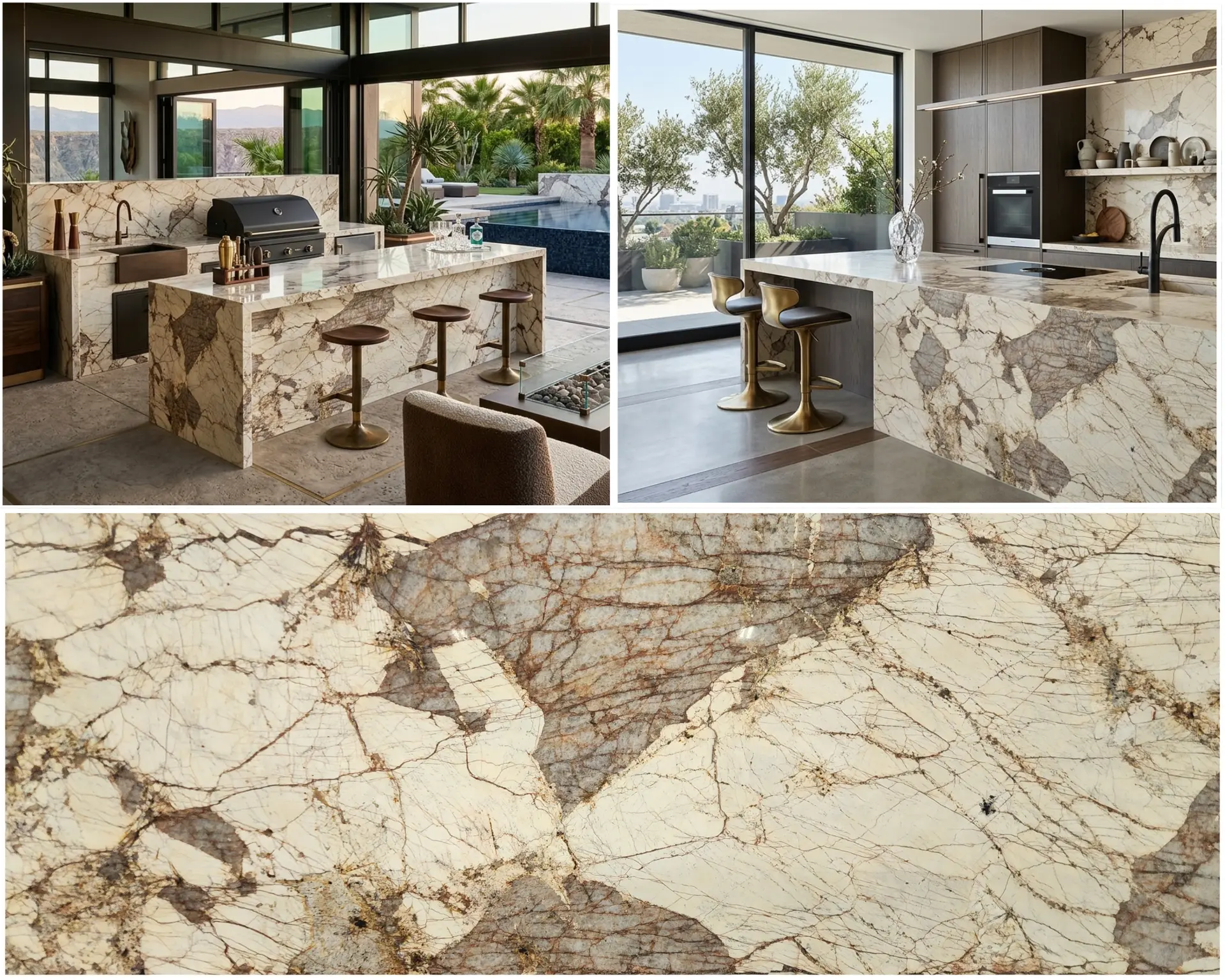
Patagonia quartzite is a rare exotic quartzite quarried in Brazil, named after the vast wilderness at the southern tip of South America, one of the most geologically dramatic landscapes on earth, defined by ancient volcanic formations, sweeping plains of solidified lava, and a raw geological energy shaped over millions of years. That same energy is written into every slab. As molten substances cooled and crystallized over millennia, various layers of striations were created, including large translucent areas interwoven with solid beige clasts and strands of gold, giving each Brazilian quartzite slab a fragmented, cross-section quality that nothing else on the market can replicate.
Brazilian quarries began extracting it in the early 2000s, and backlit Patagonia quartzite panels are now among the most striking surfaces in contemporary interior design. You can view these dramatic translucent sections in person at our Fernley and Minden showrooms featuring Patagonia quartzite slabs available for backlit applications.
Fusion Quartzite
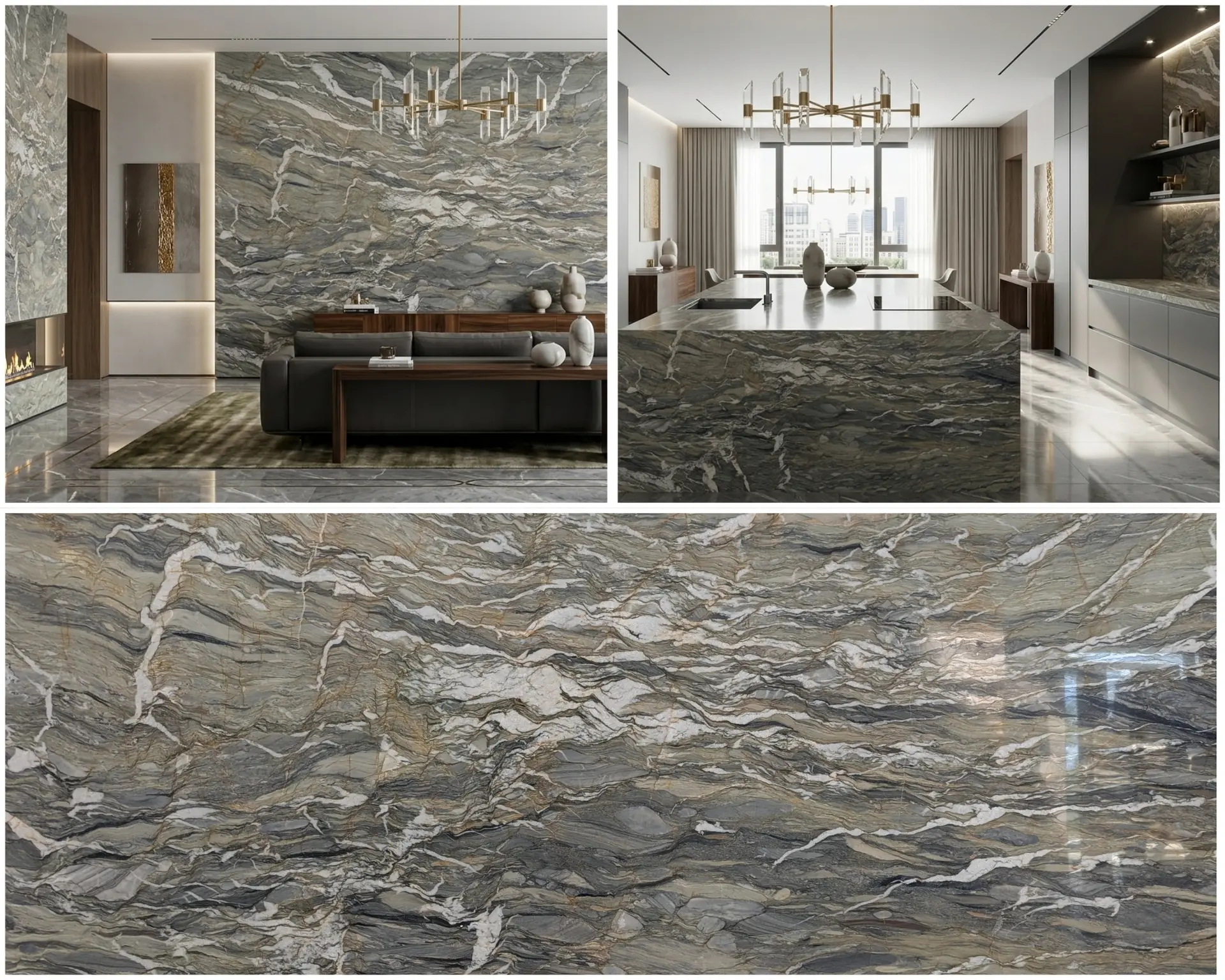
Fusion quartzite is a rare exotic quartzite quarried in Brazil, celebrated for its extraordinary multicolor palette carrying sweeping movements of deep burgundy, burnt orange, cobalt blue, cream, and gray across a single slab in combinations that feel almost deliberate, though they are entirely the work of nature. Every Fusion quartzite slab tells a different story, the color balance and movement shifting from block to block, making this Brazilian quartzite as much a curation exercise as a design decision. A kitchen island in Fusion commands the room. A feature wall finished in it reads like a work of art. For anyone investing in a surface that is genuinely one of a kind, this exotic quartzite delivers.
Botanic Green Quartzite
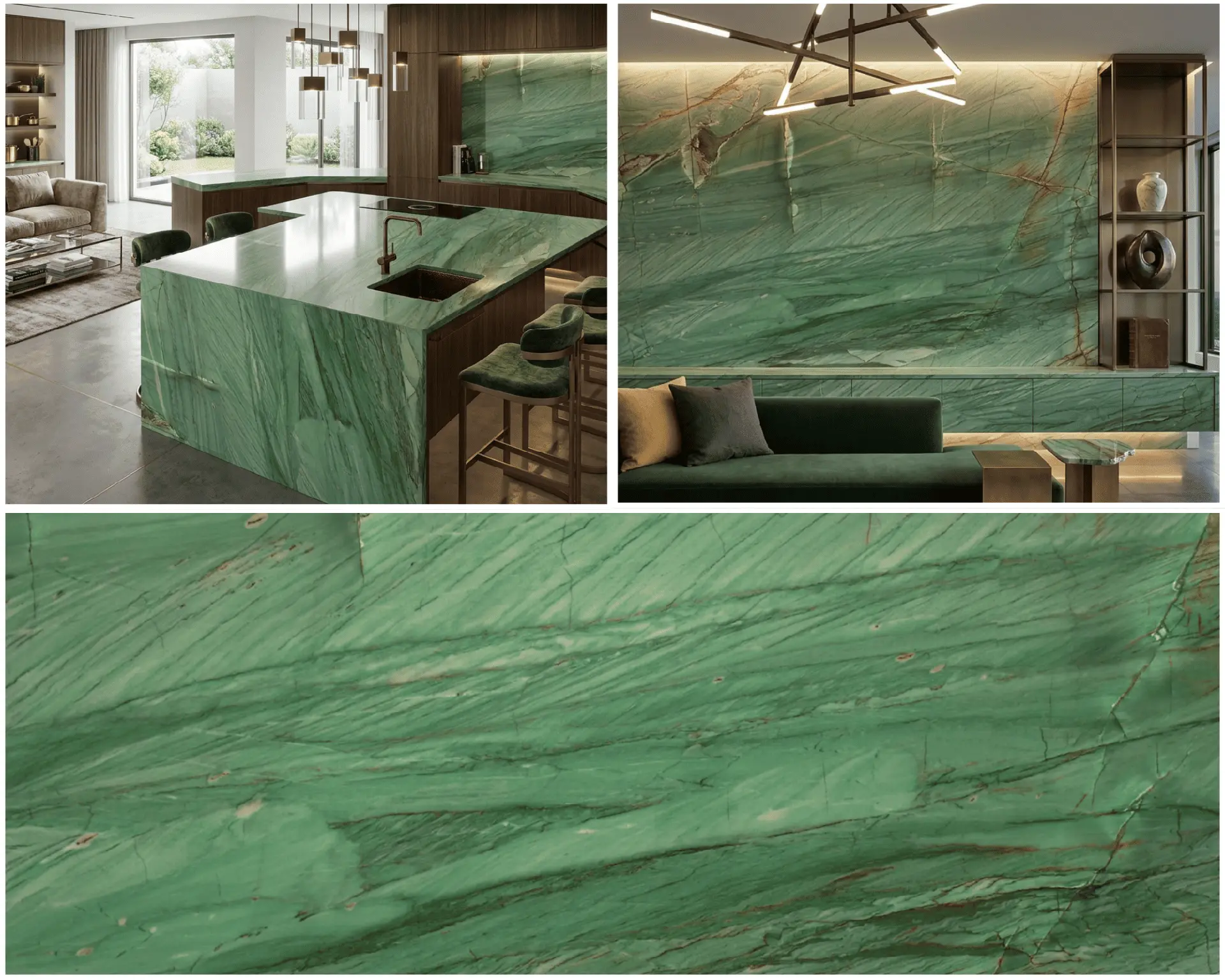
Botanic Green quartzite is a rare exotic quartzite quarried in Brazil, distinguished by its intense emerald green background and intricate veining in white, pink, ochre, and gold. As a green quartzite, it belongs to one of the rarest color categories in the natural stone market. The stone carries a spectacular base in jungle tones that genuinely evokes the freshness of tropical orchid and bromeliad leaves, making it one of the few quartzite varieties where the naming feels earned rather than invented.
The palette ranges from olive and sage through to richer emerald shades, shifting in character depending on the finish chosen. In a polished finish the color saturates and takes on a luminous quality; in a leathered or honed finish it reads more organic and tactile. In a design landscape where green has returned as a serious material choice, this Brazilian quartzite offers a version of it rooted in genuine geology rather than trend.
How to Choose the Right Type of Quartzite for Your Project
Choosing between quartzite types comes down to the palette you are working with, the mood you want the space to carry, and how prominent a role you want the stone to play.
For light, neutral warmth, the white and cream varieties are the most flexible starting point. Taj Mahal quartzite suits those who want softness and timeless appeal. Mont Blanc quartzite works when a cooler, crisper white is the goal. White Macaubas quartzite steps in when the design needs something more graphic and directional.
When restraint and sophistication are the priority, the gray quartzite varieties offer a compelling alternative. Sea Pearl quartzite elevates everything around it without drawing attention to itself. Mercury Gray quartzite suits spaces that can carry more depth and drama, particularly in darker or more contemporary palettes.
For those who want the stone to define the room, the exotic varieties each deliver in their own way. Blue Macaubas quartzite brings rare color and geological prestige. Patagonia quartzite suits large-format and backlit applications. Fusion quartzite works best as a singular statement piece. Botanic Green quartzite is the natural choice for spaces built around organic materials and nature.
Whatever the direction, always view the full slab in person. Quartzite varies dramatically from slab to slab, and no photograph fully captures the movement, depth, and character of the stone at full scale. You can schedule an appointment at our Sacramento showroom to view full quartzite slabs in person and compare options side by side.
Conclusion
Every variety covered in this article started as ordinary sandstone and was transformed over millions of years into something genuinely extraordinary, and that origin shows in the surface. The color, the veining, the translucency, the depth, none of it can be manufactured or replicated. Whether you are drawn to the quiet elegance of Taj Mahal, the atmospheric depth of Mercury Gray, or the rare geological spectacle of Blue Macaubas, the right type of quartzite has a way of making a space feel like it could not have been designed any other way.
Frequently Asked Questions
What is quartzite and how is it formed?
Quartzite is a 100% natural metamorphic rock formed when quartz-rich sandstone is subjected to extreme heat and pressure deep within the Earth's crust. This process fuses individual sand grains into a dense, interlocking crystalline structure that is generally harder than granite and often carries the elegant veined appearance associated with marble.
What are the most popular types of quartzite?
Some of the most sought-after quartzite varieties include Taj Mahal, Mont Blanc, White Macaubas, Sea Pearl, Mercury Gray, Blue Macaubas, Patagonia, Fusion, and Botanic Green. Each type has a distinct color palette, veining pattern, and geological origin suited to different design applications.
Is quartzite harder than granite?
Quartzite generally rates around 7 on the Mohs hardness scale, placing it above most granite varieties that typically fall between 6 and 6.5. This makes quartzite highly resistant to scratching and physical wear, though hardness can vary depending on the specific variety and its mineral composition.
Can quartzite be used outdoors?
Yes. Natural quartzite is UV-stable, meaning it holds its color and surface integrity even with prolonged exposure to direct sunlight, making it a solid choice for outdoor kitchens, pool surrounds, and patios where some other materials may fade or deteriorate over time.
Where can I view quartzite slabs in person in Nevada and California?
Nova Tile and Stone carries a curated selection of quartzite slabs across four showroom locations in Reno, Sacramento, Minden, and Fernley. Viewing slabs in person is strongly recommended since quartzite varies significantly from slab to slab and no sample or photograph fully captures the movement, depth, and veining of the stone at full scale.