What Is Quartzite and Why It Deserves Your Attention
Quartzite is a naturally occurring metamorphic rock formed when sandstone undergoes intense heat and pressure deep within the earth. The result is a material with remarkable hardness, breathtaking veining, and a reputation that holds up under real-world conditions. For anyone investing in natural stone slabs, quartzite offers an unmatched combination of beauty and strength.
Proper care is what separates a quartzite surface that dazzles for decades from one that dulls in a few short years. Without consistent maintenance, even the most resilient stone can lose its finish, develop etching, or absorb stains that become permanent. This guide gives you every tool you need to protect your investment.
By the end, you will know the best cleaning methods, sealing schedules, preventative habits, and design tips for quartzite in any room. Whether your surface is brand-new or years old, these practical strategies apply immediately.
Why Quartzite Outperforms Other Natural Stone Slabs
Quartzite consistently ranks among the hardest natural stones available. It scores between 7 and 8 on the Mohs hardness scale, placing it above marble and on par with granite. That density translates directly to performance in kitchens, bathrooms, living rooms, and exteriors.
Beyond raw strength, quartzite carries a visual elegance that synthetic materials simply cannot replicate. Its veining, formed naturally over millions of years, produces patterns that are genuinely one of a kind. Each slab tells a distinct geological story that no engineered product can imitate.
Recent public health research on engineered stone has prompted many designers and homeowners to revisit authentic natural alternatives. Quartzite stands out as a safer, more sustainable option that delivers on both aesthetics and longevity.
Key advantages at a glance:
- Exceptional scratch and heat resistance across high-traffic surfaces
- Unique natural veining that cannot be duplicated
- Suitable for kitchens, bathrooms, living rooms, and exterior applications
- Dramatically lower upkeep demands compared to marble
- Retains color depth and surface finish for decades with proper sealing
- Proven to increase residential resale value
Quartzite vs. Other Popular Natural Stone Options
| Feature | Quartzite | Marble | Granite |
| Hardness (Mohs) | 7 to 8 | 3 to 4 | 6 to 7 |
| Heat Resistance | Excellent | Moderate | Excellent |
| Stain Resistance | Good (when sealed) | Low | Very Good |
| Maintenance Frequency | Low to Medium | High | Low |
| Aesthetic Character | Luminous, marble-like | Classic, formal | Bold, granular |
| Indoor/Outdoor Use | Both | Indoor only | Both |
Honest Pros and Cons of Quartzite
Pros:
- One of the hardest natural stones available
- Completely authentic, with no synthetic additives
- Performs beautifully indoors and in exterior settings
- Resists heat and surface scratching reliably
- Delivers a high-end marble appearance at greater durability
Cons:
- Requires sealing every one to two years
- Higher upfront material cost than ceramic or porcelain
- Significant weight demands professional-grade installation
- Porous without a sealant, leaving it vulnerable to liquid absorption
Quartzite Design Ideas for Kitchens, Bathrooms, Living Rooms, and Exteriors
Quartzite adapts effortlessly to virtually every residential application. Its neutral tones, ranging from crisp white to warm gold and deep charcoal, work with both modern minimalism and traditional design schemes. According to 2026 interior design forecasts, natural materials are the dominant aesthetic direction this year.
The finish you select changes the entire mood of a surface. Polished quartzite reflects light and amplifies the depth of its veining for a dramatic effect. Honed finishes produce a softer, matte quality that suits casual, family-oriented spaces.

Kitchens: Countertops Built for Daily Performance
Quartzite kitchen countertops endure the demands of active cooking without complaint. Hot pans, sharp utensils, and constant use test most materials, but quartzite holds its own. Pair a light quartzite slab with dark lower cabinetry for a timeless, high-contrast effect that photographs beautifully.
Bathrooms: Refined Surfaces That Handle Humidity
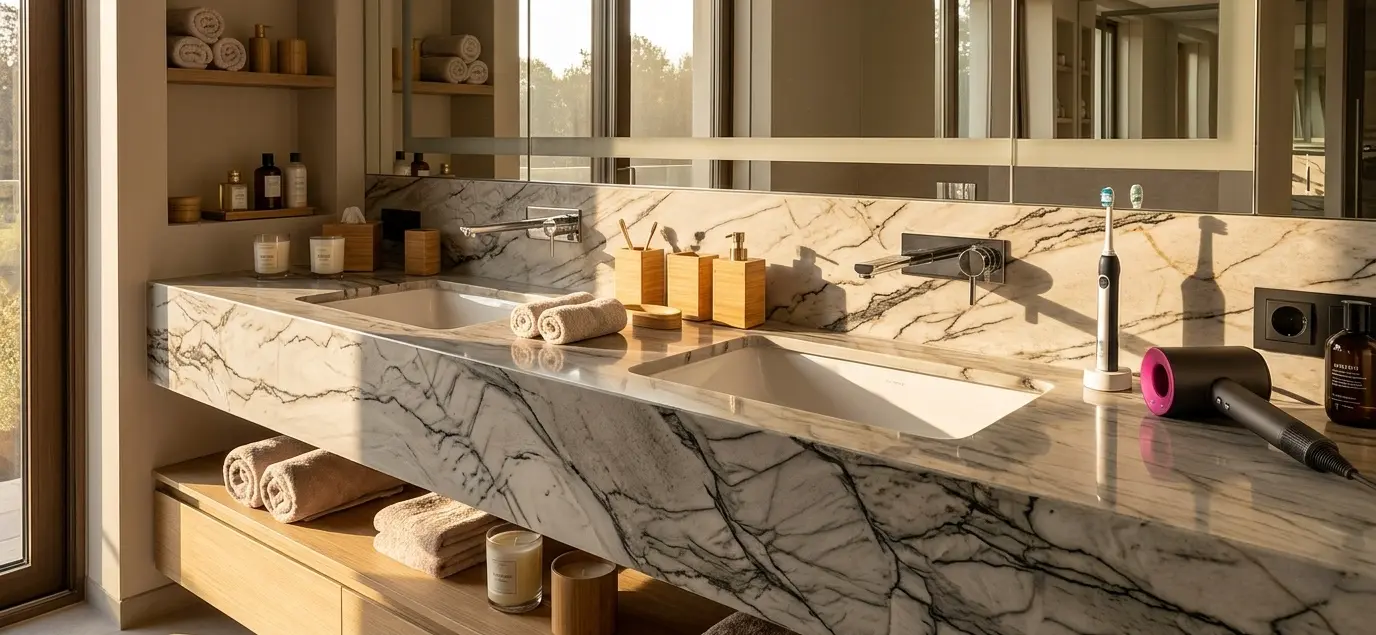
When sealed correctly, quartzite handles moisture and daily humidity with ease. Vanity tops, shower surrounds, and accent walls all benefit from its natural veining. The spa-like quality it brings to a bathroom is difficult to replicate with any other material.

Living Rooms: Feature Walls and Fireplace Surrounds
A quartzite fireplace surround instantly becomes the focal point of any living room. Its heat tolerance makes it a genuinely practical choice, not just a visual one. Extending the same stone to a nearby accent wall creates a cohesive, editorial-quality aesthetic.
Exteriors: Outdoor Surfaces That Endure the Elements
Quartzite handles freeze-thaw cycles and prolonged UV exposure better than marble or limestone. Patios, pool surrounds, and outdoor kitchen countertops are all strong candidates. Its natural surface texture provides added traction underfoot, which is a practical bonus for wet outdoor spaces.
How to Maintain Quartzite Properly: A Step-by-Step Routine
Routine care does not need to be complicated. Following a straightforward process consistently is far more effective than sporadic deep-cleaning. These five steps cover everything from daily upkeep to annual resealing.
Step 1: Wipe surfaces daily with a soft cloth and a pH-neutral cleaner. Avoid vinegar, citrus-based sprays, or anything labeled "all-purpose." Acidic cleaners degrade the sealant over time, leaving the stone exposed and vulnerable.
Step 2: Blot spills immediately rather than wiping them. Wiping spreads liquid across more surface area. Blotting lifts it away before it has a chance to penetrate the stone.
Step 3: Place trivets, coasters, and cutting boards between surfaces and direct contact. Even heat-resistant stone benefits from this habit. Prevention is far simpler than dealing with heat marks or surface abrasions later.
Step 4: Perform a water droplet test once a year. Drop a small amount of water onto the surface and wait five minutes. If the stone absorbs it rather than beading, the sealant has worn thin and resealing is overdue.
Step 5: Apply a penetrating stone sealer formulated for quartzite. Follow the manufacturer's instructions for application and allow the full cure time before returning the surface to use. Resealing typically takes less than an hour and yields two more years of reliable protection.
Sourcing Quality Natural Stone Slabs for Your Project
The quality of your stone source determines the consistency of color, thickness, and finish across your project. Reputable suppliers offer transparent grading and allow you to inspect slabs before committing. Browse the full natural stone slab inventory to find options that match your vision.
Viewing stone in person before purchasing is one of the most valuable steps in the process. Lighting conditions in a showroom reveal how a slab will truly behave in your home. Use the find a local showroom feature to locate a nearby location and experience the stone firsthand.
Northern Nevada homeowners can visit the Reno showroom or the Minden location for hands-on browsing with knowledgeable staff. California residents have access to the Sacramento showroom and its extensive quartzite selection. Those in the western Nevada corridor can also explore what is available at the Fernley location.
Professional guidance matters at every stage, from selection to installation planning. Keeping up with natural stone industry events is a great way to stay informed about new materials and techniques. This stone selection resource supports homeowners and design professionals throughout the entire project journey.
Conclusion
Quartzite earns its premium status through performance that holds up over time. With the right maintenance habits, natural stone slabs retain their color, texture, and finish for the lifetime of your home. A small investment of effort each week prevents costly repairs and refinishing down the road.
From kitchens and bathrooms to living rooms and outdoor exteriors, quartzite brings unmatched character to every surface it covers. Seal it on schedule, clean it gently, and source it from specialists who understand the material thoroughly. Your home deserves stone that performs as well as it looks.
Ready to find your perfect slab? Visit a showroom near you or explore the full collection online to start your quartzite project with confidence.
Frequently Asked Questions
Quartzite generally needs resealing every one to two years. The exact frequency depends on how heavily the surface is used and the porosity of the specific stone. Conduct a simple water droplet test annually to determine whether the sealant is still performing.
Yes. Quartzite is among the most kitchen-friendly natural stones available. Its heat and scratch resistance holds up well under daily cooking activity. Using trivets and cutting boards extends that protection even further.
Absolutely. Quartzite handles UV exposure, temperature swings, and moisture far better than marble or softer stones. It is a reliable choice for patios, outdoor kitchens, and pool surrounds.
pH-neutral stone cleaners and mild dish soap diluted in warm water are both safe options. Avoid anything containing acid, bleach, or abrasive particles, as these compounds break down the sealant and can scratch the surface over time.
Place a few drops of water on the surface and observe the reaction. If the water beads and sits on top, the seal is intact. If it absorbs into the stone within a few minutes, the sealant has worn thin and resealing should happen promptly.