The Marble Kitchen Look That Performs as Well as It Appears
Engineered stone slabs give homeowners the marble aesthetic they want without the maintenance burdens that come with natural stone. In a high-use luxury kitchen, that balance of refinement and resilience is the deciding factor for most buyers and design professionals.
Marble-look surfaces have shifted from a niche preference to a mainstream expectation in upscale kitchen design. According to kitchen color trends 2026, white and veined surfaces remain central to the most sought-after kitchen styles heading into the new year. Engineered stone meets that demand with production consistency natural slabs cannot guarantee.
This guide covers the strongest marble-look engineered stone options for luxury kitchens, how to apply them across different kitchen zones, and how to source the right slab with confidence. By the end, you will have a clear picture of which surface fits your design goals.
Why Engineered Stone Slabs Are the Practical Choice for High-End Kitchens
Marble is refined and visually compelling. It is also reactive to acidic cleaners, susceptible to etching from everyday food contact, and requires periodic resealing to maintain its surface. For a kitchen with daily cooking activity, those demands translate into real cost and ongoing attention.
Engineered stone slabs sidestep most of those requirements. Quartz-based surfaces are non-porous, meaning liquids sit on top rather than absorbing into the slab. Porcelain panels are kiln-fired at extreme temperatures, producing a surface that resists staining, scratching, and heat without topical treatments.
Key advantages that make engineered stone a strong choice for a luxury kitchen:
- Pattern consistency across the full slab makes vein matching at seams predictable and clean
- Non-porous construction blocks food acids, moisture, and bacteria from penetrating the surface
- Color stability that holds under kitchen lighting for years without fading or shifting
- Reduced lifetime upkeep compared to natural marble, which needs periodic sealing, depending on use and sealer type
- Certified performance verified through organizations like the Tile Council of North America
Well-chosen engineered slabs also align with interior design trends 2026, where clean surfaces and mineral-tone aesthetics dominate the most-published residential projects.
Top Marble-Look Engineered Stone Slabs for Luxury Kitchen Spaces
Not every engineered stone carries the same visual weight or suitability for kitchen environments. The options below rank among the most requested for homeowners who want a convincing marble result with proven durability.
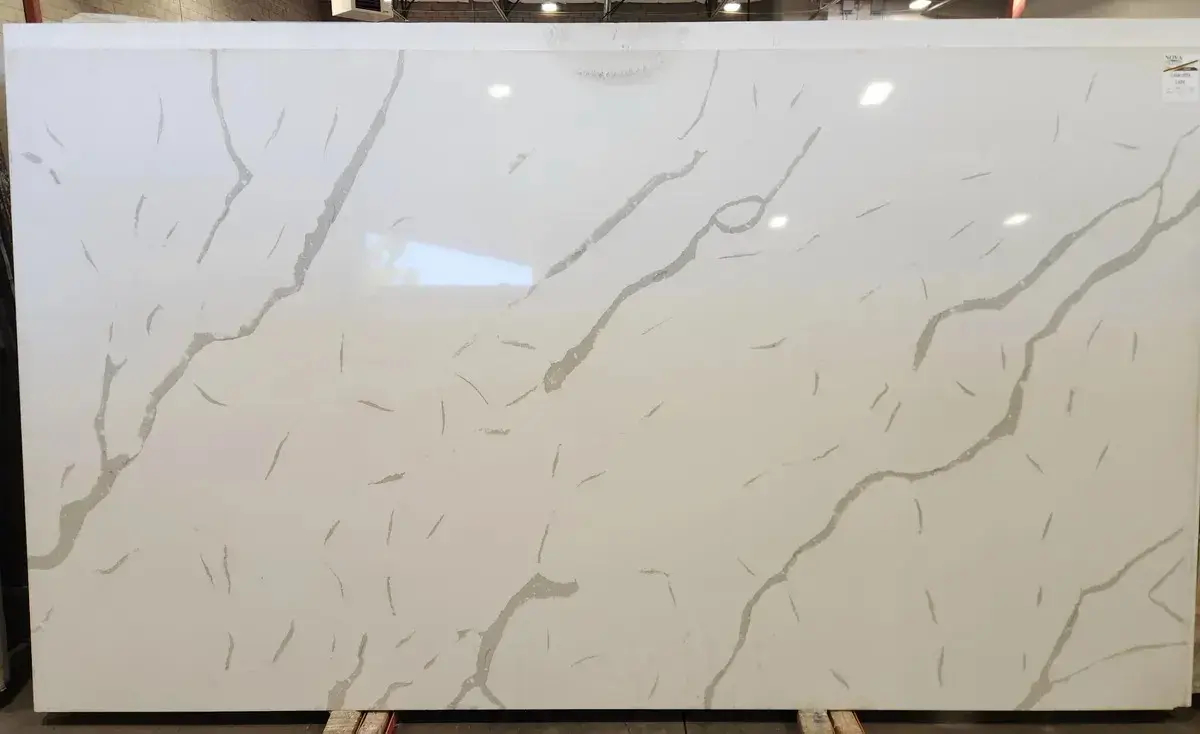
Calacatta-Look Quartz
Calacatta is one of the most recognizable marble patterns in residential design. Its white base, bold gold or gray veining, and overall brightness suit open-plan kitchens where the countertop anchors the broader visual composition. Our full slab inventory includes Calacatta-inspired patterns across multiple manufacturers, with variation in vein thickness, background tone, and finish to suit different kitchen styles.
MATERIALS
Quartz
THICKNESS
2cm (¾")
FINISH
Polished
SLAB SIZE
Varies by Lot
(please contact us)
Care:
Calacatta‑look quartz offers marble style with minimal upkeep: clean daily, avoid harsh chemicals, use trivets for heat, wipe spills quickly. No sealing required.
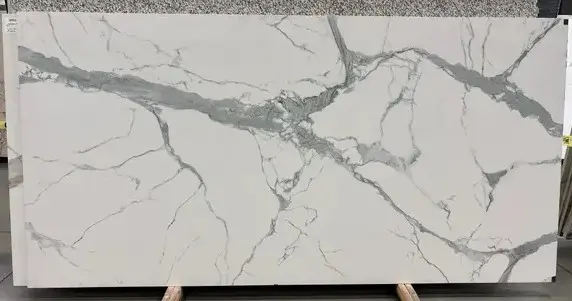
Statuario-Look Quartz
Statuario marble features finer veining than Calacatta and a crisper white background. Its quieter pattern suits kitchens where cabinetry and hardware carry the design weight and the countertop plays a supporting role. These surfaces fit transitional kitchens where warmth and brightness need to coexist without competing visual elements.
MATERIALS
Quartz
THICKNESS
1.2cm (½")
FINISH
Polished
SLAB SIZE
Varies by Lot
(please contact us)
Care: Statuario‑look quartz offers marble elegance with minimal care: clean daily, avoid harsh chemicals, use trivets for heat, wipe spills quickly. No sealing needed.
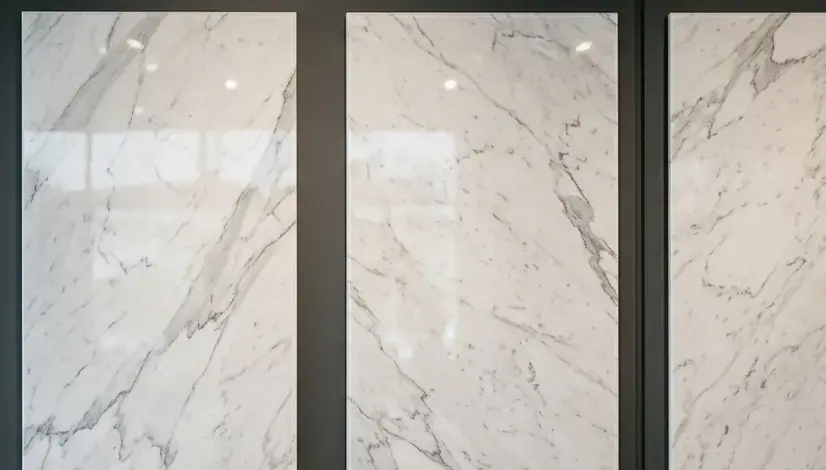
Carrara-Look Porcelain Panels
Carrara's soft gray-white tone and delicate feathered veining translate well into porcelain panels, which can be produced in very large formats without visible seams. This makes them well-suited to waterfall islands and full-wall applications. Porcelain's firing process, which must meet ANSI tile standards for certified performance, produces a surface harder than most quartz options in daily use.
MATERIALS
Porcelain
THICKNESS
2cm (¾")
FINISH
Polished
SLAB SIZE
Varies by Lot
(please contact us)
Care:
Carrara‑look porcelain panels give marble style with easy care: clean daily, avoid abrasives, use trivets for heat, wipe spills fast. Non‑porous, no sealing needed.
Marble-Look Engineered Stone: Head-to-Head Comparison
Surface Type | Pattern Style | Best Application | Sealing Required | Heat Resistance |
Calacatta Quartz | Bold white and gold vein | Island, perimeter countertop | No | Moderate |
Statuario Quartz | Fine white and gray vein | Countertop, backsplash | No | Moderate |
Carrara Porcelain | Soft gray-white vein | Floor, wall, waterfall island | No | High |
Calacatta Marble (natural) | Bold, unpredictable variation | Premium feature surface | Yes, periodically | Low |
Pros and Cons of Marble-Look Engineered Stone Slabs
Pros:
- No sealing required across most quartz and porcelain options
- Consistent veining pattern aids seam alignment and vein matching
- Resistant to food acids, wine, coffee, and standard cleaning agents
- Large-format options reduce visible seams across expansive surfaces
- Lower lifetime maintenance cost compared to natural marble
Cons:
- Cannot be refinished or re-honed if deeply scratched or chipped
- Quartz resin binders are vulnerable to sustained direct heat; trivets are recommended
- Lacks the geological variation and tactile depth of authentic natural stone
- Some patterns read as engineered under close inspection in strong kitchen lighting
- Premium real estate markets may still favor natural stone in appraisal narratives
How to Choose a Marble-Look Engineered Stone Slab: 5 Steps
Step 1: Identify your kitchen's dominant tone. White and warm-white kitchens suit Calacatta and Statuario patterns. Gray or charcoal kitchens pair better with Carrara or darker veined options.
Step 2: Decide which surfaces will carry the slab. Countertops, islands, backsplashes, and floors perform differently under daily use. Quartz suits countertops and vertical surfaces. Porcelain suits floors and large panels.
Step 3: Confirm the slab format you need. Island waterfalls and seam-free walls require large-format slabs. Standard countertop runs work with most available slab dimensions.
Step 4: View the slab in person before purchasing. Engineered stone varies between production batches. Evaluating the actual slab under your kitchen lighting removes guesswork from the selection process.
Step 5: Match the finish to the application. Polished finishes suit countertops and backsplashes. Matte and satin options handle floors and vertical cladding without showing fingerprints or water marks.
Where to Find Quality Marble-Look Engineered Stone Slabs Near You
Choosing an engineered stone slab from a screen image rarely captures the full story. Vein movement, background tonal range, and surface texture all read differently in person, particularly under the kind of lighting found in an active kitchen. Viewing slabs in a showroom produces better decisions than selecting from digital samples.
Our stone and tile destination carries a curated range of engineered stone panels across four locations in Northern Nevada and Northern California. Full-format slab samples are available to evaluate pattern and finish before committing.
The Reno showroom and the Minden showroom both carry current marble-look inventory across the most requested engineered stone patterns. Staff at both locations can help identify which surface performs best for your specific kitchen application.
Contractors managing multiple kitchen projects can apply for trade access to unlock trade pricing and streamlined ordering. For budget planning before a showroom visit, a slab quote request gets the process started remotely. Recent advances covered in flooring innovation 2026 have made large-format engineered stone installations cleaner and more reliable than in previous years. Contractors following TCAA project standards will find these installations efficient with properly sourced slabs and the right setting materials.
To check current availability or connect with a stone specialist, use our shop local page or book an appointment at the location closest to your project.
Conclusion
Engineered stone slabs have earned their position in high-end kitchen design by solving the core problem real marble cannot. They deliver the refined look luxury kitchens require while holding up under the demands of active daily use, without the maintenance cycle that makes natural marble a recurring expense.
The strongest choice depends on your kitchen's color palette, the surfaces you plan to cover, and the finish that fits your household. Calacatta and Statuario quartz handle most countertop applications with confidence. Carrara porcelain and sintered stone panels extend the options for floors and vertical surfaces where larger formats shine.
Start by viewing full-format slabs in person, comparing patterns under conditions that reflect your actual kitchen, and working with a team that understands how these surfaces perform long after installation day.
Frequently Asked Questions
What is the difference between engineered stone slabs and natural stone?
Engineered stone is manufactured from crushed minerals, resins, or kiln-fired clay. Natural stone is quarried directly from the earth. Engineered options offer consistent patterning and low maintenance, while natural stone provides unique geological character that varies from slab to slab.
Do marble-look engineered stone slabs require sealing?
Most quartz-based engineered stone slabs do not require sealing because they are non-porous by construction. Natural marble, granite, and quartzite generally need periodic sealing to maintain stain resistance over time.
Which engineered stone pattern looks closest to real marble?
Calacatta and Statuario quartz patterns from manufacturers like Cambria and Silestone produce the most convincing marble results, particularly in large-format slabs where veining can be matched across seams. Sintered stone panels also deliver strong results in full-wall and island applications.
Are engineered stone slabs heat resistant enough for kitchen use?
Sintered stone and porcelain panels handle heat well and can tolerate contact from warm cookware in most applications. Quartz-based slabs are more vulnerable to sustained heat, and trivets are recommended to protect the resin binder from thermal stress over repeated exposure.
Can engineered stone slabs be installed on kitchen floors?
Porcelain and sintered stone panels are well suited for kitchen floors due to their surface hardness and available slip-resistance textures. Quartz slabs are not typically specified for flooring because they are softer and more prone to surface marking from foot traffic and dropped objects.