Choosing the right stone slab for your countertops means evaluating material type, surface finish, veining pattern, and how the stone interacts with the lighting, cabinetry, and flooring already in your space. Natural stone slabs available for countertops include granite, marble, quartzite, soapstone, and travertine, each with distinct durability levels, porosity, and visual character. The right slab balances your aesthetic goals with your household's daily demands. At Nova Tile and Stone, we're a direct stone importer with thousands of slabs across our showrooms in Reno, Minden, Sacramento, and Fernley, and our team helps homeowners navigate every step of the selection process.
Why Slab Selection Matters More Than You Think
A countertop slab is not just a surface material. It becomes one of the most visible elements in your kitchen or bathroom, and it lives alongside your cabinets, flooring, backsplash, and hardware for decades. Unlike engineered surfaces where every piece looks the same, natural stone is entirely unique. No two slabs share an identical pattern, which makes in-person viewing essential. A photograph or small sample chip cannot fully represent how a full slab will look installed across a 10-foot run of countertop.
It is also worth noting that growing health research has raised concerns about silica dust exposure during the fabrication of engineered stone products. According to NIOSH, engineered stone contains significantly higher crystalline silica content than natural stone, making natural stone a material many homeowners and fabricators are looking at more closely.
How Lighting Affects Your Stone Choice
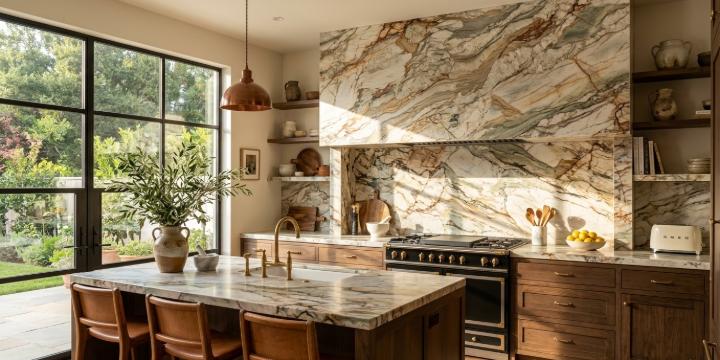
Natural and artificial light interact with stone in very different ways. A slab that reads as soft gray under fluorescent lighting may look warm beige in afternoon sunlight, and dramatic veining that appears striking in a showroom can recede in a kitchen with limited windows.
Consider the direction your windows face and the type of artificial lighting in the room. North-facing kitchens receive cool, diffuse light that tends to flatten color. South-facing kitchens get warm, direct light that can intensify golden or amber tones in granite and quartzite. If your kitchen is naturally dim, lighter stones like white marble or cream quartzite help reflect available light. If your kitchen gets abundant natural light, you have more flexibility to use darker or heavily patterned stones without the space feeling heavy.
Coordinating Stone with Cabinetry and Flooring
Your countertop sits directly adjacent to your cabinet faces and above your flooring, so undertones and value contrast play a major role in how the final space comes together.
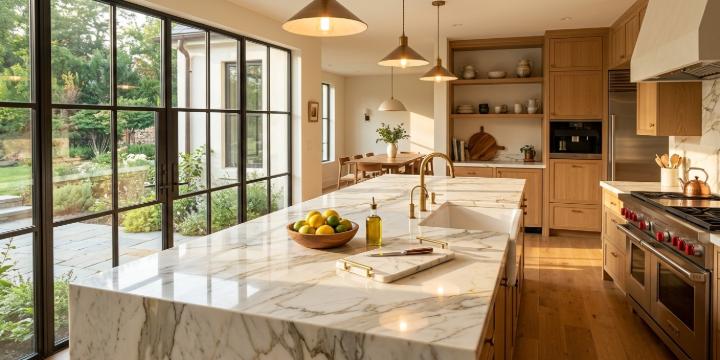
Warm-toned wood cabinets pair naturally with stones that carry gold, brown, or amber mineral movement. White or off-white cabinetry offers the most flexibility. A high-contrast marble with bold veining adds visual depth, while a softer quartzite in cream and taupe creates a more seamless, monochromatic look. For dark navy or black cabinetry, lighter stones with strong movement provide the contrast needed to keep the design balanced.
Flooring creates the third element in this relationship. Heavily patterned floors can visually compete with a bold countertop. In those cases, a calmer stone on the counter lets the floor make the statement. For more guidance on how stone selections come together in real kitchens, This Old House's overview of stone countertops is a useful reference.
Matching Stone Type to How You Actually Use the Space
Different stone types perform very differently under daily use, and understanding those differences protects your investment.
Granite is one of the most durable options for high-traffic kitchens. It resists scratching, handles heat well, and requires only periodic sealing. Quartzite delivers marble-like veining with durability that rivals granite, making it a practical choice for homeowners who want the marble aesthetic but need a more resilient surface. Marble is better suited to lower-traffic applications like powder rooms, bathroom vanities, and baking stations, where its softness and etching sensitivity are acceptable trade-offs for its visual character. Soapstone is nonporous and inert, requiring no sealing and showing no reaction to acids, water, or heat, though its softer composition can develop surface scratches over time. Travertine suits bathrooms and lower-contact kitchen zones better than primary cooking surfaces due to its higher porosity and maintenance demands.
Planning Your Layout Before You Shop
A general sense of your project scope before you visit a showroom makes the selection process far more efficient. Projects with long, uninterrupted surfaces benefit most from larger slabs that minimize seams. Smaller or segmented layouts can often be completed from a single slab or a remnant.
If your island and perimeter countertops will share the same stone, compatible matching becomes a priority. If the island will use a contrasting material, the two stones still need to relate in undertone or visual weight. Seeing slabs in person is one of the most reliable ways to evaluate these relationships before committing, which is worth considering when choosing between shopping local versus ordering online.
Understanding Veining and Pattern Flow
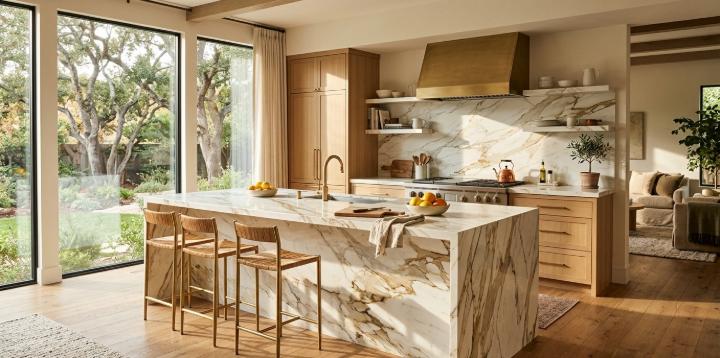
For stones with strong movement like marble and quartzite, the direction and scale of the veining significantly affects how the finished installation reads. Horizontal veining can make a kitchen feel wider, while vertical movement draws the eye upward, which can be particularly effective on a waterfall island.
When two slabs are needed for a continuous surface, book-matching creates a mirrored, symmetrical vein pattern by sourcing consecutive slabs from the same quarry block. Even without book-matching, adjacent slabs should share compatible movement, scale, and undertone. Our team can help you identify slabs that work cohesively for multi-piece projects.
Choosing the Right Surface Finish
As Fine Homebuilding notes in their guide to natural stone countertops, the choice between polished, honed, and textured finishes is one of the more meaningful decisions in the countertop selection process.
A polished finish is high-gloss and reflective, bringing out the depth of color and veining. It is the most common choice for marble and quartzite but shows fingerprints and water spots more readily than other finishes. A honed finish is matte and velvety, concealing minor scratches and etching better than polished. It is a practical choice for marble in working kitchens. A leathered or brushed finish creates a textured surface with low sheen that masks fingerprints and water spots and is well-suited to granite, quartzite, and outdoor applications.
Edge Profiles Add the Final Layer of Detail
The edge profile contributes to the overall character of the countertop. Simple eased or straight edges suit modern and transitional kitchens and are the easiest to maintain. Beveled edges add subtle dimension while keeping a clean appearance. Decorative profiles like ogee work best in traditional kitchens with detailed cabinetry. A waterfall edge, where the countertop surface wraps down the side of an island, is a design approach frequently found in contemporary kitchen projects.
Conclusion
Selecting the right stone slab comes down to understanding your space, your lifestyle, and the characteristics of natural stone. Lighting, cabinetry, flooring, usage patterns, veining flow, surface finish, and edge profile all work together to determine how the final installation looks and performs. Our team offers free design consultations at all four of our Northern Nevada and Northern California showroom locations. Visit us in Reno, Minden, Sacramento, or Fernley to browse our full range of natural stone slabs in person.
Frequently Asked Questions
Is it better to choose a stone slab in person or online?
In person is always the better approach for natural stone. Photographs and small sample chips cannot accurately represent the full scale, movement, and character of a slab. Lighting in photographs often flattens or alters color, and the scale of veining only becomes clear when you see the full slab. Visiting a showroom where you can view large slab displays under realistic lighting gives you a more accurate picture of how the stone will look installed in your home.
How do I know if a stone is the right fit for my kitchen?
Match the stone's durability profile to how you actually use the space. High-traffic kitchens with frequent cooking and acidic food preparation are best served by granite or quartzite. If your kitchen sees lighter use or you are drawn to marble for its aesthetic, honest maintenance expectations are essential. Consider visiting one of our showrooms and viewing full slabs against material samples from your existing space before making a final decision.
What is the difference between a polished, honed, and leathered finish?
A polished finish is high-gloss and reflective, bringing out the depth of color and veining. A honed finish is matte and velvety, concealing minor scratches and etching more effectively than polished. A leathered or brushed finish is textured with low sheen, hiding fingerprints and water spots well. The right finish depends on the stone type, the location of the installation, and your maintenance preferences.
What does book-matching mean and do I need it?
Book-matching is a technique where two consecutive slabs from the same quarry block are placed side by side to create a mirrored, symmetrical veining pattern. It works well on large islands, feature walls, and statement bathroom vanities. Not every project requires it. For simple layouts or stones with subtle movement, matching for compatible undertone and scale is usually sufficient.
How many slabs do I need for a typical kitchen countertop project?
Most standard kitchen projects require one to two full slabs depending on layout size and whether the design includes an island. A compact galley kitchen can often be completed from a single large slab. An L-shaped kitchen with a large island typically requires two slabs, and seam placement becomes an important consideration. Our team can help you estimate slab quantity based on your general layout during a free design consultation.