Countertop overhang is the distance a countertop extends past the front edge of the base cabinets below. The standard overhang for a kitchen countertop is 1 to 1.5 inches. For kitchen islands with seating, the standard overhang ranges from 12 to 18 inches depending on counter height. Any overhang beyond 10 to 12 inches requires structural support such as corbels or steel brackets.
Standard countertop overhang by application:
- Standard kitchen countertop: 1 to 1.5 inches past the cabinet face
- Kitchen island at counter height (36 inches): 15 inches for comfortable knee clearance
- Kitchen island at bar height (42 to 48 inches): 12 inches
- Kitchen island at table height (28 to 30 inches): 18 inches
- Raised bar top: 12 inches; can reduce to 8 inches for standing-only use
- Bathroom vanity: 1 to 1.5 inches, specified based on vanity cabinet depth
Overhang affects cabinet protection, user comfort at the counter, and how much structural support the slab requires. The right measurement depends on the counter's purpose, the height of the surface, whether seating is involved, and the thickness of the stone slab being used.
What Is Countertop Overhang?
Countertop overhang refers to the distance the countertop surface extends past the front edge of the base cabinets or vanity below. This measurement is not purely cosmetic. Overhang serves several important practical purposes in both kitchens and bathrooms.
First, overhang protects the cabinet face and drawer fronts from water damage, crumbs, and everyday spills. Without adequate overhang, liquid running off a countertop drips directly onto the cabinet doors, accelerating wear and staining over time. Second, overhang gives the person standing at the counter room to get physically closer to the work surface. A properly sized overhang allows the body to stand upright and lean in, rather than standing awkwardly away from the cabinet face. Third, overhang creates the visual transition between the counter and the cabinets below, giving the installation a clean, finished appearance.
The leading edge of a countertop, which is the edge facing outward toward the room, is where overhang is measured. Measuring from this edge back to the front of the cabinet face gives you the overhang depth.
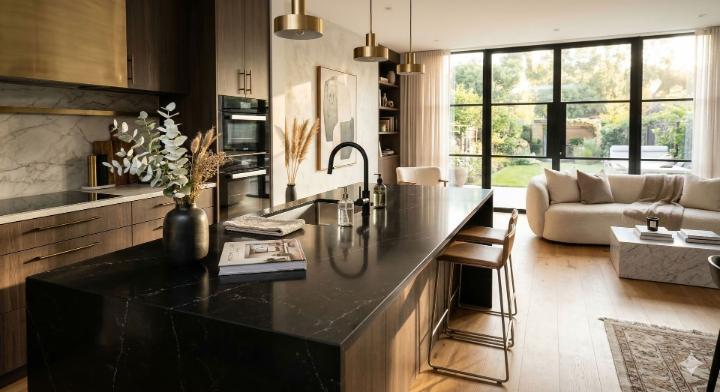
Standard Kitchen Countertop Overhang
For a standard kitchen countertop with no seating, the widely accepted measurement is 1 to 1.5 inches of overhang past the cabinet face. Most stock base cabinets are 24 inches deep. A countertop cut to 25 to 25.5 inches deep will produce the standard 1 to 1.5 inch overhang automatically, which is why this measurement is often built into the cabinet and countertop package without requiring a separate specification.
The 1.5 inch standard exists for a practical reason: it is deep enough to protect the cabinet face from spills while keeping the overhang proportional. An overhang shorter than one inch begins to look unfinished. An overhang significantly longer than 1.5 inches on a standard run of cabinets can start to look out of proportion and may interfere with opening drawers and doors smoothly.
One variation to be aware of involves cabinet door style. Inset cabinets, where the doors sit flush inside the cabinet frame, require slightly less overhang than framed overlay or frameless cabinets, where the door face sits proud of the cabinet box. If you have inset cabinetry, a 3/4 inch to 1 inch overhang is often more appropriate than the full 1.5 inches.
Where a countertop meets a wall on either side, the overhang should be zero. Allowing overhang at a wall creates a narrow gap that collects debris and is nearly impossible to clean. Next to appliances such as ranges, refrigerators, and dishwashers, overhang should be kept to a minimum of 1/8 to 1/4 inch to keep the transition tight and prevent items from falling into gaps between the appliance and the counter. According to This Old House's guide to stone countertops, precise fitting around appliances is one of the details that separates a professional installation from a DIY one.
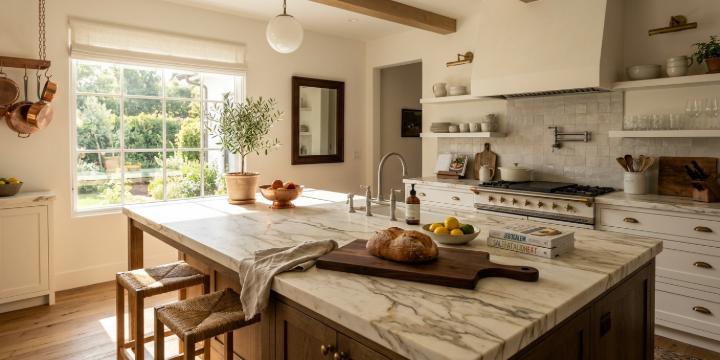
Kitchen Island Overhang for Seating
Kitchen islands with seating require significantly more overhang than standard countertops because the stools or chairs need adequate knee clearance beneath the counter's edge.
The right overhang for island seating depends on the height of the counter and the type of seating. There are three common countertop heights for island seating: table height, counter height, and bar height.
Table Height (28 to 30 inches): At table height, the recommended knee clearance is approximately 18 inches. This height works with chairs and shorter stools in the 18 to 23 inch seat height range.
Counter Height (36 inches): The standard base cabinet height, this is the most common kitchen island height. At counter height, the recommended knee clearance is 15 inches. Counter-height stools around 24 inches tall pair well with this configuration.
Bar Height (42 to 48 inches): At bar height, knee clearance requirements are reduced because the body's angle changes with taller seating. A 12 inch overhang is the standard recommendation. Stools around 28 to 30 inches tall pair with bar-height islands.
As a general rule, any island overhang beyond 8 to 10 inches will require additional structural support to prevent the countertop from flexing, cracking, or pulling away from the substrate over time. Any overhang beyond 12 inches should be supported with corbels, steel brackets, or wood support legs. Overhangs approaching 16 inches or more typically require vertical posts or structural legs at the ends of the island.
Slab thickness also affects how much unsupported overhang is safe. Thicker 3cm material provides greater rigidity and can handle longer spans more reliably than 2cm slabs, which require a plywood support layer on horizontal surfaces even at standard overhangs. If a larger overhang is part of your design plan, 3cm is generally the safer choice.
If tucking stools completely under the island is a priority, an 18 inch overhang is the target. At 12 inches, stools will typically protrude past the edge of the counter when not in use. For homeowners with open kitchen layouts where the visual line of the island is important from multiple angles, tucking stools neatly under the counter is a worthwhile design consideration.
Raised Bar Overhang
A raised bar top is a two-level island or peninsula where one side sits at standard counter height for food prep and the opposite side is elevated to bar height, typically between 42 and 48 inches, for casual seating. This configuration is common in open-concept kitchens where the raised bar creates a visual partition between the kitchen and the living or dining area.
For a raised bar top, the standard overhang is 12 inches. If the bar is being used primarily for standing or casual leaning rather than seated dining, the overhang can be reduced to around 8 inches. Below 8 inches, the bar becomes uncomfortable to use from a seated position and should be avoided if stools are part of the plan.

Bathroom Vanity Overhang
Bathroom vanity overhang follows a looser standard than kitchen countertops because vanity cabinet depths vary more widely. While kitchen base cabinets are reliably 24 inches deep, bathroom vanity cabinets are sold in depths ranging from 18 to 24 inches, and custom vanities can fall anywhere in between.
Because of this variation, the vanity countertop depth and overhang need to be specified during planning rather than assumed. A standard bathroom vanity countertop typically overhangs the cabinet face by 1 to 1.5 inches, similar to a kitchen countertop. However, if the vanity is shallower than 21 inches, a smaller overhang of around 3/4 inch may look more proportional.
As with kitchen countertops, vanity overhang at walls should be flush with no extension. Overhang at the sides of a vanity that is not against a wall is typically kept at 1 to 1.5 inches to match the front.
Overhang and Edge Profile Considerations
The edge profile selected for a countertop can visually alter the perception of the overhang depth. According to Fine Homebuilding's natural stone countertop guide, a thick or layered edge profile such as a bullnose or ogee creates the impression of a more pronounced edge, making even a standard 1.5 inch overhang feel more substantial. A simple eased or straight edge keeps the profile minimal and modern, which pairs well with sleeker cabinet styles.
Waterfall countertops, where the stone extends vertically down the sides of an island all the way to the floor, effectively eliminate the traditional overhang on the sides where the waterfall panel is installed. The front-facing overhang on a waterfall island remains standard unless the island also includes seating, in which case the same knee clearance rules apply.
Support Requirements at a Glance
Knowing when additional support is required saves significant time and frustration during planning.
Up to 8 to 10 inches: Natural stone countertops can typically be unsupported within this range, depending on thickness and material density. Granite, quartzite, and sintered stone handle this range well at 3cm thickness.
Beyond 10 to 12 inches: Corbels, metal brackets, or wood supports should be added beneath the overhang. These can be decorative or hidden depending on the design preference.
Beyond 16 inches: Vertical support elements such as legs or posts become necessary. These can be integrated into the island design as a feature rather than an afterthought.
The weight of the stone plays a role in support requirements. Denser natural stones such as granite and quartzite are heavier than engineered materials and require careful attention to support at longer spans. If you are working with natural stone and plan any cutting or fabrication on-site, the CDC NIOSH guidance on engineered stone silica dust is worth reviewing for safe handling practices, as crystalline silica exposure is a concern with stone processing regardless of material type.
Conclusion
Getting countertop overhang right from the start prevents costly adjustments later and ensures the finished kitchen or bathroom feels both comfortable and proportional. For standard kitchen countertops, 1 to 1.5 inches past the cabinet face is the benchmark. For island seating, the overhang should be sized to the counter height and seating type, with structural support planned for anything beyond 10 inches. Bathroom vanities require overhang to be specified based on the actual cabinet depth rather than assumed. The material and thickness of the slab also factor into how much unsupported span is appropriate.
Homeowners across Northern Nevada and Northern California can browse our full stone and slab collection and get guidance from our design team in person. We encourage buying from a local stone supplier rather than a big-box alternative, and we welcome you to visit one of our showrooms in Reno, Minden, Sacramento, or Fernley to see full slabs and talk through which material and thickness make the most sense for your layout and overhang needs. You can also learn more about how we work before your visit.
Frequently Asked Questions
What is the standard countertop overhang?
The standard overhang for a residential kitchen countertop is 1 to 1.5 inches past the front face of the base cabinets. Most stock kitchen base cabinets are 24 inches deep, so a countertop cut to 25 to 25.5 inches deep will produce this standard overhang without any special specification needed.
How much overhang do I need for island seating?
The right overhang for island seating depends on the counter height. At standard counter height (36 inches), a 15 inch overhang provides comfortable knee clearance. At bar height (42 to 48 inches), 12 inches is the standard. At table height (28 to 30 inches), plan for around 18 inches of knee space. Any overhang beyond 10 to 12 inches will require corbels, brackets, or structural support.
Does countertop thickness affect how much overhang is safe?
Yes. Thicker slabs, specifically 3cm stone, are more rigid and can handle longer unsupported spans than 2cm slabs. Two-centimeter slabs require a plywood sublayer on horizontal surfaces and should be evaluated carefully for overhang support at any depth beyond the standard kitchen measurement. If a larger overhang is part of the design plan, 3cm material is generally the safer choice.
What happens if my countertop overhang is too small?
An overhang that is too small can cause spills and crumbs to drip directly onto the cabinet face, accelerating wear and staining over time. It can also make the installation look unfinished where the countertop meets the cabinet. For seating applications, an overhang that is too shallow forces people to sit awkwardly far from the counter edge, making dining and working at the island uncomfortable.
Do I need additional support for a large countertop overhang?
Yes. Natural stone countertops with overhangs beyond 8 to 10 inches generally require added support such as corbels, metal brackets, or wood legs. Overhangs exceeding 16 inches typically require vertical posts or structural legs to safely carry the weight of the stone. The specific support requirements depend on the stone type, slab thickness, and total overhang depth. Our design team can help you plan the right support strategy for your specific layout.