What Makes Quartzite Slabs a Top Design Choice?
Quartzite natural stone slabs stand out for one defining reason: no two are alike. Formed when sandstone undergoes intense heat and pressure deep within the earth, quartzite develops the kind of bold, flowing veining that designers and homeowners actively seek out. It delivers the visual complexity of marble with considerably better hardness and resistance to etching, making it a practical choice that does not sacrifice beauty.
For kitchens, bathrooms, and bars, quartzite slabs offer a rare combination of high visual impact and real-world durability. Surfaces hold up well under daily use, though consistent sealing and prompt spill cleanup preserve appearance over time. Available in polished, honed, leathered, and specialty finishes, quartzite adapts to a broad range of design directions, from soft and luminous to textured and organic. The surface design community continues to recognize natural stone as a material of enduring design relevance.
Key Benefits of Quartzite Slabs for Kitchens, Bathrooms, and Bars
Quartzite consistently ranks among the hardest natural stone slab options available. Its metamorphic formation produces a tightly bonded mineral structure that resists scratching better than many softer stones, though cutting boards remain essential to preserve finish quality over time.
- Distinct veining patterns run across the full slab face, giving countertops, walls, and bar tops a signature, unrepeatable look
- UV stability means quartzite is suitable for both indoor and outdoor applications, including covered patios and alfresco bar areas
- Broad finish range spans polished, honed, leathered, and specialty options, each shifting how the stone reads in different lighting conditions
- Floor, wall, and fireplace compatibility makes quartzite one of the most versatile slab materials in any category
- Harder surface than marble or travertine reduces everyday wear, though proper sealing is still required for food-contact and wet surfaces
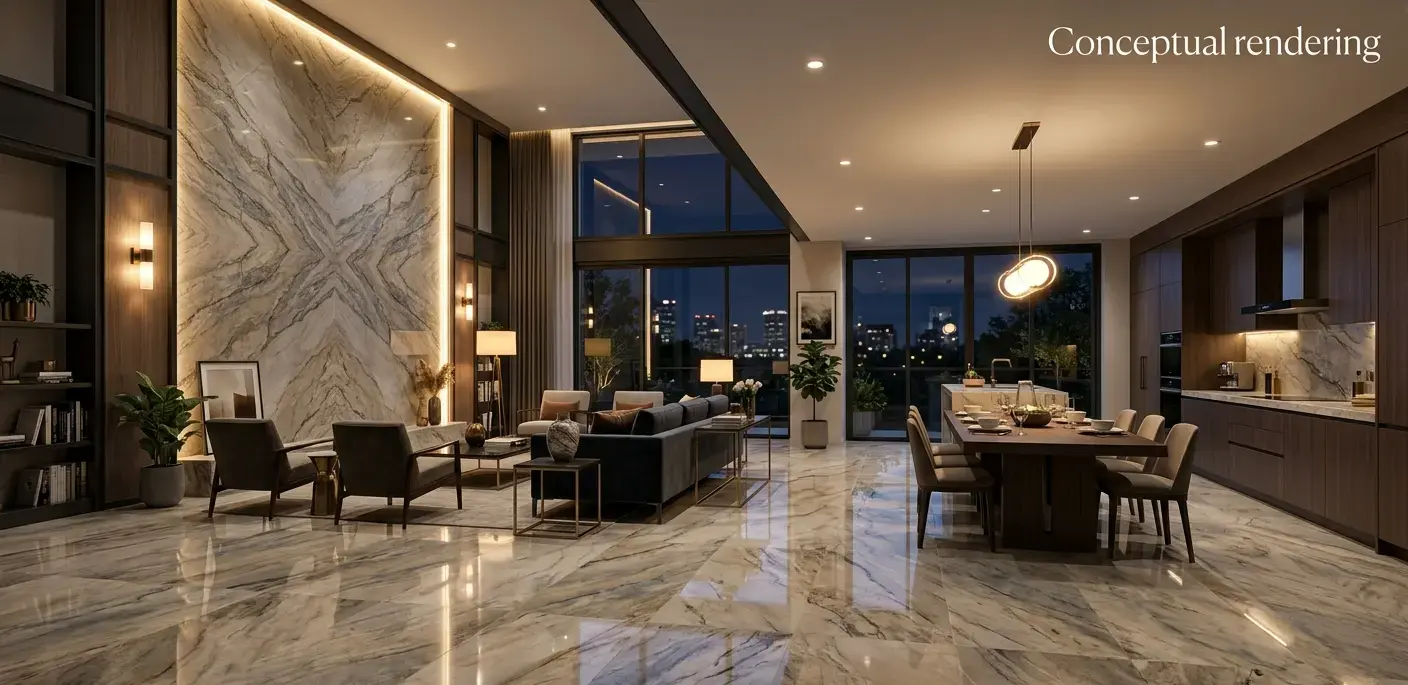
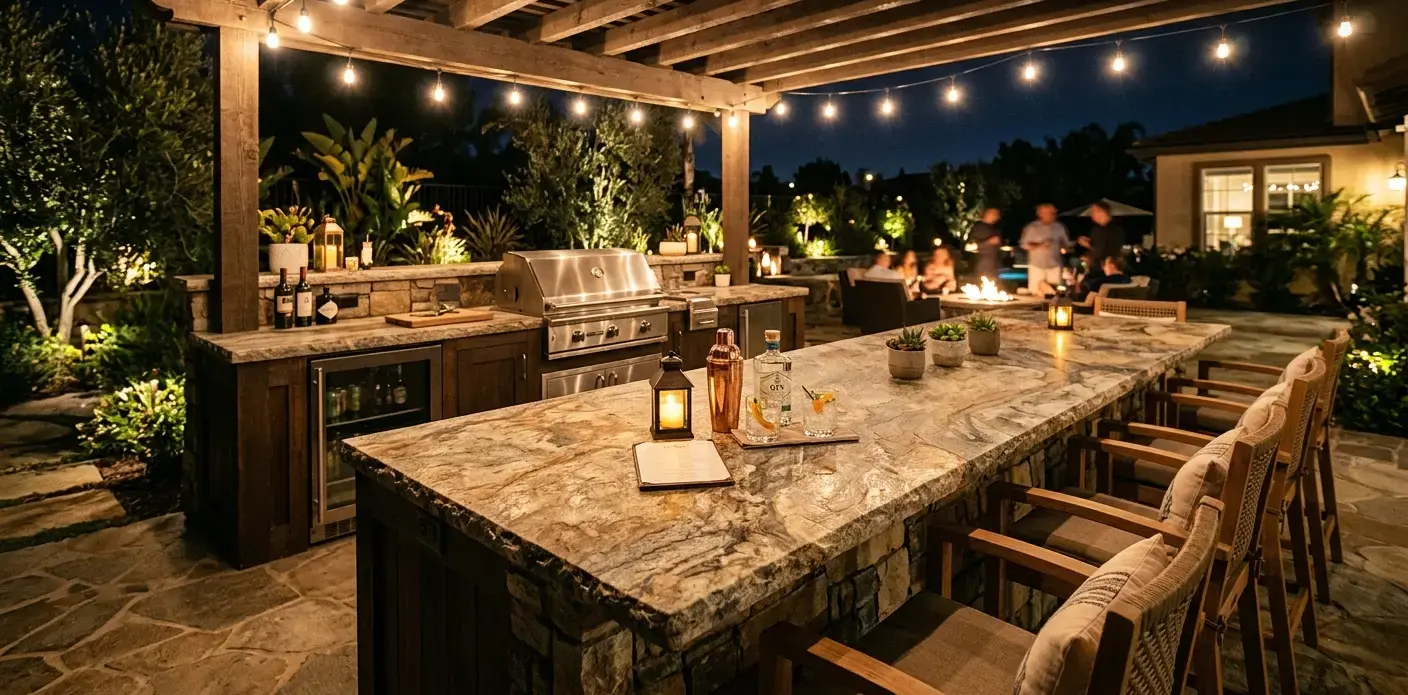 Conceptual rendering
Design trend alignment: 2026 kitchen color trends favor warm neutrals and natural materials, where quartzite tones pair naturally
Quartzite Veining Patterns and Tone Ranges Explained
Understanding the relationship between quartzite veining style and base tone helps narrow selection before viewing full slabs in person. Tone and veining intensity vary significantly from quarry to quarry and slab to slab.
Light and Ivory Tones
Light quartzite slabs typically feature white, cream, or pale grey backgrounds with veining in contrasting charcoal, taupe, or gold. These work well in kitchens where reflected light matters, and in bathrooms where a clean, spa-like backdrop is the goal. Honed finishes in lighter tones read particularly soft and matte without losing the veining definition.
Mid-Range Warm and Grey Tones
Slabs in the beige, greige, and soft gold range carry veining that often mirrors their base color at higher contrast. These tones layer well with warm wood cabinetry and are a natural fit for bar applications where the slab acts as a visual anchor. Leathered finishes suit this tone range especially well, adding a tactile quality that reads as deliberately crafted rather than polished.
Dark and Dramatic Tones
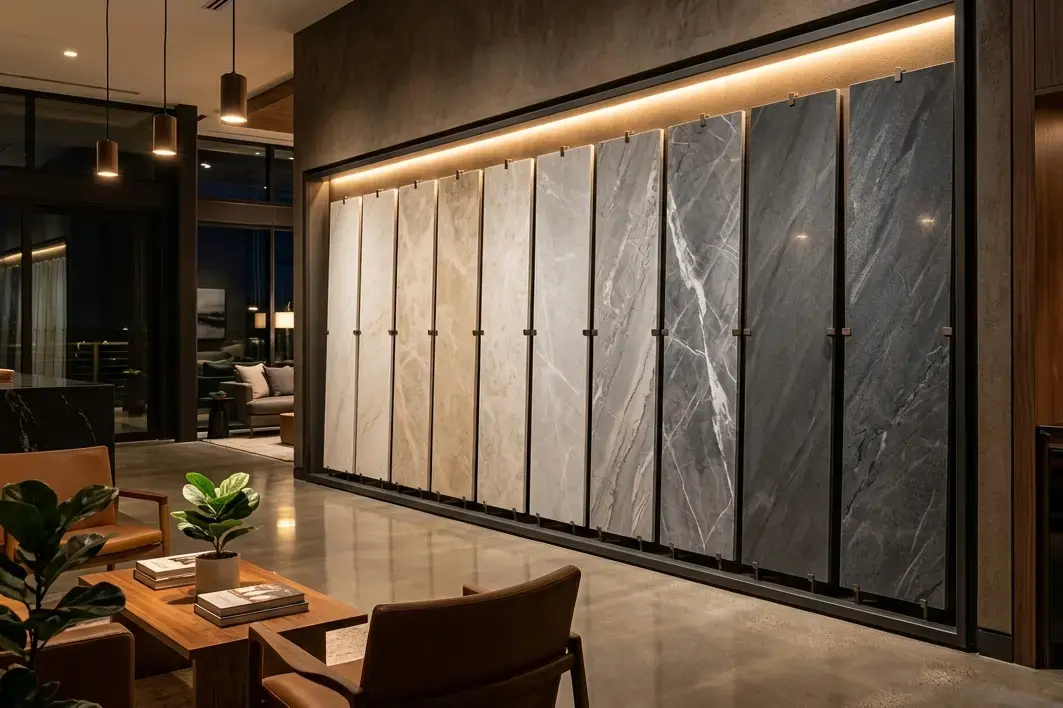
Deep charcoal, forest green, and blue-grey quartzite slabs carry veining in lighter quartz mineral threads, creating a high-contrast, statement effect. These work well as feature walls in bathrooms, back-bar displays, and fireplace surrounds. Polished finishes in darker tones amplify the stone's depth, though matte finishes are recommended for floor applications where slip resistance matters.
Finish Comparison: Quartzite Slab Options at a Glance
Finish | Surface Feel | Best Application | Slip Resistance |
Polished | Smooth, reflective | Walls, countertops | Lower when wet |
Honed | Matte, flat | Floors, bathrooms | Moderate |
Leathered | Textured, tactile | Bars, countertops, outdoor | Higher |
Specialty | Varies | Feature walls, custom design | Varies |
Pros and Cons: Quartzite Slabs for Design Projects
Pros
- One of the hardest natural stone slab materials available
- UV-stable for shaded outdoor and covered applications
- Suitable for floors, walls, countertops, and fireplaces
- Broad finish availability across polished, honed, leathered, and specialty
- Highly individual veining produces unique slab-to-slab variation
Cons
- Requires sealing; frequency depends on use and porosity
- Polished finish becomes slippery when wet; matte finishes recommended for floors
- Heat-resistant, but not thermal-shock proof; trivets required near cooking areas
- Natural variation means exact replication across multiple slabs is not guaranteed
- Hardness varies between quartzite sources; ask about specific material ratings
How to Select a Quartzite Slab: 4-Step Mini-Guide
Step 1: Define the application. Confirm whether the slab is for a floor, wall, countertop, fireplace, or outdoor surface. Quartzite suits all of these, but finish selection changes based on location and expected foot or hand traffic.
Step 2: Choose a tone direction. Start broadly: light, mid, or dark. Then review full slabs, not samples, to see how veining moves across the entire face. Veining flow matters at countertop and wall scale in ways that small samples do not reveal.
Step 3: Match the finish to the use case. Wet areas and floors call for honed or leathered finishes. Walls, back-bars, and feature applications tolerate polished finishes well. Specialty finishes suit custom or architectural projects.
Step 4: Confirm sealing and maintenance requirements. Natural quartzite requires sealing before use. Surface innovation research continues to advance sealant technology; a knowledgeable supplier can recommend the appropriate product for the finish and application type.
How Nova Tile and Stone Supports Quartzite Slab Projects
Selecting a quartzite slab is a full-slab decision, not a sample-based one. Nova Tile and Stone carries an extensive range of quartzite slabs across tone groups, veining styles, and all available finishes, with expert guidance available at every location. The full slab collection is updated regularly to reflect current availability.
Free shipping is available on qualifying orders, making it practical to source materials across a wider project radius. Local showroom teams at Reno, Minden, Sacramento, and Fernley can walk through slab options in person, where tone and veining read correctly under real lighting conditions. Viewing full slabs alongside cabinetry samples or finish boards gives the clearest picture before a final selection.
The team's design knowledge extends across kitchens, bathrooms, bars, and outdoor applications. For projects with specific veining or tone requirements, early consultation helps identify the right slabs before inventory shifts.
 Conceptual rendering
Conclusion
Quartzite natural stone slabs combine visual character with genuine surface performance. Across kitchens, bathrooms, outdoor spaces, and bars, quartzite holds its place as one of the most capable and distinctive slab materials available. Proper sealing and care preserve appearance over the long term, keeping the stone's natural beauty intact through years of regular use.
To explore current quartzite slab availability, tone groups, and finish options, visit Nova Tile and Stone. The design and supply team is ready to help match the right slab to the right project.
Frequently Asked Questions
Is quartzite suitable for kitchen countertops?
Yes. Quartzite slabs are suitable for kitchen countertops and are rated for indoor floor and wall applications. The surface is harder than marble and resists scratching well, though cutting boards are required to preserve finish quality. Sealing is necessary for food-contact surfaces, and spills should be cleaned promptly to prevent staining.
What finishes are available for quartzite slabs?
Quartzite slabs are available in polished, honed, leathered, and specialty finishes. Polished finishes reflect light and highlight veining but can be slippery when wet. Honed and leathered finishes offer more traction and suit floors and wet areas better. Specialty finishes vary by slab and are well suited to feature walls and custom applications.
Can quartzite slabs be used outdoors?
Yes. Quartzite is UV-stable and rated for outdoor applications, including floors, walls, and fireplaces. It performs well in covered outdoor kitchens and bar areas. Heat resistance does not equal thermal-shock protection; trivets are required near heat sources regardless of location.
How does quartzite compare to marble as a slab material?
Quartzite is harder than marble and more resistant to etching from acidic substances, making it better suited to high-use surfaces like kitchen countertops and bar tops. Both materials require sealing. Marble offers softer, more uniform veining in many cases, while quartzite tends toward bolder, more directional veining patterns. Neither is maintenance-free.
What tone ranges are available in quartzite slabs?
Quartzite slabs span a wide tone range from bright white and ivory through warm beige, soft gold, and greige to deep charcoal, slate blue, and green-grey. Veining contrast and pattern style vary significantly across this range. Reviewing full slabs rather than small samples gives the most accurate representation of how the stone will read at scale in a finished space.