Selecting the right countertop slab is one of the most consequential decisions in a prefab kitchen project. Because the cabinetry, layout, and hardware arrive as a predetermined package, the stone or engineered surface placed on top of it carries the bulk of the space's visual and functional character. The primary slab options suited to prefab kitchen settings are granite, quartzite, marble, quartz, and sintered stone, each with distinct hardness levels, maintenance needs, surface finishes, and aesthetic qualities that respond differently to fixed cabinetry configurations.
Granite is known for strong durability and a wide color range, making it one of the more adaptable natural stone options for standardized kitchen layouts. Quartzite tends to offer marble-like veining with generally greater resistance to scratching and etching. Marble is favored for its timeless visual character, though it requires more attentive care than harder stone varieties. Engineered quartz provides consistent patterning and a non-porous surface that does not require periodic sealing. Sintered stone, produced through extreme heat and pressure, is valued for its large-format availability and strong resistance to heat and moisture under normal kitchen conditions. Understanding how each of these materials performs, and how it interacts with prefab kitchen components, is the starting point for a surface selection that holds up both practically and visually over time.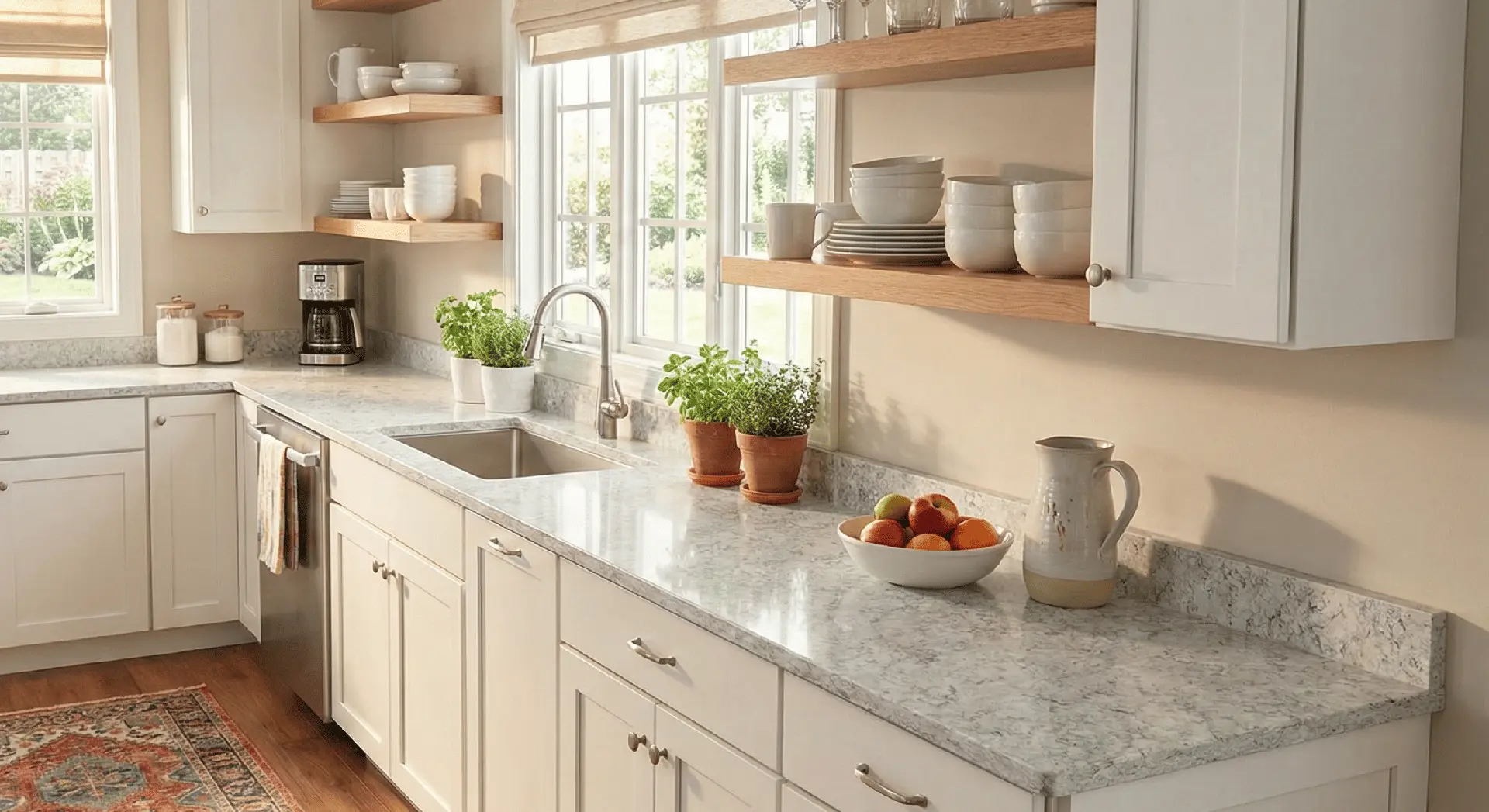
Why Slab Selection Carries More Weight in Prefab Kitchens
When cabinetry, layout, and hardware come as a package, the countertop slab becomes the primary surface where individual design expression lives. It occupies the most visually prominent horizontal plane in the kitchen and directly influences how the space reads in terms of warmth, scale, and sophistication.
Prefabricated countertop slabs in natural stone bring ready-to-install character and durability to kitchen islands and work surfaces, combining practical convenience with materials that have proven themselves in residential interiors over generations. Each material category, from natural granite to engineered sintered stone, brings a distinct personality to that surface. The challenge is matching that personality to the visual language of a kitchen that was not entirely custom-built.
The most successful prefab kitchens treat the slab as the anchor point from which all other decorative decisions respond. Backsplash color, hardware finish, and even lighting temperature can be selected in dialogue with what is already happening in the stone itself. Browsing the full slab inventory early in the planning process gives a clearer sense of what tonal and material options are actually available before any othwhat is already happening in the stone itself. Browsing the full slab inventory early in the planning process gives a clearer senseer decisions are locked in.
Granite: A Reliable Option With Genuine Character
Granite has earned a strong reputation in residential kitchens through consistent, long-term performance. It spans a wide color range, from deep charcoals and warm golds to soft creams and speckled blues, making it adaptable across many cabinetry configurations. That breadth is particularly useful in prefab settings, where cabinet finishes are fixed and the slab must either complement or contrast them with intention.
Granite is known for strong hardness and relatively low maintenance demands, which suits active households where the kitchen sees regular daily use. Its density means it is generally resistant to scratching and handles heat exposure well, though using trivets and cutting boards is still recommended to protect both the surface and its sealant over time. According to This Old House, granite is among the most heat-resistant natural stones available for kitchen surfaces, though protective measures are still advisable for long-term sealant care.
The stone does benefit from periodic resealing, but that routine is straightforward and helps the material maintain its performance characteristics for many years. For prefab kitchens featuring white or off-white shaker cabinetry, a granite slab in a deeper tone can bring contrast and visual weight that prevents the space from reading as flat or one-dimensional.
Quartzite: Natural Stone With Strong Hardness
Quartzite forms through a geological process in which sandstone is subjected to sustained heat and pressure over time, producing a dense, crystalline structure. That origin gives it a physical hardness that places it among the more durable natural stone options available for kitchen surfaces.
Many homeowners are drawn to quartzite because it can deliver veining and tonal movement that resembles marble, while generally offering greater resistance to scratching and etching under kitchen conditions. It is not entirely maintenance-free, and spills should still be wiped promptly, but it tends to be more forgiving in active cooking environments than softer stone varieties. Bob Vila's comparison of quartz vs. quartzite outlines the key structural and performance differences between these two frequently confused materials, which is worth reviewing before making a final selection.
In prefab kitchens where the cabinetry investment has already been made, selecting a surface that is known to hold up well over time is a sound approach. Viewing options in person at a local showroom before finalizing any prefab kitchen project is worthwhile, as the tonal range within quartzite can vary considerably from slab to slab.
Marble: A Classic Choice for the Right Setting
Few materials carry the visual presence of marble. Its characteristic veining has defined refined interiors across many design eras, and its presence on a kitchen countertop communicates a level of care and intention that is difficult to replicate with manufactured surfaces. Marble forms when limestone undergoes metamorphic change over time, and that process produces the distinctive movement and pattern the material is known for.
Marble is often favored by homeowners who appreciate a naturally cool surface, and it suits prefab kitchens with clean-lined modern cabinetry particularly well. A slab in classic white with soft gray veining can create a composition that feels considered and deliberate rather than assembled from a standard package.
The trade-off is that marble requires more attentive care than granite or quartzite. It is a softer stone that is more susceptible to etching from acidic substances, so regular sealing and prompt spill cleanup are important. Over time, marble can develop a patina that many homeowners appreciate as part of the material's natural character. A natural stone kitchen countertop in marble can work well alongside warmer wood-tone cabinetry, where the stone's cooler tones help balance the overall visual temperature of the space. For guidance on ongoing care, the Natural Stone Institute offers practical maintenance recommendations across all stone types.
Quartz: Engineered Consistency for Busy Kitchens
Engineered quartz is produced by combining ground quartz crystals with resin binders, resulting in a surface that offers consistent patterning and a non-porous composition. Because the surface does not absorb moisture in the way natural stone can, it is generally resistant to staining and does not require periodic sealing, which simplifies the day-to-day maintenance routine considerably.
Quartz tends to provide a more uniform visual appearance compared to natural stone, which suits homeowners who value consistency across a large kitchen island surface. For those who want the sense of natural variation and geological character that comes with stone pulled directly from the earth, natural options may feel more distinctive. Both approaches are valid, and the right choice depends on how the kitchen is used and what the homeowner values most in a surface.
Quartz pairs well with the gray and greige cabinetry that is common in contemporary prefab kitchen offerings, where its clean patterning can echo the precision of the surrounding components without competing for visual attention. Homeowners weighing their options can submit a slab quote request to get a clearer picture of what is currently available across both natural and engineered surface categories.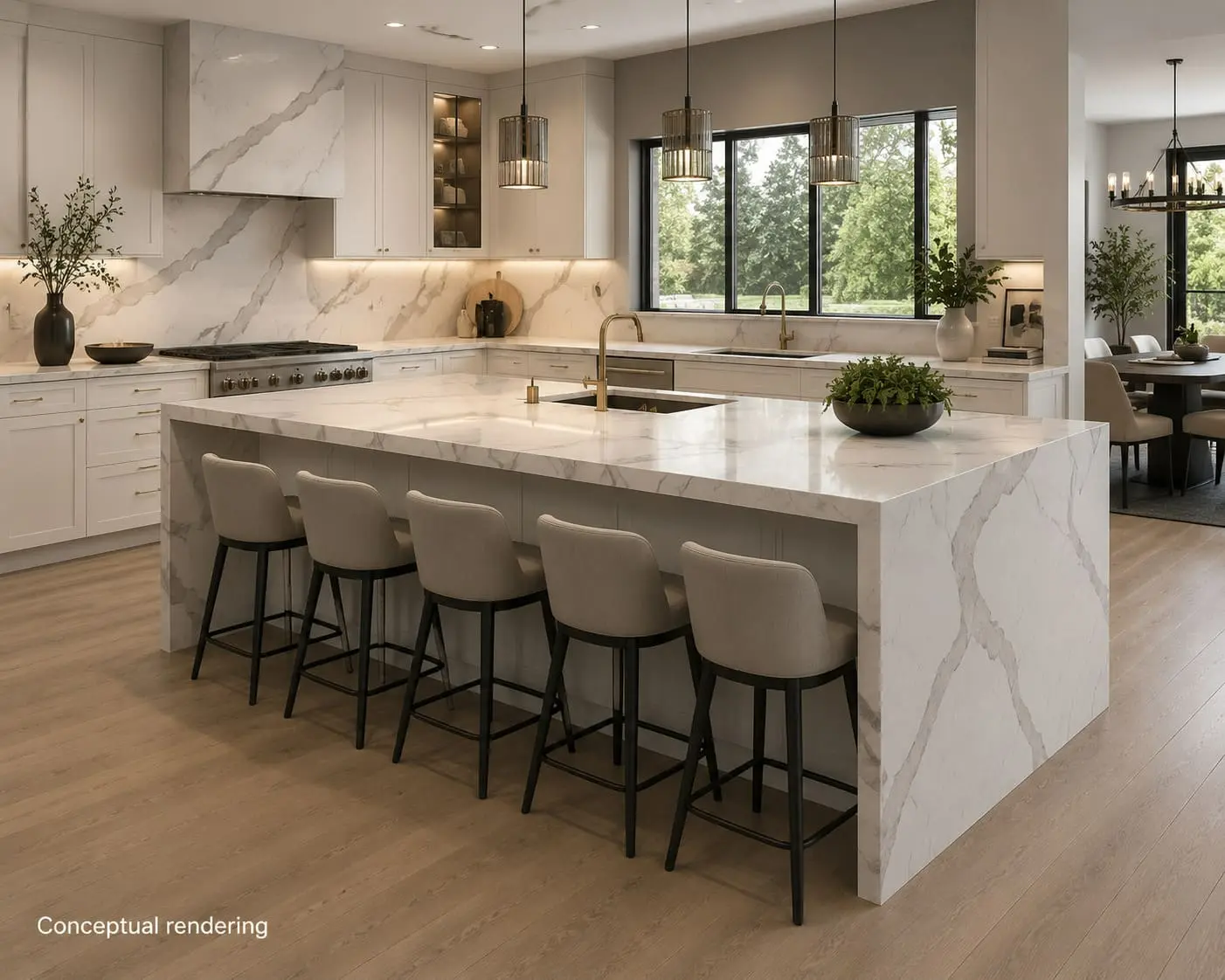
Sintered Stone: A High-Performance Engineered Surface
Sintered stone is manufactured by subjecting raw mineral materials to very high heat and pressure, producing a dense, non-porous surface. This process creates a material that is known for strong resistance to heat, moisture, and everyday surface wear, and it is available in large-format slabs that can cover expansive surfaces with minimal seaming.
One of its practical advantages in kitchen settings is the ability to span wide island surfaces with a slim profile, which lends a clean, architectural quality that suits modern and minimalist interiors. The material can also perform well in zones adjacent to cooktops, where thermal exposure is more frequent, though following fabricator and manufacturer guidance on care and use is always recommended.
Engineered stone slabs, including sintered stone, represent a growing category for homeowners who want surfaces that combine design versatility with practical durability. Checking the current overstock sale can also surface strong options across engineered and natural stone categories at accessible price points.
Matching the Slab to Fixed Kitchen Elements
The cabinetry color, hardware finish, and flooring in a prefab kitchen are not variables. They arrive as decisions already made, which means the slab selection must respond to them thoughtfully. According to Fine Homebuilding, viewing stone slabs in person under varied lighting conditions is one of the most reliable ways to assess how a material will read in an actual kitchen environment, since photographs and small samples rarely capture the full tonal depth of a slab.
A warm-toned slab in honey-veined marble or golden granite can soften gray cabinetry and prevent the space from reading as cold or clinical. A cooler white quartzite or pale engineered quartz can brighten dark wood-toned cabinets and help reflect light into areas that might otherwise feel enclosed.
Viewing full slabs in person is generally the most reliable way to compare materials, and appointments are available at showroom locations in Reno, Minden, Sacramento, and Fernley. Nova Tile and Stone offers free consultations to help homeowners work through material pairings and surface selections before committing to a final direction.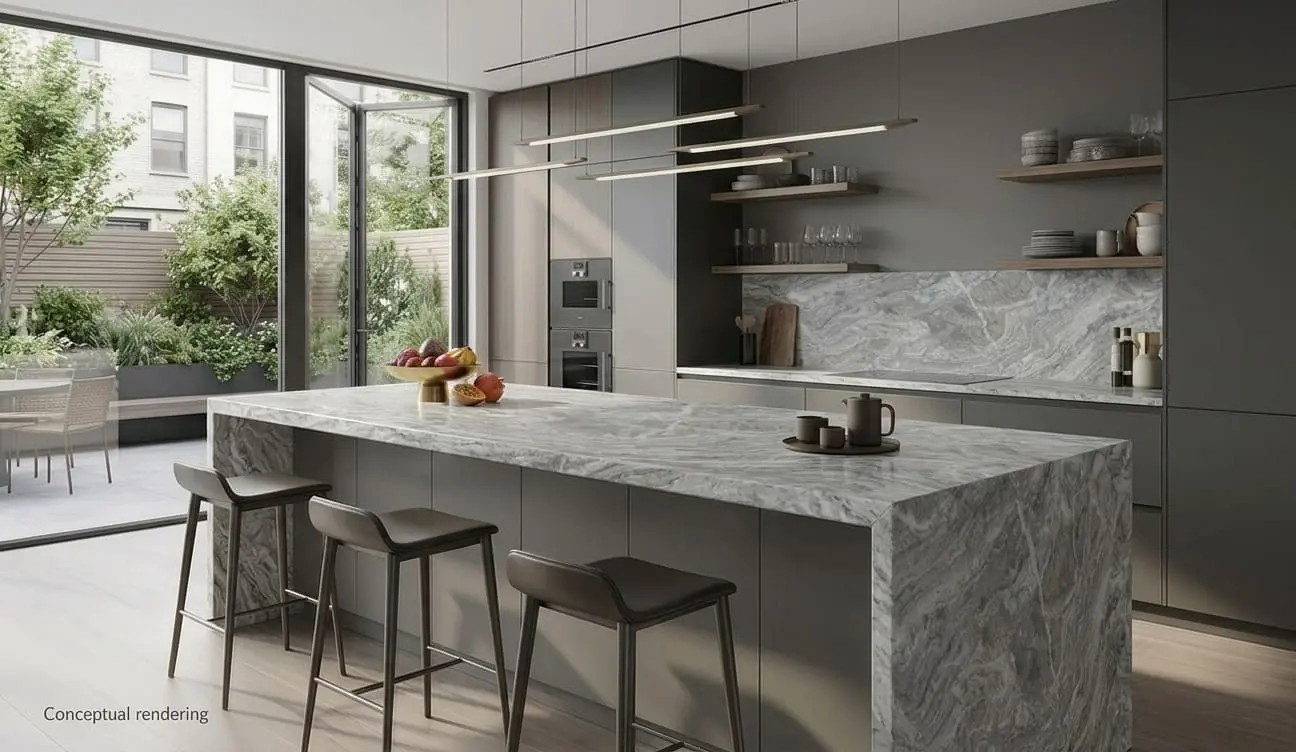
Finish Options and Why They Matter
Prefabricated countertop slabs are available in several surface finishes, each of which shapes how the stone reads visually and feels underhand. A polished finish produces a smooth, reflective surface that can amplify brightness in kitchens with limited natural light. A honed finish delivers a matte, flat surface that reads softer and more organic, particularly alongside natural wood cabinetry. A leathered finish introduces a subtle texture that adds tactile depth and can enhance the stone's natural color. For a closer look at how these finishes differ in character and application, this guide to selecting the ideal stone finish breaks down the practical and aesthetic distinctions across each option.
Honed and leathered finishes have grown in residential kitchen preference as homeowners move toward more understated, organic aesthetics. In prefab kitchens where cabinetry often has a smooth factory finish, a leathered or honed slab can introduce textural contrast that adds visual richness to the overall composition without requiring any changes to the surrounding fixed elements.
The prefabricated countertop category now spans a wide enough range of materials, finishes, and tonal options that finding a slab suited to almost any prefab kitchen configuration is a realistic and achievable outcome.
Conclusion
A prefab kitchen provides an efficient, well-engineered foundation, but the slab chosen to surface it plays a significant role in determining whether that foundation becomes a space with genuine character and presence. Granite, quartzite, marble, quartz, and sintered stone each approach the practical demands of a kitchen differently, and each brings a distinct visual identity to the surfaces it occupies. Taking time to understand those differences, and to view full slabs in person under real lighting conditions, is one of the most effective steps toward a result that feels intentional rather than simply installed.
Frequently Asked Questions
Quartzite and granite are both known for strong hardness and durability in kitchen environments. Quartzite tends to offer marble-like veining with generally greater resistance to scratching and etching, while granite covers a wide color range and requires relatively straightforward maintenance when properly sealed.
Quartzite is a natural metamorphic rock formed when sandstone undergoes heat and geological pressure over time. Engineered quartz is a manufactured product composed of ground quartz crystals combined with resin binders. Both can perform well in kitchen settings, but they differ in appearance, maintenance needs, and the degree of natural variation in the surface.
Marble can work well in kitchen settings when it is properly sealed and maintained. It is a softer stone compared to granite or quartzite and is more reactive to acidic substances, so spills should be addressed promptly. Many homeowners appreciate the patina it develops over time as part of its natural character.
A leathered finish is a surface treatment applied to natural stone that produces a matte, slightly textured feel rather than the smooth reflectivity of a polished surface. It can enhance the depth of the stone's natural color and adds tactile interest, making it a popular choice for homeowners who prefer a more organic, understated aesthetic.
Sintered stone is produced by applying extreme heat and pressure to raw mineral materials, creating a dense, non-porous surface. Unlike some engineered options, it contains no resin binders, which contributes to its strong resistance to heat and surface wear. It is available in large-format slabs and can suit applications where wider, seamless surfaces are a design priority.