Onyx countertops are a luxury natural stone surface prized for their translucency, dramatic veining, and one-of-a-kind appearance. Formed over centuries through mineral-rich spring water evaporation, no two slabs are identical, making every installation inherently exclusive.
Unlike granite or marble, onyx can be backlit with LED panels, creating a glowing effect that makes it a popular choice for kitchen islands, bathroom vanities, and feature walls. However, it rates between 3 and 4 on the Mohs hardness scale, making it softer and more maintenance-intensive than most countertop materials.
This guide covers everything you need to know about onyx countertops, from how they're formed and where to install them, to care requirements, backlighting, and whether they're the right fit for your home. If you’d like to see how these stones look in real applications and compare different patterns and colors, you can also explore our collection of natural stone slabs.
What Makes Onyx So Special?
The story of onyx starts with water. Unlike granite, which forms deep underground through intense heat and pressure, onyx forms at the earth's surface. Calcite-rich water rises from springs and, as it evaporates, deposits mineral layer upon mineral layer. This process, documented in geological research, unfolds over centuries and produces something truly rare: sweeping parallel bands and swirling patterns that make every single slab one of a kind. It's this crystalline structure that gives onyx its most defining quality: translucency.
Light doesn't simply bounce off the surface, it penetrates, illuminates veins from within, and creates a visual depth no synthetic material can come close to replicating. And the color range? Far broader than most people expect. Warm honey tones, soft blush pinks, vibrant greens, deep reds. Every slab is a geological fingerprint, one that cannot be duplicated. To fully appreciate the uniqueness of onyx and its variety of colors, check the guide on stone countertops.
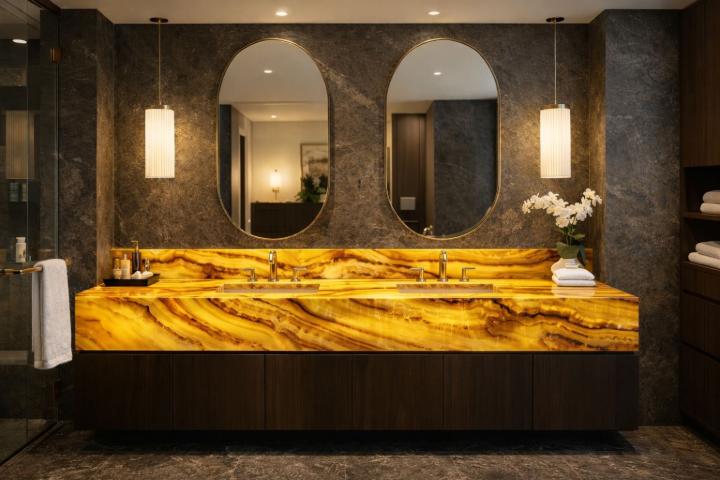
The Advantages of Onyx Countertops
Be straightforward about this: nobody chooses onyx for practicality. The decision is aesthetic, emotional, artistic. Once you accept that, the benefits become crystal clear.
Beauty that never repeats. That slab you spot in the showroom? It won't exist in any other home on the planet. Every onyx installation is inherently unique. For anyone who places value on exclusivity in design, this single fact justifies the choice.
The magic of backlighting. This is the feature that truly separates onyx from every other natural stone on the market. Its translucency allows LED panels to be installed behind the slab, and the effect is something that has to be seen in person to be fully appreciated.
If you're interested in exploring local options for onyx countertops, you can shop for onyx slabs for countertops locally, and to better understand the environmental and health impacts of natural stone, check out the guide to environmental and health labels for natural stone products.
The Honest Downsides You Need to Know
Covering only the magic wouldn't serve you well. Onyx has real limitations, and knowing them upfront prevents costly surprises down the road.
It's a delicate stone. On the Mohs hardness scale, onyx rates between 3 and 4, compare that to granite's 6 to 7. In practical terms: knives can scratch it, heavy pots can chip it, and abrasive cleaners will dull the surface. This is not a stone for careless handling.
Porosity demands your attention. Like many natural stones, onyx absorbs liquids. Leave a wine or lemon juice spill sitting for too long and you risk a permanent stain. Acidic substances can etch the surface, leaving marks that are difficult to reverse. Quick cleanup isn't optional here, it's essential.
For many homeowners, these trade-offs are completely worth it. But they need to be trade-offs you consciously accept going in, not surprises you discover after installation.
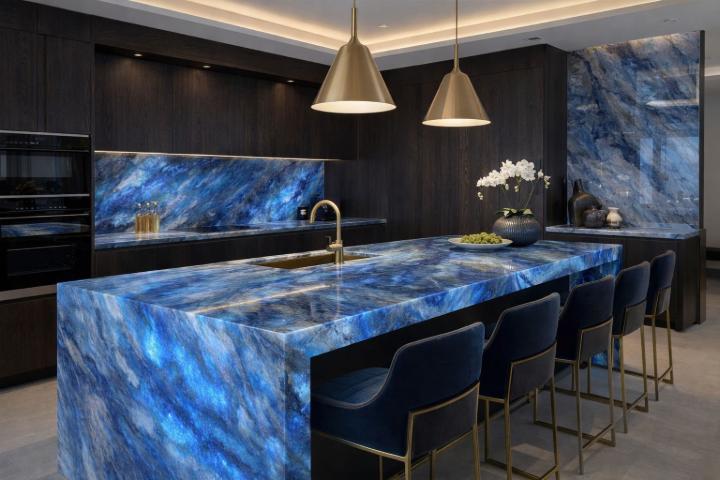
How Backlighting Actually Works
That glow you see in high-end design photos isn't accidental, it's the result of engineering meeting artistry.
The process involves placing custom-fit LED light panels directly behind the onyx slab. These panels must be positioned with precision to deliver even illumination, eliminating hotspots and dark zones. Slab thickness, the opacity of specific sections, and desired light intensity all factor into the final design.
This is not a DIY project. Hire professional fabricators who understand onyx's unique properties, they're essential to achieving a flawless result.
Where does backlighting deliver its biggest impact? Think kitchen islands that anchor the room, bar tops that set the mood for entertaining, bathroom vanities that channel a spa atmosphere, and wall features that turn blank surfaces into dramatic focal points.
For designers and contractors looking to take their projects to the next level with premium materials and expert support, apply for a trade account to connect with specialists who can help bring your vision to life.
Where Onyx Belongs in Your Home
Not every space suits onyx equally. Place it strategically to protect your investment and maximize its visual impact.
- Statement kitchen islands: A full onyx countertop in a high-traffic kitchen demands constant vigilance. But as a dedicated island, used more as a showpiece than a prep station, it can thrive. Use it for serving, for display, or for those moments when guests gather around and simply stare. For more details on selecting the perfect stone for kitchen islands, explore the guide to natural stone countertops for kitchens.
- Bathroom vanities and walls: This may be onyx's ideal setting. Lower traffic means reduced risk of scratches and impact damage. An onyx vanity or shower wall transforms a functional bathroom into a genuine luxury retreat, and every morning begins with something beautiful.
- Backsplashes and feature walls: Arguably the safest application, and often the most dramatic. As a vertical surface, onyx faces no cutting boards, no hot pans, no daily wear. It simply exists as art, protected, pristine, catching light, and drawing every eye in the room.
Caring for Your Onyx Countertop
Maintenance isn't complicated, but it is non-negotiable. Build a simple routine and your investment stays protected for decades.
Daily cleaning calls for nothing more than a soft cloth and a pH-neutral cleaner formulated for natural stone. Skip the abrasive sponges. Avoid harsh chemicals. Gentle, consistent care preserves the surface finish.
Respond to spills immediately. Wine, citrus, tomato sauce, anything acidic, needs to be wiped up the moment it lands. Don't give it time to penetrate the stone or etch the surface.
Professional sealing creates an invisible barrier against moisture and staining. Seal the countertop at installation, then reseal every 6 to 12 months. This one step prevents the majority of potential damage.
Develop protective habits. Always use a cutting board for food prep. Set hot pans on trivets. Place coasters under glasses. Small, consistent actions go a long way toward preserving the beauty of this material.
For deeper guidance on stone care, explore the maintenance principles that apply across all natural stone surfaces.
Is Onyx the Right Choice for Your Home?
There's no single answer, it depends entirely on what you value most.
If durability and low maintenance top your list, granite or quartzite will serve you better. If you love the aesthetic of marble but want more resilience, quartzite is an excellent alternative worth exploring.
But if you treat your home as a canvas for personal expression? If you want a surface that sparks conversation and inspires genuine awe? If you're prepared to invest the care a piece of natural art requires? Then onyx may be exactly what you've been looking for, and the trade-offs won't feel like trade-offs at all.
Onyx countertops do require more maintenance than most surfaces, carry a higher price tag than practical alternatives, and demand thoughtful placement. But for the right homeowner, what matters most is starting each day surrounded by beauty that exists nowhere else, owning a piece of geological history that stops visitors in their tracks.
That's not a countertop. That's a legacy.
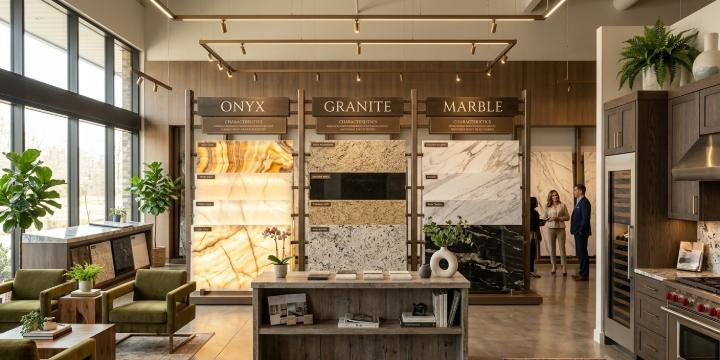
Go see it in person before you decide. Photos capture beauty, but they can't convey the way light dances through a crystalline structure, the depth that reveals itself at different angles, the almost living quality of a backlit slab. Some things genuinely need to be seen to be believed.
Ready to explore onyx for yourself? Request a slab quote or book an appointment with our experts to find the perfect slab for your home.
Conclusion
Onyx countertops represent one of the most striking choices you can make for your home. From the way light moves through its translucent surface to the one-of-a-kind veining that no two slabs share, onyx delivers a visual experience that simply cannot be replicated, not by marble, not by granite, and certainly not by engineered stone.
Yes, it asks more of you than most materials. It requires sealing, careful cleaning, and thoughtful placement. But for homeowners who see their living spaces as an extension of their personal style, that investment is a small price to pay for a surface that doubles as a genuine work of art.
Whether you're designing a statement kitchen island, a spa-worthy bathroom vanity, or a backlit feature wall that stops every guest in their tracks, onyx rises to the moment. The key is going in informed, understanding both its brilliance and its boundaries, so you can enjoy it for years to come.
If onyx has caught your attention, the next step is simple: see it in person. Visit Nova Tile and Stone, your trusted tile and stone company and let the slab speak for itself.
Frequently Asked Questions
How durable are onyx countertops compared to other natural stones?
Onyx is softer than most countertop materials, rating between 3 and 4 on the Mohs hardness scale. Granite, by comparison, sits at 6 to 7. This means onyx is more vulnerable to scratches, chips, and surface etching from everyday use. It performs best in lower-traffic areas such as bathroom vanities, backsplashes, and decorative islands rather than primary kitchen prep surfaces.
Can onyx countertops be backlit, and how does that process work?
Yes, and backlighting is one of the most compelling reasons to choose onyx. Because the stone is naturally translucent, custom LED panels can be installed directly behind the slab to illuminate it from within. The result is a glowing, dramatic effect that highlights the stone's veining and color depth. This is best handled by professional fabricators who can ensure even light distribution without hotspots or dark zones.
How do I properly clean and maintain an onyx countertop?
Daily cleaning should involve only a soft cloth and a pH-neutral cleaner specifically formulated for natural stone. Avoid abrasive scrubbers, vinegar, bleach, or any acidic cleaners, as these can etch and dull the surface. Spills, especially wine, citrus juice, or tomato-based products, should be wiped up immediately to prevent staining or etching. Routine professional sealing every 6 to 12 months is also essential for long-term protection.
Does onyx need to be sealed, and how often?
Yes, sealing is non-negotiable for onyx. Because it is a porous stone, an unsealed surface will readily absorb liquids and stain over time. Have the countertop professionally sealed at installation, then plan to reseal it every 6 to 12 months depending on usage and exposure. Regular sealing creates a protective barrier that significantly reduces the risk of moisture damage and staining.
Where is the best place to install onyx countertops in a home?
Onyx performs best in areas with lower foot traffic and minimal daily wear. Bathroom vanities, shower walls, backsplashes, and feature walls are ideal placements where the stone can be appreciated without being subjected to heavy use. Kitchen islands used primarily for display or serving, rather than active food prep, are also a strong choice. High-traffic cooking surfaces are generally not recommended unless the homeowner is fully committed to a strict maintenance routine.