Nero Marquina is a natural black marble quarried in the Basque Country region of northern Spain, near the town of Markina-Xemein. It is classified as a metamorphic limestone formed under intense geological heat and pressure, and is defined by a deep, near-jet black base and bold white calcite veining that varies in width and density from slab to slab. Nero Marquina is available in polished, honed, and tumbled finishes and is used for kitchen countertops, bathroom vanities, backsplashes, fireplace surrounds, and accent walls. Like all marble, it is susceptible to etching from acidic substances and requires annual sealing. It is not recommended for outdoor use.
The stone differs from graphite marble, which has a dark gray rather than true black base, and from black granite, which is harder, non-reactive to acids, and requires no sealing. At Nova Tile and Stone, we are a direct stone importer with slab inventory across our showrooms in Northern Nevada and Northern California, and this guide covers the stone's origin, finish options, design applications, cabinet pairings, and care requirements.
Where Nero Marquina Comes From
Nero Marquina has been quarried in the Basque Country of northern Spain for centuries. The region sits along the Bay of Biscay and is home to a dense concentration of metamorphic limestone deposits that produce the intense black base the stone is known for. The black coloration comes from organic carbon compounds locked within the limestone during its formation, and the white veining is the result of calcite minerals that migrated through fractures in the rock under pressure.
The name "Nero Marquina" translates roughly from Italian and Spanish to "Black from Markina," and the stone has been used in high-end architecture and interior design across Europe for generations. Its deep black base and crisp white veining make it one of the most recognizable black marbles available for residential and commercial design.

What Nero Marquina Looks Like
The defining characteristic of Nero Marquina is its high-contrast appearance: a true, deep black background intersected by white veining that varies in width, density, and movement from slab to slab. Some slabs feature tight, fine veining that reads as subtle against the dark background. Others carry wide, dramatic veins that cut across the full face of the stone in bold, irregular paths. Both expressions are authentic Nero Marquina, and the variation is part of what makes viewing full slabs in person an important step in the project process.
The black base is consistent in tone but not perfectly uniform. Under direct light, some slabs reveal faint gray undertones that add dimension to the surface, and the white veining is typically bright and well-defined against the dark background.
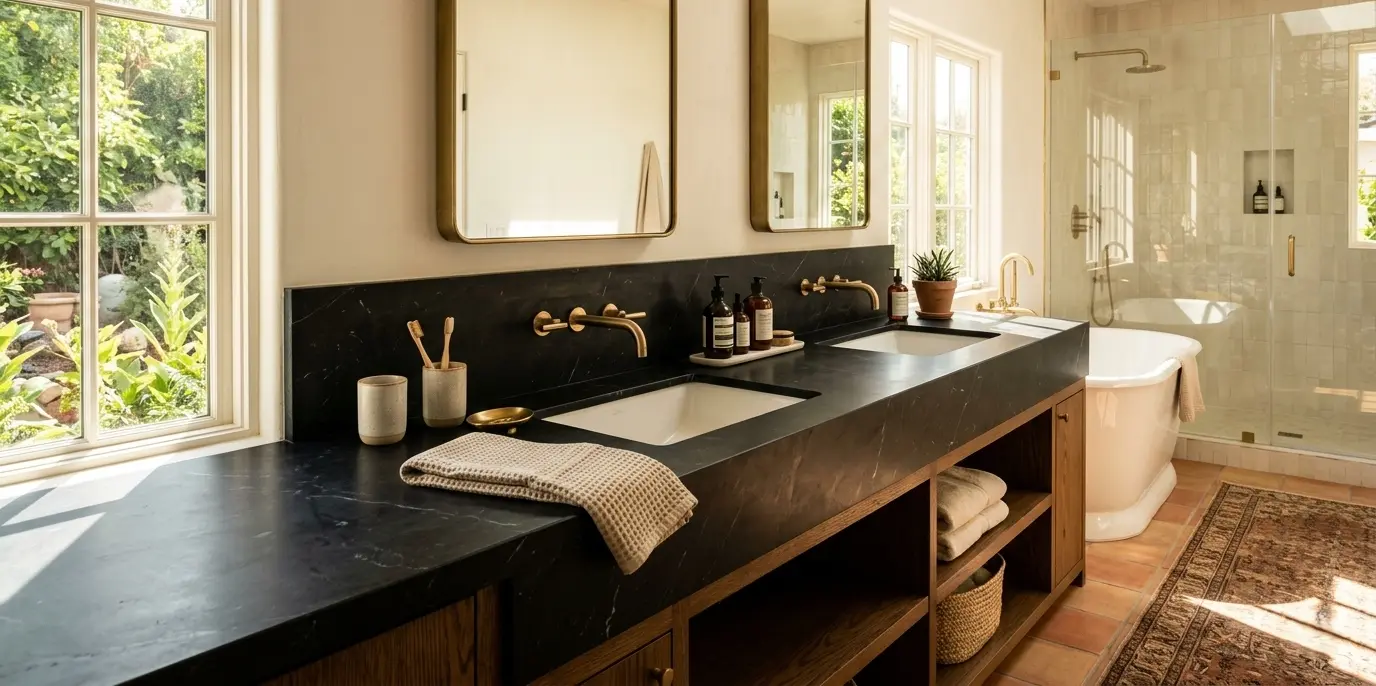
This stone is available in polished, honed, and tumbled finishes. A polished finish produces a high-gloss, reflective surface that amplifies the contrast between the black base and white veins and makes the stone read as sleek and contemporary. A honed finish removes the gloss, leaving a smooth, matte surface with a softer visual presence. Honed Nero Marquina reads as slightly lighter than polished, and some homeowners and designers prefer it for applications where a less formal aesthetic is the goal. A tumbled finish softens the edges and surface texture of the stone, giving it an aged, artisan character that suits more traditional or rustic interiors.
Where to Use Nero Marquina in the Home
Kitchen Countertops
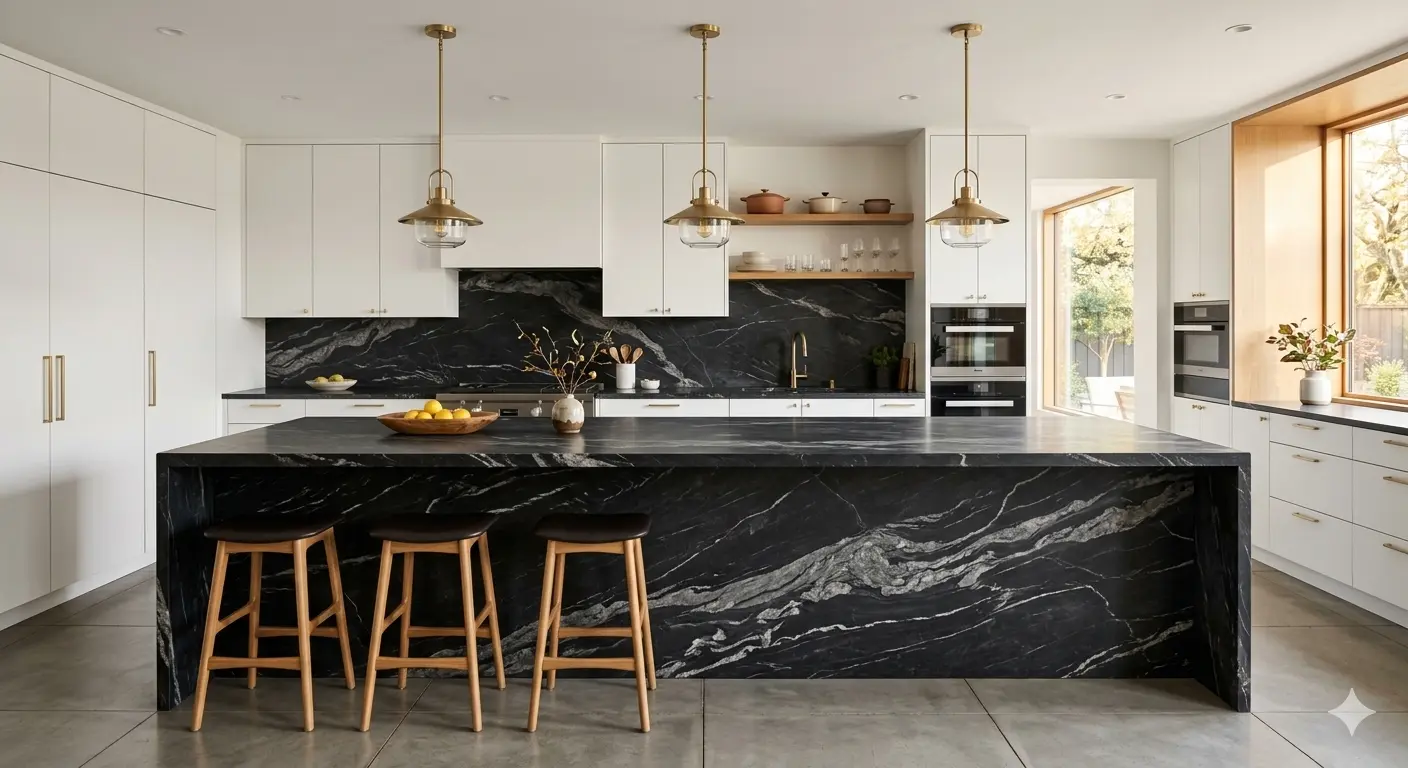
Nero Marquina countertops are best suited for kitchens where the stone can serve as a deliberate design statement. Paired with white or light gray cabinetry, the contrast is immediate and striking. Paired with dark cabinetry in navy, charcoal, or black, the stone creates a tone-on-tone effect that reads as layered and moody rather than high-contrast. For kitchen islands, Nero Marquina in a full slab format creates a natural focal point that anchors the room.
One practical consideration for kitchen use: because the surface is dark, water spots and mineral deposits from hard water can show on a polished Nero Marquina countertop more readily than they would on lighter stone. Regular wiping and the use of pH-neutral stone cleaners help maintain the surface's appearance. A honed finish tends to be more forgiving in this regard. For a broader look at how different stone surfaces perform in the kitchen, This Old House offers a useful overview of natural stone countertop options.
Bathroom Vanities
Nero Marquina performs well in bathroom vanity applications, where its visual weight and contrast work with the scale of the space. A full vanity top in Nero Marquina against white plumbing fixtures creates a grounded, refined look. In master bathrooms with lighter tile or flooring, the stone adds drama without overwhelming the room. Because bathroom countertops see less acid exposure than kitchen surfaces, Nero Marquina is often a practical choice here even for homeowners who want to avoid aggressive maintenance.
Backsplashes
A Nero Marquina slab backsplash installed from countertop to upper cabinet creates a strong, graphic backdrop in the kitchen. The continuity of a full slab backsplash in this stone eliminates grout lines and allows the natural veining to run uninterrupted. For a slightly softer approach, Nero Marquina in a tile format works well in standard backsplash heights and gives the kitchen the visual impact of black marble without committing to a full slab wall.
Fireplace Surrounds
The heat resistance of natural stone makes Nero Marquina a practical and visually appropriate choice for fireplace surrounds. The stone's dark background frames the firebox naturally, and the contrast between the black stone and the warm tones of a fire is a combination that designers have used for decades in formal living rooms and transitional spaces alike.
Accent Walls and Feature Applications
Full slab Nero Marquina accent walls in bathrooms, foyers, or dining rooms create strong visual impact. The scale of a full slab highlights the veining movement across a broad surface, and a polished finish adds depth through reflection. In shower applications, the stone pairs well with brushed metal fixtures for a spa-like aesthetic.
Cabinet Colors That Work With Nero Marquina
White and light gray cabinets create the highest contrast pairing and are the most common choice, working across modern, transitional, and classic kitchen styles. Navy cabinets produce a cooler, more sophisticated contrast that lets the white veining stand out. Natural wood tones in lighter oak and warm walnut soften the palette and introduce warmth that balances the stone's intensity. All-black cabinetry is a less common but intentional choice that produces a deeply layered aesthetic.
The pairing to approach with care is medium warm-toned cabinets in beige or cream, which can compete with the white veining without providing enough contrast for either element to read clearly.
How Nero Marquina Compares to Similar Stones
Nero Marquina vs. Graphite Marble: Graphite marble, also sold as Pietra Grey or Persian Grey, has a deep gray base rather than a true black. It reads as more understated and nuanced than Nero Marquina, with a softer tonal range and veining that tends to be more diffuse. Nero Marquina makes a stronger design statement; graphite marble is more versatile across a wider range of cabinet tones. Both are marble and require similar care.
Nero Marquina vs. Black Granite: Black granite varieties like Absolute Black offer a near-uniform dark surface with minimal veining. They are harder and more resistant to etching than marble. Homeowners who prefer very low maintenance and want a dark countertop without the veining movement of Nero Marquina often choose black granite instead. Nero Marquina offers more visual character but requires more attentive care. Fine Homebuilding's guide to choosing between natural stone materials is a helpful reference when weighing these options.
Nero Marquina vs. Nero Marquina Porcelain: Porcelain tiles and slabs manufactured to replicate the look of Nero Marquina are widely available and offer consistent patterning, zero porosity, and no sealing requirement. They are a practical alternative for high-use kitchen applications where maintenance is a primary concern. The trade-off is that porcelain lacks the depth, natural veining variation, and tactile quality of genuine marble.
Maintenance and Care
Nero Marquina requires the same care as any natural marble. It is porous and benefits from sealing at least once a year, and more frequently in areas that see regular water exposure or heavy use. A quality impregnating stone sealer applied after the surface is clean and dry is the standard approach.
Because marble is calcium-based, it is vulnerable to etching from acidic substances including citrus juice, wine, coffee, and certain cleaning products. Etching produces a dull spot on the surface where the acid has reacted with the calcite in the stone. On a polished Nero Marquina surface, etching can be visible as a contrast against the reflective background. Prompt cleanup of spills and the use of pH-neutral stone cleaners for daily maintenance reduce the risk significantly.
Abrasive scrubbing pads and acidic cleaning products, including vinegar and bleach-based cleaners, should be avoided entirely. For routine cleaning, a soft cloth or microfiber towel with a dedicated stone cleaner is all that is needed. Homeowners working with stone fabricators should also be aware that cutting and shaping natural stone generates silica dust; the CDC and NIOSH provide guidance on silica dust exposure for anyone involved in stone fabrication work.
Conclusion
Nero Marquina marble is one of the most visually commanding natural stones available for residential design. Its deep black background and bold white veining create a contrast that works across kitchen countertops, bathroom vanities, backsplashes, fireplace surrounds, and full slab accent walls, in styles ranging from contemporary minimalist to traditional and transitional. Like all natural marble, it requires periodic sealing and care around acidic substances, but for homeowners and designers who want a surface with genuine visual presence and natural character, it delivers something no engineered alternative can fully replicate.
At Nova Tile and Stone, we are a direct stone importer with slab inventory available for viewing across our showrooms in Reno, Minden, Sacramento, and Fernley. Our commission-free design team can walk you through finish options, help you compare Nero Marquina against similar dark stone varieties in our inventory, and assist with slab selection in person. Schedule a free design consultation at any of our four locations, request a slab quote online, or if you are a designer or builder, apply for a trade account to access our full inventory. We encourage you to view full slabs before making your final decision.
Frequently Asked Questions
What is Nero Marquina marble?
Nero Marquina is a natural marble quarried in the Basque Country region of northern Spain. It is characterized by a deep black background and bold white veining that runs through each slab in varying widths and patterns. The stone is classified as a metamorphic limestone and has been used in high-end residential and commercial design for generations. Like all marble, it requires periodic sealing and careful maintenance around acidic substances.
Is Nero Marquina marble good for kitchen countertops?
Nero Marquina can be used for kitchen countertops, but requires more attentive maintenance than harder stones like granite or quartzite. It is susceptible to etching from acidic spills including citrus juice, wine, and vinegar, which can dull the polished surface over time. Homeowners willing to clean up spills promptly, use pH-neutral cleaners, and reseal annually can use it successfully. For high-use kitchens where low maintenance is the priority, black granite or porcelain may be a more practical fit.
What finish is best for Nero Marquina marble?
Polished Nero Marquina produces a high-gloss surface that maximizes contrast between the black base and white veining. Honed removes the gloss for a smooth matte appearance that is more forgiving of water spotting and fingerprints. Tumbled softens the edges and texture for a more aged, artisan look suited to traditional interiors. Finish selection depends on the aesthetic goals of the space and the level of maintenance the homeowner prefers.
How does Nero Marquina compare to graphite marble?
Nero Marquina has a true deep black base with bright white veining and originates in Spain. Graphite marble, also sold as Pietra Grey or Persian Grey, has a dark gray base with veining that is more diffuse and softer in contrast. Nero Marquina makes a stronger visual statement; graphite marble is more versatile across a wider range of cabinet tones. Both require similar care and sealing.
Does Nero Marquina marble need to be sealed?
Yes. Nero Marquina is a porous natural stone and benefits from sealing at least once a year, and more frequently in wet or high-use areas like kitchen countertops and shower walls. A quality impregnating stone sealer helps slow the absorption of liquids into the stone's pores and reduces the risk of staining. The sealer does not prevent etching, which is a surface reaction rather than a staining process, so prompt cleanup of acidic spills remains important regardless of sealing frequency.