Natural stone slab grades are a quality classification system that ranks slabs by visual consistency, structural soundness, and overall appearance before they reach a distributor or showroom. Most stone is sorted into three tiers: First Choice (Grade A), Standard (Grade B), and Cutter Grade (Grade C), with each tier reflecting differences in color uniformity, veining predictability, surface irregularities, and thickness consistency. Grading is applied at the quarry or processing facility and varies by supplier since there is no universal industry standard. Understanding how grades work helps homeowners and designers evaluate granite, marble, quartzite, and other natural stone slabs with confidence before making a purchase decision.
Why Slab Grading Exists
Natural stone comes directly from the earth. Once quarried in blocks and cut into slabs at a processing facility, each piece is evaluated before it enters the supply chain. The goal of grading is to give buyers a consistent way to communicate quality expectations without inspecting every slab individually, though inspecting slabs in person is always recommended before finalizing a purchase.
Grading also serves a practical purpose for importers, distributors, and retailers. Stone that meets strict visual and structural criteria commands a different price tier and is marketed differently than stone with more pronounced natural variation or visible irregularities. For buyers, knowing a slab's grade helps set realistic expectations before the slab ever reaches a showroom floor.
It is worth noting that grading is not a universal or regulated system. There is no single international standard that all quarries follow. Different countries of origin, different stone types, and different distributors may apply their own grading terminology. What one supplier calls "Grade A" another might label "First Choice" or "Commercial Grade." This is why understanding the criteria behind the label matters more than memorizing the label itself.
The Most Common Grade Categories
While terminology varies, most natural stone is sorted into two or three broad tiers. Here is how those tiers generally break down.
First Choice / Grade A / Commercial Grade
This is the highest tier available from most distributors. Slabs in this category are selected for consistent color, predictable veining patterns, uniform thickness, and minimal surface irregularities. Fissures, which are naturally occurring separations in the stone that do not affect structural integrity, are either absent or very minor. Pitting, which refers to small surface voids common in stones like travertine and some granites, is limited. Thickness is consistent across the slab, which matters during fabrication.
First Choice slabs are what you typically see displayed prominently in a stone showroom. They are well-suited for large countertop projects, matched backsplashes, and book-matched applications where visual continuity across panels is important.
Standard / Grade B / Second Choice
Standard grade slabs have more pronounced natural variation. This may include more dramatic or irregular veining, slight color shifts across the slab, minor surface pitting, or small natural fissures that have been filled and stabilized at the processing facility. Thickness may vary slightly more across the slab surface.
Standard grade stone is not defective stone. For many projects, the additional character is desirable rather than objectionable. A slab with bold, irregular veining that a strict grader might classify as second choice could be exactly what a designer is looking for in a statement island or feature wall. The key is knowing what you are buying and evaluating it against your specific project needs.
Commercial / Grade C / Cutter Grade
Some distributors carry a third tier, often called cutter grade or commercial remnants. These slabs have more significant variation, visible fissures, irregular edges, or other characteristics that make them unsuitable for large continuous countertop runs. They are commonly used for smaller applications such as bathroom vanities, accent surfaces, fireplace surrounds, or cut-to-size tile work where the irregularities fall outside the finished piece.

What Graders Actually Evaluate
Regardless of the label applied, graders at the quarry or processing facility are assessing several specific characteristics.
Color consistency refers to how uniformly the background color distributes across the slab. Some stones, like certain granites and quartzites, naturally shift in tone from one end of the slab to the other. Higher grades exhibit less of this drift. Lower grades may show a noticeable color transition that can make matching multiple slabs difficult.
Veining pattern is evaluated for both predictability and intensity. In a first-choice marble, veining is typically distributed in a way that repeats reasonably across the slab. Dramatic bursts of color, sudden directional shifts, or dense clusters of veining may push a slab into a lower grade even if they are visually striking.
Surface irregularities include pitting, natural voids, filled cracks, and rough patches. In stones like travertine, some degree of pitting is inherent to the material. In granite and quartzite, pitting is less expected and more likely to affect grade. Filled irregularities, where the processor has applied epoxy or resin to stabilize a crack or void, are disclosed at higher-quality distributors and are a normal part of working with natural stone.
Thickness consistency matters because slab thickness affects how the stone behaves during cutting and how it sits on a substrate. Standard slabs come in 2cm and 3cm thicknesses. A slab that varies significantly from its stated thickness across its surface introduces complications that graders account for.
Fissures are long, linear separations in the stone crystal structure. They are different from cracks because they do not compromise the structural integrity of the slab in normal use. However, fissures that run through high-stress areas like sink cutouts or cooktop openings require attention during fabrication planning. Higher-grade slabs have fewer prominent fissures.
How Stone Type Affects Grading Expectations
Grading criteria are not identical across all stone types. A quartzite graded as first choice will be evaluated differently than a marble or a granite because the natural characteristics of each stone are different.
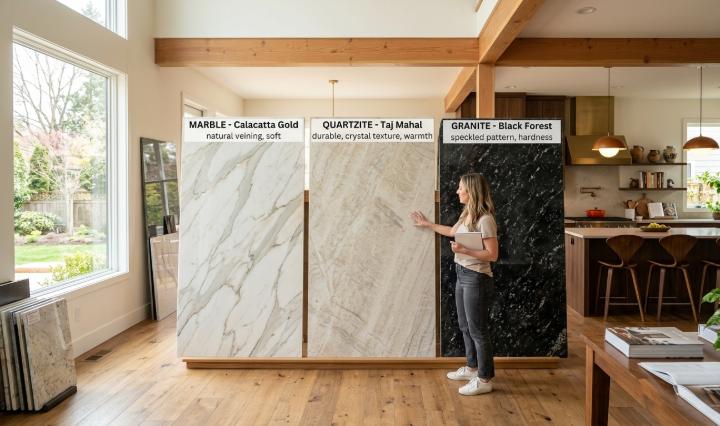
Marble is a metamorphic stone known for its dramatic veining. First-choice marble from a top-tier quarry like those in Carrara, Italy, or from Brazilian sources may still exhibit bold movement that would concern a buyer unfamiliar with the material. The expectation for marble is that veining is present and prominent. Grade in marble is more about consistency and structural soundness than about limiting veining. This Old House's guide to stone countertops offers a useful overview of how different stone types behave in kitchen and bathroom environments.
Granite is an igneous stone with a more uniform grain structure. Grading in granite often focuses more heavily on color consistency and the presence of fissures, since granite buyers frequently expect a more predictable, speckled or flowing appearance across the full slab surface.
Quartzite sits somewhere in between. Because quartzite varies widely from one source to another, from the soft creamy movement of Taj Mahal to the bold directional veining of Calacatta Macaubas, grading expectations are set more by the specific stone variety than by a blanket quartzite standard. Buyers considering engineered quartz alongside natural quartzite should also be aware that engineered stone fabrication carries distinct silica dust exposure risks, which the National Institute for Occupational Safety and Health has documented in detail.
Seeing Slabs in Person
Slab grade is a starting point, not a final verdict. The only reliable way to evaluate a slab for your project is to see it in person, standing upright under natural or showroom lighting, at the scale of the full slab.
Two slabs from the same quarry, the same lot, and the same grade tier can look dramatically different. The way light hits the surface, the direction of veining relative to your countertop layout, and the way the stone photographs versus how it reads in person are all factors that no online image or grade label fully communicates.
Our showrooms in Reno, Minden, Sacramento, and Fernley carry full slab inventory that you can view standing up, the way slabs are meant to be evaluated. Seeing the full slab is a step that experienced designers and stone professionals consistently recommend before any purchase decision, and it is one we always encourage for customers working through their selection.
What Grade Means for Your Project
For large, continuous countertop runs, particularly in open kitchens where multiple slabs will be visible at once, first-choice material makes the matching and layout process more straightforward. Consistent color and predictable veining give you more flexibility in how the slabs are oriented and joined.
For smaller countertop applications, single-slab islands, bathroom vanities, or decorative accent surfaces, standard-grade stone is often an excellent choice. The additional natural variation can make the stone more visually interesting, and the difference in visual outcome between grades is frequently minimal once the slab is cut, edged, and installed in context. The Fine Homebuilding guide to natural stone countertops breaks down how stone performs across different kitchen applications, which is useful context when weighing grade against end use.
Book-matched applications, where two slabs are opened like a book to create a mirrored veining pattern, typically require first-choice material. The symmetry only works when veining is consistent enough to mirror cleanly, which is a characteristic of higher-grade inventory.
If you are sourcing stone locally in Northern Nevada or Northern California, working with a local provider gives you the advantage of viewing the actual slab assigned to your project before fabrication begins, a step that distributor and big-box purchasing models do not always accommodate.
Conclusion
Natural stone slab grades give buyers a useful framework for understanding quality tiers, but they are a tool, not a guarantee. A grade label tells you how a slab was evaluated at the processing facility. It does not tell you whether that specific slab is right for your kitchen island, your bathroom vanity, or your feature wall. The characteristics that push one slab into a lower grade tier might be exactly what makes another project sing. Understanding what graders look for, seeing slabs in person, and working with a knowledgeable team are the steps that actually lead to a result you will be happy with for years. We are here to help you navigate those choices at any of our four Northern Nevada and Northern California showroom locations.
Frequently Asked Questions
What is the difference between Grade A and Grade B natural stone slabs?
Grade A, also called first choice or commercial grade, refers to slabs selected for consistent color, uniform veining, and minimal surface irregularities. Grade B, or standard grade, includes slabs with more pronounced natural variation such as irregular veining, minor pitting, or slight color shifts. Both grades are structurally sound; the difference is primarily visual and depends on how much variation suits your specific project.
Is lower-grade stone lower quality?
Not necessarily. Lower-grade stone is not defective stone. It simply has more natural variation than the highest-tier slabs. For many projects, especially single-slab applications or accent surfaces, standard-grade stone performs identically to first choice and can offer a more visually dynamic result. The right grade depends on the demands of your project, not on a universal ranking of quality.
Does stone grade affect durability?
Stone grade primarily reflects visual characteristics rather than structural performance. A standard-grade granite is just as hard and heat-resistant as a first-choice granite from the same source. The exception involves significant fissures or unfilled voids, which can affect how a slab performs in high-stress areas like sink cutouts. For most countertop applications, grade does not meaningfully change how the stone holds up over time.
Do all stone suppliers use the same grading system?
No. There is no universal or regulated grading standard across the natural stone industry. Grading terminology and criteria vary by supplier, country of origin, and stone type. What one distributor calls Grade A another may label first choice or premium. This is why understanding the specific criteria behind a grade label, rather than the label itself, is the most reliable way to evaluate slab quality.
How do I know which grade is right for my project?
The best way to determine the right grade for your project is to view slabs in person and discuss your layout and application with a stone professional. Large countertop runs with multiple slabs, or book-matched applications, generally benefit from first-choice material. Smaller surfaces, statement pieces, or projects where bold natural variation is part of the design intent can work beautifully with standard-grade stone. Our team at any of our showroom locations can help you evaluate options based on your specific needs.