Natural stone fireplace surrounds use non-combustible materials that handle radiant heat without warping, discoloring, or releasing harmful compounds. The six most common natural stone options for fireplace surrounds are marble, quartzite, granite, travertine, dolomite, and soapstone. Engineered quartz should not be used for this application because its resin content can discolor or degrade under sustained heat exposure.
The best stone for a fireplace surround depends on the room's style and the homeowner's maintenance preferences. Here is how each material compares:
- Marble is the most traditional choice for formal and classical spaces; honed finishes perform better near a firebox than polished because they conceal minor surface wear more effectively
- Quartzite offers marble-like veining with greater hardness and heat resistance, making it one of the most practical options for high-use fireplaces and floor-to-ceiling feature walls
- Granite is the most heat-resistant of the common options, resists staining, and many dense dark varieties require little to no sealing
- Travertine suits warm, earthy, and Mediterranean-style interiors; its porous surface requires sealing but sees minimal liquid exposure in a fireplace context
- Dolomite delivers a clean, consistent surface with subtle veining that suits understated architectural surrounds; it requires sealing and shares a similar maintenance profile to marble in a fireplace setting
- Soapstone is the only common fireplace stone that requires no sealing; it is non-porous, highly heat-resistant, and develops a natural patina over time
Why Natural Stone Works Well for Fireplace Surrounds
Natural stone has been used in fireplace design for centuries, and for practical reasons. All true natural stone is non-combustible. Granite, quartzite, marble, travertine, dolomite, and soapstone will not ignite, warp, or release harmful compounds when exposed to the radiant heat of a fireplace, as long as the stone is not placed directly inside the firebox or in sustained contact with an open flame.
This distinguishes natural stone from engineered quartz, which contains resins that can discolor or degrade under prolonged heat exposure. Engineered quartz is not a suitable material for surround applications near an active firebox, and natural stone is the appropriate alternative.
Beyond safety, natural stone brings a visual character that manufactured surfaces do not replicate. Each slab carries its own pattern of movement, veining, and mineral variation, and because a fireplace surround is one of the most prominent surfaces in a living space, that variation carries real design weight. Natural stone does not fade or discolor with age in the way some manufactured surfaces do, and with routine sealing and cleaning, most natural stone fireplace surrounds do not require replacement over the life of the home.
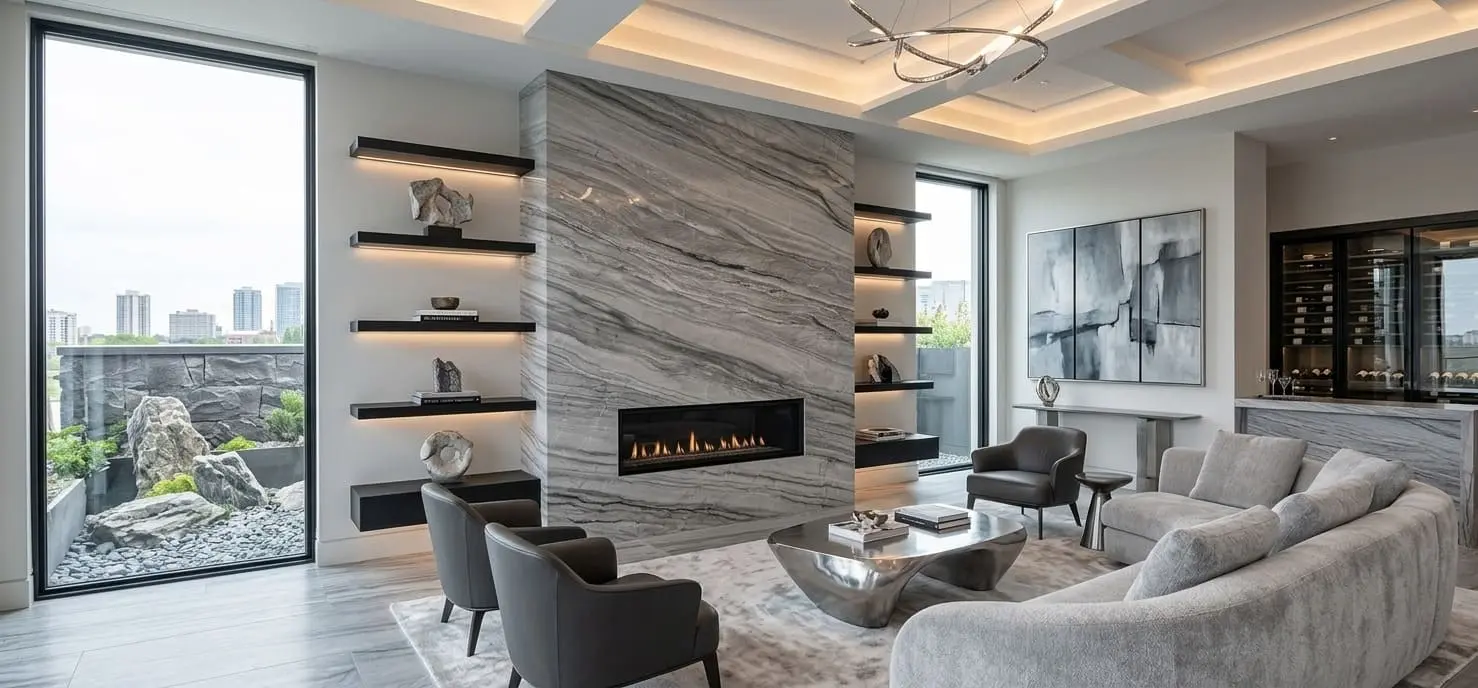
Stone Options for Fireplace Surrounds
All six of the stones covered below are available to view in person at our showroom locations. Because color saturation, veining scale, and finish quality read differently at full slab size than in photos or small samples, seeing the stone in person before committing to a material is always the recommended approach.
Marble
Marble is one of the most traditional choices for fireplace surrounds, particularly in formal living rooms, primary suites, and spaces where a refined, classical aesthetic is the goal. White and light gray varieties such as Calacatta and Carrara are widely used for their soft veining and compatibility with a broad range of design styles. Darker varieties like Nero Marquina create high-contrast focal points when paired with lighter walls or cabinetry.
Marble is susceptible to etching from acidic substances, but a fireplace surround is one of the more forgiving applications for it. Unlike a kitchen countertop, the stone has no exposure to food, liquids, or cleaning chemicals. A honed finish is a practical choice because it conceals minor surface wear more effectively than a polished finish and suits both traditional and contemporary interiors.
Quartzite
Quartzite offers marble-like visual character with a higher hardness rating and better overall heat tolerance. Varieties such as Taj Mahal, White Macaubas, and Super White are commonly selected for fireplace applications because of their warm neutral palettes and flowing veining that reads well at the scale of a full wall. Quartzite is well-suited for floor-to-ceiling surround designs and is a strong candidate for bookmatched feature walls, where its directional movement can be displayed at full scale. Honed and leathered finishes both work well in this context.
Granite
Granite is among the most heat-resistant natural stones and has a long track record in fireplace surround applications. Its density makes it resistant to scratches and staining, and many dark granite varieties are dense enough to require minimal sealing. Granite is available in a wide range of colors, from solid blacks and crisp whites to warm earth tones and multicolor varieties, giving it adaptability across design styles from rustic to contemporary.
Travertine
Travertine suits Mediterranean, Tuscan, and transitional interiors well. Its naturally textured surface can be left with its characteristic pitting for a rustic character, or filled and honed to a smooth, refined finish. Travertine is a porous material that benefits from sealing, but in a fireplace application where liquid exposure is minimal, maintenance demands are modest. It tends to read as warm and approachable rather than formal, making it a reasonable fit for family rooms and casual living spaces.
Dolomite
Dolomite is a sedimentary stone with a composition similar to marble, typically presenting in white, light gray, or soft beige tones with subtle veining. It is often selected for surrounds where a clean, quiet surface is preferred over stones with strong movement or dramatic patterning. Like marble, dolomite is susceptible to etching from acidic substances, but in a fireplace context where liquid exposure is not a factor, that characteristic has minimal practical impact. Dolomite requires periodic sealing and benefits from routine care, but its maintenance demands in a dry, heat-only environment are manageable.
Soapstone
Soapstone is among the most heat-resistant natural stones and is a traditional material for wood-burning stove surrounds and hearths. Unlike marble and quartzite, soapstone is non-porous and does not require sealing. It develops a natural patina over time and is available primarily in gray and charcoal tones, which suits both modern and rustic settings. Its heat absorption and radiation properties are well-suited to functional, high-use fireplaces.
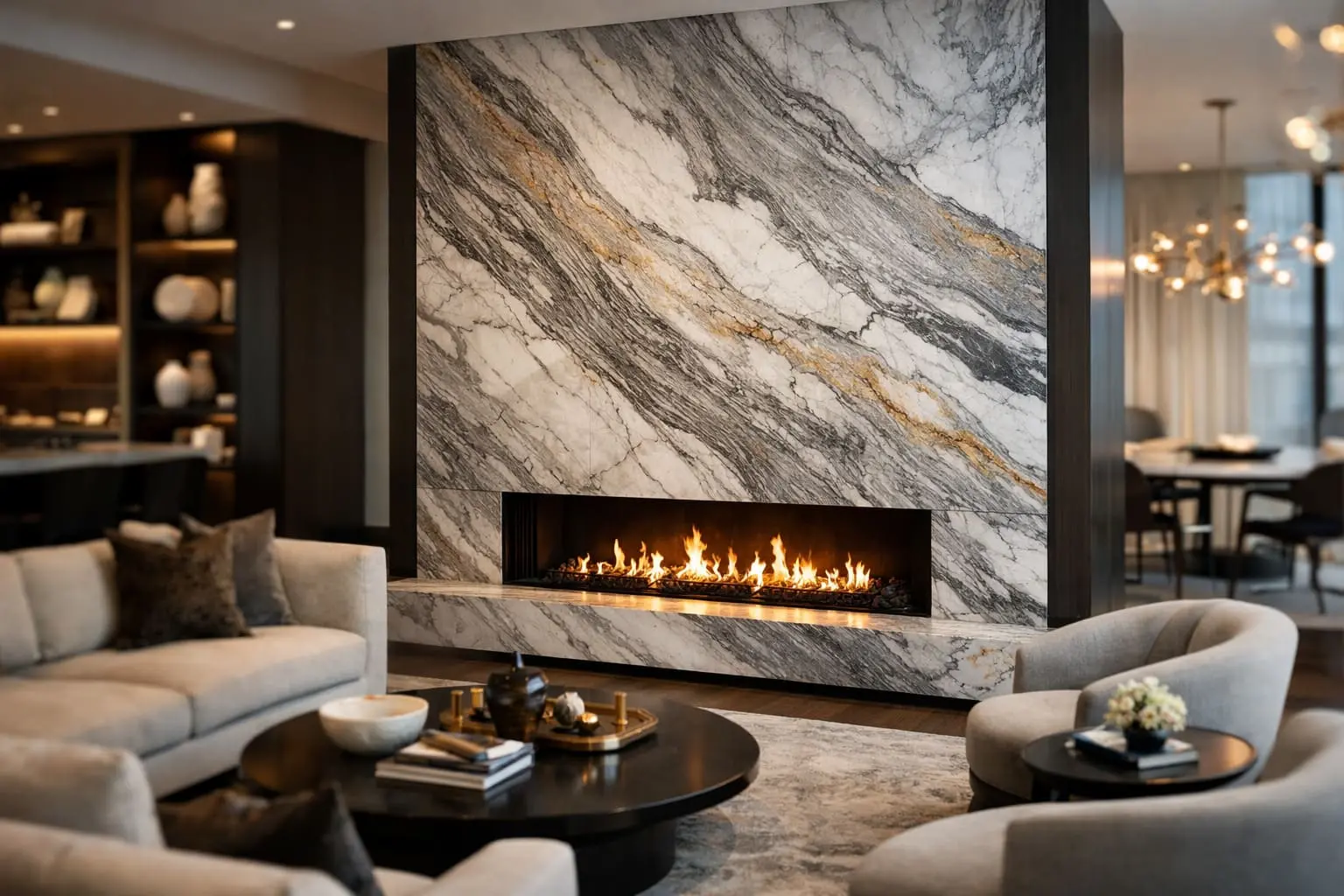
Design Considerations
Scope: How Much of the Wall to Cover
The most basic surround consists of two vertical legs and a horizontal header that frame the firebox opening, with a mantel shelf above. This format works well in rooms with other strong architectural features where a more understated approach is preferred. A full-height surround, where stone extends from the floor to the ceiling, creates a focal wall and is effective in rooms with high ceilings or where the fireplace is intended to serve as the primary design element. According to guidance published by This Old House, a well-proportioned surround should generally rise to roughly half to two-thirds the room height before transitioning to a mantel or open wall above, though full-height designs work effectively when the room's scale supports them.
Bookmatching
Bookmatching, where two sequential slabs from the same block are opened to create a mirrored veining pattern, is one of the more common design techniques for fireplace feature walls. The resulting symmetry adds intentionality and architectural weight to the surround and works particularly well with stones that have strong directional movement, such as quartzite and marble. Viewing available slab pairs in person is the most reliable way to evaluate how a bookmatched layout will read at full scale, since the mirror pattern can only be fully understood when the two slabs are standing side by side.
Finish Selection
Polished finishes amplify the depth and reflectivity of veining and work well in formal or traditional settings. Honed finishes produce a matte surface that reads as softer and more organic, and they hide minor wear more effectively. Leathered finishes add a subtle texture that reduces glare while preserving the stone's natural movement. Any of the three finishes can be appropriate for a fireplace surround. If you are unsure which finish suits your room's overall tone, scheduling a consultation with one of our design team members is a good way to evaluate options against your specific materials and lighting before making a final decision.
Coordinating the Hearth and Mantel
The hearth floor can be finished in the same stone as the surround for a unified result, or in a complementary material such as a contrasting finish of the same stone, slate, or another natural stone altogether. The mantel shelf can be cut from the same slab for a seamless appearance, or finished in wood or a different material for contrast. As Fine Homebuilding notes, the material relationship between the surround, hearth, and mantel shelf plays a meaningful role in whether the overall composition reads as intentionally designed or simply assembled.
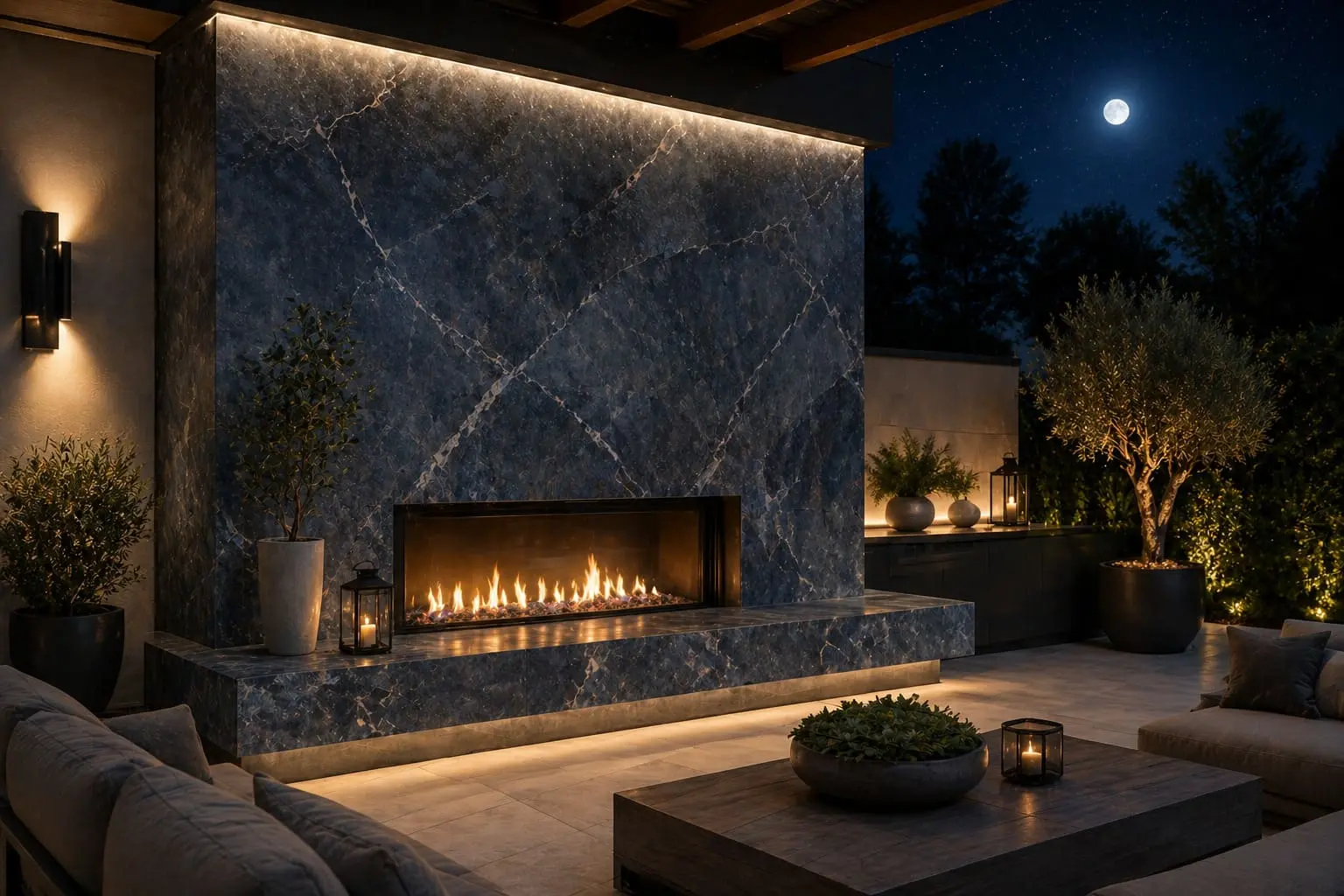
Working with a Stone Professional
Working with a local stone source means you can view actual inventory rather than relying on digital renderings that vary in accuracy. As a direct importer, we are able to offer access to a broader range of slab options and help identify coordinating stones for use across multiple surfaces in the same renovation, such as pairing a fireplace stone with countertop and flooring materials for a cohesive result throughout the home.
Interior designers and trade professionals can apply for a trade account to access project support and additional resources. For homeowners ready to begin planning, a slab quote request is the first step in understanding material requirements and project scope.
A note on stone fabrication: any cutting or shaping of natural stone generates silica-containing dust. According to NIOSH, silica dust exposure is a recognized respiratory hazard and requires appropriate ventilation, dust control, and protective equipment. This work should always be performed by a qualified fabricator in a controlled environment.
Conclusion
A natural stone fireplace surround is one of the more permanent design decisions a homeowner makes. Because it is not subject to the daily wear of a countertop surface, the right stone requires minimal upkeep and does not need replacement under normal conditions. The decision involves balancing the visual character of the stone against the room's scale, the type of fireplace, and the desired maintenance level.
Whether the goal is a simple framed surround in honed marble, a floor-to-ceiling quartzite feature wall, or a bookmatched design in a formal living room, the foundation of a good outcome is seeing the actual slabs in person. Our team works with homeowners, designers, and trade professionals across Northern Nevada and Northern California to help identify the right stone for each project and each space.
Frequently Asked Questions
Is natural stone safe to use around a fireplace?
Yes. Natural stone such as marble, granite, quartzite, travertine, dolomite, and soapstone is non-combustible and safe for use around a fireplace opening. These materials will not ignite, warp, or release harmful compounds when exposed to radiant heat. The key boundary is that natural stone should not be placed directly inside the firebox or in sustained direct contact with an open flame.
Can engineered quartz be used for a fireplace surround?
No. Engineered quartz contains resins that can discolor, soften, or degrade under the sustained heat produced by an active fireplace. True natural stone is the appropriate material for surround applications near a functioning firebox.
What is the most low-maintenance natural stone for a fireplace surround?
Granite and soapstone are among the lowest-maintenance options. Dense granite varieties require only infrequent sealing, and soapstone requires none at all. Both are heat-resistant and durable. Quartzite is another solid option because it requires only annual sealing and resists staining more readily than marble.
How much of the wall should a fireplace surround cover?
This depends on the room's proportions and the design intent. A basic surround covers just the legs and header around the firebox opening. Full-height surrounds that extend to the ceiling are effective in rooms with high ceilings and create a stronger focal wall. A general guideline is that the stone framing should rise to roughly half to two-thirds the wall height before a mantel or open wall takes over, though full-height designs can work well when the room's scale supports them.
What is the difference between a fireplace surround and a hearth?
The surround refers to the stone framing around the firebox opening, including the legs on each side, the header across the top, and any stone that extends further up or across the wall. The hearth is the floor extension that projects out from the firebox opening at floor level. The two elements are often finished in the same stone for a unified appearance, but they are distinct parts of the fireplace assembly and can also be finished in complementary materials.