A kitchen island countertop is a natural stone or engineered slab installed on a freestanding or built-in kitchen island, serving as the primary work surface at the center of the kitchen. Because the island is visible from all sides, used for food preparation and entertaining, and subject to more daily contact than perimeter counters, material and finish selection requires different considerations than a standard wall-run counter. For a broader look at how these materials compare across all countertop applications, Fine Homebuilding's guide to natural stone countertops is a useful reference.
The most common materials used for kitchen island countertops are quartzite, granite, marble, porcelain slab, and sintered stone, each differing in hardness, porosity, finish options, and maintenance requirements:
- Quartzite is a metamorphic rock rated 7 on the Mohs scale, resistant to scratching and acid etching, and available in marble-like veining patterns.
- Granite is an igneous rock rated 6 to 7 on the Mohs scale with broad color range and strong heat resistance; requires periodic sealing.
- Marble is composed primarily of calcium carbonate (CaCO3), rated 3 to 4 on the Mohs scale, and prone to etching from acidic substances; best suited to islands where aesthetics outweigh heavy daily use.
- Porcelain slab is a kiln-fired engineered surface rated 7 to 8 on the Mohs scale with near-zero water absorption and no sealing requirement.
- Sintered stone is produced by compressing natural minerals under extreme heat and pressure, resulting in a non-porous, scratch- and UV-resistant surface that also requires no sealing.
Key island-specific factors include slab thickness (3 cm is standard for structural integrity across an unsupported span), overhang depth (12 to 15 inches for seating), finish choice (polished, honed, leathered, or brushed), and whether the island material matches or contrasts the perimeter countertops.
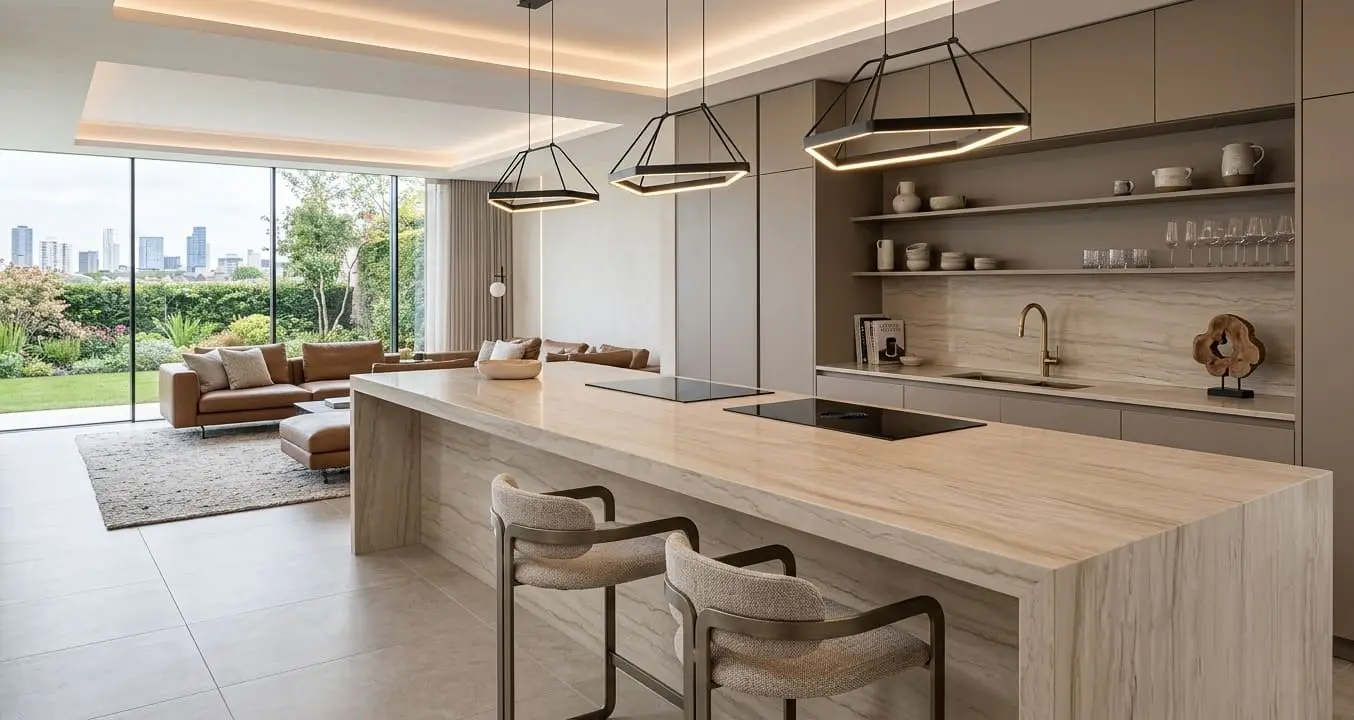
Why the Island Requires Different Thinking
The kitchen island handles daily meal prep, acts as a gathering point during entertaining, and often doubles as a breakfast bar. Because it sits in the open and is approached from all sides, it receives wear from multiple directions and is seen under varied lighting throughout the day.
Material and finish choices that work well for a perimeter counter may not always translate directly to an island. A stone with minimal spill exposure against a backsplash faces a different reality as the primary prep surface. At the same time, the island is typically the first thing people notice when they enter a kitchen, which makes material selection a design decision as much as a practical one. Thickness, overhang, seaming, and finish all behave differently on a large-format island slab than on a standard counter run.
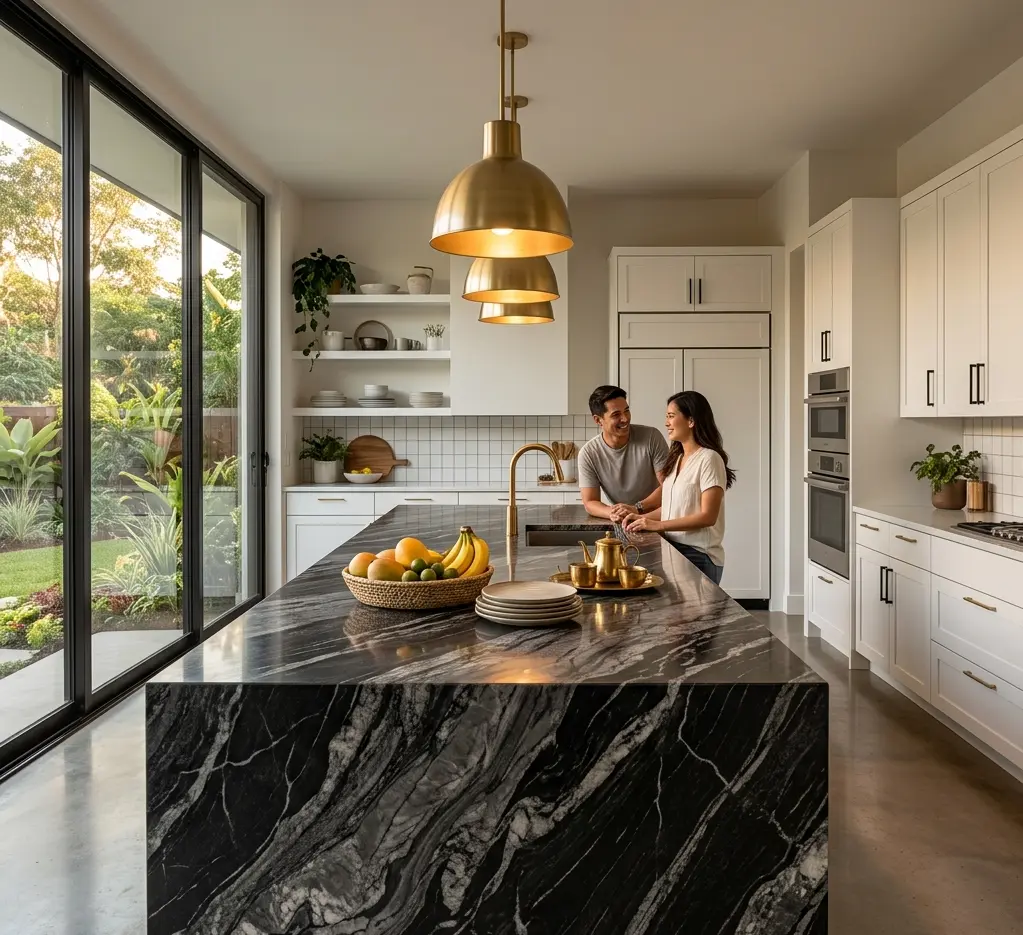
Best Stone Materials for Kitchen Islands
Quartzite
Quartzite forms when quartz-rich sandstone undergoes intense heat and pressure, producing a stone rated 7 on the Mohs hardness scale. It resists scratching from utensils, handles heat well, and holds up under the daily contact an island attracts. Its veining closely resembles marble, making it a practical choice for homeowners who want that aesthetic without marble's susceptibility to acid etching. Varieties like Taj Mahal, Super White, White Macaubas, and Sea Pearl are among the most requested island stones we see across our showrooms. You can view our current slab inventory to see available quartzite selections. Quartzite requires periodic sealing, and porosity varies by variety.
Granite
Granite is an igneous rock rated 6 to 7 on the Mohs scale, offering outstanding heat resistance, broad color variety, and strong stain resistance when sealed. Darker varieties such as Absolute Black and Black Galaxy are particularly dense and absorb very little liquid. Lighter varieties require more consistent sealing. Granite's color range, from warm golds and creams to deep blues and forest greens, makes it easier to anchor the island to a specific cabinet color or kitchen palette. This Old House covers the full range of natural stone countertop properties if you want a detailed material comparison alongside granite.
Marble
Marble is a metamorphic rock composed primarily of calcium carbonate (CaCO3), rated 3 to 4 on the Mohs scale. Its calcium carbonate composition makes it reactive to acidic substances including lemon juice, vinegar, and wine, which etch the surface over time. A honed finish is recommended for island use because the matte surface conceals minor etching more effectively than a polished one. For homeowners who understand its care requirements and are comfortable with a surface that develops character over time, marble works well in kitchens where the island functions more as a centerpiece than a primary work surface.
Porcelain Slab
Porcelain slab is engineered from clay and minerals fired at extremely high temperatures, producing a surface rated 7 to 8 on the Mohs scale with near-zero water absorption and no sealing requirement. It resists stains from coffee, wine, and cooking oils without special treatment and is UV-stable, making it suitable for islands near large windows or open-plan kitchens connected to outdoor spaces. Large-format porcelain slabs, often up to 126 inches in length, allow many island surfaces to be covered in a single piece with no seams.
Sintered Stone
Sintered stone is produced by subjecting natural minerals to extreme heat and pressure, resulting in a dense, non-porous surface resistant to heat, scratches, UV light, and household chemicals, with Mohs ratings typically in the 6 to 8 range. Its combination of durability and zero sealing requirement makes it a practical choice for heavily used island surfaces. Homeowners comparing engineered surface options should be aware that NIOSH has identified silica dust exposure as a serious occupational concern with some engineered stone products, making fully sintered materials a relevant consideration for households mindful of long-term material safety. Like large-format porcelain, sintered stone is available in slab sizes that cover most islands without seaming.
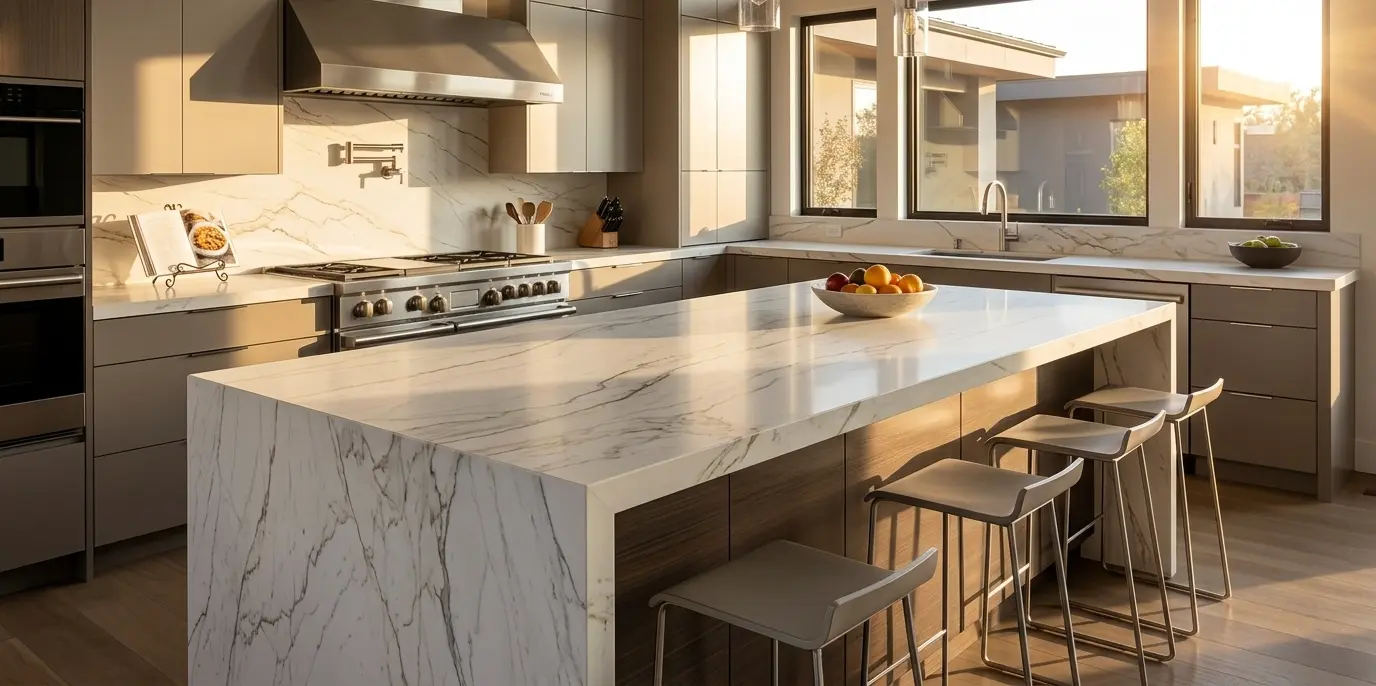
Finish Options for Island Countertops
A polished finish delivers a high-gloss, reflective surface that enhances color depth and veining but shows fingerprints and water spots more readily on a surface with frequent contact.
A honed finish is smooth and matte, more forgiving in a working kitchen, and the recommended choice for marble islands where etching concealment matters.
A leathered finish adds subtle texture through a diamond-tipped brushing process, deepens color, hides fingerprints well, and adds a tactile quality that suits islands intended as a design focal point.
A brushed finish produces a softer texture than leathered with a slightly worn appearance that works well in transitional and farmhouse-style kitchens.
Island-Specific Considerations
Thickness
Three centimeters (approximately 1 1/4 inches) is the standard for island countertops. The added thickness provides structural integrity across a large unsupported span and reads as visually substantial. Two-centimeter slabs are sometimes paired with mitered edge profiles to create the appearance of greater thickness.
Overhang
Islands typically include a 12 to 15 inch overhang on the seating side for bar stools or chairs. This unsupported span creates a potential stress point depending on the material. Granite and quartzite handle standard overhangs well when properly supported. Longer overhangs typically require corbels or hidden steel supports.
Single Slab vs. Seamed
Larger islands may require two slabs joined with a seam. Selecting sequential slabs from the same block allows veining to continue more naturally across the joint. Viewing full slabs in person before purchase is the most reliable approach, as photographs and small samples cannot convey how a stone reads across a full island surface.
Matching the Island to the Perimeter Countertops
Using the same material throughout creates a unified kitchen where stone becomes a continuous design element. This approach works particularly well with veined stones where two different varieties placed side by side would create visual competition rather than cohesion.
Contrasting materials allow the island to serve as a focal point. A common approach uses a quieter stone on the perimeter with a more dramatic slab on the island. Mixing finishes on the same material, such as polished on the island and honed on the perimeter, creates visual distinction without introducing a second stone type. In either case, the two surfaces should share at least one common element, whether a color tone, mineral undertone, or finish direction, to keep the overall design cohesive. If you are working through material pairings, our team is available to help when you find a showroom near you.
Conclusion
The kitchen island is the most visible and most used horizontal surface in the kitchen, meaning the stone selected for it shapes both appearance and daily function. Quartzite delivers the balance of visual character and durability that most active kitchens need. Granite offers broad color range and proven heat resistance. Marble suits kitchens where the island serves a display role and attentive care is part of the plan. Porcelain and sintered stone provide non-porous alternatives for households that want strong performance without ongoing sealing.
Finish selection, slab thickness, overhang dimensions, and the relationship between island and perimeter countertops all affect the final result in ways photographs and samples cannot fully communicate. Viewing full slabs in person, under your kitchen's actual lighting, remains the most effective step before committing to a material.
As a direct stone importer, we bring slabs straight from the quarry to our warehouse locations in Reno, Minden, Sacramento, and Fernley. Our commission-free design team offers free consultations to help homeowners and trade professionals find the right material and finish for island projects of any scale.
You can schedule a consultation appointment online, request a slab quote for your project, or apply for a trade account if you are a contractor or designer working on behalf of a client.
Frequently Asked Questions
What is the most durable stone for a kitchen island?
Quartzite and granite are the most durable natural stone options for kitchen islands. Quartzite rates 7 on the Mohs scale and resists scratching and acid etching. Granite rates 6 to 7 and offers strong heat and stain resistance when sealed. Porcelain slab and sintered stone are engineered alternatives with similar hardness ratings and no sealing requirement.
Does a kitchen island need a different stone than the perimeter counters?
No. Many kitchens use the same stone throughout, which creates a cohesive result. Using a different stone or finish on the island is also a common approach that allows it to serve as a focal point. When two stones are used, they should share a common color tone or finish direction to keep the design unified.
What is the best finish for a kitchen island countertop?
It depends on use and design intent. Polished finishes enhance veining and depth but show marks more readily. Honed finishes are matte and more forgiving in a working kitchen, particularly for marble. Leathered finishes add texture and hide daily marks well, making them a practical choice for a heavily used surface.
How thick should a kitchen island countertop be?
Three centimeters, approximately 1 1/4 inches, is standard. This thickness provides structural integrity across the unsupported span of a large island. Two-centimeter slabs can be used with mitered edge profiles to achieve the appearance of greater thickness.
Can marble be used on a kitchen island?
Yes, though it requires more deliberate care than quartzite or granite. Its calcium carbonate composition makes it reactive to acids including lemon juice, vinegar, and wine, which etch the surface over time. A honed finish is recommended as it conceals etching more effectively than polished. Marble works well for homeowners who understand its maintenance requirements and prefer a surface that develops a natural patina over time.