What Makes Quartzite a Strong Kitchen Countertop Choice
Quartzite is a naturally occurring metamorphic rock formed when sandstone undergoes intense heat and pressure deep within the earth. That geological process produces a surface harder than most natural stones available for kitchen countertop designs today. On the Mohs hardness scale, quartzite typically scores between 7 and 8, compared to marble's 3 to 4. For homeowners weighing surface options, that difference is meaningful.
The short answer: yes, quartzite is durable enough for most kitchens, provided the slab is properly sealed and maintained. Its hardness resists scratching from daily prep work better than softer stones, and its density makes it less prone to staining when sealed correctly. Quartzite slabs are available in polished, honed, leathered, and specialty finishes, each with distinct performance characteristics suited to different household needs.
Quartzite is often confused with quartz engineered stone. They are different materials. Quartzite is 100% natural stone. Quartz engineered surfaces contain polymer resins that limit outdoor use. Quartzite, by contrast, is UV-stable and rated for both indoor and outdoor applications, making it one of the more versatile slab materials on the market.
The Practical Benefits of Quartzite Slabs
Understanding what quartzite actually delivers in a working kitchen helps clarify whether it fits your lifestyle. Here is a straightforward summary of its core performance characteristics:
- Scratch resistance: Quartzite's high Mohs rating means metal utensils and dishware are unlikely to mark the surface. Using cutting boards remains the standard practice to preserve finish over time.
- Heat tolerance: Quartzite handles ambient kitchen heat well. Thermal shock from extremely hot cookware placed directly on the surface can still cause stress fractures, so trivets are recommended.
- Stain resistance: When sealed, quartzite resists most common kitchen spills, including oils, wine, and acidic juices. Prompt cleanup preserves the seal and the stone.
- UV stability: Unlike engineered quartz, quartzite does not fade under sun exposure, which matters for kitchens with large window exposure or connected outdoor pass-through counters.
- Finish variety: Polished, honed, leathered, and specialty finishes are all available. Polished surfaces amplify the stone's veining but are slipperier when wet; honed and leathered finishes provide a more matte texture with better grip.
- Longevity: Properly sealed and maintained quartzite surfaces hold their appearance for decades. No surface is maintenance-free, but quartzite's durability compares favorably with other natural stone options.
Quartzite Slabs Design Applications
Quartzite's tonal movement, layered veining, and wide color range make it one of the most adaptable stones in kitchen design. It reads as luxurious in high-end builds and grounded in casual family spaces.
For homeowners interested in seeing current stone selections and attending live design events, the Natural Stone Institute events calendar is an excellent resource to stay connected with industry trends and suppliers.
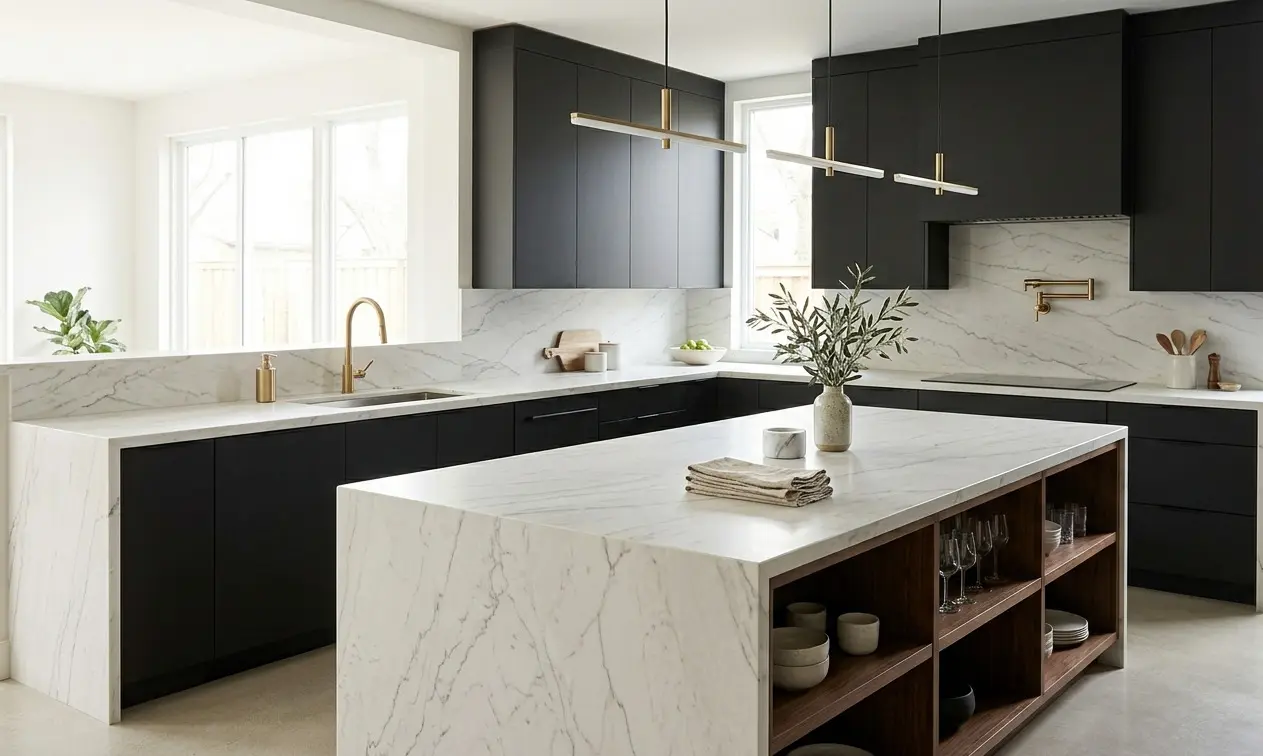
Kitchen Countertops and Islands
Quartzite's natural veining patterns range from subtle white-and-grey compositions to bold gold, blue, and rust formations. That variety makes it adaptable across contemporary, transitional, and traditional kitchen countertop designs. Large-format slabs allow designers to create continuous book-matched surfaces across islands or peninsula runs without visible seaming.
Waterfall edges, where the slab continues vertically down the side of an island, showcase quartzite's natural patterning as a structural focal point. Mitered corner joints create the illusion of a thicker slab without the added weight. Both details work especially well with quartzite because of the material's inherent movement and depth.
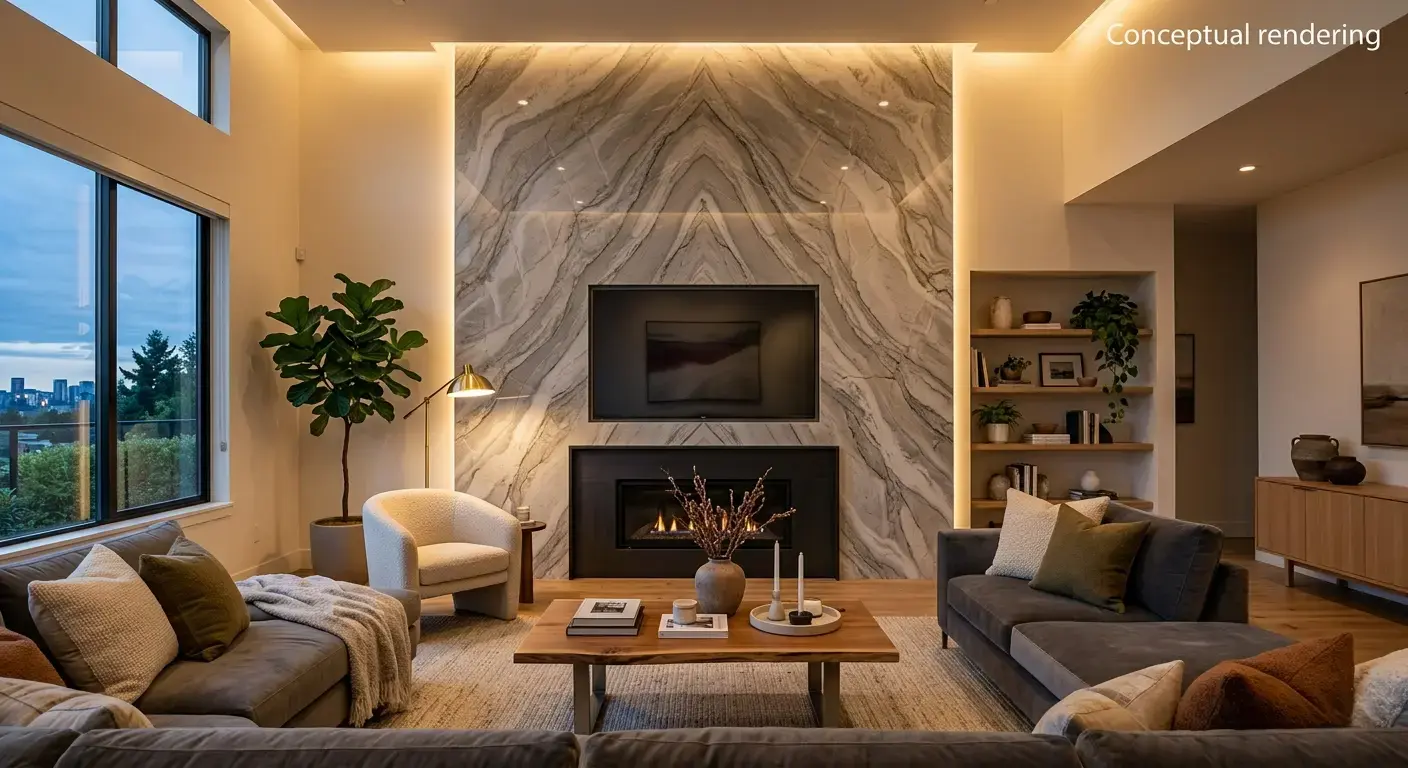
Fireplace Surrounds and Feature Walls
Quartzite is rated for fireplace surround applications, where its heat tolerance and dimensional stability are assets. As a wall slab, it performs well in both living spaces and kitchen backsplash configurations. When leathered finishes are used on vertical surfaces, the matte texture diffuses light differently than polished stone, creating a more tactile visual environment, according to surface design coverage from Dezeen's 2026 design events guide.
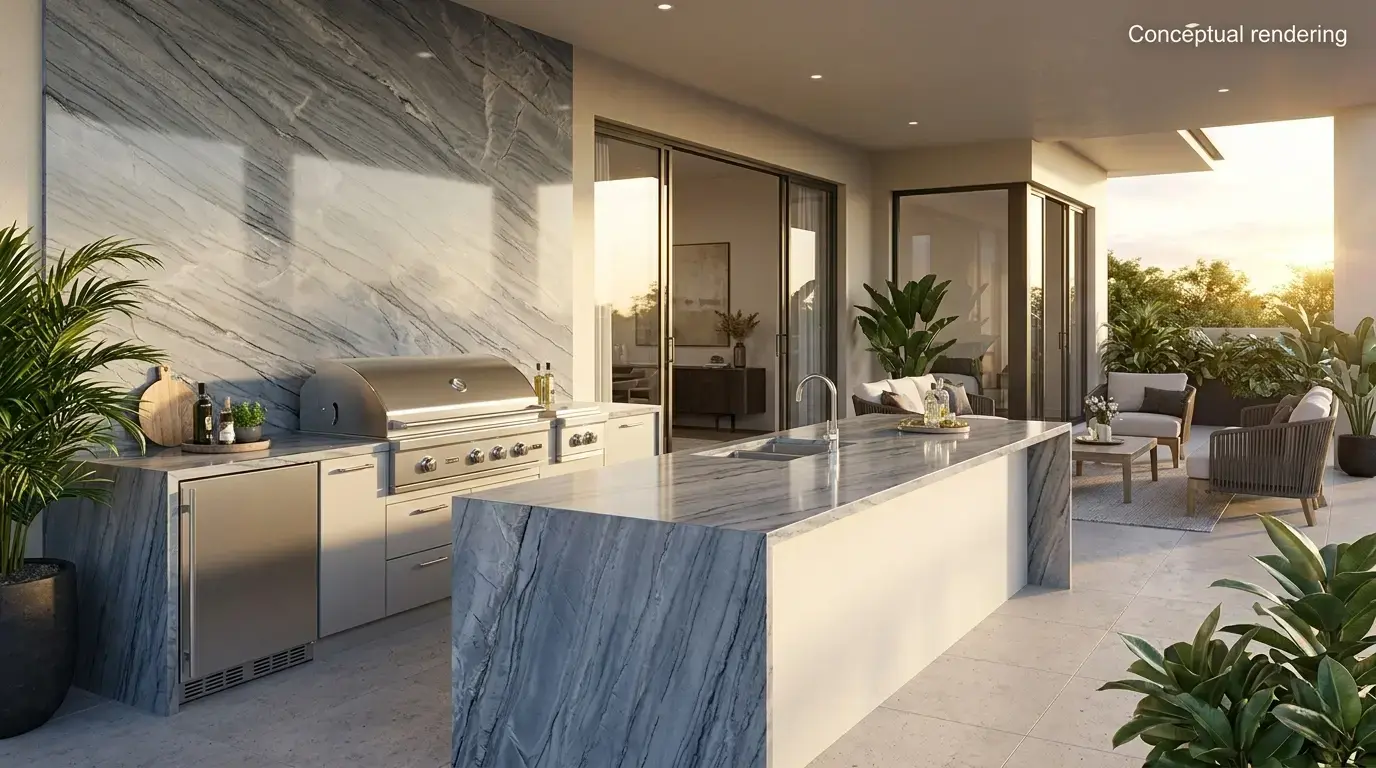
Outdoor Kitchens and Covered Entertaining Areas
Because quartzite is UV-stable and resistant to freeze-thaw cycling, it extends naturally to outdoor counter and bar applications. This is an area where engineered quartz cannot follow, as polymer resins in quartz degrade under prolonged UV exposure. For homeowners building or renovating covered outdoor kitchen spaces, quartzite bridges indoor and outdoor design continuity without material switching.
Quartzite vs. Common Kitchen Slab Alternatives
Material | Hardness (Mohs) | UV Stability | Outdoor Use | Leathered Finish | Heat Notes |
Quartzite | 7–8 | ✅ Yes | ✅ Yes | ✅ Yes | Trivets recommended |
Marble | 3–4 | Shaded outdoor only | Limited | ✅ Yes | Trivets recommended |
Granite | 6–7 | ✅ Yes | ✅ Yes | ✅ Yes | Trivets recommended |
Porcelain Slab | 7–8 | ✅ Yes | ✅ Yes | ✅ Yes | Highly heat tolerant |
Quartz (engineered) | 7 | ❌ No | ❌ No | ❌ No | Trivets required |
Quartzite Pros and Cons
Pros
- Among the hardest natural stone slab options available
- UV-stable for indoor and outdoor applications
- Available in polished, honed, leathered, and specialty finishes
- Natural veining produces unique, non-repeating visual character
- Rated for floors, walls, counters, and fireplace surrounds
- Long-term durability when properly sealed and maintained
Cons
- Requires periodic sealing; frequency depends on finish and use intensity
- Polished finishes become slipperier when wet, limiting use on floor areas without appropriate finish selection
- Veining variation means slab-to-slab matching requires showroom review
- Thermal shock risk remains even with high heat tolerance; trivets are still the standard practice
- Higher weight compared to engineered options may affect cabinetry planning
How to Choose the Right Quartzite Slab
This short guide helps narrow the selection process before a showroom visit:
- Identify your finish priority. Polished finishes maximize visual depth and are best for wall and vertical applications or dry countertop zones. Honed and leathered finishes offer matte traction more suitable for heavily used prep surfaces.
- Map your application zones. Quartzite is rated for floors, walls, counters, fireplaces, and outdoor spaces. Knowing which zones are in scope helps the selection focus on slabs suitable for all planned uses.
- Review full slab movement. Quartzite veining varies significantly across a slab. Book-matched layouts require reviewing two slabs side by side in person before committing to a design.
- Understand your sealing schedule. Ask about sealing frequency relative to each slab's density and finish. Denser, lower-porosity quartzite needs less frequent attention than more porous specimens.
- Cross-reference with ANSI standards when quartzite is specified for floor or wet-area applications to confirm the slab's slip resistance and load ratings align with the installation environment.
Quartzite at Nova Tile and Stone
Nova Tile and Stone carries quartzite slabs across four showroom locations, with options suited to both residential kitchen countertop designs and broader architectural applications. The showroom teams in Reno, Minden, Fernley, and Sacramento can walk through slab selections in person, which matters for a material where no two slabs look identical.
Nova offers free shipping on slab orders, which reduces the logistical friction of coordinating large-format stone delivery. Expert guidance is available at every location to help match specific quartzite slabs to project scope, finish requirements, and design intent. Seeing full slabs under showroom lighting before specifying is the single most reliable step in the selection process.
For those exploring options beyond quartzite, the broader slab collection includes granite, marble, dolomite, porcelain, travertine, and semi-precious stone, with finishes and applications clearly mapped across each category.
The 2026 surfaces season is bringing renewed attention to natural stone textures and large-format slab formats, a direction well represented in Nova's current inventory, with surface innovation coverage reflected across publications tracking the flooring and surfaces sector.
Conclusion
Quartzite earns its reputation for durability through geological composition, not marketing claims. The same heat and pressure that formed it over millions of years produces a surface that holds up under the demands of a working kitchen. Among natural stone slab options for kitchen countertop designs, quartzite sits at the harder end of the spectrum, offering UV stability, finish variety, and outdoor versatility that few materials match.
The right slab for any project depends on finish selection, application mapping, and seeing the actual stone. Visit a Nova showroom near you to review quartzite slabs in person, discuss your project with an expert, and book your free consultation today.
Frequently Asked Questions
Is quartzite harder than granite?
Quartzite typically scores 7 to 8 on the Mohs hardness scale, which overlaps with or exceeds granite at 6 to 7. The two stones are comparably hard, with some quartzite specimens testing harder than most granite varieties. Both require proper sealing to maintain stain resistance.
Can quartzite be used outdoors?
Yes. Quartzite is UV-stable and rated for outdoor applications, including countertops, floors, and walls. Unlike engineered quartz, which contains polymer resins that degrade under prolonged sun exposure, quartzite maintains its appearance and structural integrity in outdoor environments.
Does quartzite need to be sealed?
Yes, quartzite requires periodic sealing. The frequency depends on the slab's porosity, the finish applied, and the intensity of use. Denser quartzite with a polished finish typically needs sealing less often than more porous specimens in honed or leathered finishes. A showroom specialist can advise based on the specific slab being considered.
What finishes are available for quartzite slabs?
Quartzite is available in polished, honed, leathered, and specialty finishes. Polished finishes deliver the most visual depth and reflectivity but are slipperier when wet. Honed and leathered finishes have a more matte surface texture that performs better in high-use or moisture-adjacent applications.
How does quartzite compare to engineered quartz for kitchen countertop designs?
Quartzite is a natural stone with UV stability, outdoor suitability, and leathered finish availability. Engineered quartz contains polymer resins that limit it to indoor applications and exclude leathered finishes. Quartzite's veining is natural and unique per slab, while engineered quartz produces consistent patterning. Both require trivets to avoid thermal shock risk from direct heat contact.