To read a natural stone slab before you buy it, evaluate these six things in person:
- Veining direction and scale: check whether veins run consistently across the full surface, not just the section facing you in the rack
- Fissures versus cracks: fissures are smooth, naturally occurring separations that do not affect structural integrity; cracks are damage and feel rough to the touch
- Resin fill level: light fill is standard; heavy fill covering large areas may indicate the stone had significant voids at the quarry stage
- Thickness consistency: countertop slabs should be uniform from edge to edge, with 3cm (approximately 1¼ inches) being the residential standard
- Full slab view: the section facing you in the showroom rack is often the most dramatic part; evaluate the entire piece including edges and corners
- Lighting conditions: view the slab under both showroom light and natural light, as undertones and veining depth shift significantly between the two
No sample chip or online photo replicates what a full slab looks like across eight feet of countertop. Natural stone ranges from granite (Mohs hardness 6 to 7) and quartzite (Mohs 7) to marble and dolomite (Mohs 3 to 4), and each material requires a different evaluation approach. At Nova Tile and Stone, our showrooms in Reno, Minden, Sacramento, and Fernley carry natural stone slabs you can view and compare in person, with a commission-free design team available to walk through each factor with you.
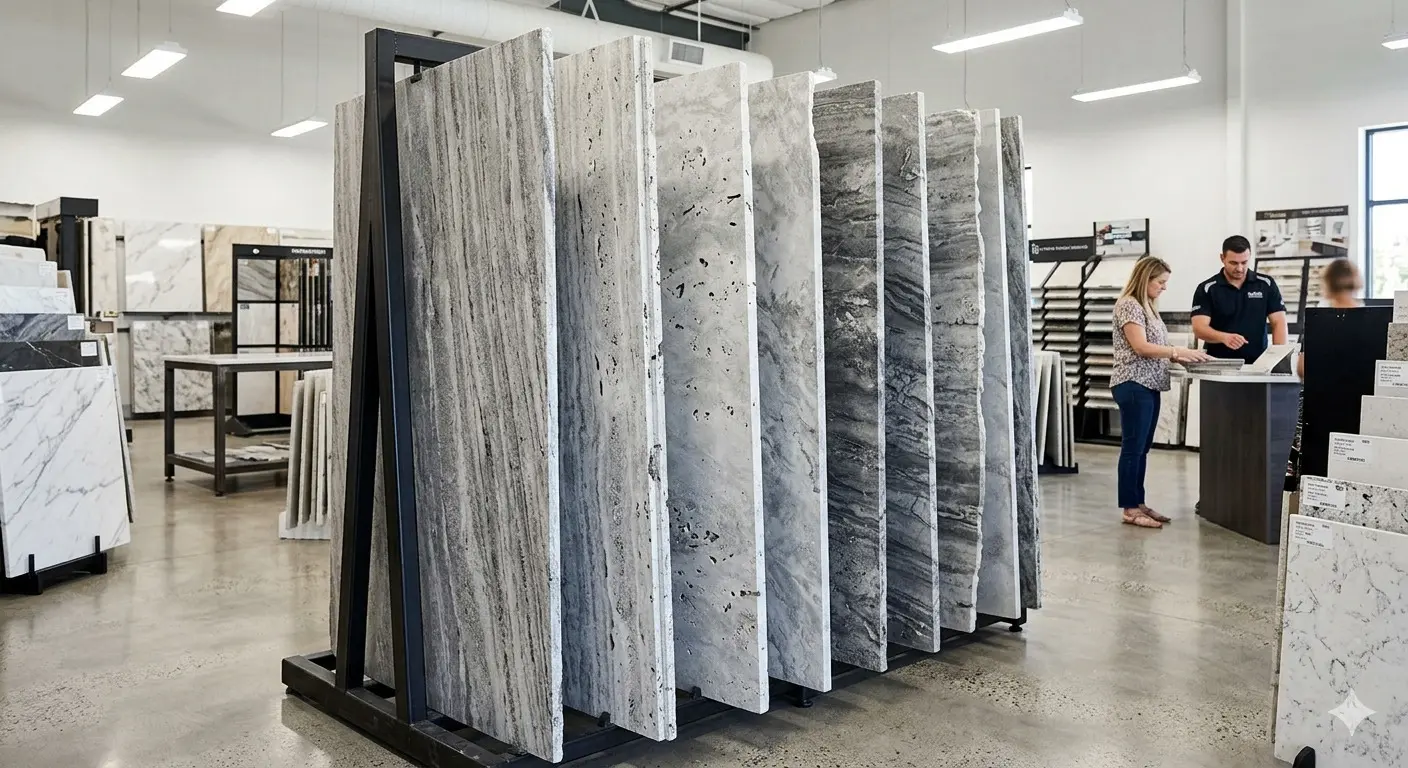
Start With Veining: Direction, Scale, and Distribution
Veining is the easiest characteristic to misread from a small sample. A sample chip shows you the color and general movement of a stone, but tells you nothing about whether those veins run edge to edge, cluster in the center, or shift dramatically across the full surface. When you stand in front of a complete slab, look at whether the veining is directional or branching. Directional veining reads as calm and structured. Branching, high-movement veining reads as more active.
Scale matters just as much as direction. A bold vein that reads well across a full slab may feel overwhelming when cut down to a 25-inch perimeter counter, while a delicate vein may nearly disappear on a small vanity. Before selecting, mentally map where the most expressive part of the slab will land in your layout. Our design team is available at each location to help you work through this. You can also book a showroom appointment to review options side by side before you decide.
Also check for evenness of distribution. A slab where all the activity is concentrated in one corner will look unbalanced once installed, especially on a long run.
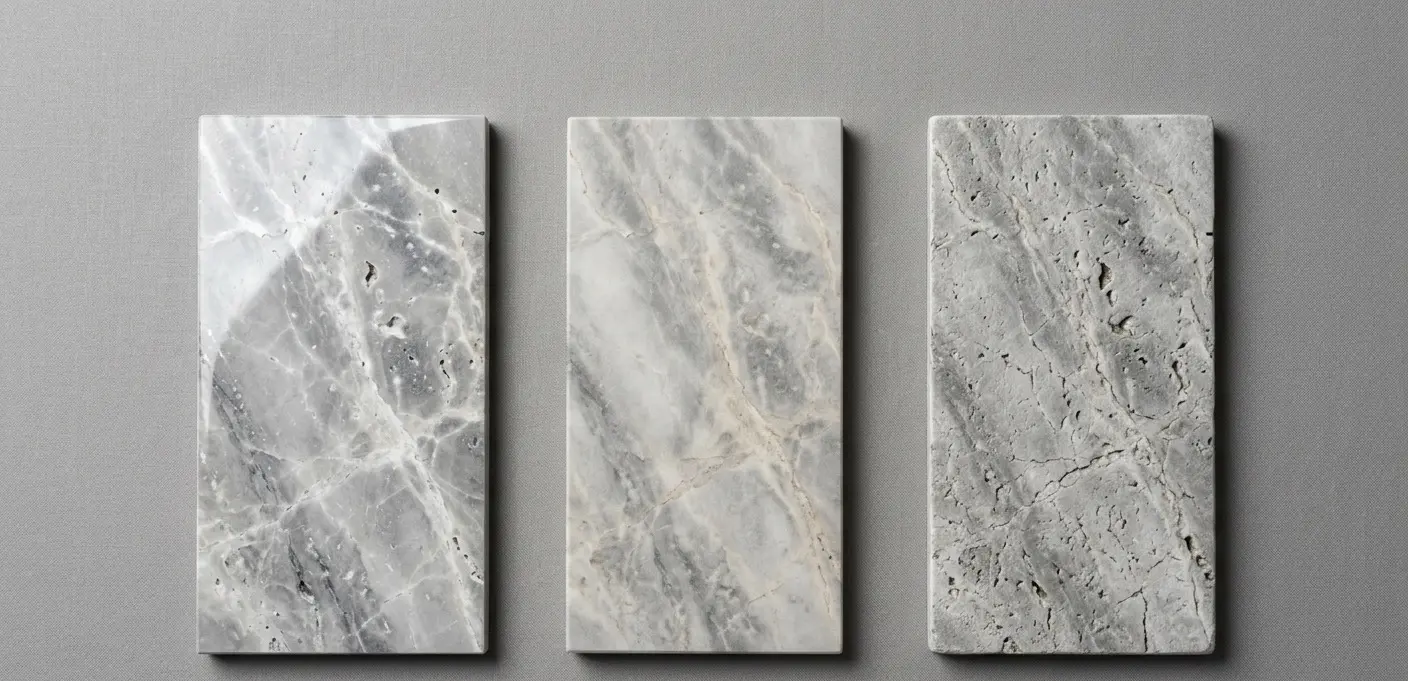
Fissures vs. Cracks: Know the Difference
This is the distinction that confuses more buyers than any other, and it matters because one is a structural concern and one is not.
A fissure is a natural separation within the stone's crystalline structure. It is not a defect. Fissures are present in nearly every slab of natural stone to some degree, do not affect structural integrity under normal countertop conditions, and will feel smooth when you run a finger along them.
A crack is damage caused by stress during quarrying, transport, or handling. Cracks run deeper into the stone and may show as a separation you can feel with your fingernail. They represent actual structural compromise and should influence your decision on whether to purchase that slab, or at minimum, how it is cut.
When evaluating a slab, run your hand slowly across the full surface. Any spot where the surface catches your nail or shows an obvious gap needs a closer look. Ask the stone specialist working with you to confirm what you are seeing. For a broader look at how natural stone performs as a countertop material, This Old House covers the key characteristics worth understanding before you shop.
Evaluate Resin Fill
Most natural stone slabs receive some amount of resin fill during processing to stabilize natural voids and smooth the surface before polishing. A moderate amount is normal and does not indicate a low-quality slab.
What to watch for is heavy fill, which suggests the stone had significant voids or structural weakness at the quarry stage. Heavy fill areas often appear slightly different in sheen or color from the surrounding stone and can feel slightly raised when you run your hand across the surface.
As a direct stone importer, we work directly with quarry sources, and our team can speak to the sourcing background of any material you are viewing. If you are also weighing engineered stone options, occupational health guidance on engineered stone from NIOSH is worth reviewing before committing to that material category.
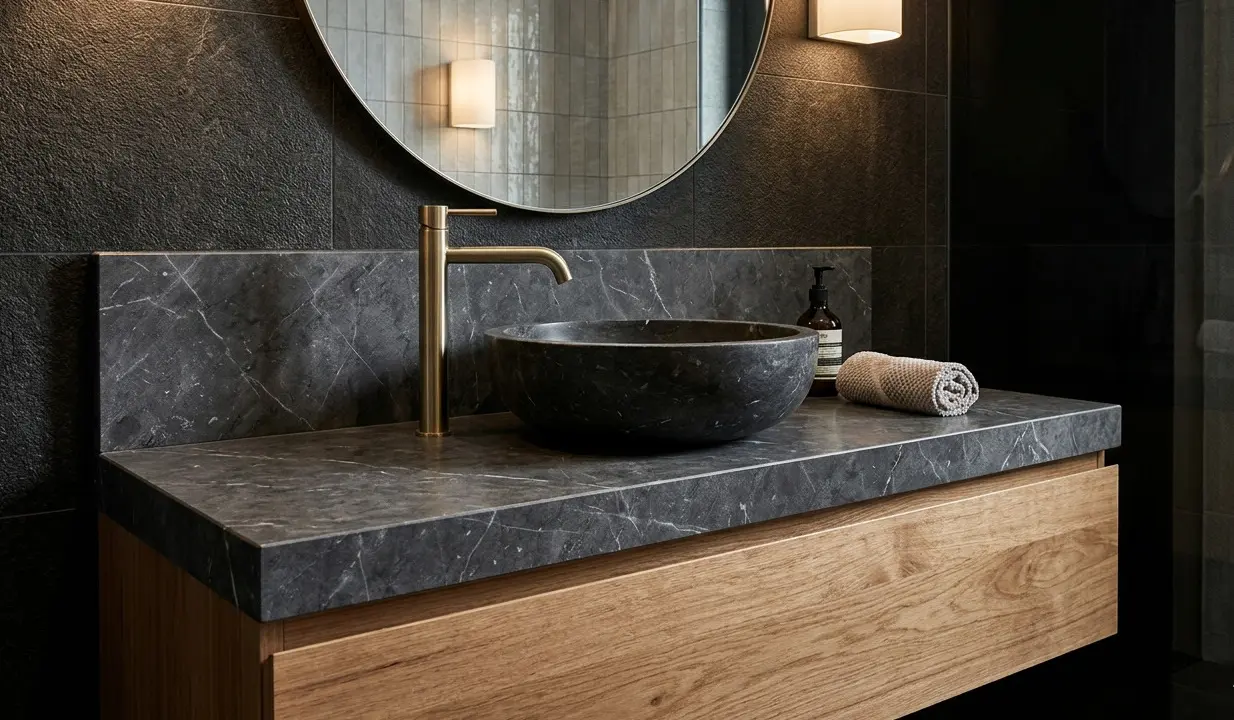
Check Thickness Consistency
Standard countertop slabs come in two common thicknesses: 2cm (approximately 3/4 inch) and 3cm (approximately 1 1/4 inches). For most countertop applications, 3cm is the industry standard because it provides structural integrity across unsupported spans without requiring plywood backing. Fine Homebuilding's natural stone countertop guide covers slab thickness, support requirements, and material selection considerations in useful detail.
When evaluating a slab, check whether the thickness is consistent from one end to the other by running your hand along the edges and viewing the slab from the side. Significant variation can create complications and may indicate inconsistent processing. Also note edge condition: clean, consistent edges suggest careful handling, while chips along the edge are worth factoring into how the slab is cut.
View the Slab Under Multiple Lighting Conditions
Showroom lighting is designed to present stone favorably, but your countertop will spend its life under natural light, overhead fixtures, and under-cabinet lighting. A slab that reads well under showroom fluorescents may look warmer, cooler, or lighter in your actual space.
Whenever possible, view a slab near a natural light source or ask if samples are available to take home. Pay attention to undertones in particular. A stone marketed as white may have cool gray, warm cream, or faintly green undertones that only become apparent under natural light, and those undertones interact with your cabinet color, flooring, and hardware.
Our showrooms in Reno, Minden, Sacramento, and Fernley keep samples available so you can view materials in your own space before finalizing your selection. We also offer free design consultations to help you work through material combinations with your specific project in mind.
Assess the Full Slab, Not Just One Section
The most important principle in reading a slab is to evaluate the entire piece, not just the section that caught your eye. The section facing you in the showroom rack may be the most active or prominent part, but your fabricator will cut from the full surface, and the less prominent areas will end up on your countertops too.
Walk the full length of the slab, checking the far edges, corners, and areas harder to see when the stone is racked tightly. For large kitchens where two or more slabs will be used, ask to see multiple slabs from the same block or lot to evaluate how consistently the material runs.
Conclusion
Reading a stone slab before you buy requires seeing the material in person. Veining scale, fissure patterns, resin fill, thickness consistency, and lighting behavior are all factors that photographs cannot communicate accurately. Each element gives you a clearer picture of how the stone will look installed and whether it is the right fit for your project.
At Nova Tile and Stone, our showrooms carry natural stone slabs you can view, compare, and evaluate side by side. As a direct importer, we know the sourcing history of the materials we carry and our commission-free design team is available at each location to walk you through the evaluation process. Whether you are selecting granite for a high-use kitchen, marble for a bathroom vanity, or quartzite for a statement island, the goal is to make sure you have the information needed for a well-informed selection.
Visit our showrooms in Reno, Minden, Sacramento, and Fernley, or connect with our team to schedule a free design consultation. Contractors and designers working across multiple projects can apply for a trade account for streamlined slab access. You can also request a slab quote directly through our website.
Frequently Asked Questions
What is the difference between a fissure and a crack in a natural stone slab?
A fissure is a naturally occurring separation within the stone's crystalline structure. Fissures are smooth to the touch and do not affect structural integrity. A crack is physical damage caused by stress during quarrying, transport, or handling. Cracks may feel rough or uneven and can represent a structural concern depending on their location and depth. Running your finger along a line in the stone is a simple way to begin distinguishing between the two.
Is resin fill in a natural stone slab a sign of poor quality?
Not necessarily. A moderate amount of resin fill is standard practice and is applied to stabilize minor surface voids and smooth the slab before polishing. Heavy fill covering large areas can indicate that the stone had significant structural voids at the quarry stage, which may be worth factoring into your decision for high-visibility surfaces. Ask your stone specialist directly about the fill level on any slab you are seriously considering.
Can I select a slab from a photo or sample chip?
A sample chip gives you useful information about color, general veining character, and finish, but does not show how veining distributes across a full 9-foot slab, where fissures are located, or how the stone reads under different lighting. Full-slab viewing in person is always the better approach, as the area that will end up on your countertop may look different from the section facing you in the rack.
How do I know if a slab labeled as quartzite is actually quartzite?
True quartzite rates a 7 or higher on the Mohs hardness scale and will scratch glass clearly when a chip is dragged firmly across the surface. If the stone slides across without marking the glass, the material is likely marble or dolomite, both of which are sometimes mislabeled as quartzite. An acid test using lemon juice or white vinegar is a second confirming test: genuine quartzite will not etch or react, while marble and dolomite will show a dull reaction.
How many slabs do I need to view before selecting one?
Viewing at least two to three slabs of the same material gives you a useful sense of the natural variation within that stone. Slabs from the same quarry can differ noticeably in color intensity, veining density, and movement. For large projects where more than one slab will be used, viewing and approving multiple pieces at the same time allows you to confirm they read consistently together.