The best marble for kitchen countertops depends on your priorities. Carrara marble is the most accessible option, with soft gray veining and wide availability. Calacatta marble offers a bolder, more dramatic look with a brighter white background and thicker veining. Danby marble is the most durable choice, with lower porosity and better stain resistance than most Italian varieties. Other popular options include Statuario, Arabescato, and Nero Marquina, each suited to different design styles and maintenance preferences.
Marble has graced kitchens for centuries, and its appeal shows no signs of fading. Few materials can match its natural elegance: the luminous surface, the organic veining, the unmistakable sense of luxury it brings to any space. But choosing the right variety is about more than beauty. Your kitchen endures daily heat, spills, food prep, and heavy use, so the marble you select needs to perform just as well as it looks.
Not all marble is created equal. Some varieties are denser and more stain-resistant, while others offer dramatic veining that transforms a countertop into a true focal point. Understanding the differences between types and knowing what to look for when shopping makes all the difference between a countertop you love for decades and one that requires constant maintenance from day one.
As a direct stone importer, we offer thousands of premium slabs at competitive prices across four showroom locations in Northern Nevada and Northern California. Our design consultants can walk you through the options in person, help you compare slabs under natural light, and match you with the right marble for your lifestyle and budget. Here's what you need to know before making your decision.
What Makes Marble Different from Other Countertop Materials?
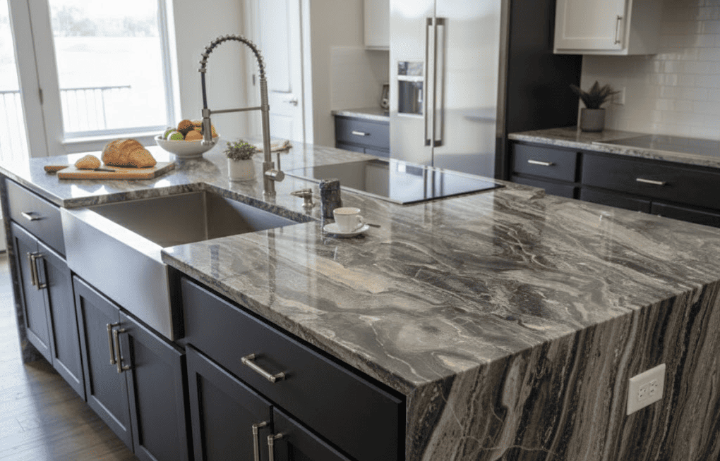
Marble is a metamorphic rock formed when limestone is subjected to intense heat and pressure deep within the earth's crust. This geological transformation produces a crystalline, recrystallized structure that gives marble an unmatched depth and luminosity that no engineered material can fully replicate. For a deeper look at how natural stone compares to synthetic alternatives, This Old House has a comprehensive overview of stone countertop materials worth reading before you shop.
The primary mineral in marble is calcite (CaCO3). Impurities introduced during formation, including clay, iron oxides, graphite, and silica, create the veining and color variations that make each slab unique. No two marble slabs are ever identical, which is part of what makes natural marble so compelling as a design material.
Marble rates between 3 and 5 on the Mohs hardness scale, softer than granite or quartz but still durable enough for kitchen use when properly maintained. It is naturally cool to the touch, making it a favorite among bakers. On the downside, marble is porous and reactive to acids, which means spills from citrus, wine, vinegar, and tomato-based foods can etch or stain the surface if not wiped up promptly.
The Most Popular Types of Marble for Kitchen Countertops
Carrara Marble
Carrara is the most widely recognized marble in the world, quarried from Tuscany, Italy. It features a soft white or light gray background with fine, feathery gray veining evenly distributed across the slab. The result is an understated, classic look that works equally well in modern and traditional kitchens.
Carrara is one of the more porous marble varieties, requiring regular sealing and prompt attention to spills. Its widespread availability makes it one of the most accessible natural marble options and a great entry point for homeowners who want genuine marble without stepping into the luxury tier. It pairs beautifully with white or off-white cabinetry, warm wood tones, and both polished and honed finishes.
Calacatta Marble
Often confused with Carrara due to its shared Italian origin, Calacatta is a distinctly different and considerably rarer material. Where Carrara is subtle, Calacatta is bold. It features a bright white background with thick, dramatic veins in shades of gold, warm beige, or deep gray, creating high-contrast patterning that commands attention.
Calacatta's lower porosity compared to Carrara makes it slightly more forgiving in a kitchen environment, but it still requires sealing and careful maintenance. If your design vision centers on a statement kitchen island or a countertop that commands attention, Calacatta delivers that impact like no other material. It pairs exceptionally well with dark cabinetry, brass or matte black hardware, and minimalist design schemes.
Statuario Marble
Statuario occupies a middle ground between the quiet refinement of Carrara and the drama of Calacatta. Quarried in Italy, it features a bright white base with well-defined veins that tend to be finer and more linear than Calacatta's bold movements, making it both sophisticated and versatile across a wide range of design styles.
One of Statuario's most appealing qualities is the luminosity of its white base, which interacts beautifully with natural light. When shopping for Statuario, ask to see multiple slabs side by side, as veining patterns can vary significantly from slab to slab.
Arabescato Marble
Arabescato is an Italian marble defined by its distinctive swirling gray veins against a soft white background. Unlike the more uniform veining of Carrara or the bold movements of Calacatta, Arabescato's veining is erratic and fluid, almost painterly in quality, giving each slab a one-of-a-kind character.
Its heavily veined surface has a practical advantage: minor scratches and light etching tend to be far less visible against the complex pattern. Arabescato pairs especially well with minimalist cabinetry and neutral color palettes that let the marble's natural movement take center stage.
Nero Marquina Marble
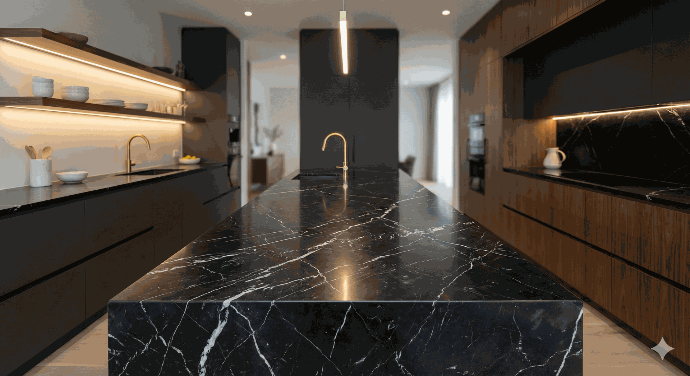
For kitchens where a bold, contemporary aesthetic is the goal, Nero Marquina offers something entirely different from the traditional white marble palette. Quarried in the Basque Country of Spain, this marble features a deep jet-black background accented by crisp white veining that can appear sporadic, linear, or dramatically sweeping depending on the slab.
Its dark surface makes dust, water spots, and light scratches more visible than they would be on lighter varieties, and it requires diligent sealing. For the right kitchen, particularly those with white or light cabinetry, industrial-inspired designs, or monochromatic color schemes, it delivers a level of drama and sophistication that is difficult to achieve with any other natural stone.
Danby Marble
Quarried in Vermont, Danby is a domestically sourced alternative to Italian marble that deserves serious consideration. It features cream or white backgrounds with soft, diffused veining in gray, gold, or taupe tones, and comes in several varieties including Imperial, Montclair, and Eureka.
What sets Danby apart is its lower porosity compared to most Italian marbles, which translates to improved stain resistance and less frequent sealing requirements. It is one of the most durable natural marble options for kitchen countertops, making it a smart choice for households that cook frequently. Danby works well in farmhouse kitchens, transitional designs, and any space where a natural, understated aesthetic is the goal.
Key Factors to Consider When Choosing Your Marble
How you use your kitchen. A household that cooks daily with acidic ingredients will see more wear on a marble countertop than one used for light prep work. Denser, lower-porosity options like Danby or a honed-finish Carrara tend to be more forgiving in high-use environments.
Your maintenance commitment. All natural marble requires sealing once or twice a year. If you appreciate the natural patina marble develops over time and enjoy caring for a living material, it rewards that investment with timeless beauty. If you prefer a low-maintenance surface, quartz or porcelain may be a better fit, though it is worth noting that engineered stone fabrication carries its own health and safety considerations that consumers should research before making a final decision.
Finish selection. A polished finish enhances veining and adds reflective depth but shows etching more readily. A honed finish provides a softer, matte look that conceals minor wear better, making it a popular choice for busy kitchens. Leathered finishes add texture and depth while offering good resistance to fingerprints and light staining.
Slab grading. Natural marble is graded A through D based on veining consistency and the presence of natural fissures. Grade A slabs are the most uniform and command the highest prices. For a detailed breakdown of how slab grading works in practice, Fine Homebuilding's guide to natural stone countertops is an excellent reference. Viewing slabs in person is the only reliable way to assess grade and make a confident selection.
Seeing Marble Slabs in Person Makes All the Difference
Selecting marble from a website photo is one of the most common mistakes homeowners make. Marble's translucency, veining depth, and color shift dramatically depending on lighting conditions, and two slabs of the same variety can look entirely different from one another.
Our Reno, Minden, Sacramento, and Fernley showrooms carry a curated selection of natural marble slabs, including premium options like Calacatta and Carrara, that you can see, touch, and compare in person. View our current slab inventory online before your visit to get a sense of what's available, then come in to evaluate slabs against your cabinetry samples, flooring, and hardware selections.
If you have a specific marble variety in mind, schedule a free design consultation and our team will let you know what's currently in stock and help you find the closest match to your vision.
Conclusion
Marble remains one of the most sought-after countertop materials for good reason. Its natural beauty, the uniqueness of every slab, and its timeless presence in a kitchen are qualities that no engineered surface has fully replicated. The key is choosing the right variety for your lifestyle, selecting a finish that works for how you actually use your kitchen, and committing to the maintenance routine that keeps it looking its best.
Whether you are drawn to the classic refinement of Carrara, the bold luxury of Calacatta, the practicality of Danby, or the drama of Nero Marquina, our team has the expertise to help you find the right marble for your project. Our complete stone and tile collection spans every style and budget. Visit one of our four showroom locations to browse our slab inventory in person and make your decision with confidence.
Frequently Asked Questions
Does marble need to be sealed before use as a kitchen countertop?
Yes. All natural marble should be sealed before installation and resealed periodically, typically once or twice a year. Sealing does not make marble stain-proof, but it significantly slows absorption and gives you more time to wipe up spills before they penetrate the surface.
What is the difference between Carrara and Calacatta marble?
Both are Italian marbles, but they have distinct appearances. Carrara has a softer white or light gray background with fine, subtle veining and is one of the more accessible natural marble options. Calacatta features a brighter white background with bold, dramatic veining in gold or deep gray tones and is considerably rarer and more premium.
Is marble too high-maintenance for a kitchen countertop?
Marble requires more care than non-porous materials like quartz or porcelain, but many homeowners find the maintenance routine manageable. The essentials are sealing once or twice a year, wiping spills promptly, and using pH-neutral cleaners.
What marble finish is best for a busy kitchen?
A honed or leathered finish is generally the better practical choice for a high-use kitchen. Polished marble is stunning, but it shows etching and fingerprints more readily. Honed and leathered finishes conceal minor wear better and maintain a more consistent appearance over time.
Does our marble slab inventory include all of the varieties mentioned in this article?
Our inventory is constantly evolving as we receive new shipments. We consistently carry popular varieties like Calacatta and Carrara, and our selection changes regularly. We recommend visiting one of our showrooms to see what's currently available and speaking with a design consultant to find the right fit for your project.