Choosing natural stone for an accent wall comes down to four decisions: stone type, finish, room placement, and how the slab is viewed before purchase. The most common materials used for stone accent walls are marble, quartzite, granite, travertine, and onyx, each with distinct visual characteristics and performance properties that determine where each one works best. Marble is the most widely specified for its dramatic veining and strong design presence. Quartzite offers similar aesthetics with greater hardness, making it the stronger choice near heat or in kitchen applications. Granite brings crystalline depth and bold mineral pattern. Travertine delivers warm, porous texture suited to Mediterranean and transitional interiors. Onyx, when backlit, produces a translucent glow that differs from other natural stone materials.
Finish selection, choosing between polished, honed, and leathered surfaces, determines how the stone interacts with light and how formal or organic the final installation reads. Room placement determines impact: floor-to-ceiling coverage on a fireplace wall, behind a headboard, or as a kitchen range backdrop consistently produces stronger results than partial or wainscot-height applications. And because veining, scale, and tonal range do not translate accurately through online photography, viewing full slabs in person before committing is a key step in the selection process.
At our stone showrooms in Reno, Minden, Sacramento, and Fernley, we work with homeowners and designers selecting slabs for vertical applications every week. This guide covers each decision in detail.
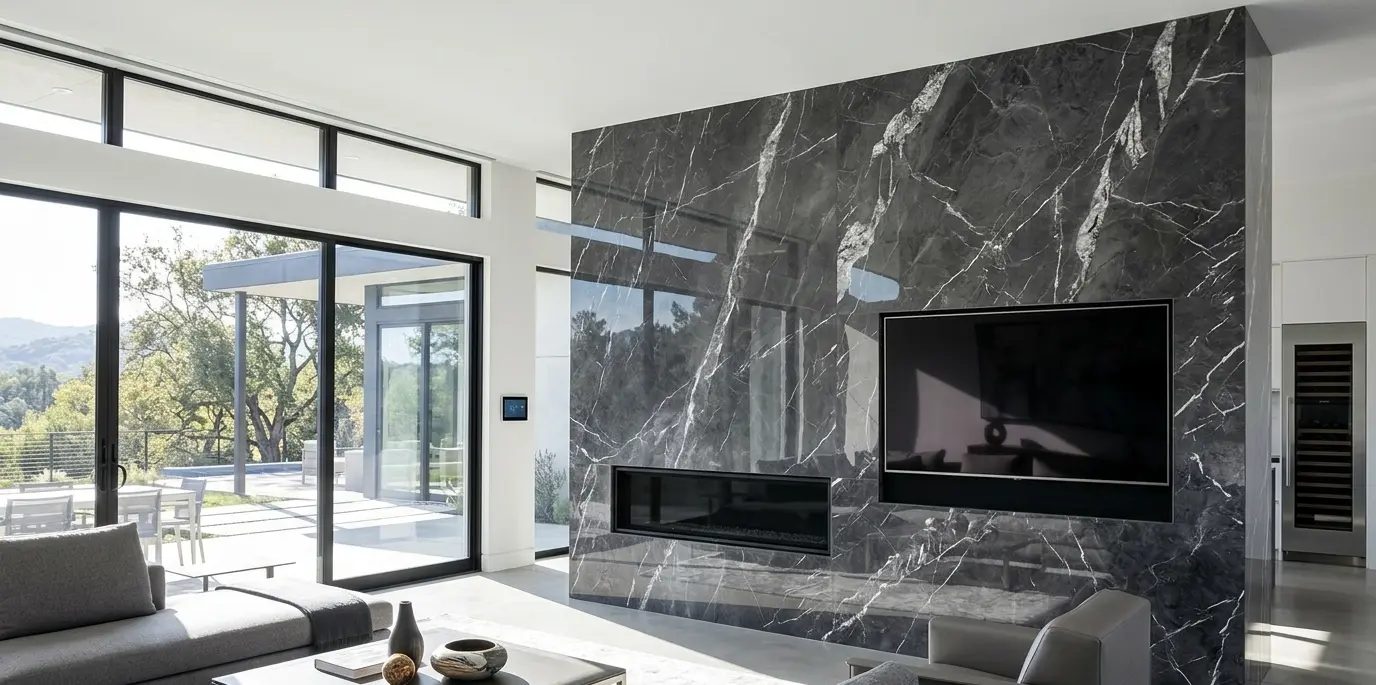
Why Natural Stone Works for Accent Walls
Paint and wallpaper change a room's color. Stone changes its character. The depth of a veined marble slab, the movement in a quartzite panel, or the warm grain of a granite surface creates a visual complexity that reads differently throughout the day as light shifts. Stone also adds physical texture, which makes a wall feel like a deliberate architectural element rather than simply a backdrop.
Because accent walls involve far less physical contact than countertops or floors, the performance requirements are lower. Staining resistance, scratch hardness, and heat tolerance matter far less on a wall than they do on a horizontal working surface. This also means homeowners who might otherwise gravitate toward engineered alternatives can consider natural stone freely here, without the durability trade-offs that apply to horizontal surfaces. For context, ongoing health research on engineered stone processing has added another reason many designers and homeowners are returning to quarried natural materials.
Unlike trend-driven finishes, a well-selected stone slab holds its long-term design value across decades. For homeowners who prefer buying stone locally from a direct importer rather than through a distributor chain, the advantage is access to full slab inventory and the ability to view panels at true scale before committing.
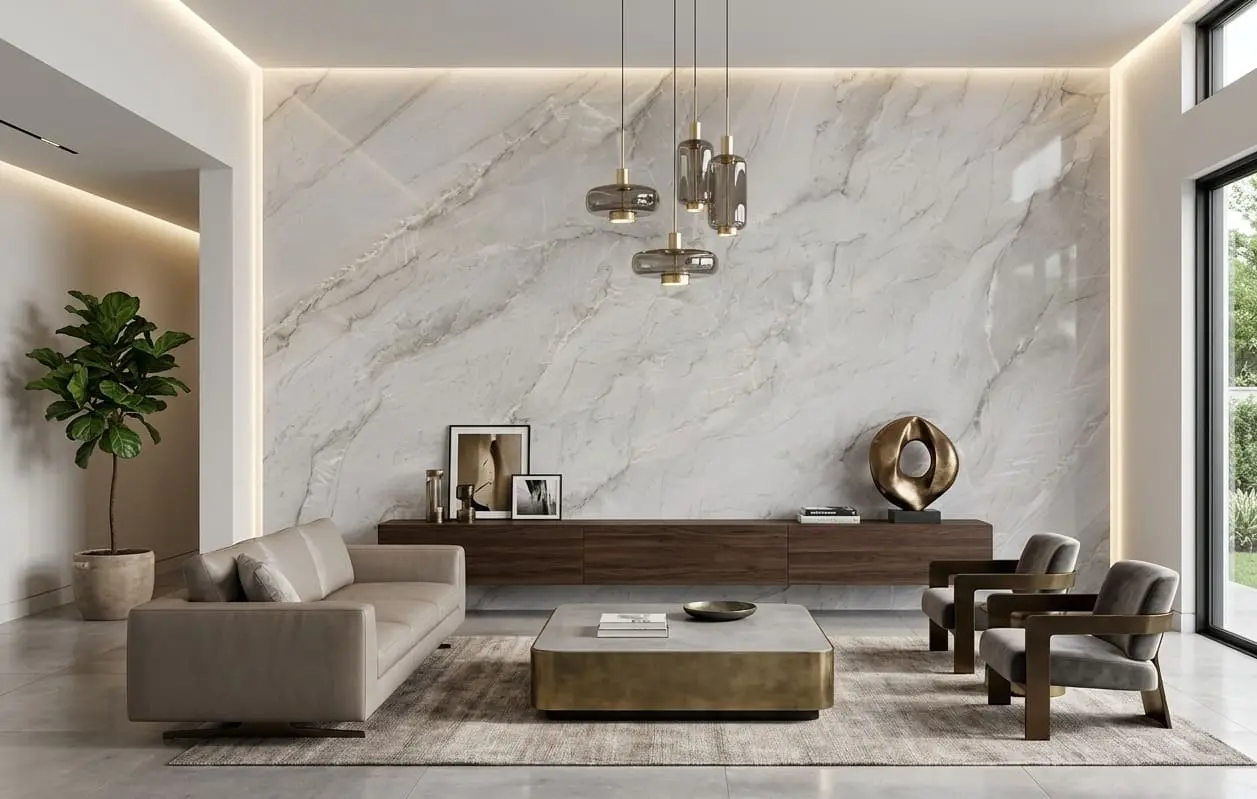
Choosing a Stone Type
Marble
Marble is the most popular stone for accent walls. Its characteristic veining creates natural movement that makes it well-suited as a focal point. Light-toned marbles such as Calacatta and Carrara brighten a space and pair well with both warm and cool surrounding palettes. Darker marbles like Nero Marquina or Portoro create high contrast against light cabinetry or white walls and bring a more formal, sophisticated tone.
On a wall, marble's acid sensitivity, a relevant concern on kitchen countertops, becomes a much smaller factor. Marble works especially well in living rooms, bedroom feature walls, bathroom walls behind freestanding tubs, and powder rooms where the surface area is small and the visual impact is large.
Quartzite
Quartzite brings the aesthetic qualities of marble, particularly its flowing veining and soft tonal ranges, with significantly greater hardness and density. Popular varieties for accent walls include Taj Mahal, Calacatta Macaubas, and Patagonia, each offering ivory, gold, or blue-gray tones with dramatic natural movement.
Because quartzite is harder and less reactive than marble, it is a practical option for kitchen accent walls, fireplace surrounds, and any location where contact or heat is a possibility.
Granite
Granite's mineral-rich surface adds a different kind of visual energy. Rather than flowing veins, granite features crystalline flecks, interlocking mineral patterns, and tonal variety across the slab face. Darker granites, including black and deep green varieties, work well as accent wall materials in contemporary and industrial-influenced spaces. Lighter granites with golden or cream tones suit traditional or transitional interiors.
Granite's high density and low porosity make it a practical option for vertical uses near moisture or kitchen activity. For a deeper look at stone durability and maintenance across material types, This Old House offers a thorough breakdown that applies equally to wall and countertop applications.
Travertine
Travertine has a long history of use as a wall material in architecture. Its natural pores and tonal variation, ranging from ivory and cream to rich walnut and gold, create a texture and warmth that differs from polished stones. It works especially well in Mediterranean, Tuscan, and transitional interiors and is a popular choice for fireplace surrounds, entryway feature walls, and bathroom wall applications. Travertine should be sealed on installation to protect against moisture penetration.
Onyx
Onyx is a translucent natural stone used in interior applications where backlit effects are a design goal. Its translucent structure allows light to pass through the material, creating a glowing effect when backlit with LED panels. Honey onyx and green onyx are the most commonly specified varieties for backlit wall installations. Given its relative softness compared to granite or quartzite, onyx is best reserved for low-contact settings such as powder rooms, bar walls, or primary suite feature walls.
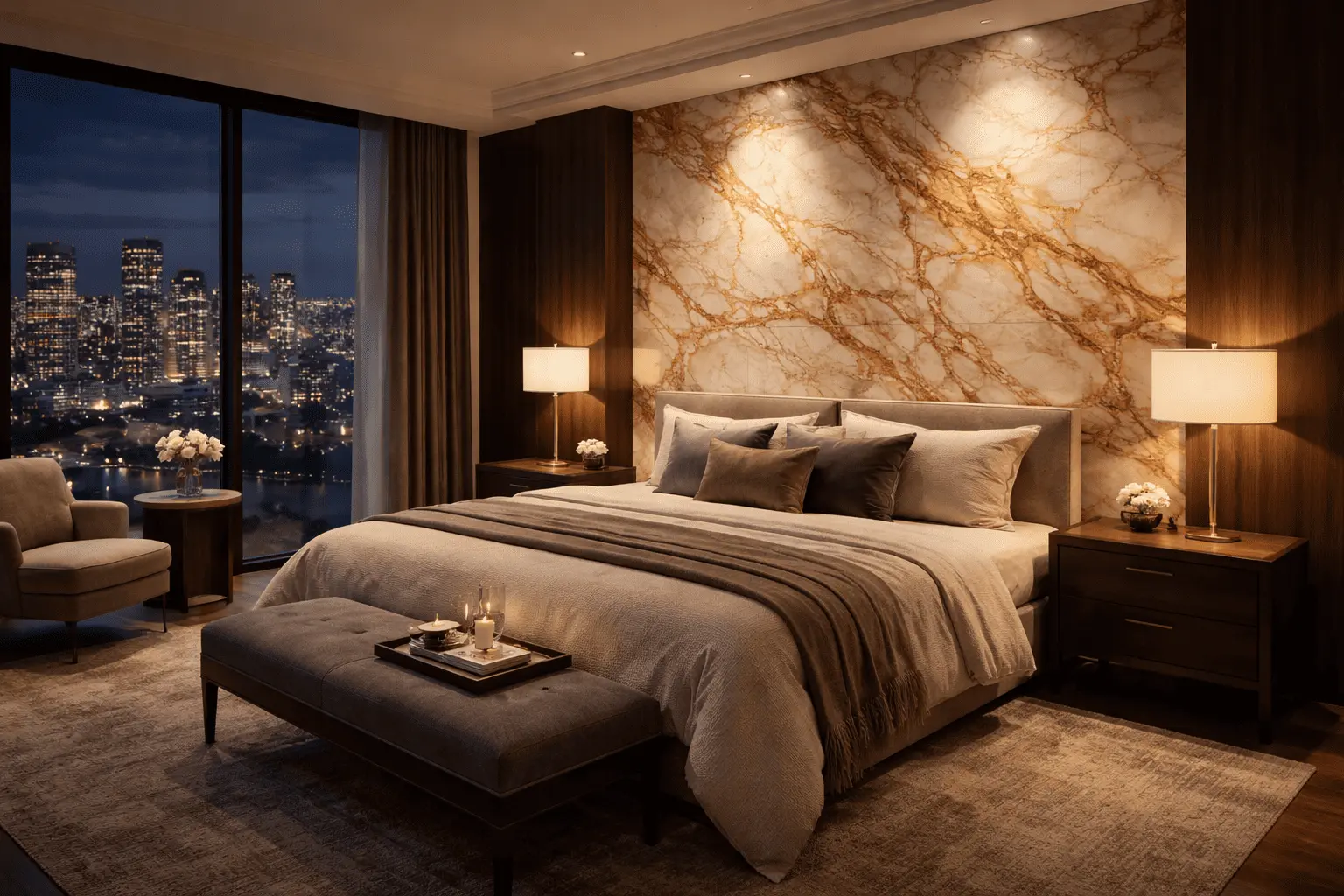
Understanding Finish Options
The finish applied to a slab affects how it interacts with light and what the surface feels like. For accent walls, the three most common finishes are polished, honed, and leathered.
A polished finish brings out the full depth of color and creates a reflective surface that amplifies veining and movement. It is a common choice for formal or contemporary spaces.
A honed finish produces a matte or satin appearance that softens the stone's visual intensity and creates a more understated, architectural look. Honed finishes are particularly popular in bedroom feature walls and transitional interiors.
A leathered finish adds a subtle texture while maintaining most of the stone's color depth. It reads as more tactile and organic than polished or honed and works well in earthy, natural material palettes. Leathered finishes have seen significant growth in residential design specifications in recent years.
Selecting the Right Wall and Room
The most successful accent walls are the first wall visible on entry, anchor a key piece of furniture or architectural feature, or occupy the visual center of the room's primary sitting or sleeping orientation.
In a living room, the fireplace wall or the wall behind the main sofa are natural choices. In a primary bedroom, the wall behind the headboard is the most commonly specified location. In a kitchen, the wall behind the range or the full run behind a waterfall island creates a cohesive stone moment that ties countertop and wall together. In an entryway, a full-height stone panel on the arrival wall sets the tone for the entire home.
Floor-to-ceiling or wall-to-wall coverage creates the strongest impact. Partial applications can work in smaller spaces but require more careful proportional planning to avoid reading as incomplete.
Bookmatching for Maximum Visual Impact
Bookmatching, the practice of placing two consecutive slabs side by side so their veining mirrors symmetrically, is a well-established technique for accent wall design. The result creates a symmetrical pattern that reads as deliberate and visually structured.
Bookmatched installations work especially well on fireplace walls, behind headboards, and in any space where the wall is viewed head-on from a fixed position. Selecting slabs with strong natural movement and ensuring that the veining runs in a direction that reads well at wall scale are two key criteria. Our team can help identify consecutive bookmatching pairs when you browse our slab inventory across all four locations.
Lighting, Palette, and Slab Viewing
Stone's appearance shifts significantly with light. A polished marble slab that looks bright and cool under showroom fluorescents may read warmer and deeper under residential LED or incandescent lighting. Viewing slabs under conditions similar to the installation environment is the most reliable way to evaluate how the material will perform.
The surrounding palette should support rather than compete with the stone. Well-executed accent wall installations keep adjacent surfaces restrained in color and pattern. A heavily veined Calacatta marble wall paired with a busy wallpaper on adjacent walls creates visual conflict rather than hierarchy.
For an accent wall that may span eight to twelve feet or more, only a full slab view communicates the true scale of the veining, tonal range, and how the material will feel in the room. Our showrooms in Reno, Minden, Sacramento, and Fernley carry rotating slab inventory across marble, quartzite, granite, travertine, and onyx, including a current overstock selection that often includes premium panels at reduced availability. As a direct stone importer serving Northern Nevada and Northern California, we work with homeowners and trade professionals to identify the right slab for vertical applications and help visualize the installation at full scale.
Conclusion
Choosing natural stone for an accent wall is a decision that rewards careful attention to material, finish, placement, and light. Each of those factors builds on the others, and stone selected thoughtfully and viewed in person at full scale will read in the space as intended.
Whether you are drawn to the dramatic veining of bookmatched marble, the warmth of travertine, the crystalline depth of granite, or the glowing translucency of backlit onyx, our team is ready to help you find the right slab. Book a showroom appointment to view full panels in person, or request a slab quote to start your project with a clear picture of what is available and what works for your space.
Frequently Asked Questions
What is the best natural stone for an accent wall?
The best stone depends on the room, the design style, and the level of visual impact you want to create. Marble is the most popular choice for its distinctive veining and wide design applicability. Quartzite offers similar aesthetics with greater hardness, making it well-suited for kitchen accent walls and fireplace surrounds. Travertine brings warmth and texture to transitional and Mediterranean-influenced spaces. Granite works particularly well in contemporary interiors where a bold, mineral-rich pattern is the goal.
Does a natural stone accent wall require maintenance?
Accent walls require significantly less maintenance than stone countertops or floors because they are not subject to daily use, spills, or abrasion. Most natural stone used on walls should be sealed on installation to protect against moisture and dust accumulation. Periodic resealing, generally every one to two years depending on the stone type and exposure, keeps the surface protected. Routine cleaning with a soft cloth and a pH-neutral cleaner is all that is typically needed for day-to-day care.
Can I use marble on a fireplace accent wall?
Yes. Marble has been used in fireplace surrounds and mantel applications for centuries and performs well in this setting. The key consideration is that stone installed directly within the firebox opening, or in close proximity to an active flame, should be specified with heat tolerance in mind. For the broader accent wall surrounding the firebox, marble, quartzite, and granite are all appropriate choices.
How much stone do I need for an accent wall?
Standard natural stone slabs typically range from roughly 55 to 65 square feet per slab, though this varies by material and origin. For a full floor-to-ceiling accent wall, measure the total square footage and account for cuts and waste, which generally adds 10 to 15 percent to the total material required. Viewing the actual slabs in person is the most reliable way to plan coverage.
What finish is best for a stone accent wall?
Polished finishes create a high-reflective surface that suits formal or contemporary spaces. Honed finishes produce a softer, more architectural look that works well in bedrooms and transitional interiors. Leathered finishes add tactile depth and work well in natural material palettes alongside wood, linen, and earthy tones. The best finish is the one that serves the room's atmosphere and the stone's natural character.