To choose a backsplash that complements your countertop, follow these four steps: select the countertop first, read its pattern and movement, match the undertones of both surfaces, and align the finish and texture of the tile to the stone. The countertop serves as the design anchor because it covers more surface area and takes the most physical use. From there, the backsplash plays one of two roles: it supports the countertop quietly by staying within the same color family, or it creates deliberate contrast to add depth and visual separation.
The right pairing depends on the specific countertop material. Granite, with its natural speckle and movement, pairs best with simple, single-color tile. Marble, defined by its veining, works well with classic formats like subway tile in a neutral tone. Quartzite pairs with both neutral ceramics and moderately patterned tile depending on the stone's complexity. Travertine, with its earthy texture, pairs best with matte or handmade-look tile in warm tones. Porcelain slab countertops, which tend to have consistent patterning, offer the most flexibility in tile choice. For all stone types, a slab backsplash that extends the countertop material up the wall is also an option and eliminates grout lines entirely.
We carry both tile and natural stone slabs in one location across our showrooms in Reno, Sacramento, Minden, and Fernley, so you can compare pairings with real samples before making a decision.
Start with the Countertop
In almost every kitchen design, the countertop should be chosen before the backsplash. Countertops cover significantly more square footage, take more physical wear, and tend to be the dominant visual element in the room. Once you have a countertop selected, you have a clear anchor point to work from.
Bring a physical sample of your countertop material to the tile showroom if possible, or photograph it in natural light before you shop. Tile looks different in a warehouse versus in a kitchen with windows, and the goal is to find a pairing that works in your actual space. If you already have an existing countertop and are only updating the backsplash, the process is the same. Your countertop becomes the design anchor, and your backsplash has one job: to support, frame, or complement what is already there.
Match or Contrast
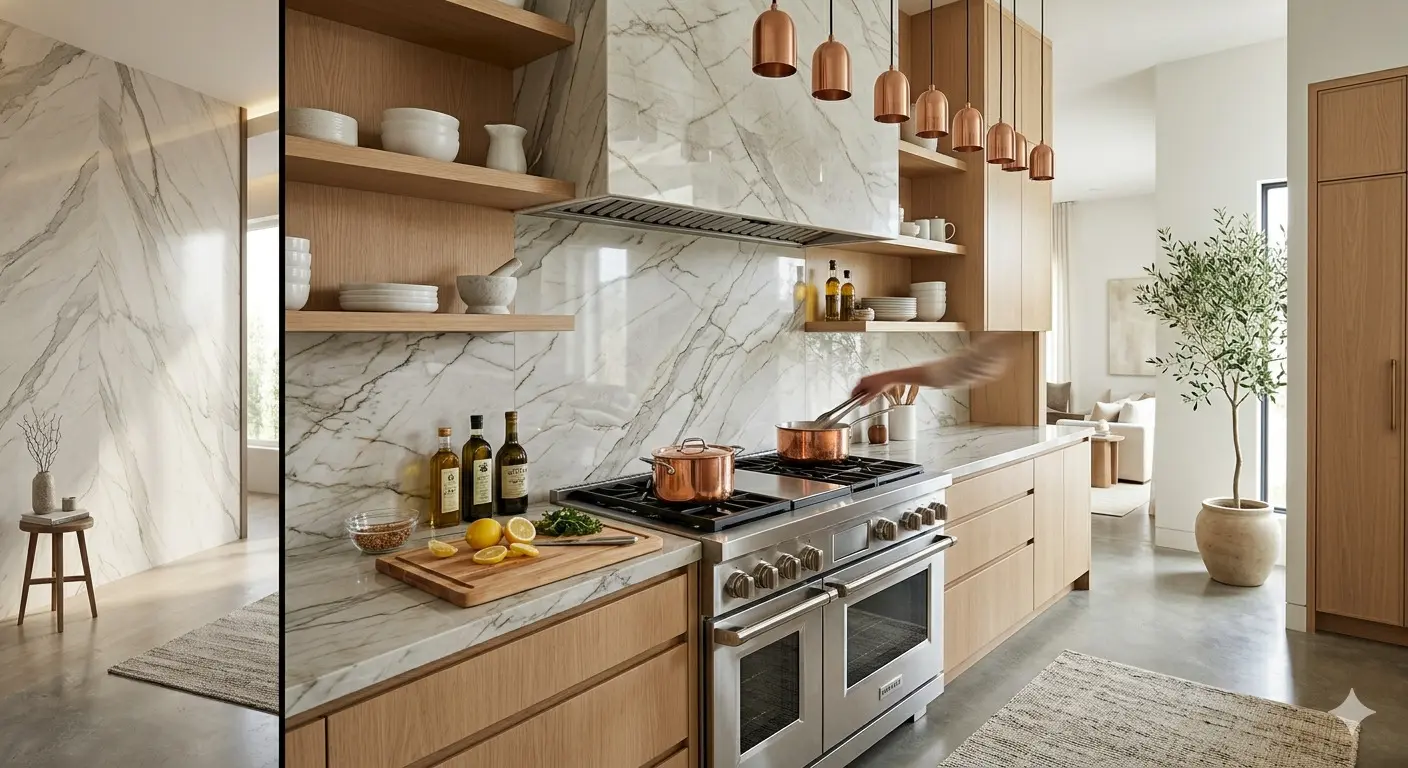
The most common question homeowners ask is whether the backsplash should match or contrast the countertop. Both approaches work. The right choice depends on how much visual activity is already present in the stone.
Matching means staying within the same color family and keeping tones close. This approach creates a calm, continuous look across the countertop and wall. It works well in smaller kitchens, minimalist designs, or spaces where the countertop already has significant veining or movement. When the stone does a lot of visual work on its own, a quiet backsplash that echoes its tones lets the material be the focal point.
Contrasting means introducing a different tone, texture, or material to create separation and depth. A dark countertop with a light backsplash, or a neutral stone with a patterned tile, can make both surfaces feel more intentional. Contrast works well in larger kitchens or when the countertop is relatively simple in color and pattern.
The key is that one surface should lead and the other should support. When both the countertop and the backsplash compete for attention, the result tends to feel busy rather than layered. The Fine Homebuilding guide to natural stone countertops notes that effective kitchen designs give the eye a clear focal point and let surrounding surfaces play a secondary role.
Read the Pattern and Movement in Your Stone
Before choosing any tile, study the specific countertop material you have selected. Natural stone is not uniform. Every slab of granite, marble, quartzite, and travertine has its own veining, mineral movement, and color variation.
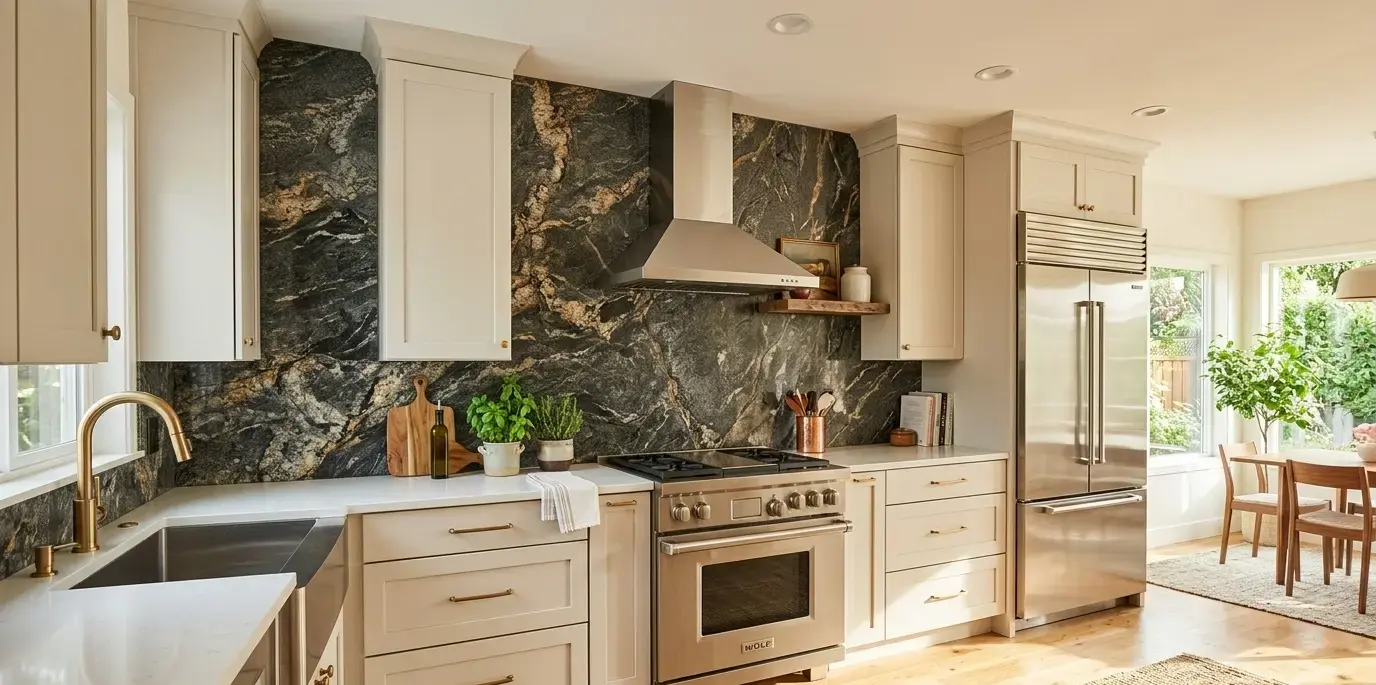
If your countertop has heavy movement, such as bold veining, dramatic color shifts, or large mineral deposits, the backsplash should be simple. A single-color subway tile, a solid ceramic, or a natural stone mosaic in a neutral tone all work well. These quieter choices give the eye somewhere to rest after taking in the complexity of the stone.
If your countertop has subtle movement, such as soft veining, uniform color, or a consistent texture, you have more flexibility. A patterned tile, a textured handmade-look ceramic, or a backsplash with moderate color contrast can add visual interest without competing with the countertop. Avoid pairing two highly active surfaces, as two busy patterns side by side tend to read as uncoordinated.
Color and Undertone Pairing
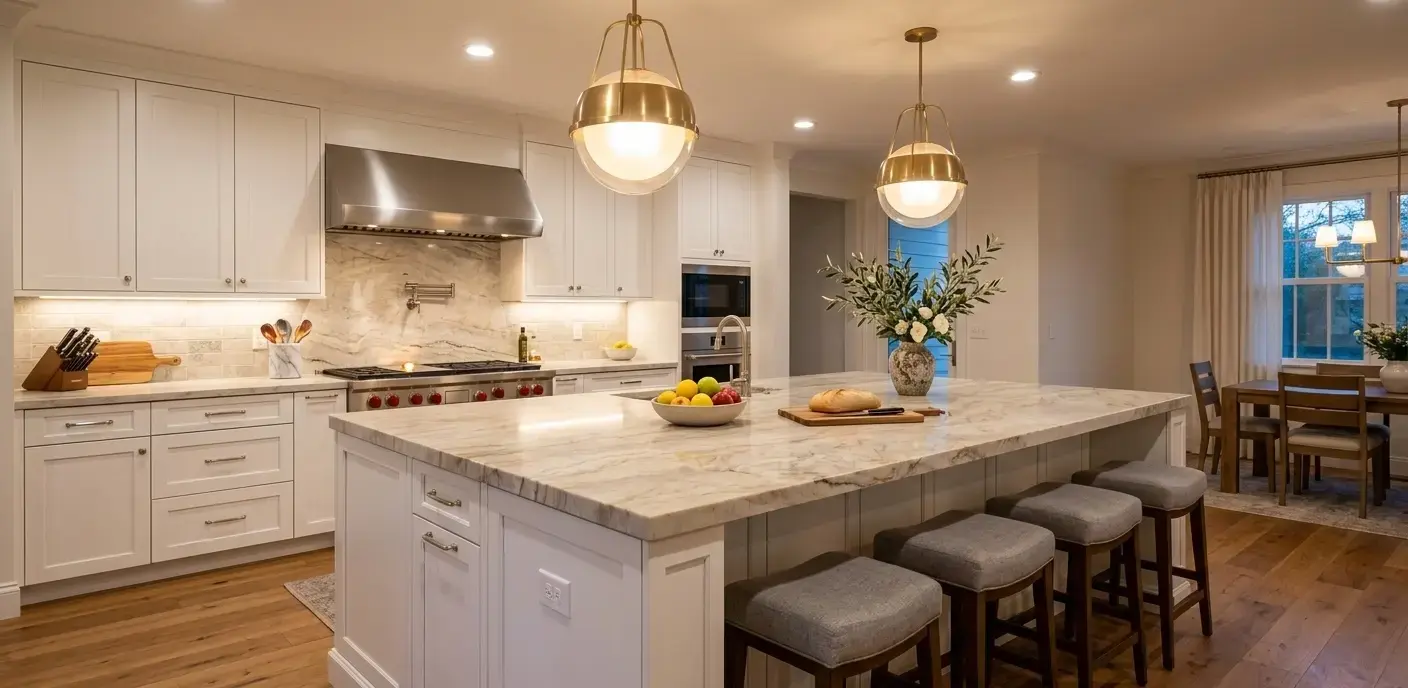
Every stone and every tile has an undertone, and undertones matter more than surface color when creating a cohesive pairing. A white countertop with blue-gray undertones will clash with a backsplash that has warm yellow or cream undertones, even if both surfaces look similar at a glance.
Look at your countertop in natural daylight and identify whether it reads warm (beige, cream, gold, brown) or cool (gray, blue, white, green). Then apply the same test to your tile options. Warm countertops pair best with warm backsplashes. Cool countertops pair best with cool or neutral tiles. You can introduce some contrast in tone as long as the undertones stay compatible.
If you want to pull a specific color from the countertop into the backsplash, look at the secondary or accent tones in the stone rather than the dominant background color. A granite with silver and black mineral movement might pair well with a deep charcoal tile that echoes the darker tones without replicating the overall color of the slab.
Pairing by Countertop Material
Granite has natural variation, mineral speckle, and movement that can range from subtle to dramatic. Because granite is already visually active, it pairs best with simple backsplash options: white or gray subway tile, solid ceramic, or glass tile in a coordinating tone. This Old House's overview of stone countertops recommends letting dramatic natural stone be the design statement and keeping surrounding elements restrained.
Marble is defined by its veining and luminous white or gray background. A white marble countertop with soft gray veining pairs naturally with a white or light gray tile in a classic format like subway or stack bond. Avoid combining marble with heavily patterned tile because the veining and the pattern will compete. A honed marble countertop also pairs well with a large-format matte ceramic that shares its soft, non-reflective finish.
Quartzite ranges from the soft warm tones of Taj Mahal to the bold gray movement of Super White and Calacatta Macaubas. Warm quartzite pairs well with neutral stone-look tile or soft cream ceramics. Cooler quartzite varieties work well with white or pale gray subway tile in elongated rectangular formats. Because quartzite tends to be a relatively clean-looking stone, it can also support a backsplash with moderate pattern or texture.
Travertine has an earthy, textured character that pairs naturally with handmade-look ceramics, matte tile in warm beige or ivory, or tumbled stone mosaics. Avoid high-gloss or heavily patterned tile next to travertine because the sheen and the texture read as a mismatch.
Porcelain slab countertops have grown in popularity as both a design and a practical choice. They are available in stone-look designs that closely mimic marble, quartzite, and concrete, and because their patterning tends to be consistent, they offer more flexibility in backsplash pairing. Porcelain can support both a simple tile for a quiet look and a bolder geometric pattern for contrast. For homeowners researching countertop materials more broadly, the CDC and NIOSH have published guidance on engineered stone that is worth reviewing when comparing natural and manufactured surface options.
The Slab Backsplash Option
Extending the countertop material up the wall as a full slab backsplash eliminates grout lines and creates a continuous surface that showcases the natural movement of the stone from counter to wall. This option works best with materials that have dramatic veining because the continuity of the stone becomes the design feature. Marble, quartzite, and large-format porcelain are all strong candidates.
Visiting a local stone showroom and working with a design team in person allows you to view full slab options and see how the stone reads across a larger surface before committing to a direction.
Finish and Texture
The finish of your countertop and backsplash tile affects how they read together visually. In general, mixing finishes creates interest, but the contrast should feel intentional.
A polished marble countertop with a matte ceramic backsplash creates a deliberate contrast between refined and grounded. A honed quartzite countertop with a textured handmade tile feels cohesive because both surfaces share an understated, natural quality. A leathered granite countertop pairs well with a matte or stone-look tile that echoes its tactile character.
Avoid pairing a high-gloss countertop with an equally reflective backsplash unless the design is intentionally bold, as the competing sheen can make the space feel harder and colder than intended.
Test Samples in Your Space
No amount of planning replaces seeing actual samples together in your kitchen. Tile and stone look different under different lighting conditions, and the combination that works on a showroom board may read differently next to your cabinets and appliances.
Bring tile samples home and place them next to your countertop material. Observe them in the morning, midday, and evening to see how natural and artificial light affect both surfaces. Taping a few options to the wall and living with them for a day or two is the most reliable way to confirm a pairing before committing.
Conclusion
Pairing a backsplash with your countertop comes down to four decisions: which surface leads, how the undertones relate, how much pattern each surface carries, and how the finishes interact. Start with your countertop as the anchor, read its color and movement honestly, and choose a backsplash that either supports it quietly or creates deliberate contrast. When one surface leads and the other follows, the kitchen feels balanced and cohesive. Our Northern Nevada and Northern California showrooms carry both tile and stone in one place, and our commission-free design teams are here to help you work through these decisions with real samples in hand.
Frequently Asked Questions
Should the backsplash match the countertop exactly?
The backsplash does not need to match the countertop exactly. In most cases, a perfect match can look monotonous. The goal is coordination rather than duplication. Choose a backsplash that shares the undertones or a secondary color of the countertop so the two surfaces feel related without being identical.
Do I choose the countertop or the backsplash first?
Always choose the countertop first. Countertops cover more surface area, take the most physical use, and serve as the design anchor for the kitchen. Once your countertop is selected, finding a backsplash that complements it becomes much easier.
What backsplash works best with a busy or heavily veined countertop?
When a countertop has heavy veining or significant movement, the backsplash should be simple. A solid subway tile, a single-color ceramic, or a neutral stone mosaic gives the eye somewhere to rest and keeps the stone as the focal point rather than competing with it.
Can I use the same stone for both the countertop and the backsplash?
Yes. Extending the countertop slab up the wall creates a seamless, dramatic look that highlights the natural movement of the stone. This works especially well with marble, quartzite, and large-format porcelain. The result is a clean, grout-free surface that is easy to maintain.
How do I match backsplash tile to a countertop with multiple colors?
Look at the secondary and accent tones in the stone rather than the dominant background color. Pulling a quieter tone from the countertop into the backsplash creates cohesion without having the tile compete with the primary surface. Bringing actual samples together in your kitchen under your specific lighting conditions is the most reliable way to confirm the pairing works.