Buying stone slabs in person requires visiting a showroom to evaluate full-size natural stone slabs including granite, marble, quartzite, porcelain slab, and sintered stone before committing to a material for countertops, shower walls, or flooring applications. Unlike engineered stone surfaces, each natural stone slab is unique in color, veining, movement, and finish, making an in-person visit the only reliable way to assess the actual piece that will be cut for your project.
Key steps for buying stone slabs in person:
- Bring cabinet samples and project dimensions so showroom staff can confirm slab availability and compatibility with your layout
- Evaluate the full slab surface for fissures, filled voids, veining direction, and finish type before selecting
- Compare consecutive slabs from the same bundle if your project requires more than one slab to ensure consistent color and movement
- Ask about stone type, quarry origin, porosity, and grade to understand performance expectations and maintenance requirements
- Reserve your slab before finalizing fabrication details, as inventory changes regularly
This guide covers how to prepare for a showroom visit, what to evaluate when viewing slabs, and how to move from selection to purchase.

Why In-Person Slab Selection Matters
Natural stone forms over millions of years under varying geological conditions, which means no two slabs are identical. A slab of Calacatta marble photographed in a warehouse in Italy will look different under the lighting in your kitchen. The background color may read warmer or cooler depending on the ambient light in your home, and veining that appears bold in a photo may be subtle in person, or the reverse.
Visiting a showroom allows you to evaluate the actual slab that will be cut for your project. In most cases, slabs are numbered sequentially from the same block, and viewing consecutive slabs helps you understand the range of variation within a bundle. If your project requires multiple slabs, seeing them side by side confirms whether the veining and color are consistent enough to work across a large surface area.
What to Bring to the Showroom
Arriving prepared makes the visit more productive and helps you make a faster, more confident decision.
Bring cabinet door samples or photos if your cabinetry is already selected. Cabinet color has a significant effect on how a stone reads in a space. A warm cream quartzite that looks neutral against white cabinets may appear quite yellow against natural oak. Having a physical sample to hold against the slab is more reliable than relying on memory or phone photos.
Bring your project dimensions. Knowing the square footage of your countertops or the height and width of your shower walls allows a showroom team member to confirm whether the slabs in stock are large enough for your layout, and whether you will need one slab or two. If you would like to prepare ahead of time, you can schedule a showroom appointment before your visit so a design consultant is available when you arrive.
Bring photos of your space if your flooring, tile, or fixtures are already in place. Seeing the full picture helps when pairing a slab with existing finishes.
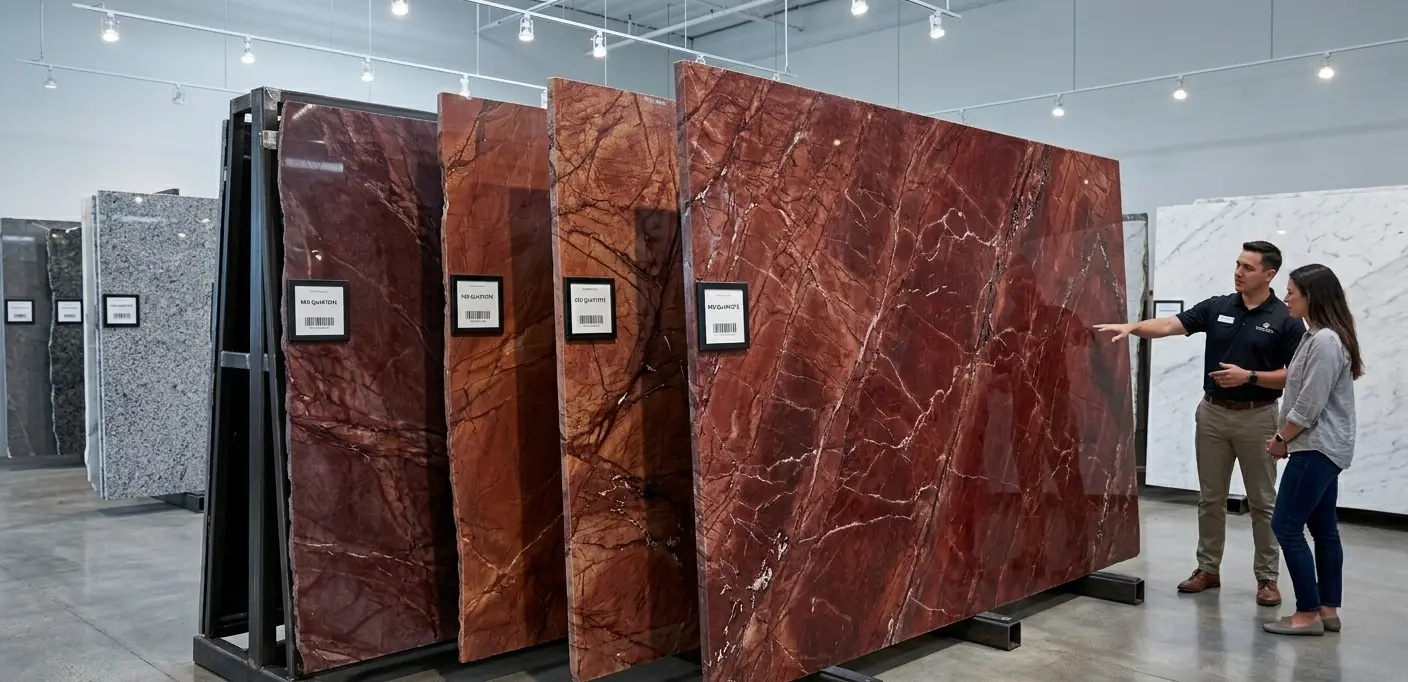
How to Evaluate a Slab
Look at the full surface, not just the face
Slabs are typically displayed vertically on A-frames or horizontal racks. Ask to have the slab pulled forward or turned so you can see the full surface in good light. Look across the entire slab, not just the section that will face you in photos. Check for fissures, which are naturally occurring separations in the stone that are part of its structure, and for pits or voids that may have been filled during processing. Filled areas are common and generally acceptable, but their extent varies by grade.
Evaluate the finish
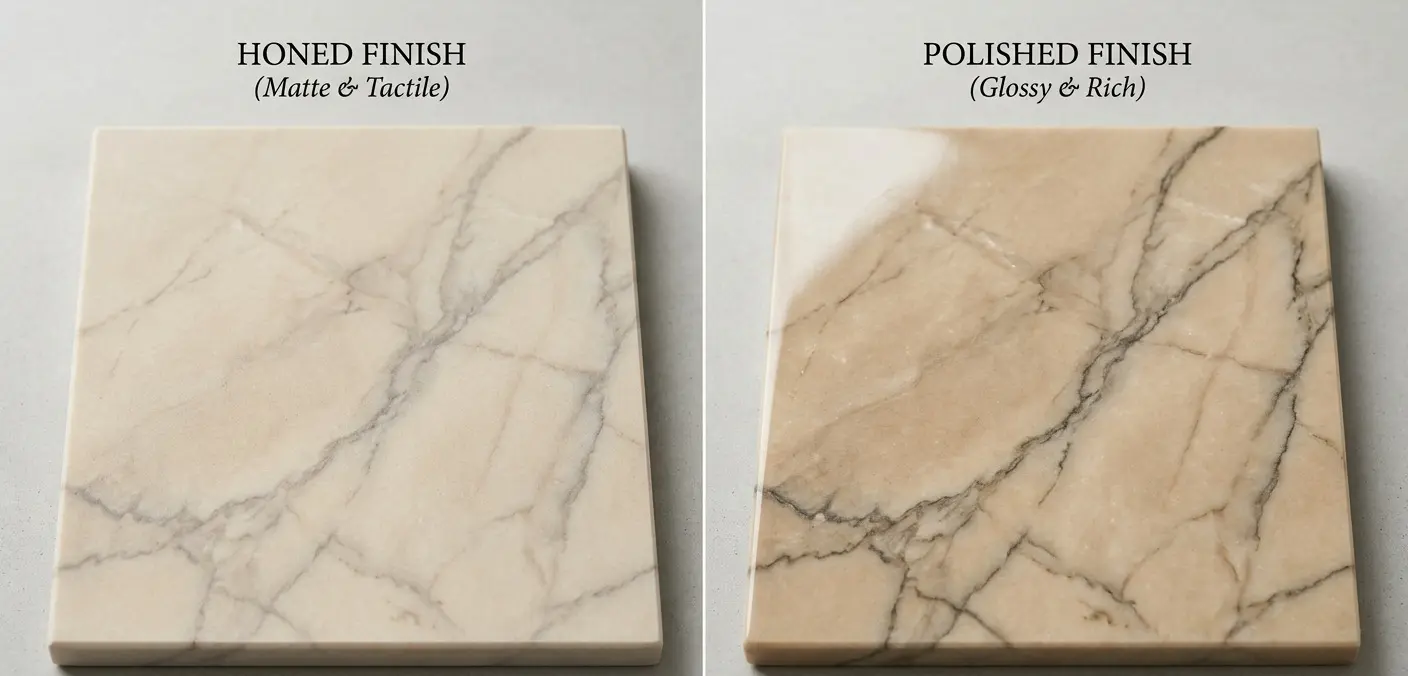
Run your hand across the surface. A polished finish will feel smooth and will show fingerprints and water marks more readily. A honed finish is matte and softer to the touch. A leathered finish has a slight texture from the brushing process and tends to conceal daily marks well. The finish affects both the appearance and the maintenance requirements of the stone, so it is worth spending time understanding how each one feels before deciding.
Check the veining direction
Veining runs in a specific direction across most slabs. Before selecting a slab, think about how the veining will orient on your countertop. Running veins horizontally across a long kitchen counter creates a calm, linear effect. Diagonal or irregular movement creates more visual energy. If you are planning a full slab backsplash or a waterfall island, the veining direction becomes even more important since the stone will be visible on multiple planes.
View the slab under different lighting conditions
If possible, move the slab or carry your cabinet sample to a section of the showroom with different lighting. Showroom lighting is typically bright and neutral, which is not always representative of residential lighting. Ask whether you can hold your cabinet sample near a window to see how the stone reads in natural light. Most showrooms accommodate this for serious buyers.
Compare slabs from the same bundle
If your project requires more than one slab, ask to see consecutive slabs from the same bundle. Slabs from the same block are cut in sequence and will be numbered. Consecutive slabs share similar veining structure, which allows them to be matched across seams or installed with complementary movement. Viewing them together before committing helps avoid inconsistencies that are difficult to address after fabrication.
Questions to Ask at the Showroom
Knowing what to ask speeds up the selection process and gives you the information you need to make a confident decision. This Old House offers a useful overview of stone countertop materials and properties if you want to build familiarity with the options before your visit.
Ask about the stone type and origin. Quartzite, marble, dolomite, and granite have different performance profiles, and some stones sold under similar names perform very differently. Confirming the actual stone type and quarry origin helps you understand what to expect from the material in daily use.
Ask about porosity and sealing requirements. Some stones require sealing before use and periodic resealing over time. Others, like very dense granites, may not require sealing at all. Understanding the maintenance commitment before you buy is important, particularly in kitchens and wet areas.
Ask about slab dimensions and yield. Each slab has a specific length and width, and your fabricator will need to cut your countertop pieces from that slab. If your layout has a large island or an unusual configuration, ask whether the slab dimensions are sufficient and whether there is enough material to accommodate cuts and waste.
Ask about grade. Stone slabs are graded based on consistency, color range, and the presence of filled areas or natural variation. Higher grades tend to have tighter color consistency and fewer filled sections. Understanding the grade helps you evaluate whether the price reflects the quality you are viewing.
How to Narrow Down Your Selection
Most homeowners arrive at a showroom and feel overwhelmed by the number of options. A practical approach is to eliminate categories first rather than trying to compare every slab individually. Fine Homebuilding's guide to natural stone countertop selection covers material comparisons in detail and is a useful reference when preparing for your visit.
Start by deciding on a color family. If your kitchen has warm wood tones and brass hardware, a cool gray marble may work against the design rather than with it. Narrowing to warm whites, creams, or golds eliminates a large portion of the options immediately.
Then decide on a finish. If you are planning a high-use kitchen counter, a leathered or honed finish may be more practical than a polished one. If you are selecting for a bathroom vanity or a shower feature wall, a polished finish is often preferred for the way it interacts with moisture and light.
Once you are down to a material and finish category, compare two or three slabs side by side. Hold your cabinet sample against each one. Take photos in multiple lighting conditions. Ask a design consultant for input on how each option has been used in similar projects.
We offer free design consultations at our showrooms, and our team works on a commission-free basis, which means the guidance you receive is focused on your project rather than on moving a particular product.
After the Visit: Next Steps
Once you have identified a slab, ask whether it can be reserved while you finalize your project details. Slab inventory moves, and a stone you select today may not be available in two weeks if it is not held. You can submit a slab quote request online to get the process started before or after your showroom visit.
Coordinate with your fabricator before finalizing the slab purchase. Your fabricator will need to know the slab dimensions, thickness, and finish to confirm it is compatible with your countertop layout and edge profile. Some fabricators prefer to purchase the slab directly; others work from slabs you supply. Clarifying this process before committing avoids complications.
If you are a trade professional working on behalf of a client, you can apply for a trade account, which may give you access to additional inventory, project support, and other resources.
Conclusion
Buying a natural stone slab in person gives you control over the specific piece of stone that will be used in your home. Unlike engineered surfaces, natural stone cannot be reproduced identically, and the slab you select is the slab you get. Preparing before your visit, knowing what to evaluate, and asking the right questions at the showroom all reduce the chance of surprises after fabrication. As a direct stone importer, we carry a broad range of natural stone slabs across our showroom locations in Reno, Minden, Sacramento, and Fernley, and our design team is available to guide you through the selection process at no obligation. You can also browse our current slab inventory online before your visit to get a sense of the materials and varieties available.
Frequently Ask Questions
What should I bring to a stone slab showroom?
Bring cabinet door samples or photos, your project dimensions in square feet, and photos of your existing flooring, tile, or fixtures if they are already in place. Having physical samples to hold against slabs gives you a more accurate read on how the stone will look in your actual space than relying on photos alone.
How do I know if a stone slab is good quality?
Evaluate the consistency of the color and veining across the full slab surface, check for an excessive number of filled areas or voids, and ask about the grade designation. Higher-grade slabs tend to have tighter color consistency and fewer filled sections. Ask the showroom team about the stone's origin and type, since these factors affect both quality and performance.
How many slabs do I need for a kitchen countertop?
The number of slabs depends on the square footage of your countertop layout and the dimensions of the individual slabs. A standard slab is typically 55 to 65 inches wide and 110 to 130 inches long. Most kitchen countertop projects require one to two slabs, though large kitchens with an island may require more. Your fabricator can confirm the slab count based on your specific layout before you purchase.
What is the difference between a slab showroom and a tile showroom?
A slab showroom displays full-size stone slabs used for countertops, shower walls, flooring, and other large-format applications. Each slab is a unique piece of natural stone. A tile showroom displays smaller, repeating units used for backsplashes, floors, and walls. Some showrooms carry both. When selecting a natural stone slab for a countertop or feature wall, visiting a showroom that displays full slabs is important because the scale and character of the material cannot be assessed from a small tile sample.
What is the difference between a fissure and a crack in natural stone?
A fissure is a naturally occurring separation within the stone that forms during the geological process. It is part of the stone's structure and does not affect its performance or integrity. A crack is a break that occurs after the stone has been cut or installed, typically from impact or stress. When viewing slabs at a showroom, ask a team member to help you identify any fissures present so you understand what is natural variation versus structural damage.