Natural stone countertops are made through a six-stage process: quarry block extraction, gang sawing into uniform slabs, surface finishing, quality inspection and resin treatment, grading and bundling, and sea freight shipment to a domestic importer. Each stage involves specialized equipment and skilled labor, and the full process from quarrying to showroom arrival can take 30 to 90 days depending on the stone's country of origin. Understanding how natural stone countertops are made helps homeowners evaluate slab quality, interpret grading and bundle terminology, and make more informed selections when choosing between granite, marble, quartzite, and travertine at the slab yard.
The six stages of natural stone countertop production are:
- Quarry extraction: Diamond wire saws and hydraulic splitters cut large rectangular blocks from the quarry face, typically weighing 20,000 to 40,000 pounds
- Gang sawing: Industrial gang saws cut the block into uniform slabs, most commonly at 2 cm or 3 cm thickness
- Surface finishing: Slabs are polished, honed, or leathered using diamond abrasive equipment
- Quality inspection and resin treatment: Fissures are identified and back-filled with polyester or epoxy resin as a standard stabilization step
- Grading and bundling: Slabs are sorted by quality grade and grouped into numbered bundles by block of origin
- Shipping and importation: Slabs are crated vertically and transported by sea freight to domestic importer warehouses
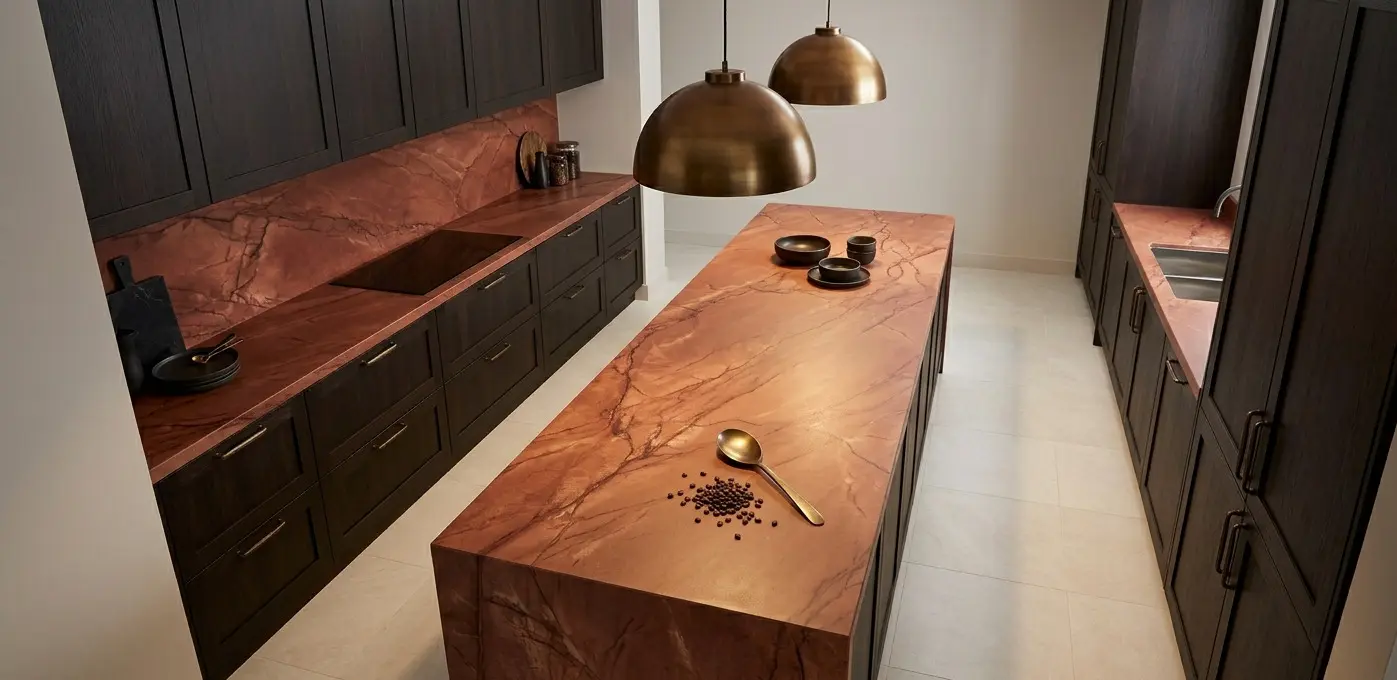
Where Natural Stone Comes From
Every granite, marble, quartzite, and travertine countertop traces back to a quarry. Quarries are large open-pit or underground mining operations located in regions where specific stone deposits are concentrated. Italy's Apuan Alps produce Calacatta and Carrara marble. Brazil is a major source of quartzite varieties including Taj Mahal, as well as granite. India supplies a wide range of granite, and Turkey, Spain, and Portugal are significant sources for travertine and limestone.
Quarry sites are chosen after geological surveys confirm the quality, volume, and accessibility of the stone deposit. Once a site is approved, operators clear the overburden, the soil and loose rock above the deposit, before beginning extraction of the usable stone below. For a broader overview of how these materials perform once installed, This Old House provides a thorough primer on stone countertop types and characteristics.
Extracting the Stone: Block Cutting
The first step in producing a slab is extracting large rectangular blocks from the quarry face. Workers use diamond wire saws, hydraulic splitters, and channel drills to separate blocks from the surrounding rock without cracking or damaging the interior. Diamond wire saws are the most common tool at this stage: a continuous loop of steel cable embedded with diamond beads is threaded through drilled channels and pulled through the stone, cutting cleanly along planned lines.
A standard quarry block measures roughly 9 feet long, 5 feet wide, and 5 feet tall and weighs anywhere from 20,000 to 40,000 pounds depending on the density of the stone. These blocks are inspected for fractures, color consistency, and usable volume before being loaded onto trucks for transport to a processing facility, which may be located near the quarry or in a separate manufacturing region.

Gang Sawing: Blocks Into Slabs
At the processing facility, the quarry block is loaded into a gang saw. A gang saw is a large industrial machine that holds dozens of parallel blades, each spaced to cut the block into uniform slabs in a single pass. Most residential countertop slabs are cut to either 2 centimeters or 3 centimeters thick, approximately three-quarters of an inch and one and a quarter inches respectively. The cutting process can take 12 to 24 hours depending on the hardness of the stone. Quartzite, which rates 7 on the Mohs hardness scale, takes longer to cut than softer limestone or travertine.
Water is continuously sprayed over the blades during cutting to cool the equipment and reduce dust. After the saw completes its pass, the block has been converted into a set of matched slabs that preserve the stone's interior veining and color. Because consecutive slabs come from the same position in the block, they share closely similar patterning. This is the origin of slab bundles, and it is why selecting from a bundle matters when matching material across a large countertop layout or bookmatched installation.
Surface Finishing: Polish, Hone, and Leather
Once sawn, the raw slabs move to finishing lines where the surface is prepared for use. The finish applied at this stage determines how the stone looks and performs in a finished installation. Fine Homebuilding's guide to natural stone countertop selection covers how finish choices affect maintenance and long-term performance in residential applications.
Polished finishing uses progressively finer diamond abrasive pads, moving from coarse grinding wheels that smooth the saw-cut surface down through increasingly fine grits until the stone reaches a high-gloss mirror finish. Polishing enhances the depth of veining, intensifies color, and slightly reduces surface porosity by closing the pore structure. Most marble, granite, and quartzite slabs leave the factory with a polished finish as the default.
Honed finishing stops the abrasive process before the final polishing stages, leaving the surface smooth and flat but without the high-gloss reflection. Honed finishes are matte or satin in appearance and are common on marble and limestone applications where a softer look is preferred.
Leathered finishing adds a textured pass after honing using specialized brushing equipment. The brushes follow the natural topography of the stone's crystalline structure, raising subtle texture and creating a slightly undulating surface. Leathered finishes are used on granite and quartzite where the texture adds visual depth and helps conceal daily marks.
Some slabs also receive a brushed or antiqued finish, which uses abrasive brushes to produce a worn surface texture common in travertine applications.
Quality Inspection and Resin Treatment
After finishing, slabs go through quality inspection. Inspectors evaluate natural fissures, color variation, surface condition, and structural integrity. Many natural stones, particularly marble and some quartzites, contain natural fissures. These are separations that formed during the geological process and are part of the stone's character rather than damage. They are assessed to determine whether reinforcement is needed.
Slabs with fissures or open pores are commonly back-filled with polyester or epoxy resin at this stage. Resin is applied to the back of the slab and sometimes the face, filling voids and stabilizing areas that might otherwise crack during fabrication or installation. Resin treatment is a standard and widely accepted practice in the natural stone industry and it does not affect the slab's appearance or performance. Homeowners researching surface material options should note that engineered stone surfaces carry separate health and safety considerations during fabrication, which NIOSH has documented in detail for fabricators and consumers. Natural stone does not carry the same silica exposure profile as engineered quartz during countertop fabrication.
Grading and Bundling
Finished slabs are graded based on aesthetic quality, color consistency, and the extent of natural variation. Commercial-grade stone is typically used in large-volume construction projects. Standard-grade stone offers good character with minor natural variation appropriate for most residential applications. First-choice or premium grade represents slabs with consistent color, pronounced patterning, and minimal defects.
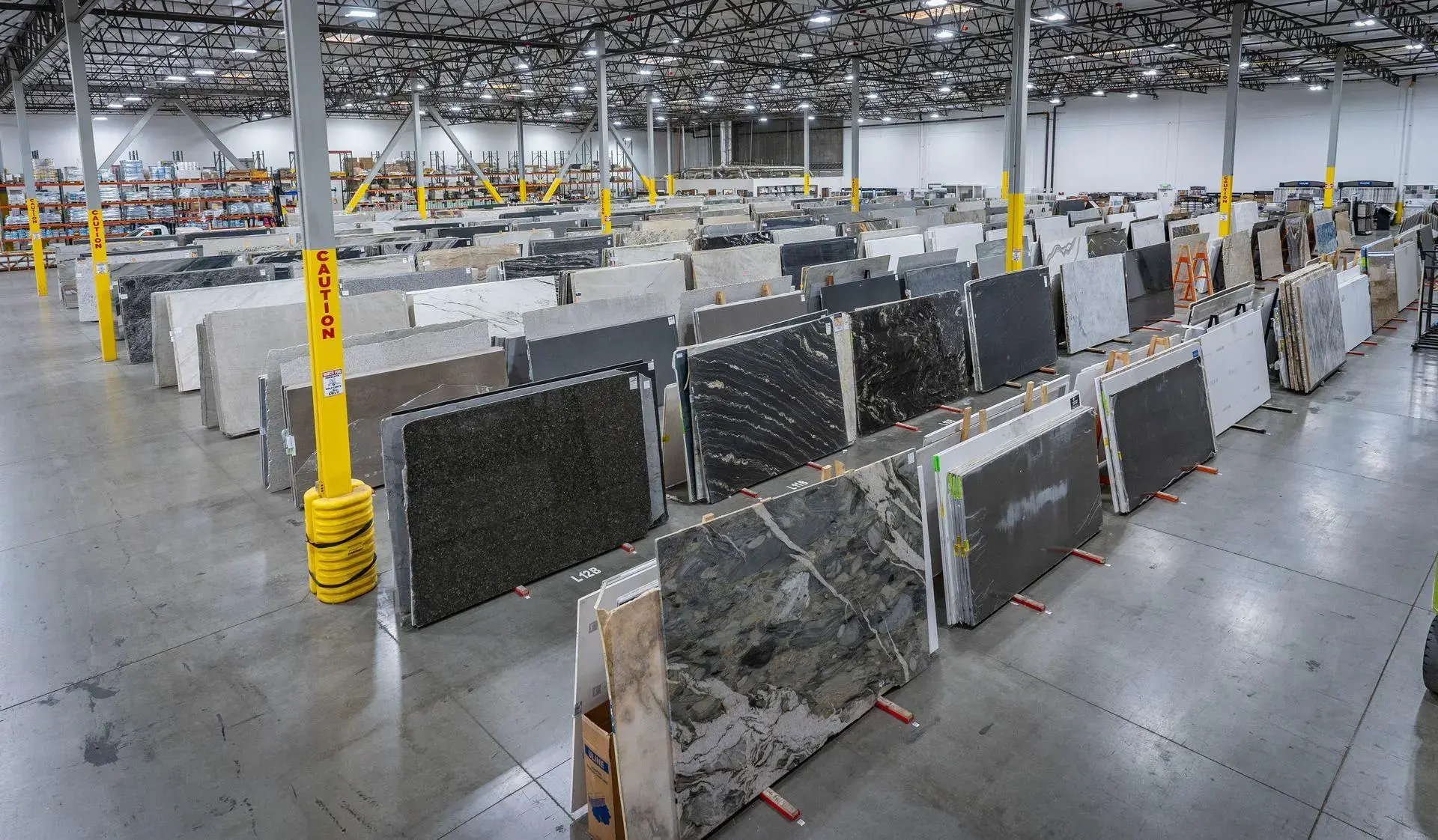
Slabs from the same block are kept together in numbered bundles so buyers can select consecutive slabs with matching veining for projects requiring continuity. Contractors and designers working on larger projects can apply for a trade account to access dedicated support for bundle selection and volume orders.
Shipping and Importation
Once graded and bundled, slabs are loaded vertically into purpose-built wooden crates called cradles, which hold them upright to prevent surface-to-surface contact and reduce the risk of cracking during shipping. Crates are loaded into shipping containers and transported by sea freight from quarry regions to receiving ports. Transit times vary by origin: stone from European quarries may arrive within 30 to 45 days from processing, while material from South American sources often takes 60 to 90 days from cutting to domestic warehouse delivery.
As a family-owned direct stone importer, we bring slabs straight from the quarry to our warehouse, which gives us greater control over selection, bundle integrity, and inventory consistency. Importing directly supports more accurate planning for projects that require matched material across multiple slabs.
Arrival at the Showroom
Once slabs clear customs and arrive at our warehouse, they are unloaded, inspected, and arranged in our showroom for selection. Viewing slabs in person is the most reliable way to evaluate color, movement, finish, and scale. A photograph or small sample tile cannot convey how a full slab will read in an installed space. When you visit one of our showroom locations in Reno, Minden, Sacramento, or Fernley, you are viewing the actual slabs that would be cut for your project. Our commission-free design team offers free consultations and can walk you through bundle selection, finish options, and material comparisons to help you make a confident choice.
You can browse our current slab inventory before your visit to identify varieties and finishes worth seeing in person, or schedule a free appointment with a member of our design team.
Conclusion
The journey from quarry to countertop involves geological extraction, precision sawing, surface finishing, quality grading, and international logistics. Each step in that process contributes to the character of the finished slab. Natural stone differs from engineered surfaces because it is not manufactured to a uniform specification. The veining, color, and texture in each slab reflect the specific conditions under which that stone formed. Understanding this process helps homeowners approach slab selection with more context and gives practical grounding for the differences in finish, grade, and bundle selection that come up during a showroom visit. If you have questions about how a specific material is processed or what to look for when selecting slabs for your project, submit a slab quote request or visit our commission-free design team at any of our four showroom locations in Reno, Minden, Sacramento, and Fernley.
Frequently Asked Questions
What is a slab bundle and why does it matter?
A slab bundle is a set of consecutive slabs cut from the same quarry block. Because they come from adjacent sections of the same block, slabs within a bundle share closely matching veining patterns, color, and movement. For large countertop layouts, bookmatched applications, or projects where multiple slabs will be visible in the same space, selecting from a bundle supports material consistency across the finished installation. Selecting slabs from different bundles or different lots can result in noticeable variation in color or patterning.
What does it mean when a slab has been resin treated?
Resin treatment is a standard step in natural stone processing where polyester or epoxy resin is applied to fill natural fissures and stabilize porous areas in the slab. It is a normal and widely accepted practice used on the majority of marble and many quartzite varieties. Resin treatment does not affect the performance or appearance of the finished countertop and is present in most natural stone slabs regardless of origin or supplier.
What is the difference between a fissure and a crack in natural stone?
A fissure is a naturally occurring separation within the stone that formed during the geological process. It is part of the stone's inherent structure and does not affect its integrity or performance. A crack is a break that occurs after the stone has been cut or installed, typically from impact or stress during fabrication, shipping, or installation. When viewing slabs at our showroom, a member of our design team can help you identify any fissures present so you understand what you are looking at before making a selection.
Does the country of origin affect the quality of natural stone?
Country of origin indicates where the stone was quarried, which influences the mineral composition, color range, and veining characteristics of the material. It is not a direct indicator of quality on its own. Quality within any origin varies based on the specific quarry, block position, finishing standards, and grade of the individual slab. Viewing the actual slab in person is more informative than relying on country of origin as a quality signal.
How long does it take for natural stone to go from quarry to showroom?
Transit time depends on the origin of the stone and the logistics chain. Stone sourced from European quarries typically takes 30 to 45 days from processing to domestic warehouse arrival. Material from South American quarries commonly takes 60 to 90 days due to longer sea freight transit. Additional time is needed for customs clearance, domestic transport, and warehouse receiving. As a direct importer, we manage this pipeline directly, which gives us visibility into lead times and current inventory that supports more accurate planning for your project.