The color of natural stone comes from its mineral composition. Iron oxides produce reds, oranges, and browns. Manganese creates blacks and purples. Feldspar contributes whites and pinks. Mica adds metallic shimmer. Chlorite and copper-bearing minerals generate greens and blues. Because each stone slab forms under unique geological conditions, no two pieces share identical coloring, even when cut from the same quarry block.
Key facts about mineral-driven stone color:
- Iron is the most common coloring agent in natural stone, responsible for the warm spectrum from pale yellow to deep rust
- Oxidation state matters: ferrous iron (Fe²+) produces greens and blues, while ferric iron (Fe³+) produces reds and browns
- Mica minerals (muscovite and biotite) are responsible for the metallic glitter visible in many granite and quartzite slabs
- Manganese dioxide creates the black veining and dark patches found in stones like Nero Marquina marble
- Calcite and dolomite, the primary minerals in marble and travertine, are naturally white; their veining comes from mineral intrusions during formation
- Heat and pressure during metamorphism can concentrate, redistribute, or chemically alter minerals, producing the dramatic color contrasts seen in many metamorphic stones
Understanding what creates stone color helps you predict how a slab will look in different lighting, how consistent it will be across multiple pieces, and why certain color families appear in specific stone types.
Why Mineral Composition Is the Starting Point
Every natural stone begins as accumulated minerals, either crystallized from molten rock, compressed from sediment, or transformed by heat and pressure over millions of years. The minerals present during formation, and the conditions under which they formed, determine everything about the stone's final appearance.
This is why stone color is not a surface quality. It runs through the full depth of the slab and can shift across the face of a single piece. The minerals responsible for color in natural stone fall into a few broad categories: silicate minerals that form the structural matrix, oxide and hydroxide minerals that introduce warm and dark tones, carbonate minerals that define the pale base of softer stones, and trace elements that create unexpected blues, greens, and purples.
Iron: The Most Influential Coloring Agent
No mineral family shapes stone color more broadly than iron-bearing compounds. Iron appears in nearly every natural stone type in some concentration, and its color output depends on its chemical state at the time of formation.
Ferric iron, the oxidized form, produces the warm end of the spectrum. Hematite is responsible for the deep reds and strong oranges found in many granites. Goethite, a hydrated iron oxide, accounts for the yellows and tawny browns that run through travertine, some limestones, and warm-toned granites. When these minerals are concentrated, the result is a rich, saturated warm tone. When dispersed through a lighter matrix, they create the golden and honey variations common in travertine. This Old House offers a useful overview for anyone comparing warm-toned stone countertop options before committing to a material.
Ferrous iron behaves differently. In iron-rich minerals like fayalite or pyroxenes, it produces greens and bluish tones. This is why some granites and quartzites carry subtle green undertones even though they appear mostly gray. The transformation between ferrous and ferric iron can also happen after a stone forms, as oxidation over geological time shifts color toward warmer, rustier tones.

Feldspar and Quartz: The Structural Base
In siliceous stones, including granite, quartzite, slate, and many others, the dominant minerals are feldspars and quartz. These make up the largest volume of the stone and establish the base tone that other minerals modify.
Quartz in its pure form is colorless or white. It transmits and scatters light rather than absorbing it, which contributes to the luminous quality of quartzite slabs with high quartz content. White quartzite slabs with near-pure quartz content can be extraordinarily bright because there is relatively little absorbing material. Our full natural stone slab inventory includes a range of quartzite, granite, marble, and other siliceous options across a variety of tones and movement levels.
Feldspars are more variable. Orthoclase feldspar is commonly pink or salmon, responsible for the warm rose tones in many pink granites. Plagioclase feldspars tend toward white, cream, or pale gray. In many granites, the mix of pink orthoclase and white plagioclase creates the mottled, multi-toned appearance that makes the stone visually complex at close range while reading as a unified color from a distance.
Mica: The Source of Metallic Shimmer
If you've ever noticed light catching a stone surface in a way that produces a subtle sparkle or sheen, that effect almost always comes from mica. Mica minerals form in flat, reflective sheets that sit at various orientations within the stone, catching and bouncing light rather than absorbing it.
Muscovite mica is silver-white and produces the bright, glittery effect visible in many light-colored granites and quartzites. Biotite mica is dark brown to black and contributes to the dimensional depth seen in darker stones.
The concentration of mica strongly affects how a stone reads in a room. A slab with abundant muscovite will shift noticeably as light angles change, appearing brighter near windows and more muted under flat overhead lighting. Fine Homebuilding's guide to natural stone countertop selection covers how lighting conditions should factor into material decisions, which is particularly relevant for mica-heavy stones in kitchen environments.

Manganese and the Dark Spectrum
Manganese dioxide is the primary driver of the deep blacks and dark purples found in certain stones. Nero Marquina marble derives its near-black base tone from carbon-rich material within the original limestone that was metamorphosed. The white veining that runs through it is calcite that intruded into fractures after the stone formed, a sharp contrast created by entirely different mineral families occupying the same slab.
Manganese dendrites, the fern-like or branching black patterns visible in some limestone and marble slabs, form when manganese-rich water moves through hairline fractures and deposits thin films of manganese oxide along the crack walls. These patterns are entirely natural and are sometimes mistaken for veining, though they sit at or near the surface rather than running through the full stone depth.
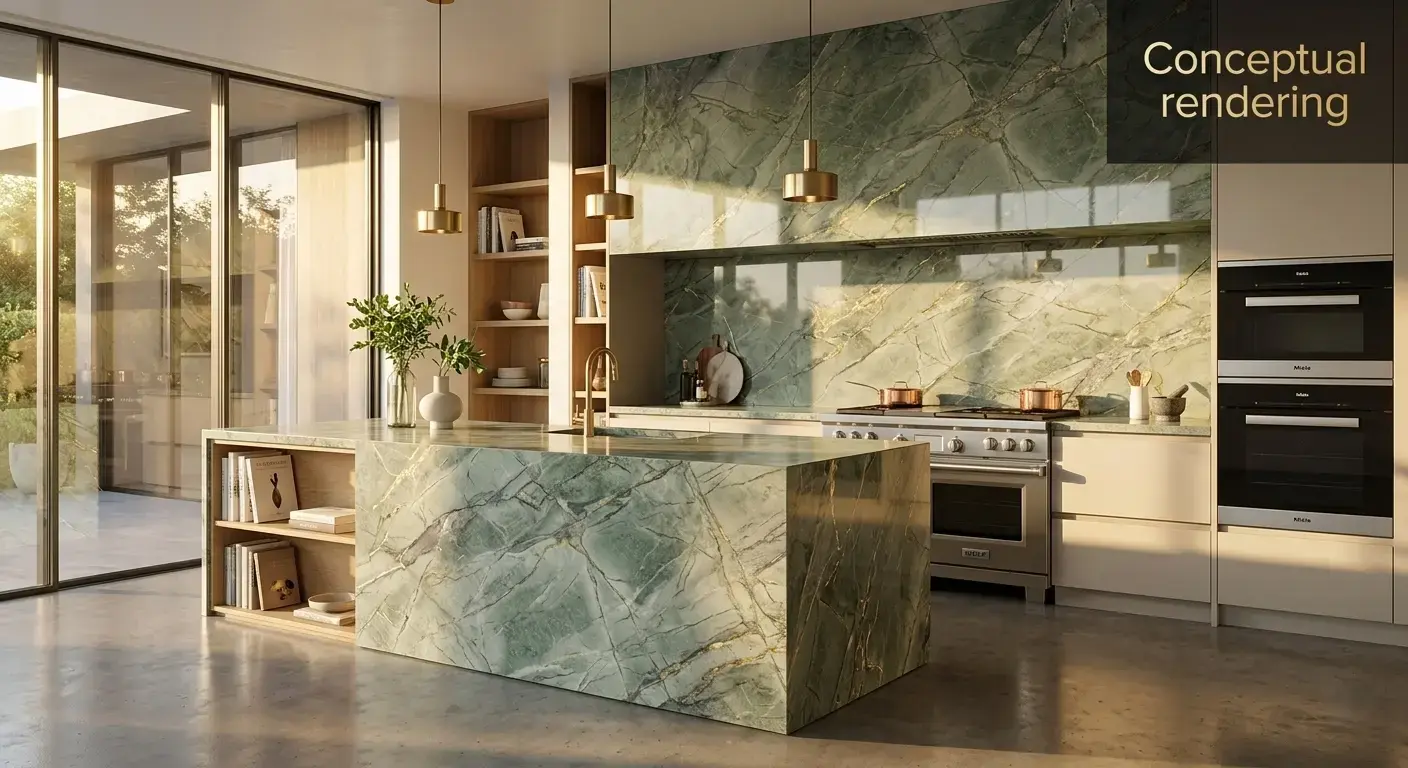
Copper, Chlorite, and the Green-Blue Spectrum
Green and blue tones in natural stone are less common than warm or neutral colors, which makes slabs carrying them particularly distinctive. Chlorite, a green silicate mineral, appears in many metamorphic rocks and gives certain slate and quartzite varieties their characteristic green color. Chlorite forms during low-to-medium grade metamorphism, which is why green-toned stones are often found in mountain regions where rock has been moderately transformed by pressure.
Copper-bearing minerals produce some of the most vivid greens and blues in decorative stone. Malachite delivers deep emerald and banded green. Azurite produces intense blue. These minerals appear most dramatically in semi-precious stone slabs used for feature applications. Serpentine, a magnesium silicate, is responsible for the mottled green appearance of verde antique marble.
How Metamorphism Shapes Color and Veining
The transformation of stone under heat and pressure does not just change the mineral structure. It moves minerals, concentrates them into bands, and creates entirely new minerals from existing ones. This process is directly responsible for many of the dramatic veining and color contrast patterns that make metamorphic stones so visually complex.
In marble, the parent limestone contained calcite and various impurities. During metamorphism, heat-driven fluid movement carried iron, manganese, and silicate minerals into fractures and grain boundaries, depositing them as the veins that now define the stone. The veining in Calacatta marble follows the ancient fracture and fluid-flow pathways from the metamorphic event that transformed the original sediment.
Taj Mahal quartzite illustrates this clearly. Its gold and cream veining runs through a white quartz matrix because iron-rich minerals followed specific pressure pathways through the stone during metamorphism. Understanding this helps explain why veining is never truly random; it maps the geology of the deposit.
Practical Implications for Stone Selection
Mineral composition has direct practical implications beyond aesthetics. Iron-bearing minerals can affect how certain stones respond to acidic cleaners, as acidic exposure can leach iron and cause staining in some travertines and limestones. Mica-heavy stones may need slightly different sealing considerations because mica planes can sometimes act as micro-channels.
Because mineral distribution in any deposit is naturally uneven, color variation within a single stone type is normal and expected. Two slabs cut from the same quarry block can show meaningfully different color intensity, vein density, or background tone depending on exactly where in the deposit they originated. Visiting our showroom locations is the most reliable way to evaluate full slab faces before purchasing, since small samples rarely capture the full range of movement and tone. For projects requiring multiple slabs, bookmatching can turn natural variation into a design asset by mirroring the mineral patterning across adjacent pieces. Trade professionals sourcing stone for client projects are welcome to apply for a trade account for streamlined access to our slab inventory.
Conclusion
The color you see in a natural stone slab is a geological record. Every tone, vein, and flash of shimmer traces back to specific minerals that formed, moved, and transformed over millions of years under conditions that will never repeat exactly. That's what separates natural stone from manufactured surfaces; the color isn't applied. It's built into the material at its most fundamental level.
When you're ready to explore stone in person, our team at our Northern Nevada and Northern California showrooms is happy to walk through the mineral story behind any slab you're considering. Schedule a free design consultation to bring your project details, or submit a slab quote request to get the process started.
Note: Some images on this page may be conceptual renderings created to illustrate design possibilities and may not depict actual installations.
Frequently asked questions
The pink and red tones in granite come primarily from orthoclase feldspar. When orthoclase is present in high concentrations, granite takes on a salmon, rose, or deep red appearance depending on the iron content within the feldspar crystals.
Marble veins form when mineral-rich fluids move through fractures in the parent limestone during metamorphism. As these fluids cool or interact with surrounding rock, they deposit minerals, most commonly iron compounds, manganese, or silicates, along the fracture walls.
Green and blue tones in quartzite typically indicate the presence of chlorite, iron in its ferrous state, or trace copper-bearing minerals. These tones often appear in quartzite that formed under moderate metamorphic conditions where iron and magnesium were abundant in the original sediment.
The base mineral coloring in natural stone is stable and does not fade. However, surface staining from iron oxidation, organic materials, or improper cleaners can alter appearance over time. Proper sealing and pH-neutral cleaning products help preserve the original surface appearance.
Mineral distribution in any stone deposit is naturally uneven. Veining follows fluid pathways, color concentration varies with mineral density, and metamorphic processes affect different zones of a deposit differently. This variation is inherent to natural stone and is part of what distinguishes it from manufactured surfaces.