Most kitchens require one to three natural stone slabs for countertops. A single slab typically covers 45 to 65 usable square feet after accounting for sink cutouts, cooktop openings, and edge waste. To get your exact count, measure every countertop section in inches, multiply length by depth, divide by 144 for square footage, add all sections together, then apply a 15 to 20 percent waste factor. Divide that adjusted total by the usable yield of your chosen slab (usually around 50 square feet) and round up to the nearest whole number. The final count also depends on your kitchen layout, seam placement, and whether your stone requires veining alignment across sections.
Why Slab Count Matters Before You Shop
Walking into a stone showroom without knowing your square footage is one of the most common mistakes homeowners make. Natural stone slabs are one-of-a-kind cuts from the earth. No two slabs are identical in veining, color, or size. If you underestimate how many slabs you need and come back for a second slab later, there is no guarantee a matching slab from the same lot will still be available.
Knowing your approximate slab count before you visit also helps you think through continuity. If your design calls for matching veining across an island and perimeter countertops, you may want to source slabs from the same block, a selection process our team can help guide you through in person.
Step 1: Understand Standard Slab Dimensions
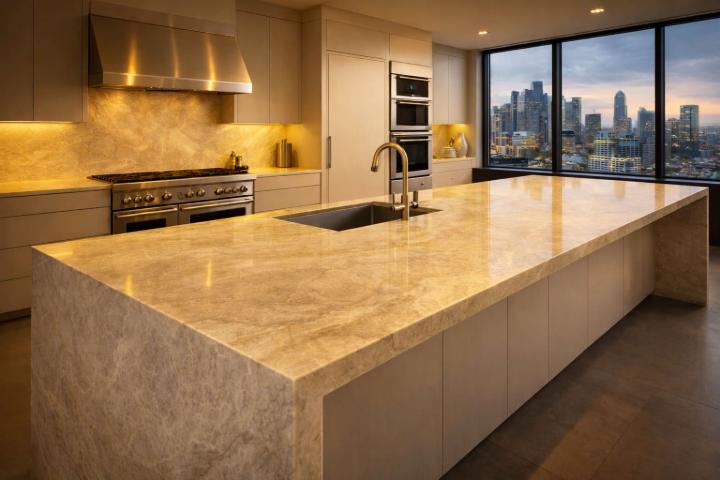
Before measuring your kitchen, it helps to understand the range of slab sizes you will encounter. Natural stone slabs are not uniform products. Their dimensions depend on where the stone was quarried, how it was cut, and the characteristics of that particular block.
Typical slab dimensions:
- Length: 90 inches to 130 inches (7.5 to nearly 11 feet)
- Width: 50 inches to 75 inches (roughly 4 to 6 feet)
- Gross surface area: 55 to 75 square feet per slab
Usable square footage is always lower than gross square footage. After subtracting edge trim, cutouts for sinks and cooktops, and any unusable areas near corners or natural fissures, most slabs yield between 45 and 65 square feet of finished countertop surface.
Engineered stone and sintered stone slabs, such as porcelain, often come in more standardized formats (126 inches by 63 inches is a common size), which can simplify your calculations. If you are considering engineered stone, the CDC and NIOSH have published guidance on silica dust exposure during fabrication, which is worth reviewing as part of your overall material research.
Step 2: Measure Your Kitchen Countertops
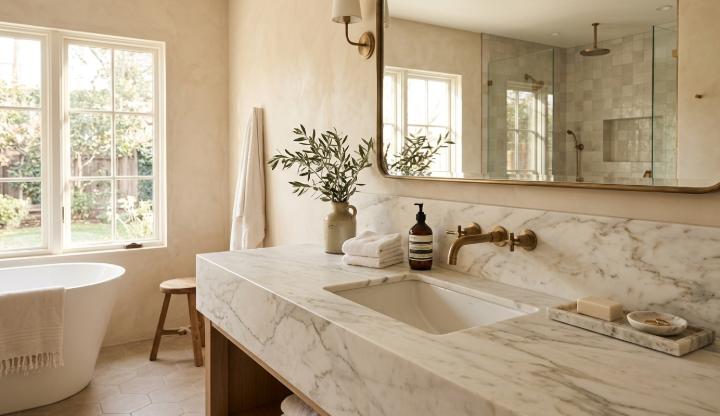
Grab a tape measure and sketch out your kitchen layout on paper. Measure every countertop run separately, noting the length and depth of each section. Standard countertop depth is 25 inches including a 1-inch overhang over the cabinet face. Island dimensions vary widely.
What to measure:
- Every straight countertop run along walls
- The island length and width (top surface only)
- Any peninsula sections
- Windowsill extensions if you plan to tile them in the same material
For a broader overview of how natural stone countertops are measured and installed, This Old House has a detailed guide on stone countertop planning that covers field measuring best practices.
Calculating square footage for each section:
Multiply the length (in inches) by the depth (in inches), then divide by 144 to convert to square feet.
Example: A countertop run that is 96 inches long and 25 inches deep: 96 × 25 = 2,400 ÷ 144 = 16.67 square feet
Add up all sections to get your total gross square footage.
Step 3: Add a Waste Factor
Raw square footage is never the number you bring to a stone supplier. You need to add a waste factor to account for:
- Sink cutouts: An undermount sink typically removes 1.5 to 2.5 square feet of material from a slab
- Cooktop cutouts: A standard 30-inch cooktop opening removes roughly 1.5 to 2 square feet
- Corner pieces and irregular cuts: Angled layouts, diagonal islands, and L-shaped corners generate offcuts that cannot always be reused
- Edge overhangs and breakage: Thin edges and outside corners are vulnerable during handling, so some material is lost
Industry-standard waste factor: For straightforward rectangular layouts, add 15 to 20 percent to your total square footage. For complex layouts with multiple angles, arched edges, or highly veined stone that requires pattern matching, a waste factor of 20 to 25 percent is more appropriate.
Example: Total gross square footage: 65 sq ft Add 20% waste: 65 × 1.20 = 78 square feet needed
Step 4: Divide by Usable Slab Yield
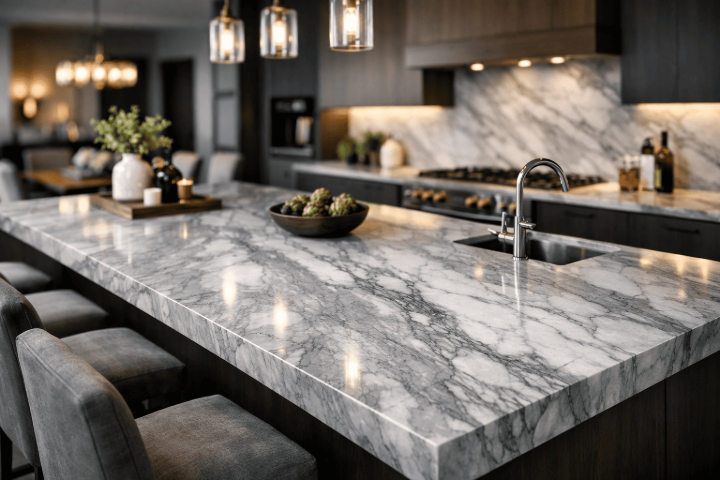
Now divide your adjusted square footage by the expected usable yield per slab. If you are shopping for specific slabs, ask for the actual dimensions and calculate the gross area yourself. For planning purposes, use 50 square feet as a conservative usable yield estimate per slab.
Continuing the example: 78 sq ft needed ÷ 50 sq ft per slab = 1.56 slabs
Round up to the nearest whole number. In this case, you would plan to purchase 2 slabs.
Step 5: Factor in Seam Placement
Seam placement is often what pushes a project from one slab to two, or two slabs to three. A seam is where two pieces of stone meet, and it is unavoidable in any kitchen where a single run exceeds the length of a slab.
Seams are typically placed:
- At corners where two runs meet
- Near a sink or cooktop where the joint is less visible
- At a natural break in the cabinet layout
Highly figured stones, such as marble and quartzite with bold diagonal veining, require careful seam planning so the pattern continues visually across the joint. This matching process, called book-matching or flow-matching, can require more material from each slab to be cut away, increasing your total slab count.
According to Fine Homebuilding's complete guide to natural stone countertops, thoughtful seam placement during the planning phase is one of the most overlooked factors in a successful stone countertop installation, and decisions made early directly affect both appearance and material costs.
Step 6: Account for Thickness
Slab thickness affects weight and edge profile options but does not change square footage calculations. However, it is worth noting that 3cm slabs (approximately 1.25 inches thick) are generally recommended for kitchen countertops because they provide greater structural integrity and a fuller edge profile without requiring a laminated build-up along the front edge.
If you are deciding between 2cm and 3cm for your project, our full breakdown of slab thickness options covers how each affects countertop performance and appearance.
How Many Slabs by Kitchen Size
Here is a general reference guide based on common kitchen layouts:
| Kitchen Size | Approx. Countertop Sq. Ft. | Estimated Slabs Needed |
|---|---|---|
| Small galley (under 100 sq ft kitchen) | 25–35 sq ft | 1 slab |
| Medium kitchen with island | 50–70 sq ft | 1–2 slabs |
| Large kitchen with island | 70–100 sq ft | 2–3 slabs |
| Open-plan kitchen with extended island | 100+ sq ft | 3+ slabs |
These are estimates only. Your actual count depends on slab size, stone type, layout complexity, and seam requirements.
Tips for Buying the Right Number of Slabs
Buy from the same lot whenever possible. Slabs from the same quarry block share the same base color and veining family. Even within a single stone variety, slabs sourced from different lots can vary noticeably in tone.
View slabs standing upright. Stone distributors and showrooms display slabs vertically on A-frames so you can see the full face. This is the most accurate way to evaluate how the material will look on a horizontal countertop surface.
Ask about remnants for smaller sections. If your island is small or you have a single short countertop run in a butler's pantry, a remnant piece from a previous project may be large enough to cover it without needing a full slab.
Consider the full layout before committing. Bringing your kitchen measurements and a rough sketch to your stone consultation helps our team match slab size to your specific layout and minimize material waste. You can visit us at our showrooms in Reno, Minden, Sacramento, or Fernley for a no-cost design consultation. Choosing a local stone dealer also means you can view full slabs in person rather than relying on digital swatches.
Conclusion
Calculating how many slabs you need for your kitchen comes down to four things: total countertop square footage, waste factor, usable slab yield, and seam strategy. For most kitchens, one to two slabs is sufficient, but larger layouts with islands and complex runs often require three or more. The safest approach is to measure carefully, add at least 15 to 20 percent for waste, and buy all your slabs at once from the same lot. Seeing your actual slabs in person before committing is always the better choice over ordering from a thumbnail. Our team is here to help you match the right stone to your layout and make sure you walk away with exactly what your kitchen needs. Planning a kitchen countertop project? Browse our natural stone slab collection or visit a showroom near you to view full slabs in person and get expert guidance on material selection and layout planning.
Frequently Asked Questions
How do I calculate square footage for my kitchen countertops?
Measure the length and depth of each countertop section in inches. Multiply length by depth and divide by 144 to convert to square feet. Add up all sections for your total, then add 15 to 20 percent for waste before calculating how many slabs you need.
Can one slab cover an entire kitchen?
In smaller kitchens with a simple layout and no island, one slab can be enough. However, most mid-size and large kitchens require at least two slabs to cover the perimeter countertops and island. The limiting factor is usually the usable length of a single slab relative to the total run of your countertop sections.
Do I need extra slabs if I want matched veining?
Yes. Book-matching or flow-matching veining across seams requires careful layout planning and usually results in more material being cut away from each slab to achieve the desired alignment. For highly figured stones like calacatta marble or dramatic quartzite, it is common to plan for additional material to ensure a continuous visual flow.
What happens if I order too few slabs?
If you run short and need to source an additional slab later, there is no guarantee the same stone lot will still be available. Natural stone varies from block to block, so a second purchase from a different lot may not match in tone or veining. Always purchase all slabs for a project at the same time.
Does slab thickness change how many slabs I need?
No. Slab thickness (2cm vs. 3cm) does not affect your square footage calculations. It does affect the weight of the material, the structural support requirements, and the edge profile options available to you, but the number of slabs needed is determined entirely by surface area, not thickness.