Graphite marble is a natural metamorphic stone characterized by a deep gray to near-black base and bold white or silver veining, formed when limestone is transformed under extreme heat and pressure deep within the earth. It is quarried primarily in Iran and is closely related to stones sold under the names Pietra Grey, Grafite Marble, and Persian Grey. The stone is commonly used for kitchen countertops, bathroom vanities, fireplace surrounds, and accent walls, and is available in polished, honed, and leathered finishes. Like all natural marble, graphite marble requires periodic sealing and is sensitive to acidic substances, but with proper care it delivers a dramatic, one-of-a-kind surface that engineered materials cannot replicate. If you are considering this stone for your next project, here is everything you need to know.
What Is Graphite Marble?
Graphite marble is a metamorphic rock formed when limestone is subjected to extreme heat and pressure deep within the earth's crust. During this geological process known as metamorphism, mineral impurities including graphite, clay, and iron oxides are trapped within the crystallizing calcite structure. It is precisely those graphite mineral inclusions that produce the stone's signature dark gray to charcoal base tones and the white or pale gray veining that runs through each slab.
Because the stone forms over millions of years under variable geological conditions, no two graphite marble slabs are identical. The veining can range from thin, delicate threads of white to bold, sweeping strokes that command attention across a full countertop run. This natural variation is part of what makes the stone so appealing to designers and homeowners who want a surface that functions as a statement piece.
The stone is also known by several regional and trade names depending on its exact origin and veining pattern. You may encounter it listed as Grafite Marble, Pietra Grey Marble, Persian Grey Marble, Bardiglio, or Graphite Grey Marble. While subtle differences exist between these varieties in terms of base tone saturation and vein density, they all share the same essential character: a dark, refined natural stone with dramatic visual presence.
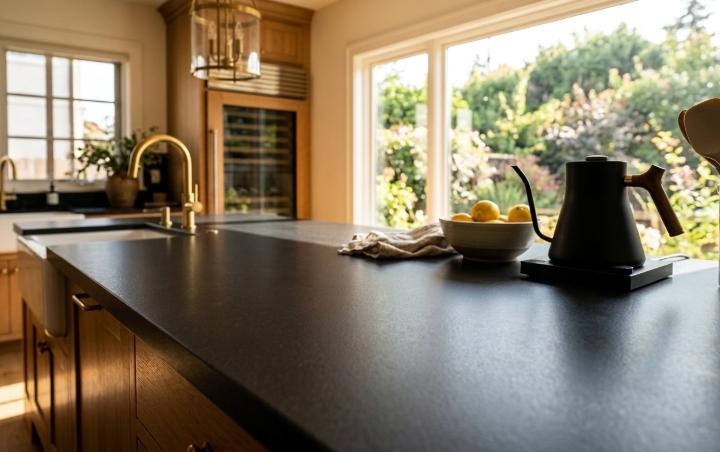
How Graphite Marble Compares to Similar Dark Marbles
Understanding how graphite marble differs from related stones helps narrow down the right choice for your specific project.
Graphite Marble vs. Nero Marquina
Nero Marquina is a Spanish black marble with a dramatically darker, near-jet base and bright white veining. Graphite marble tends to read as a softer, more nuanced dark gray rather than true black, making it slightly more versatile across a range of cabinet colors and lighting conditions. Nero Marquina makes a louder design statement; graphite marble is more understated.
Graphite Marble vs. Pietra Grey
Pietra Grey is essentially a close relative of graphite marble and is sometimes the same stone sold under a different name depending on the supplier. In general, Pietra Grey tends toward a lighter medium gray, while graphite marble leans darker. The two are often compared directly, and slab selection in person is the best way to determine which tone suits your space.
Graphite Marble vs. Bardiglio
Bardiglio is an Italian gray marble that ranges from pale blue-gray to deeper charcoal. Its veining is typically more diffuse and cloudlike compared to the crisper, more linear veining seen in graphite marble. Bardiglio has a softer, almost watercolor appearance while graphite marble tends to look sharper and more architectural.
Graphite Marble vs. Dark Quartzite
Unlike marble, quartzite is far harder and more resistant to etching from acidic substances. Dark quartzites like Black Fusion or Black Beauty offer a similar color palette with greater practical resilience, making them a popular alternative for busy kitchens. You can explore our natural stone slab collection to compare both graphite marble and dark quartzite options side by side.
Design Applications for Graphite Marble
One of graphite marble's greatest strengths is its design flexibility. Its dark, neutral base reads as both warm and cool depending on the lighting and surrounding materials, making it compatible with a wide range of kitchen and bathroom palettes.
Kitchen Countertops Graphite marble countertops pair exceptionally well with white, cream, and light wood cabinetry. The contrast between a near-black stone surface and bright cabinet fronts is one of the most sought-after looks in contemporary kitchen design. The stone also works in all-dark kitchens, where it blends into a rich, layered aesthetic alongside charcoal or deep navy cabinets. For kitchen islands, a graphite marble slab creates a focal point that anchors the entire room.
Bathroom Vanities In bathrooms, graphite marble adds a spa-like luxury that lighter stones cannot always achieve. A full vanity top in graphite marble against white plumbing fixtures and soft lighting creates a visually grounding effect. The stone also works well as a shower surround when bookmatched slabs are used to create a mirrored vein pattern across adjacent panels.
Fireplace Surrounds Graphite marble's heat tolerance makes it appropriate for fireplace surrounds and hearths. The dark base tone complements both traditional and contemporary fireplace designs, and the natural veining gives the installation a one-of-a-kind quality that manufactured materials cannot replicate.
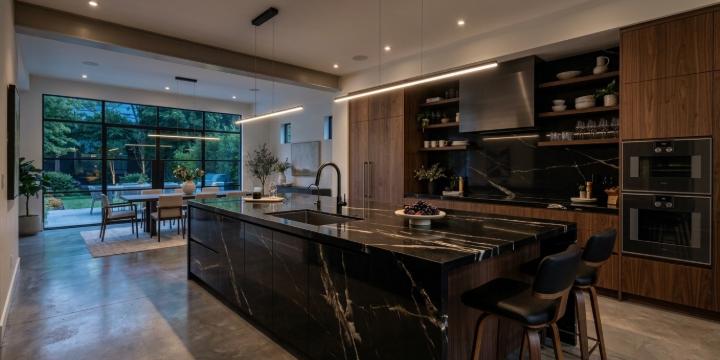
Finish Options for Graphite Marble
Graphite marble is available in several surface finishes, each of which changes how the stone looks and performs in daily use.
Polished A polished finish brings out the full depth of graphite marble's color and creates a reflective, mirror-like surface that highlights the veining. It is the most dramatic option and the most common for countertops. The downside is that polished surfaces show fingerprints and water spots more readily, requiring regular wiping to maintain their appearance.
Honed A honed finish produces a flat, matte surface with no reflectivity. The stone appears slightly lighter than in its polished state. Honed graphite marble is easier to maintain on a day-to-day basis since it does not show smudges as prominently. It is a popular choice for bathroom floors and shower walls where slip resistance is a consideration.
Leathered A leathered finish adds a subtle texture to the stone's surface by brushing it during the finishing process. The result sits between polished and honed in terms of sheen and offers a tactile quality that many homeowners find appealing. Leathered finishes also do a better job of concealing minor surface marks than polished finishes. Clients visiting our showrooms frequently request leathered samples of dark natural stones for side-by-side comparisons.
Caring for Graphite Marble
Marble is a calcium carbonate-based stone, which means it is reactive to acidic substances. Citrus juice, vinegar, wine, and certain cleaning products can etch the surface over time, dulling the finish in the areas of contact. Understanding how to properly care for graphite marble extends the life and beauty of the installation significantly.
Sealing
Sealing is the most important maintenance step for any natural marble surface. A penetrating impregnating sealer fills the stone's pores and reduces its ability to absorb liquids. Graphite marble should be sealed at installation and resealed periodically based on use. The water bead test is the easiest way to check if resealing is needed: if water no longer beads on the surface and instead absorbs into the stone, it is time to reseal. As outlined by This Old House in their guide to stone countertops, natural stone surfaces in high-use kitchens typically benefit from sealing once or twice per year.
Daily Cleaning
For daily maintenance, a soft cloth with warm water and a pH-neutral stone cleaner is all that is required. Avoid bleach, ammonia-based products, and general-purpose kitchen sprays, which can degrade the sealer and etch the stone. The CDC's guidance on safe household cleaning products is a useful reference when evaluating which cleaners are appropriate around natural stone surfaces. Wipe up spills promptly, particularly acidic ones.
Preventing Etching
Etching is a chemical reaction between the marble's calcite and an acid, leaving dull spots on the surface. Unlike stains, etches cannot be lifted by cleaning. Minor etches can sometimes be buffed out with a marble polishing powder, while severe etching may require professional stone restoration. Using cutting boards, trivets, and coasters reduces the risk of both etching and surface damage.
Long-Term Durability
With proper care, graphite marble holds up well in residential applications. The stone's density and hardness, while lower than granite or quartzite, are entirely sufficient for most residential applications. Many historic buildings and kitchens feature marble surfaces that have remained in place and in active use for generations. As detailed in Fine Homebuilding's guide to natural stone countertops, natural stone countertops, when properly installed and maintained, can outlast virtually every other countertop material in a home.

Is Graphite Marble Right for Your Project?
Graphite marble is best suited for homeowners who appreciate the character of a natural material and are willing to commit to basic maintenance routines. It is an excellent choice for those who want the prestige and visual drama of a true natural stone without the uniformity of engineered surfaces.
It may not be the right fit for households with very young children or for owners who want a completely zero-maintenance countertop. In those cases, a dark-toned sintered stone or porcelain slab can replicate a similar aesthetic with greater practical resilience.
If you are designing a project in the Northern Nevada and Northern California region and want to see graphite marble slabs in person before committing, visiting a local showroom is always the most reliable way to evaluate the stone's color, veining, and finish in natural and artificial light. Our team offers free design consultations and can walk you through current slab inventory and help you find a stone that fits your project's specific needs.
We are proud to serve homeowners and trade professionals across our showroom locations in Reno, Minden, Sacramento, and Fernley. Choosing to buy from a local stone showroom means you get hands-on access to full slabs, expert guidance, and the confidence of seeing your stone before it goes into your home.
Conclusion
Graphite marble is one of the most visually compelling natural stones available for residential and commercial interiors. Its deep gray base, elegant veining, and range of available finishes make it adaptable to both contemporary and transitional design directions. Unlike the pale white marbles that dominate design media, graphite marble brings weight, drama, and a grounded sophistication that few other countertop materials can match.
Understanding the stone's origins, finish options, and maintenance requirements puts you in a stronger position to make a confident decision. Whether you are planning a kitchen renovation, a bathroom remodel, or a custom fireplace surround, graphite marble rewards homeowners who choose it with a surface that only grows more beautiful with age.
Frequently Asked Questions
What is graphite marble made of?
Graphite marble is a metamorphic rock formed when limestone undergoes extreme heat and pressure deep within the earth. During this process, mineral impurities including graphite, iron oxides, and clay become locked within the calcite structure, producing the stone's dark gray base and characteristic white or silver veining.
Is graphite marble the same as Pietra Grey?
Graphite marble and Pietra Grey are closely related and are sometimes the same stone sold under different trade names depending on the supplier and region of origin. Both are quarried primarily in Iran. Pietra Grey tends to run slightly lighter in tone, while graphite marble typically presents a deeper charcoal base. Viewing slabs in person is the best way to distinguish between them.
Does graphite marble need to be sealed?
Yes. Like all natural marble, graphite marble is porous and should be sealed at installation and resealed periodically based on use. A penetrating impregnating sealer protects the stone from liquid absorption and reduces the risk of staining. A quick water bead test on the surface will tell you when the sealer needs refreshing.
Can graphite marble be used in bathrooms?
Graphite marble is an excellent choice for bathrooms, including vanity tops, shower surrounds, and accent walls. A honed or leathered finish is often preferred for shower floors due to its lower slip risk compared to a polished surface. Regular sealing is especially important in wet environments.
How does graphite marble differ from granite?
Graphite marble is a calcium carbonate-based stone that is softer and more reactive to acids than granite, which is a silicate-based igneous rock. Granite scores higher on the Mohs hardness scale and is more resistant to scratching and etching. Marble offers a more refined, luminous appearance that granite typically cannot replicate, but it requires more careful maintenance in active kitchen environments.