Calacatta marble is a premium natural stone quarried from the Apuan Mountains in Carrara, Italy, recognized for its bright white background and bold gray, gold, or taupe veining. It is widely used in kitchens, bathrooms, feature walls, and entryway floors, and is considered rarer and more exclusive than Carrara marble due to its limited quarry availability. Because of its porous nature, it requires periodic sealing and pH-neutral cleaning to maintain its appearance. For homeowners who want the Calacatta aesthetic with less maintenance, high-quality porcelain alternatives such as the Luxury Calacatta Marble Look Porcelain Tile closely replicate its signature look with greater resistance to staining and moisture.
With its luminous surface and one-of-a-kind veining patterns, Calacatta marble has long been associated with luxury interiors and homes designed to leave a lasting impression. Whether you are considering it for a kitchen surface, a bathroom feature wall, or a statement entryway floor, understanding what makes this stone exceptional will help you decide how to incorporate it most effectively into your own home.
What Is Calacatta Marble?
Calacatta marble is quarried from the Apuan Mountains in Carrara, a town in northern Tuscany, Italy, where it has been extracted for centuries. Because both Calacatta and Carrara marble come from the same region, the two are often confused, but they are distinct materials. Calacatta is extracted from more limited, specific areas within these quarries, which accounts for its lower availability and its standing as a more exclusive stone.
What sets it apart visually is its bright white background paired with bold, thick veining in gray, gold, or warm taupe tones. Carrara marble, by contrast, features a softer gray-white base and lighter, more feathery patterning. Each Calacatta slab carries entirely its own natural patterns, meaning no two pieces are ever identical. According to This Old House, natural stone countertops remain among the most sought-after surfaces for kitchens precisely because of this one-of-a-kind character. For those ready to explore authentic stone options, our natural stone slab inventory is a strong starting point.
The Key Varieties Worth Knowing
The Calacatta family encompasses a wide range of varieties, each with its own distinct appearance and character.
Calacatta Borghini is considered one of the most prestigious, known for its exceptionally clean white base and bold gray veining, occasionally accented with subtle gold tones. The Borghini quarry is one of the oldest operating quarries in the Carrara region, with cuts that can be traced back to Roman times.
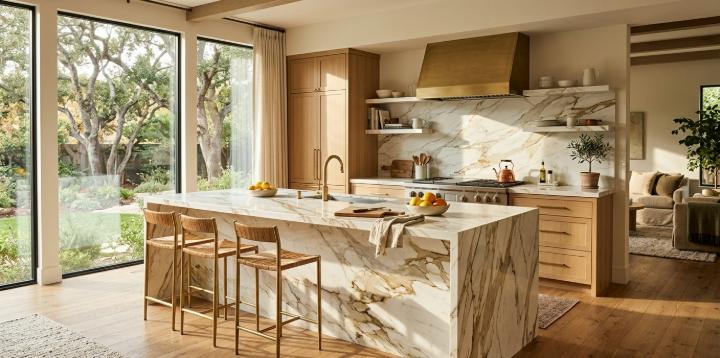
Calacatta Oro features warm gold and gray veining on a white background. It pairs naturally with brushed brass fixtures or darker cabinetry, making it a strong fit for modern and transitional kitchen designs.
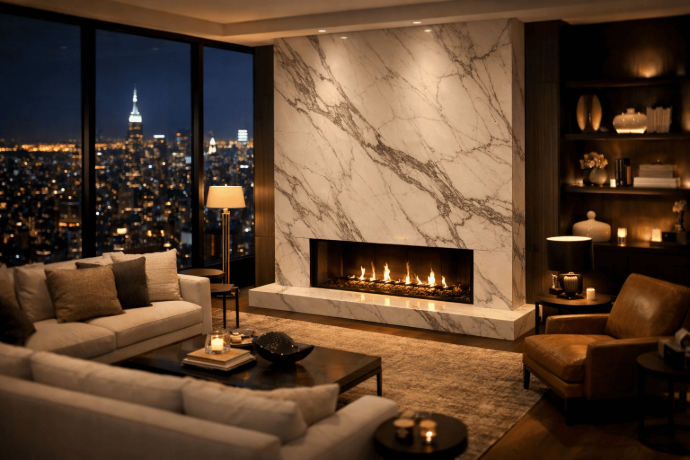
Calacatta Viola takes a more dramatic direction, with deep burgundy and purple veining against a creamy white base. It is frequently used in feature walls, luxury fireplace surrounds, and statement bathroom vanities where visual impact is the priority.
Calacatta Michelangelo is a named variety characterized by finer, more delicate veining against a white background. It works well across flooring and indoor cladding applications where a softer, more understated pattern is preferred.
These varieties collectively offer a wide spectrum of expression, from soft and refined to bold and theatrical. If you are uncertain which direction suits your project, scheduling a free design consultation with one of our specialists is a practical way to evaluate your options before making a decision.
Where This Stone Works Best in the Home
Kitchen Countertops and Islands
The bright white surface and bold veining make Calacatta marble a compelling choice for kitchen countertops and islands. Its smooth finish is practical for food preparation while lending a refined character to the heart of the home. In open-plan layouts, a Calacatta island naturally becomes the visual centerpiece of the entire space.
Fine Homebuilding's guide to natural stone countertops outlines why stone like marble continues to be favored over engineered alternatives for homeowners who value individuality and long-term character in their surfaces.
Bathroom Surfaces
Calacatta marble transforms bathrooms into spa-like retreats. Using it across vanities, shower walls, and flooring creates a cohesive, elevated look throughout the room. The reflective quality of a polished surface is especially effective in bathrooms where natural light is limited, making the space feel noticeably more open and airy.
Feature Walls and Fireplace Surrounds
One of the most impactful ways to use this stone is as a feature wall or fireplace surround. Large slabs allow the veins to run in uninterrupted patterns, making the wall itself a striking focal point. Book-matching a technique where mirrored slabs are placed side by side produces symmetrical patterns that feel intentional and artistic without requiring additional decoration.
Entryways and Living Area Floors
Calacatta marble flooring exudes quiet opulence, particularly in entryways, hallways, and large open-plan spaces. Its light-reflecting qualities make rooms feel significantly more spacious, while the flowing veining creates a sense of movement underfoot that manufactured flooring materials cannot fully replicate.
Kitchen Backsplashes
A Calacatta backsplash elevates a kitchen without committing to the full surface area of a countertop slab. The veining functions as a kind of natural artwork above the stove or sink, serving as both a practical surface and a visual anchor in the room.
Porcelain as a Practical Alternative
For homeowners who love the Calacatta aesthetic but prefer a surface that requires less maintenance, porcelain tile crafted to replicate this look offers a highly practical path forward. Modern manufacturing has made it possible to closely mirror the characteristic white base and bold veining in a porcelain body that resists staining and holds up well under everyday use.
Our Luxury Calacatta 12x24 Matte Marble Look Porcelain is an excellent option for floors and wall surfaces, crafted in Spain with a rectified edge for precise, clean grout lines. For accent surfaces and detailed mosaic layouts, the Luxury Calacatta 2x2 Matte Marble Look Porcelain Mosaic is well-suited to shower niches, backsplashes, and decorative borders.
Porcelain carries a naturally low porosity level, making it highly resistant to moisture and household spills. Routine cleaning with warm water and a pH-neutral solution is typically all that is needed to keep the surface looking well-maintained over time.

Caring for Natural Calacatta Marble
Consistent upkeep is essential to protect an investment in authentic natural stone. Because of its porous nature, Calacatta marble is vulnerable to acidic substances such as lemon juice, vinegar, and harsh cleaning agents. Wiping spills promptly and using a pH-neutral stone cleaner for routine maintenance will reduce the risk of etching and discoloration over time.
Applying a high-quality impregnating sealer on a regular basis is standard practice for preserving both the surface integrity and the visual clarity of the veining. For detailed guidance on long-term stone care, the Natural Stone Institute's care and maintenance resource is a reliable reference. It is also worth noting that natural marble develops a patina over time that adds depth and character, making it a material that genuinely improves with thoughtful, consistent care.
Choosing Between Natural Stone and Porcelain
The decision between an authentic slab and a porcelain alternative often comes down to room function, lifestyle, and personal priorities. For high-traffic floors or active kitchen environments, a white-veined porcelain format may offer a more forgiving everyday surface while delivering comparable visual presence. For a bathroom vanity, feature wall, or fireplace surround where wear and liquid exposure are minimal, authentic stone makes a genuinely compelling case.
For those looking to explore natural stone more seriously, submitting a slab quote request is a straightforward way to start a more tailored conversation. Before committing, it's worth seeing the material in person: browse full slabs at a showroom for natural stone, or order a tile sample if you're leaning toward the porcelain option.
Conclusion
Calacatta marble has endured as one of the most celebrated natural stones in interior design for good reason. Its origins in the limited quarries of the Apuan Mountains, its luminous white base, and the bold veining that makes every slab entirely unique position it as a material that genuinely transforms a space. Whether you select authentic stone for a statement application or opt for a high-quality porcelain format for a more practical surface, the Calacatta aesthetic brings a level of refinement that few other materials can match. Nova Tile and Stone carries both natural stone slabs and porcelain stone-look tile to help bring that vision to life with confidence.
Frequently Asked Questions
What is the difference between Calacatta and Carrara marble?
Both originate from the same quarrying region in northern Tuscany, Italy, but they differ noticeably in appearance. Calacatta features a brighter, more intensely white background with bold, thick veining in gray, gold, or taupe. Carrara presents a softer gray-white base with lighter, more feathery patterning. Calacatta is generally considered rarer and more exclusive, while Carrara is more widely available.
Is Calacatta marble suitable for kitchen use?
Yes, it can be a beautiful surface for kitchen countertops and islands. However, because it is a porous natural stone, it requires regular sealing to protect against staining from oils, acids, and everyday food and beverage contact. For high-use kitchen environments, a porcelain alternative in a similar pattern offers comparable visual impact with significantly less maintenance.
How often does Calacatta marble need to be sealed?
Sealing frequency depends on how frequently the surface is used and the type of sealer applied. High-traffic areas may need more frequent applications, while a bathroom vanity or fireplace surround may need it less often.
Can Calacatta marble be used in bathrooms?
Absolutely. It is one of the most popular natural stone choices for bathroom applications, including shower walls, floor surfaces, and vanity tops. Its light-reflective qualities make smaller bathrooms feel more open and airy, and using a consistent material across walls and floors creates a seamless, spa-inspired aesthetic.
What is a good alternative to natural Calacatta marble?
Porcelain tile designed to replicate the Calacatta look is widely regarded as the most practical and visually convincing option. Products like the Luxury Calacatta 12x24 Matte Marble Look Porcelain Tile reproduce the characteristic white base and bold veining of authentic stone while offering greater resistance to moisture, staining, and everyday wear, making them suitable for a broader range of applications throughout the home.