Brazil is a leading global source of natural stone countertops because its ancient Precambrian geological formations produced mineral combinations across multiple distinct quarrying regions that are not found in other countries. These formations are responsible for over 1,000 commercial stone varieties in active production, including Taj Mahal quartzite from Ceará, exotic granites such as Azul Bahia from Bahia, soapstone from Minas Gerais, and marble from Espírito Santo.
Brazil's geological age is the primary factor behind its stone diversity. The country's Precambrian bedrock formed during intense tectonic activity roughly 450 to 700 million years ago, creating mineral concentrations that produce colors and surface characteristics specific to each region. For homeowners selecting countertops, this translates into a broader range of material options than most other stone-producing countries offer, from deep blue exotic granites and warm ivory quartzites to matte gray soapstone and warm-toned white marble. For a broader overview of how natural stone countertop materials compare, This Old House covers stone countertop selection in detail.
What makes Brazilian stone significant for countertop buyers:
- Brazil has more commercial granite varieties than any other country, with over 800 types in active production
- Espírito Santo is the primary quarrying and export hub, accounting for 40% of Brazil's total stone production and 70% of its processing capacity
- Taj Mahal quartzite, one of the most frequently specified stones in high-end residential projects, is quarried exclusively in Ceará, Brazil
- Brazilian soapstone from Minas Gerais is naturally non-porous and requires no sealing, unlike most other natural stone countertop materials
- Exotic granite varieties such as Azul Bahia exist in specific geological formations in Bahia and cannot be sourced from any other country
- According to industry association ABIROCHAS, Brazil traded more stone variety in the past 30 years than Europe did over the previous 500 years
Brazil's Geological Foundation
Brazil is the fifth-largest country in the world by area, and its geological history stretches back billions of years. Much of the country sits atop Precambrian bedrock formed during the Brasiliano orogeny, a period of intense tectonic activity roughly 450 to 700 million years ago. That ancient geological pressure and heat created the conditions for broad mineral diversity.
In practical terms, this means the mineral content within Brazilian slabs often includes combinations of feldspar, quartz, mica, tourmaline, and other trace minerals that produce colors ranging from deep burgundy and midnight blue to warm gold and soft ivory. According to ABIROCHAS, Brazil has traded a greater variety of stone in the last 30 years than Europe did over the previous 500 years. That range reflects the diversity of the country's geological zones.
Key Quarrying Regions
Brazil's stone production is concentrated across several states, each known for different material types.
Espírito Santo is the center of the Brazilian stone industry. The state accounts for 40% of national stone production and houses 70% of the country's processing and finishing capacity. The cities of Cachoeiro de Itapemirim, Vitória, Cariacica, and Serra are home to hundreds of quarries, sawing plants, and polishing facilities. The Port of Vitória handles the majority of Brazil's stone exports and serves as the main departure point for slabs shipped to North America, Europe, and beyond. Classic white marbles and a wide range of granite varieties originate from this region.
Minas Gerais is known primarily for quartzite, soapstone, and slate. São Tomé das Letras, located in the southern part of the state, is one of the most significant quartzite production centers in the world. Minas Gerais is also responsible for most of Brazil's soapstone production, making it the primary global source for this material. The state's geology is closely tied to the ancient São Francisco craton, a stable Precambrian shield that has remained largely undisturbed for hundreds of millions of years.
Bahia and Ceará in northeastern Brazil are the primary sources for exotic quartzites and granites that carry color characteristics distinct from material produced in other regions. Taj Mahal quartzite is quarried in Ceará, over 1,300 miles from Espírito Santo, requiring a combination of air and overland travel to reach. Bahia produces granite varieties whose coloration results from mineral concentrations specific to that geological formation.
Brazilian Granite
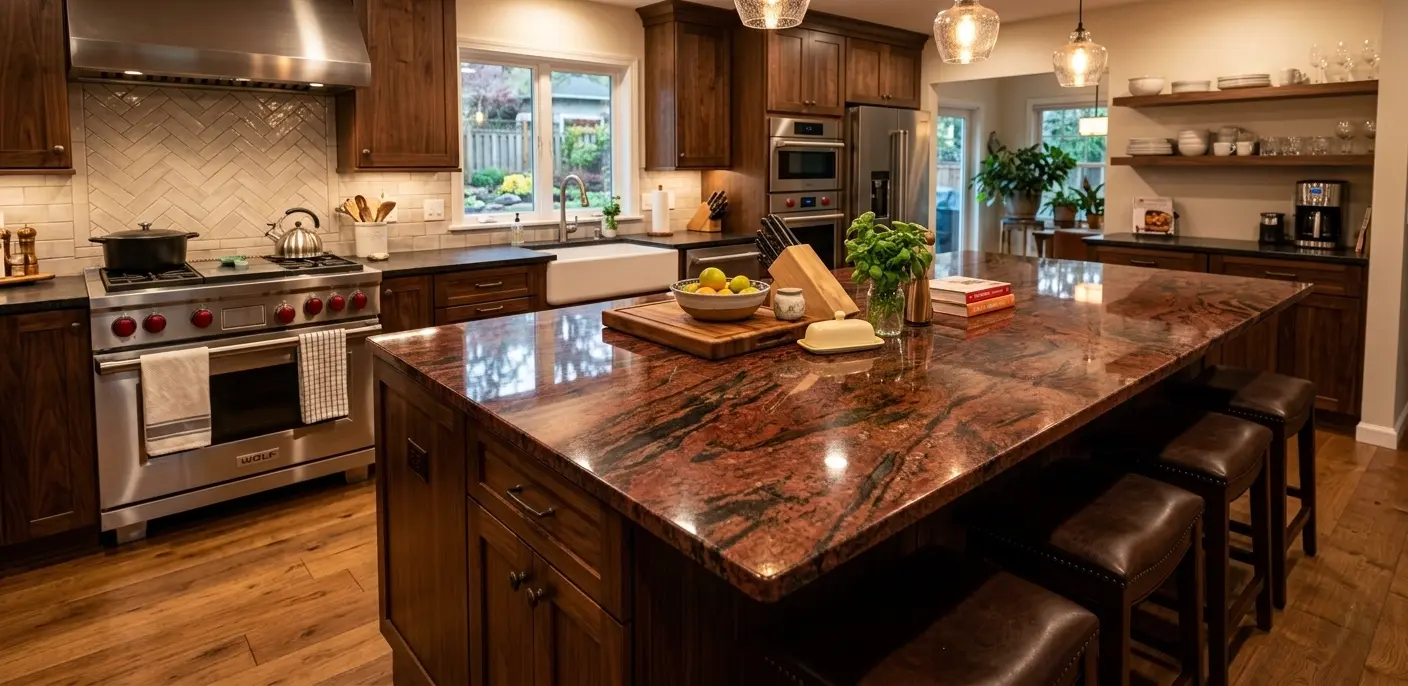
Brazil produces over 800 commercial granite varieties, the widest range of any single country. The range extends well beyond the beige and gray granites common in standard kitchen renovations.
Classic Brazilian granites such as Giallo Ornamental, New Venetian Gold, Bianco Antico, and Ubatuba have been consistent fixtures in the North American countertop market for decades. These materials are heat and scratch resistant and offer broad color compatibility with cabinetry.
Exotic Brazilian granites differ from standard granite in the intensity and rarity of their coloration. Azul Bahia, also called Blue Bahia, is quarried exclusively in Bahia and produces a deep blue coloration that results from the unusual mineral concentration in that specific geological formation. Bordeaux granite carries a dark burgundy base with complex mineral movement. Juparana varieties, quarried across multiple states, range from soft golden tones to deeply patterned red and gray movement.
What distinguishes exotic varieties from standard granite is that the mineral combinations responsible for their colors exist in specific geological pockets. Once a quarry producing a particular exotic variety is exhausted, that coloration cannot be sourced elsewhere. Contractors and designers working with exotic Brazilian materials on a regular basis can apply for a trade account for access to preferred pricing across our full slab inventory.
Brazilian Quartzite
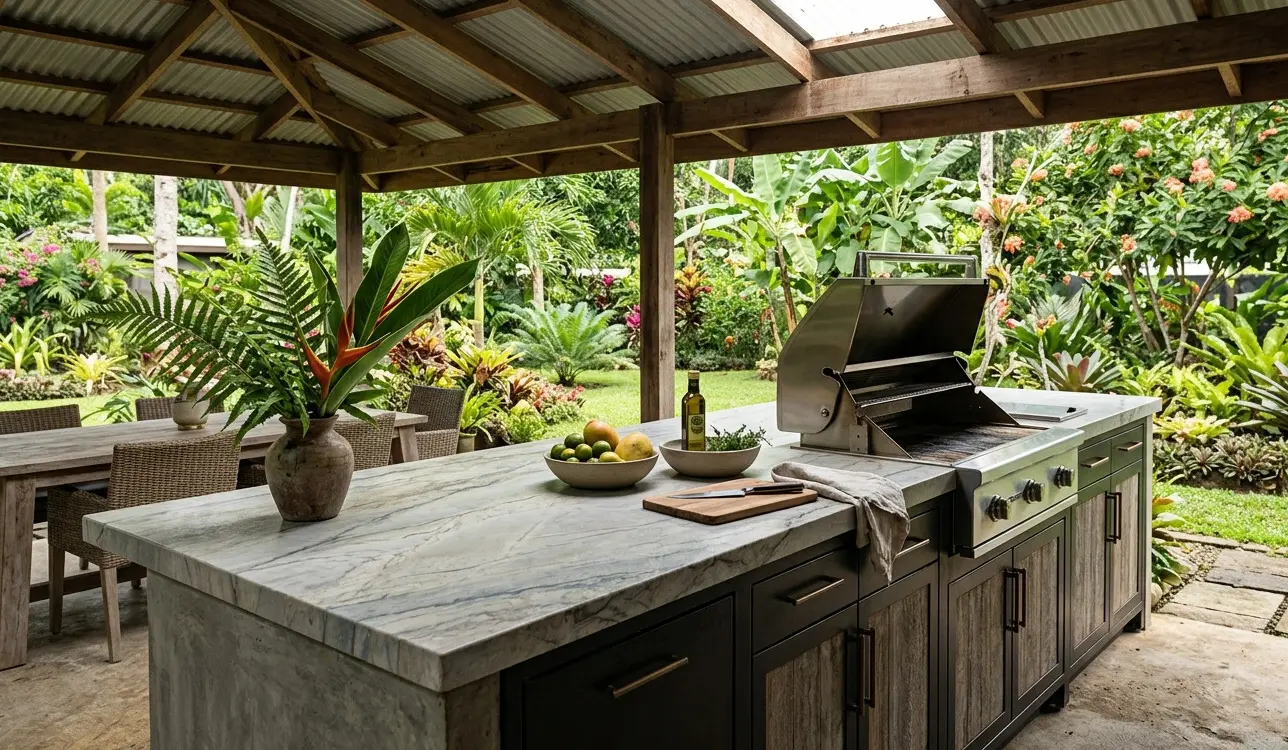
Brazilian quartzite is a widely specified material in the countertop industry. While quartzite is quarried in other countries, Brazil's geological conditions produce varieties with a range of visual and structural characteristics that have made them a common specification in residential design.
Taj Mahal quartzite, sourced from Ceará, is frequently specified for kitchen and bathroom countertop applications. Its warm ivory background with subtle gold and gray veining is visually similar to certain Italian marbles, and its surface hardness and resistance to etching make it a practical choice for kitchen countertops. You can review currently available quartzite and granite options in our natural stone slab inventory.
White Macaubas quartzite, from Minas Gerais, has a lighter, more neutral profile with fine, linear veining. It pairs well with both white and wood-toned cabinetry and is frequently used for bathroom vanity applications. Fantasy Brown, a warm-toned material with origins in similar Brazilian geological formations, is a frequently specified countertop option in North America for homeowners seeking earth tones with natural veining movement.
An important note on quartzite labeling: the industry has a documented inconsistency problem in which some soft marbles or dolomites are sold under quartzite names. When selecting a quartzite at a showroom, asking for material verification, including hardness data, helps confirm the stone's true composition. Fine Homebuilding's guide to natural stone countertops covers stone composition and what to look for when evaluating slab materials before purchase.
Brazilian Soapstone
Brazil is the world's leading producer and exporter of soapstone, with the majority of production concentrated in Minas Gerais. Soapstone is a metamorphic rock composed primarily of talc, which gives it a soft, matte surface texture. It is naturally non-porous, requires no sealing, and resists heat.
Brazilian soapstone ranges in color from light gray to deep charcoal, often with white, green, or gray veining. Over time, the surface develops a natural patina. Periodic treatment with food-grade mineral oil deepens the stone's color and maintains visual consistency across the surface.
For kitchen environments where chemical exposure is a concern, soapstone resists both acids and heat, which has historically made it a material of choice in laboratory settings. Its non-reactive surface holds up under conditions that would cause etching or staining in calcium-based stones such as marble. Homeowners comparing natural stone to engineered quartz should also be aware that NIOSH has documented silica exposure risks associated with engineered stone fabrication, a concern that does not apply to natural soapstone.
Brazilian Marble
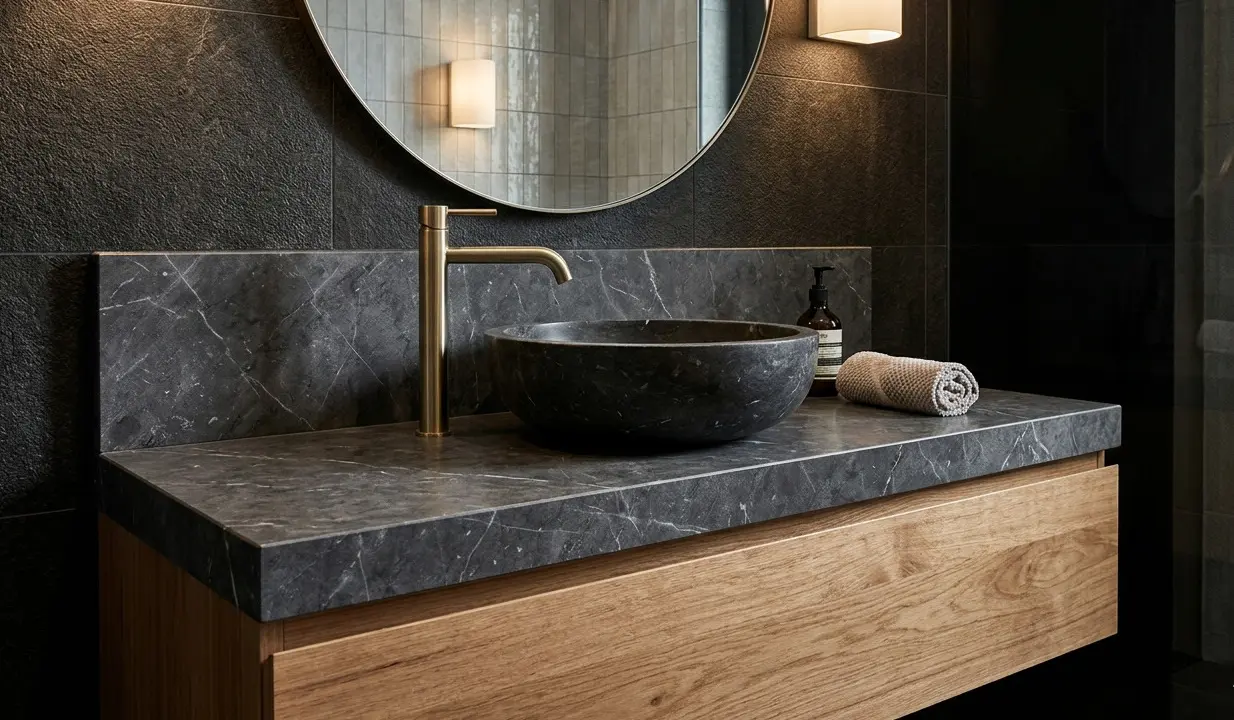
While Italy is historically associated with marble production, Brazil produces a range of marbles from Espírito Santo and neighboring regions. Brazilian Calacatta Gold, Portonari, Super White, and regional varieties offer options distinct from Italian quarries in terms of coloration and veining character.
Brazilian white marbles tend to carry warmer undertones than Italian Carrara, with gold or cream tones in the veining rather than the cool blue-gray that characterizes many Italian varieties. For homeowners seeking a warmer white aesthetic in the kitchen or bathroom, Brazilian marble options are worth evaluating alongside Italian alternatives when visiting a slab yard.
Working With Brazilian Stone
Because Brazil produces such a wide variety of materials, slab selection requires in-person viewing. Color saturation, veining intensity, and background tone vary from slab to slab, particularly in exotic granites and quartzites, in ways that photographs do not fully capture.
As a family-owned direct stone importer, we carry natural stone varieties across granite, quartzite, marble, and soapstone categories sourced from Brazil and other major producing regions around the world. You can find a showroom near you to view full-sized slabs across all material types in Reno, Minden, Sacramento, and Fernley, giving you the opportunity to compare slabs side by side and evaluate how a material will look at countertop scale.
Our commission-free design team is available at each location to walk through material options with you and answer questions about origin, composition, and maintenance requirements. You can schedule a free design consultation at any of our four locations, or if you are already in the planning stages, request a slab quote to get specific information on available Brazilian stone for your project.
Conclusion
Brazil's position as a leading natural stone producer is rooted in geology, scale, and decades of developed export infrastructure. Its Precambrian bedrock produces mineral combinations responsible for colors and patterns that are not replicated from other regions, and its quarrying network spans multiple states, each contributing distinct material categories. From the exotic granites of Bahia to the soapstone of Minas Gerais and the quartzites of Ceará, Brazilian stone covers a range of aesthetic and functional requirements across kitchen and bathroom applications. For homeowners selecting countertops, understanding Brazil's regional geology helps explain why certain materials look and perform the way they do, and why sourcing relationships matter when working with stone from this part of the world.
Frequently Asked Questions
What types of natural stone come from Brazil?
Brazil produces granite, quartzite, marble, soapstone, slate, limestone, and travertine. It is particularly known for exotic granite varieties, quartzite including Taj Mahal and White Macaubas, and soapstone. Brazil has over 1,000 commercial stone varieties in active production across more than 1,500 active quarries.
Is Brazilian granite different from granite quarried in other countries?
Brazilian granite varies in appearance and mineral composition depending on the quarrying region. Espírito Santo produces a wide range of classic and exotic granites. Bahia is the source of color varieties such as Azul Bahia, which result from mineral concentrations specific to that geological formation. These combinations are not found in granite from other major producing countries.
What makes Taj Mahal quartzite from Brazil a common specification in high-end projects?
Taj Mahal quartzite is quarried in Ceará, Brazil. Its warm ivory background, subtle gold and gray veining, surface hardness, and resistance to etching make it a practical option for kitchen countertops while maintaining the visual character associated with Italian marble. The quarry is remote and production volume is limited relative to demand.
Does Brazilian soapstone require sealing?
No. Soapstone is naturally non-porous and does not require sealing. Periodic application of food-grade mineral oil is recommended to deepen and even the surface color over time, but this is an aesthetic treatment rather than a protective one. Brazil is the world's leading soapstone producer, with most production concentrated in Minas Gerais.
Can I view Brazilian stone slabs in person before purchasing?
Yes. We carry granite, quartzite, marble, and soapstone at our showrooms in Reno, Minden, Sacramento, and Fernley. Viewing slabs in person is the most reliable way to evaluate color, veining, and surface character before making a selection. Our design team is available at each location to assist with material questions at no charge.