The best marble for kitchen countertops is Carrara marble for most homeowners, thanks to its classic gray veining, versatile style, and lower cost compared to premium varieties. Calacatta marble is the best choice for luxury kitchens, with bold gold or gray veins on a bright white base. Statuario marble offers a refined middle ground with elegant charcoal veining, while Danby marble is the most durable option due to its higher density and lower porosity. Nero Marquina marble is ideal for modern kitchens that call for a dramatic dark surface with white veining. For homeowners who want the look of marble without ongoing sealing and maintenance, marble look porcelain tiles provide a stain-resistant, scratch-resistant alternative at a lower overall cost.
Marble has been a hallmark of high-end kitchen design for centuries, and it remains one of the most desired countertop materials for homeowners across Northern Nevada and Northern California. Its natural veining, cool-to-the-touch surface, and timeless sophistication make it a standout choice for everything from traditional farmhouse kitchens to sleek modern spaces. However, not every marble variety performs the same way in a busy kitchen environment. Differences in porosity, hardness, veining intensity, and acid sensitivity all play a role in how well a particular marble holds up over time.
In this guide, we break down the most popular marble types for kitchen countertops, compare their strengths and weaknesses, and explore why marble look porcelain tiles have become a go-to alternative for homeowners who want beauty without the burden of high maintenance.
Understanding Marble as a Countertop Material
Marble is a metamorphic rock formed when limestone undergoes intense heat and pressure deep within the earth's crust. This geological transformation gives marble its signature crystalline texture, natural veining, and the slight translucency that allows it to interact beautifully with light. The primary mineral in marble is calcite (calcium carbonate), which is also the reason marble reacts to acidic substances like lemon juice, vinegar, and wine, causing surface etching over time.
From a practical standpoint, marble rates between 3 and 5 on the Mohs hardness scale, making it softer than granite or quartz. It is also naturally porous, meaning it can absorb liquids and stain if left unsealed. These characteristics mean that while marble is undeniably beautiful, it does require a commitment to regular sealing, gentle cleaning with pH-neutral products, and mindful daily use. Understanding these trade-offs is essential before investing in a natural stone countertop.
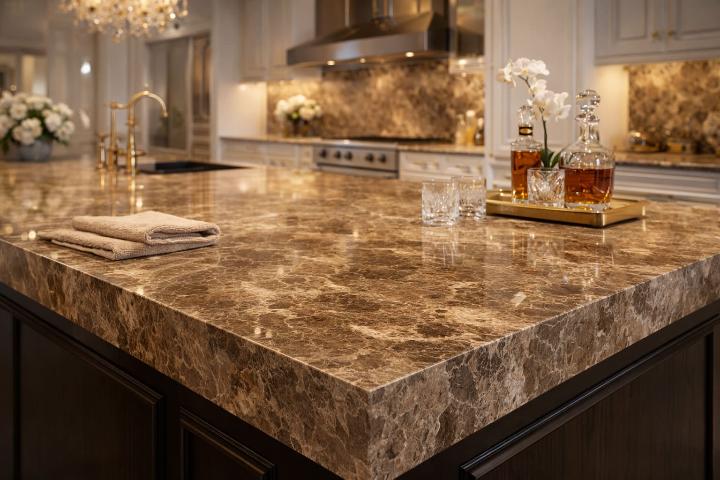
The Best Types of Marble for Kitchen Countertops
Carrara Marble
Carrara is the most widely recognized and accessible marble variety, quarried from the Carrara region of Tuscany, Italy. It features a soft white or light gray background with fine, feathery veins in cool gray or blue-gray tones. The veining tends to be subtle and evenly distributed, making Carrara a versatile option that complements both contemporary and classic kitchen styles.
Carrara is also one of the more affordable marble options, making it accessible for a wide range of kitchen budgets. It is relatively dense but sits on the more porous end of the marble spectrum, so consistent sealing is important to prevent staining from everyday kitchen spills. For homeowners who want an elegant marble countertop without the premium cost of rarer varieties, Carrara remains an excellent starting point.
Calacatta Marble
Often confused with Carrara due to its Italian origins, Calacatta marble is a distinctly different and more luxurious stone. It features a bright white background with thick, dramatic veins in gold, deep gray, or warm beige tones. These bold veining patterns create a striking visual focal point that instantly elevates any kitchen.
Calacatta is rarer than Carrara, which contributes to its significantly higher price point. It has slightly lower porosity than Carrara but still requires regular sealing and careful maintenance. This marble pairs beautifully with dark cabinetry and metallic hardware, making it a favorite for luxury kitchen renovations.
Statuario Marble
Statuario marble occupies a middle ground between Carrara's subtlety and Calacatta's drama. It offers a luminous white base with well-defined veins ranging from soft gray to deep charcoal. The veining tends to be more refined and structured than Calacatta, giving it a polished, sophisticated appearance.
Statuario is a premium option that works across a range of kitchen styles, from transitional to modern. It has moderate porosity and benefits from regular sealing, but its balanced aesthetic makes it one of the most versatile high-end marbles available.
Nero Marquina Marble
For homeowners drawn to a darker, more contemporary look, Nero Marquina marble offers a dramatic departure from traditional white marble. Quarried in Spain, this stone features a deep black background with thin to medium white veining that creates a bold, high-contrast appearance.
Nero Marquina works especially well in modern, industrial, or monochromatic kitchen designs. One consideration is that scratches, dust, and etching marks tend to be more visible on dark surfaces, so this marble requires consistent care. It makes an exceptional choice for a kitchen island centerpiece or a statement countertop paired with light cabinetry.
Danby Marble
Quarried in Vermont, Danby marble is an American alternative to Italian varieties that offers improved density and lower porosity. It features a white or cream-toned background with soft, diffused veining in gray, gold, or taupe, creating an understated and elegant appearance.
Danby is known for its enhanced resistance to moisture absorption and surface scratches compared to many Italian marbles. This makes it one of the most practical natural marble options for active kitchens. It pairs well with farmhouse, transitional, and contemporary design styles.
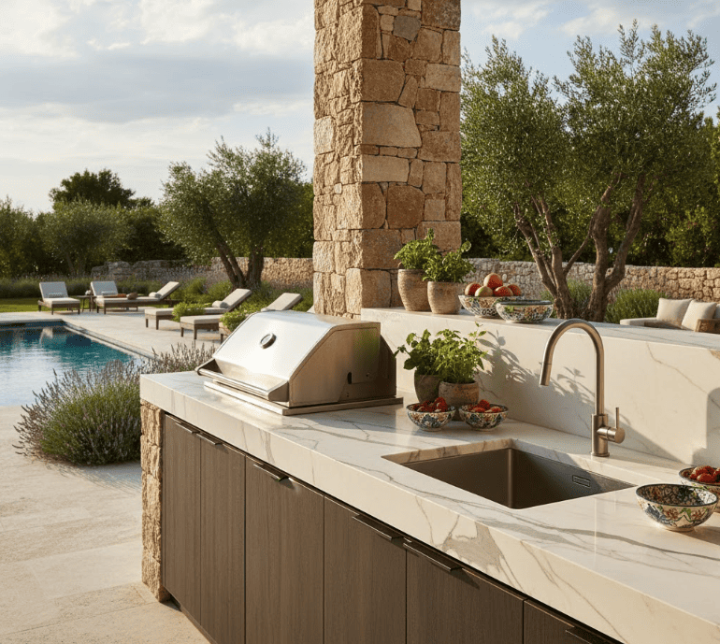
Key Factors to Consider When Choosing Marble
Selecting the right marble for your kitchen goes beyond picking the prettiest slab. Consider your household's cooking habits, how much maintenance you are willing to commit to, and your overall budget, including fabrication, installation, sealing, and long-term upkeep costs.
For busy kitchens with children, frequent cooking, and heavy daily use, denser varieties like Danby or honed-finish Carrara tend to perform better. For kitchens where aesthetics are the priority and usage is lighter, premium options like Calacatta or Statuario deliver maximum visual impact. Visiting a showroom to view full slabs in person is one of the best ways to evaluate veining patterns, color undertones, and surface finishes before making a final decision.
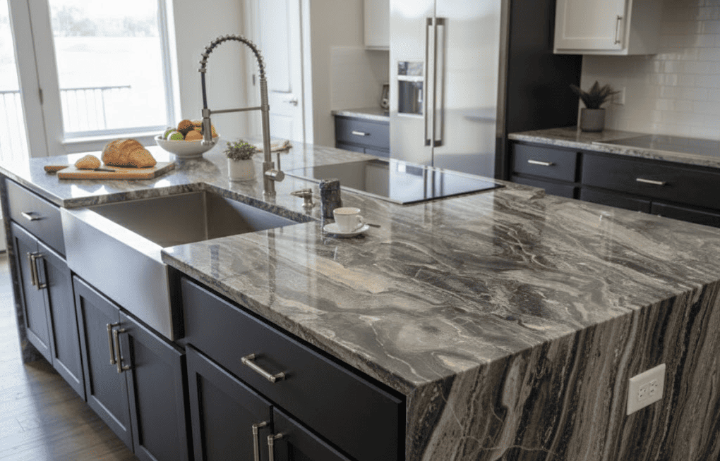
Marble Look Porcelain Tiles: A Low-Maintenance Alternative
For homeowners who love the look of marble but want to skip the sealing, staining, and etching concerns, marble look porcelain tiles have become an increasingly popular alternative. These tiles are manufactured from refined clay and mineral pigments, fired at extremely high temperatures to create a dense, non-porous surface that resists scratches, stains, heat, and moisture. It is also worth noting that concerns around silica exposure during stone fabrication have led more homeowners to consider porcelain as a safer, health-conscious countertop material.
Modern inkjet printing technology allows manufacturers to replicate the organic veining and natural color variations of real marble with remarkable precision. High-definition scans of actual marble slabs are digitally applied to the tile surface, producing patterns that closely mimic Carrara, Calacatta, Statuario, and other sought-after varieties. Available in polished, matte, and textured finishes, these tiles deliver the visual impact of natural stone with virtually none of the maintenance.
Marble look porcelain tiles are ideal for kitchen countertops (in slab format), backsplashes, flooring, shower walls, and accent features. They never need sealing, clean up easily with soap and water, and maintain their appearance for years without fading or etching. They also cost significantly less than natural marble, making them a smart choice for homeowners who want luxury on a realistic budget.
| Feature | Natural Marble | Marble Look Porcelain Tiles |
|---|---|---|
| Porosity | Porous, requires regular sealing | Non-porous, no sealing needed |
| Maintenance | High, special cleaners and annual sealing | Low, soap and water |
| Scratch Resistance | Moderate, can scratch and etch | High, resists scratches and etching |
| Heat Resistance | Moderate, thermal shock risk | High, withstands high temperatures |
| Cost | Higher overall investment | More budget-friendly option |
| Design Variety | Limited to natural availability | Wide range of colors, patterns, and finishes |
Conclusion
Choosing the best marble for your kitchen countertops comes down to balancing aesthetics, durability, and the level of maintenance you are comfortable with. Classic options like Carrara and Calacatta deliver timeless elegance that few other materials can match, while harder-wearing varieties like Danby offer improved practicality for active households. For homeowners who want the beauty of marble without the ongoing care, marble look porcelain tiles provide a durable, cost-effective, and virtually maintenance-free solution that holds up beautifully in real-world kitchen conditions. For a broader comparison of how marble stacks up against granite, quartz, and other popular surfaces, this stone countertop overview is a helpful resource.
We are a family-owned business and direct stone importer with four showroom locations in Reno, Minden, Sacramento, and Fernley. Our showrooms carry thousands of natural stone slabs, including marble, granite, and quartzite, along with quartz, sintered stone, porcelain slabs, and a wide selection of porcelain and ceramic tiles. Whether you are remodeling a kitchen or simply upgrading your countertops, our commission-free design team is here to help you find the perfect material for your space. Schedule a free design consultation to get personalized recommendations tailored to your kitchen's style and your family's lifestyle.
Frequently Asked Questions
Is marble a good choice for kitchen countertops?
Marble is an excellent choice if you value natural beauty, unique veining, and a cool surface ideal for baking and pastry work. However, it is softer and more porous than granite or quartz, which means it requires regular sealing and careful maintenance to prevent staining and etching from acidic foods and beverages.
What is the most durable marble for kitchen countertops?
Danby marble, quarried in Vermont, is considered one of the most durable natural marble options due to its higher density and lower porosity compared to Italian varieties. It resists moisture absorption and surface scratches better than most marbles, making it a practical choice for kitchens that see heavy daily use.
How often does marble need to be sealed?
Most marble countertops should be professionally sealed once or twice per year, depending on the variety and how heavily the kitchen is used. Lighter, more porous marbles like Carrara may need more frequent sealing, while denser options like Danby can go longer between applications.
Are marble look porcelain tiles as attractive as real marble?
Yes. Advances in digital inkjet printing technology allow porcelain manufacturers to reproduce the veining, color variation, and surface texture of natural marble with impressive accuracy. Many homeowners and designers find it difficult to distinguish high-quality marble look porcelain from the real thing, especially in larger formats that minimize grout lines.
Where can I see marble and marble look tile options in person?
We have four showroom locations across Northern Nevada and Northern California where you can browse natural marble slabs and marble look porcelain tiles side by side. As a direct stone importer, we carry thousands of slabs in-store. Schedule a free design consultation with our commission-free team to get expert guidance on the best option for your project.