The most common bathroom countertop materials are marble, granite, quartzite, quartz, porcelain slab, and sintered stone, each with a distinct set of performance characteristics suited to different bathroom environments and maintenance preferences. Natural stones including marble, granite, and quartzite are quarried directly from the earth and carry natural veining and variation that engineered surfaces do not replicate, but they require periodic sealing and careful use around acidic personal care products. Engineered surfaces including quartz, porcelain slab, and sintered stone are non-porous, require no sealing, and resist the chemical exposure common in busy bathrooms, including acetone-based nail polish remover, hydrogen peroxide, and benzoyl peroxide acne treatments. The right material depends on the bathroom's daily use pattern, the homeowner's tolerance for maintenance, and the design goals of the space. We are a direct stone importer with slab inventory across our showrooms in Reno, Minden, Sacramento, and Fernley, and this guide covers each material in depth so you can choose with confidence before visiting a showroom or submitting a slab quote request.
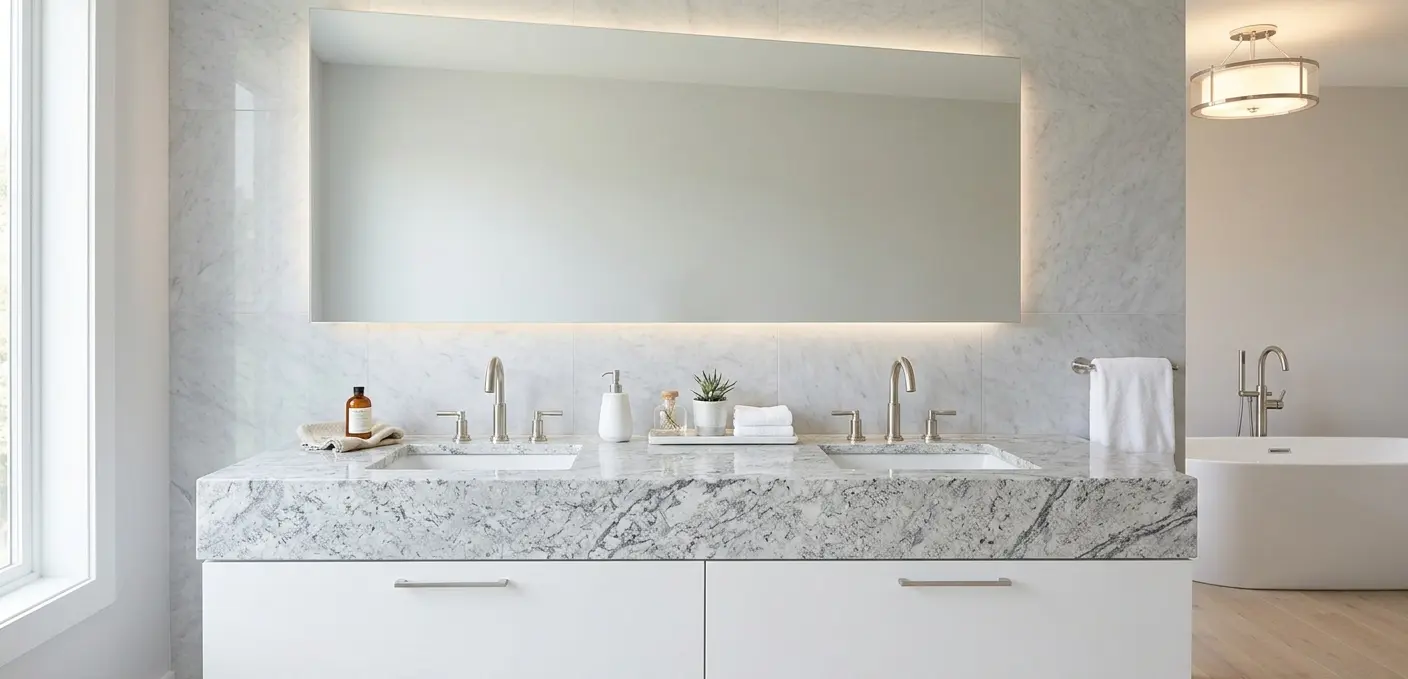
What Makes Bathroom Countertops Different From Kitchen Countertops
Kitchen countertops face heat, food acids, and heavy daily use from prep work. Bathroom countertops face a different set of conditions: prolonged water exposure around the sink, steam from showers, and chemical exposure from everyday products like acne treatments, hair dye, nail polish remover, and perfumes. Some of those chemicals are more aggressive on natural stone than anything found in a kitchen environment. Acne medication containing benzoyl peroxide, for instance, can bleach and discolor marble surfaces. Bathroom vanity tops are also smaller in scale than kitchen surfaces, which means the material budget goes further and high-end choices become more accessible per square foot.
With those conditions in mind, here is a breakdown of the most commonly used materials for bathroom vanity tops and how each one performs.
Marble
Marble is one of the most widely recognized natural stones in the bathroom category and a common selection for primary and master bath vanities. Its soft, flowing veining and polished surface bring a formal quality to bathroom spaces that other materials approach differently. Calacatta, Carrara, and Statuario are the most familiar varieties, each with a white or off-white background and veining that ranges from delicate gray lines to bold, sweeping strokes.
The trade-off with marble in a bathroom setting is maintenance. Marble is a calcium carbonate-based stone that etches when it comes into contact with acidic substances, and many common personal care products qualify. Etching shows up as dull, flat patches on the polished surface. For master bathrooms and powder rooms with controlled daily use, marble is a workable choice with appropriate maintenance routines in place. For a high-traffic family bathroom where products regularly sit on the vanity, a harder stone or engineered surface holds up better. A honed finish can also be a practical choice in bathroom applications, as it tends to show etching less visibly than a polished surface.
Granite
Granite is a hard natural stone and has been a common material for bathroom vanity design for decades. It is an igneous rock formed from cooled volcanic material and is composed primarily of quartz, feldspar, and mica minerals, giving it a dense surface that resists scratching and impact. Granite is harder than marble, less reactive to acids, and generally more forgiving of the chemical exposures common in a bathroom environment.
Granite varies in pattern and color from slab to slab, ranging from subtle, fine-grained surfaces to high-variation slabs with pronounced mineral movement. Granite does require periodic sealing to protect against staining, particularly around the sink where water and soap accumulate. Lighter-colored granites may need resealing annually, while denser dark granites can go longer between applications.
Quartzite
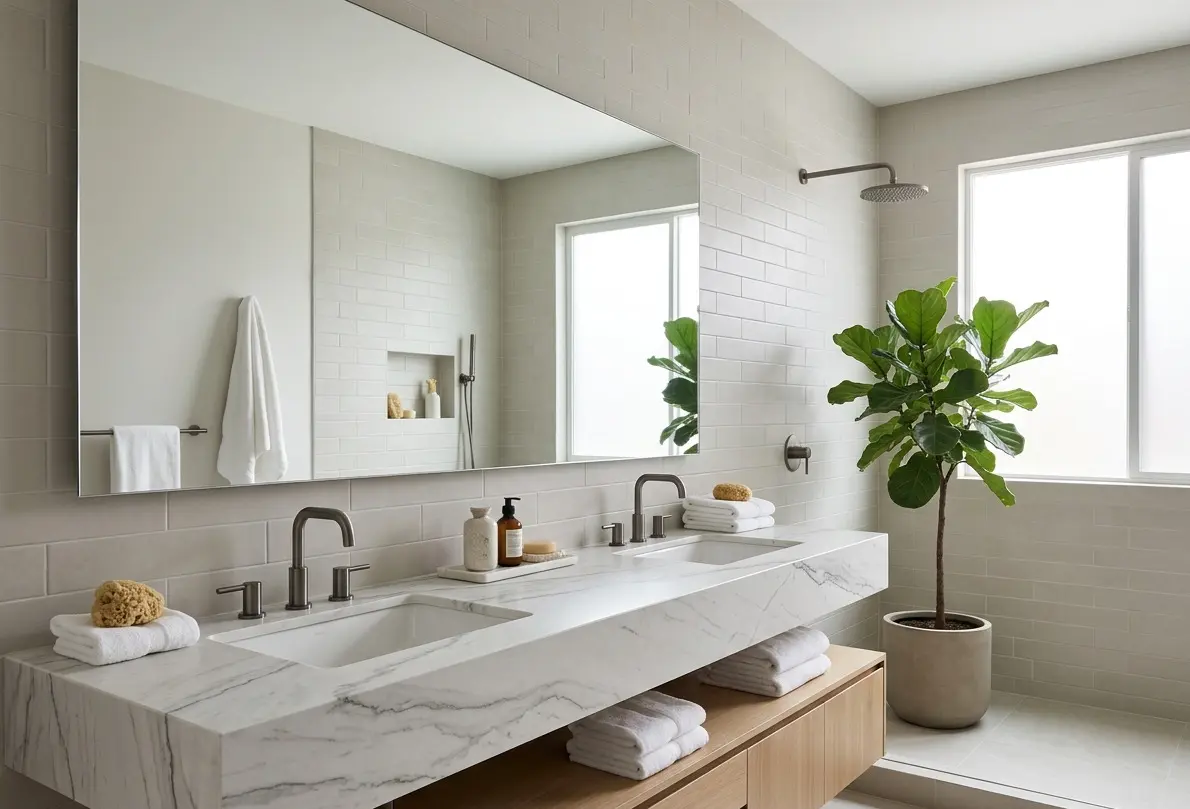
Quartzite is a natural metamorphic rock that forms when sandstone is subjected to extreme heat and pressure over geological time, converting its quartz grains into a dense, interlocking crystalline structure. The result is one of the hardest natural stones available for residential use, with a surface that is more resistant to scratching and etching than either marble or granite.
Quartzite is frequently selected for bathroom vanity applications where the homeowner wants the visual character of marble without the etching vulnerability. Many quartzite varieties, including Super White, Taj Mahal, and White Macaubas, feature soft white or cream backgrounds with flowing veining that resembles marble. Because quartzite is a natural stone, it is porous and requires sealing, though denser varieties like Taj Mahal tend to need resealing less frequently than softer stones.
Quartz
Quartz countertops are engineered stone products made from approximately 90 to 95 percent crushed natural quartz crystals bound together with polymer resins and pigments. Because the manufacturing process creates a fully non-porous slab, quartz does not absorb liquids, does not require sealing, and is highly resistant to staining from the cosmetics and personal care products that are common in bathroom environments. Homeowners and trade professionals working with engineered stone surfaces during fabrication and renovation should be aware of silica dust exposure guidelines.
For family bathrooms and high-use shared spaces, quartz is a practical material choice. It requires no sealing, holds up against water exposure, and is available in a wide range of styles including patterns that mimic Carrara and Calacatta marble. The consistency of engineered stone also makes color and pattern matching straightforward when multiple vanities need to align across a larger bathroom renovation.
The one performance consideration worth noting is heat. Quartz contains resin binders that can discolor under sustained direct heat, though in a bathroom setting this is rarely a practical concern.
Porcelain Slabs
Large-format porcelain slabs are a widely used category in bathroom vanity design. Porcelain is a fired ceramic product produced at very high temperatures, which results in an extremely dense, fully vitrified surface with near-zero water absorption. In a bathroom setting, where moisture is constant, that performance characteristic is directly relevant.
Porcelain slabs for bathroom vanities are available in a wide range of surface designs, including stone-look patterns that print the visual appearance of marble, quartzite, or granite onto the tile body. The visual consistency across a porcelain slab is more uniform than natural stone, which can be an advantage when precise pattern control is a priority.
Because porcelain requires no sealing and resists virtually all common bathroom chemicals including acetone and bleach, it requires minimal ongoing maintenance. It does not etch from acidic products, which makes it a practical choice for busy bathrooms where personal care products are regularly left in contact with the surface. Porcelain slabs work well for undermount, drop-in, and integrated sink configurations.
Sintered Stone
Sintered stone is a category of engineered material produced by compressing and baking natural mineral powders under extreme heat and pressure, a manufacturing process that mirrors the geological formation of natural stone in a compressed timeline. The result is an ultra-dense, fully vitrified surface with properties similar to porcelain but produced from a different material composition.
Sintered stone is non-porous, requires no sealing, resists staining and chemical exposure, and handles heat without discoloration. In a bathroom context, its chemical resistance is a practical advantage since many products in daily use that damage other surfaces, including nail polish remover, acetone-based cleaners, and hydrogen peroxide formulas, do not affect sintered stone. It is available in designs that replicate the appearance of marble, quartzite, and concrete, and its density makes it suitable for thin-slab configurations where weight is a consideration.
How to Choose Between Materials
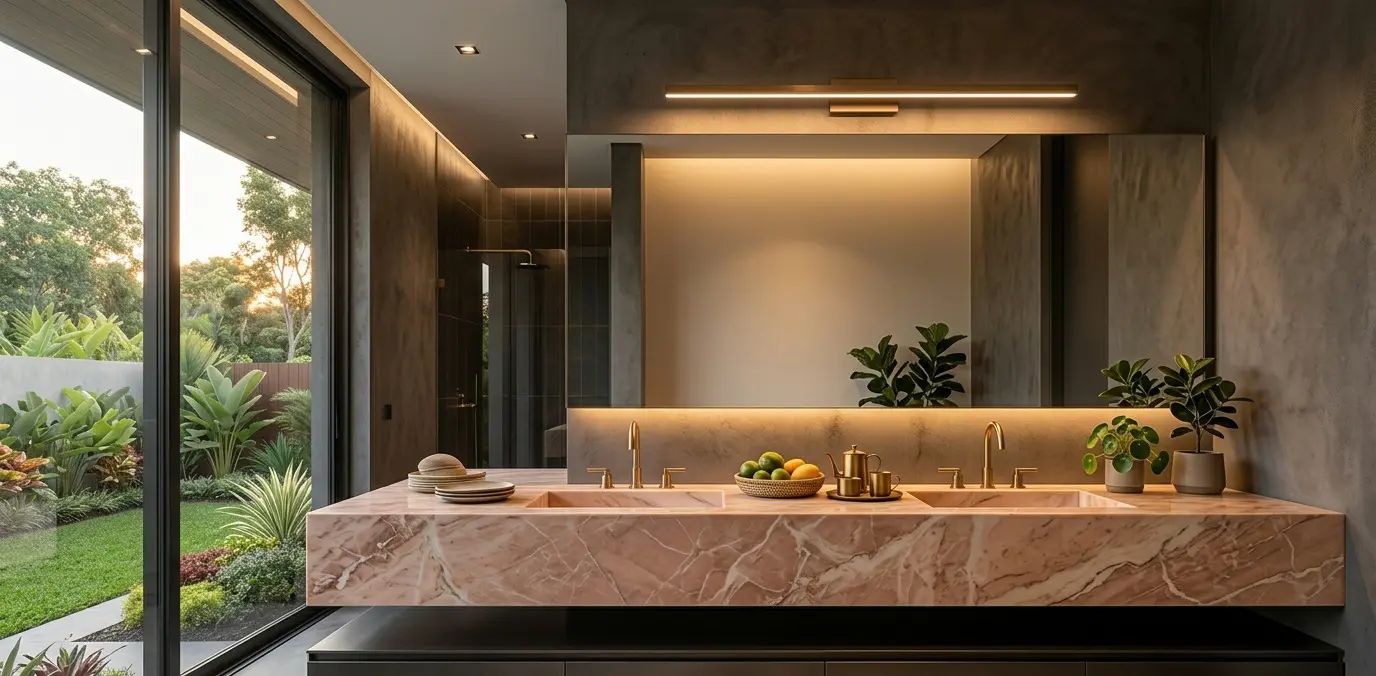
The most useful framework for choosing a bathroom vanity top is to match the material to the specific bathroom and the people using it.
For a master bath or powder room with controlled daily use and a homeowner willing to maintain natural stone, marble, granite, or quartzite are suitable options. Each carries natural veining and variation that engineered materials are produced to approximate.
For a family bathroom used by children or teenagers, or for a homeowner who wants minimal ongoing maintenance, quartz, porcelain slab, or sintered stone are the more practical options. All three require no sealing and resist the chemical exposure common in high-use bathroom environments.
Viewing full-size slabs in person is the most reliable way to evaluate how a material will look in your space. The scale and movement of a full slab, particularly for marble or quartzite, often reads very differently from a small sample photograph. For a deeper overview of how natural stone performs across residential applications, this guide to natural stone countertops from Fine Homebuilding covers the key material categories in detail.
We offer free design consultations at all four of our showroom locations and carry slab inventory across granite, marble, quartzite, quartz, porcelain, and sintered stone categories.
Conclusion
Choosing the right bathroom countertop material comes down to matching the surface to how the bathroom is used day to day. Natural stones including marble, granite, and quartzite carry natural veining and variation that engineered surfaces do not replicate, and they are suitable choices for bathrooms where maintenance is part of the plan. Quartz, porcelain slab, and sintered stone are non-porous, require no sealing, and resist chemical exposure common in high-use bathroom environments. We carry the full range of materials across our Northern Nevada and Northern California showrooms, and our team is available to walk you through the options in person. Design professionals and contractors can apply for a trade account for project-based access to our slab inventory.
Frequently Asked Questions
What is the most durable material for a bathroom countertop?
Quartzite and granite are among the most durable natural stone options for bathroom vanity tops, with dense, hard surfaces that resist scratching and stand up well to daily use. Among engineered materials, porcelain slab and sintered stone are both extremely hard and durable, with fully vitrified surfaces that resist staining, etching, and chemical exposure. The most durable choice depends on which type of durability matters most: resistance to scratching and impact, resistance to staining, or resistance to chemical exposure from personal care products.
Does marble work in a bathroom?
Marble can work very well in bathroom applications where it is properly maintained and used with care. Because bathrooms typically see less heat exposure than kitchens, and because the scale of vanity surfaces is smaller, marble is often more practical in a bathroom setting than in a kitchen. The main consideration is chemical exposure from personal care products. Acidic substances including some acne treatments, certain hair products, and citrus-based cleansers can etch marble surfaces. Resealing annually and wiping up product spills promptly helps preserve the surface over time.
What is the difference between quartz and quartzite for a bathroom vanity?
Quartz is an engineered stone product made from crushed quartz minerals bound with resin. It is non-porous, requires no sealing, and is consistent in color and pattern. Quartzite is a natural metamorphic rock that must be periodically sealed to protect against staining. Quartzite tends to have a more varied, organic visual character than engineered quartz and is harder and more resistant to etching than marble. The choice between the two often comes down to maintenance preference and how much the buyer values a naturally sourced material versus a zero-maintenance engineered surface.
How often does a natural stone bathroom countertop need to be sealed?
Sealing frequency depends on the specific stone and the level of use. Granite vanity tops typically benefit from resealing every one to two years. Marble and quartzite countertops in active use generally benefit from an annual sealer application, though denser quartzite varieties like Taj Mahal can often go longer between applications. The simplest way to test whether resealing is needed is the water bead test: if water beads on the surface, the sealer is still active; if water absorbs into the stone, it is time to reseal.
Is porcelain a good choice for a bathroom vanity top?
Porcelain slab is one of the most practical materials for bathroom vanity tops because of its fully vitrified, non-porous surface. It does not absorb moisture, requires no sealing, and resists virtually all common bathroom chemicals including acetone, bleach, and hydrogen peroxide formulas. Porcelain slabs are available in stone-look designs that realistically mimic marble, quartzite, and granite, and they work across undermount, drop-in, and integrated sink configurations. For homeowners prioritizing low maintenance and chemical resistance, porcelain slab is consistently one of the strongest options in the bathroom category.