The three best types of natural stone countertops are granite, marble, and quartzite. Each material is quarried directly from the earth and offers a distinct combination of color, veining, hardness, and maintenance requirements that make it suited to different kitchens, bathrooms, and lifestyles. Granite leads in everyday durability and heat resistance, making it the top choice for active family kitchens. Marble is prized for its timeless luxury and distinctive veining, best suited for spaces where aesthetics take priority. Quartzite delivers the closest thing to the best of both worlds, combining marble-like beauty with granite-level hardness.
Choosing the right natural stone countertop is one of the most consequential decisions in any kitchen or bathroom renovation. Unlike engineered surfaces, no two natural stone slabs are identical, meaning every installation is genuinely one of a kind. According to This Old House, natural stone countertops are considered a luxury feature that can increase a home's resale value, making them one of the most rewarding long-term investments a homeowner can make. This guide breaks down each of the three best natural stone countertop materials by appearance, durability, finish options, and ideal applications so you can make a confident choice for your space.
1. Granite
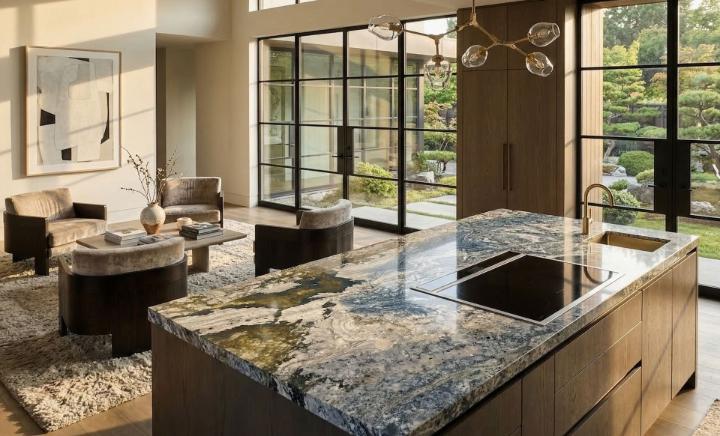
Granite is the most widely used natural stone countertop material and has maintained that position for decades. It is an igneous rock formed from slowly cooled magma, composed primarily of quartz, feldspar, and mica. That mineral composition gives granite its characteristic speckled appearance and exceptional hardness.
Granite countertops are available across an enormous range of colors, from deep uniform blacks and rich browns to warm golds and soft creams. Its visual variety means it complements virtually any cabinet color or kitchen style, from contemporary to transitional to traditional. Homeowners across Northern Nevada and Northern California can explore the full range of available granite and natural stone slabs to find the right combination of color and movement for their space.
Finish Options
Granite can be finished in several ways depending on the look and feel you want for your space. A polished finish delivers a high-gloss, reflective surface that enhances color depth and makes veining pop. A honed finish produces a soft matte surface that feels less formal and conceals minor scratches better than a polished surface. A leathered finish adds subtle texture and is especially effective at hiding everyday smudges and fingerprints.
Durability and Maintenance
Granite ranks among the hardest natural surfaces available for residential use. It resists scratches from knives and daily kitchen activity and withstands heat from hot cookware without damage. Because granite is porous, it requires sealing upon installation and periodic resealing every one to two years to protect against staining. A simple water bead test can tell you when resealing is needed: if water absorbs into the surface rather than beading up, it is time to reseal. With proper care, granite countertops can last 30 years or more.
Best Applications
Granite is best suited for high-traffic kitchens, outdoor cooking surfaces, and bathroom vanities where long-term durability and broad design flexibility are the top priorities.
2. Marble
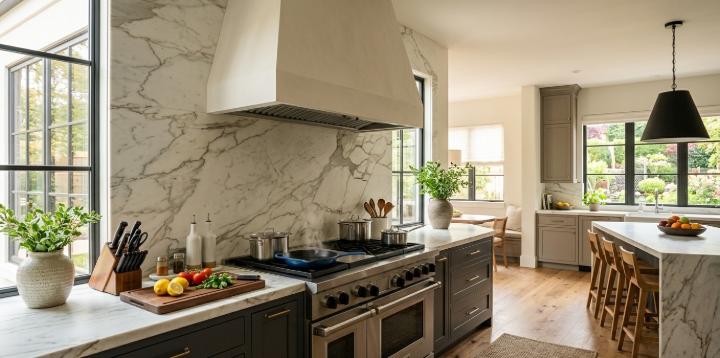
Marble has been synonymous with luxury and refinement for centuries. It is a metamorphic rock formed when limestone is subjected to extreme heat and pressure deep within the earth, a process that produces the flowing veins and luminous surface that marble is known for. Classic varieties like Carrara feature soft gray veining on a white base, while bolder options like Calacatta present dramatic, sweeping movement across a brighter white background.
Marble is naturally cool to the touch, which makes it a preferred surface among bakers and pastry enthusiasts. The wide range of available varieties means marble suits everything from soft, transitional kitchens to bold, contemporary bathroom designs.
Finish Options
A polished marble surface is highly reflective and brings out maximum color depth and the full drama of the veining. A honed finish provides a velvety matte look that is more forgiving of minor scratches and etching, making it a practical choice for kitchen applications. A leathered finish on marble is less common but delivers a subtle texture with an understated, sophisticated appearance.
Durability and Maintenance
Marble is softer and more porous than granite or quartzite, which is the key trade-off for its unmatched aesthetic. As a calcium carbonate-based stone, it is susceptible to etching from acidic substances like lemon juice, wine, and vinegar, which dull the surface over time. Sealing every six to twelve months is strongly recommended, and spills should be wiped up immediately with a pH-neutral cleaner. Abrasive cleaning products and bleach should be avoided entirely. Fine Homebuilding's guide to natural stone countertops offers a thorough look at sealing schedules and care routines that apply across marble varieties.
Many homeowners find that marble develops a patina over time that adds to its character rather than detracting from it. Choosing a honed finish in kitchen applications helps conceal minor etching and wear far more effectively than a polished surface.
Best Applications
Marble is best suited for bathroom vanities, fireplace surrounds, baking stations, and kitchens where aesthetics are the primary consideration and attentive maintenance is manageable.
3. Quartzite
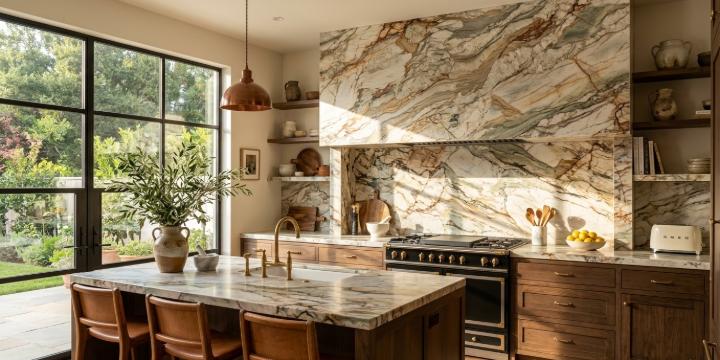
Quartzite has become one of the most sought-after natural stone countertop materials among homeowners who want the elegant, veined appearance of marble paired with strength closer to granite. It is a natural metamorphic rock formed when quartz sandstone undergoes intense heat and pressure, causing individual sand grains to fuse into an extremely dense and durable surface.
The result is a stone that visually resembles high-end marble but performs significantly better under the demands of daily kitchen use. Quartzite typically ranges from whites and soft grays to warm beiges and pale golds, often with flowing veins that are easily mistaken for luxury marble varieties. It is worth noting that quartzite is entirely different from engineered quartz, which is a manufactured surface that contains resin binders. The CDC's National Institute for Occupational Safety and Health has raised awareness around silica exposure risks during the cutting of engineered stone products, which is one reason many homeowners and designers prefer working with natural stone like quartzite for their countertop projects.
Finish Options
A polished quartzite surface maximizes the stone's natural luster and brings out the full depth of its veining. A honed finish delivers a contemporary matte appearance that pairs well with modern kitchen designs. Both finishes are widely available and hold up well over time when the stone is properly sealed and maintained.
Durability and Maintenance
True quartzite is hard enough to scratch glass, which is a useful field test for distinguishing genuine quartzite from softer stones that are sometimes mislabeled in the market. It ranks among the hardest natural stones available and resists scratches, heat, and daily wear exceptionally well. Because quartzite is still a natural stone, it is porous and requires sealing upon installation and annual resealing to maintain stain protection. Routine cleaning with a pH-neutral stone cleaner and prompt attention to spills is all that is needed for day-to-day care.
Best Applications
Quartzite is best suited for kitchen islands, busy household countertops, and bathroom vanities where a high-end aesthetic and strong performance under daily use are both required.
Conclusion
Granite, marble, and quartzite represent the three best natural stone countertop options for a reason. Each brings something distinct to a space that no engineered surface can fully replicate: a one-of-a-kind slab formed over millions of years, with depth, movement, and character that only becomes fully apparent when viewed in person at full scale.
The right choice comes down to how you use your space and what you value most. Granite is the clear winner for households that want maximum durability with minimal upkeep. Marble is the right choice for homeowners who prioritize visual impact and are prepared to care for the surface. Quartzite is the ideal middle ground for those who want the look of marble with far better resistance to scratching and daily wear.
When you are ready to move from research to selection, the most important step is seeing full slabs in person. Samples give a general sense of color and pattern, but the full movement and depth of a stone only reveals itself at scale. As a direct stone importer serving Northern Nevada and Northern California, we carry granite, marble, and quartzite slabs across showrooms in Reno, Minden, Sacramento, and Fernley. Our free design consultants are available to help you compare options side by side at no cost. If supporting a locally owned business matters to you, learn more about why shopping local makes a difference when sourcing natural stone for your home.
Frequently Asked Questions
What is the best natural stone for kitchen countertops?
Granite and quartzite are the top choices for kitchen countertops because of their hardness, heat resistance, and ability to hold up under daily use. Granite is widely available in a broad range of colors and requires sealing every one to two years. Quartzite offers a more refined, marble-like aesthetic with similar durability. Marble is a beautiful option for kitchens where aesthetics take priority, though it requires more attentive care to guard against etching and staining.
Which natural stone countertop is the most low maintenance?
Granite is generally the most low-maintenance of the three. When properly sealed, it resists staining and withstands scratches and heat without damage. Routine cleaning with a mild pH-neutral cleaner and annual resealing is all that is typically required. Quartzite has a similar maintenance profile. Marble demands the most attention, particularly in kitchen environments where acidic spills and etching are a regular risk.
What is the difference between quartzite and quartz?
Quartzite is a 100 percent natural metamorphic rock quarried directly from the earth. It forms when quartz sandstone undergoes extreme heat and pressure, producing a dense stone with natural veining and variation. Quartz is an engineered surface manufactured by combining crushed quartz crystals with resin binders and pigments. Engineered quartz is non-porous and never requires sealing, while natural quartzite is porous and must be sealed periodically. Both are strong countertop options, but they are entirely different materials.
Can marble be used in a kitchen?
Yes, marble can be used in a kitchen and many homeowners do so successfully. The key consideration is maintenance. Marble is susceptible to etching from acidic foods and beverages and requires sealing every six to twelve months. Choosing a honed finish rather than a polished finish in kitchen applications helps conceal minor etching and everyday wear far more effectively. Homeowners who love the look of marble and are willing to care for it properly can enjoy it in the kitchen for decades.
How do I choose between granite, marble, and quartzite?
Start by matching the stone's performance characteristics to how you actually use your space. Active family kitchens benefit most from granite or quartzite, which handle heavy use with minimal upkeep. Marble is better suited to lower-traffic applications or kitchens where careful maintenance is feasible and the visual impact of the stone is the primary goal. After narrowing your options by performance, visit a showroom to view full slabs in person. Color, veining, and finish are difficult to evaluate from small samples, and seeing the stone at full scale under real lighting makes the decision far clearer.