Visiting a stone and tile showroom in Sacramento gives you something no website or sample chip can replicate: the ability to see full slabs and tile formats at scale, under real light, before committing to a material that will anchor your space for years. When you visit a Sacramento stone and tile showroom, expect a hands-on selection experience that covers slab viewing in a yard, tile browsing across display walls, and a conversation with a knowledgeable team that can help you narrow your options without pressure. Knowing what to bring and how to prepare will make the visit more productive and help you leave with a clear direction.
Why an In-Person Showroom Visit Matters
Online photos of natural stone are useful for initial research, but they consistently misrepresent color, movement, and scale. A slab that photographs as soft white often reads as ivory or cream in person. Veining that looks delicate in a product image can turn out to be bold once you see the full slab. Tile formats that look standard in thumbnail size reveal significant texture variation when you hold them.
Visiting our Sacramento showroom lets you evaluate material under Northern California light conditions, which tend to be bright and warm. This matters because the same quartzite can look different in a dim Seattle showroom versus a sun-washed Sacramento kitchen. Viewing stone locally gives you a more reliable preview of how it will perform in your home.
What Happens When You Arrive
Most showrooms encourage scheduled appointments rather than walk-ins, especially for slab viewing. Booking in advance gives the team time to pull relevant inventory and pair you with someone who has context on your project before you walk through the door. If you're visiting to look at slabs for a kitchen countertop or bathroom remodel, let them know when you book.
When you arrive, you'll typically be greeted and asked a few orienting questions: what room you're working on, whether you have a cabinet color or flooring material already selected, and whether you have a fabricator lined up. These questions shape which part of the showroom the team directs you toward and which materials are realistic candidates for your project.
We operate across multiple showroom locations in Northern Nevada and Northern California. Our Sacramento commission-free team works with you to understand your project goals before making any suggestions, and we offer free design consultations so there's no pressure to buy during your visit.
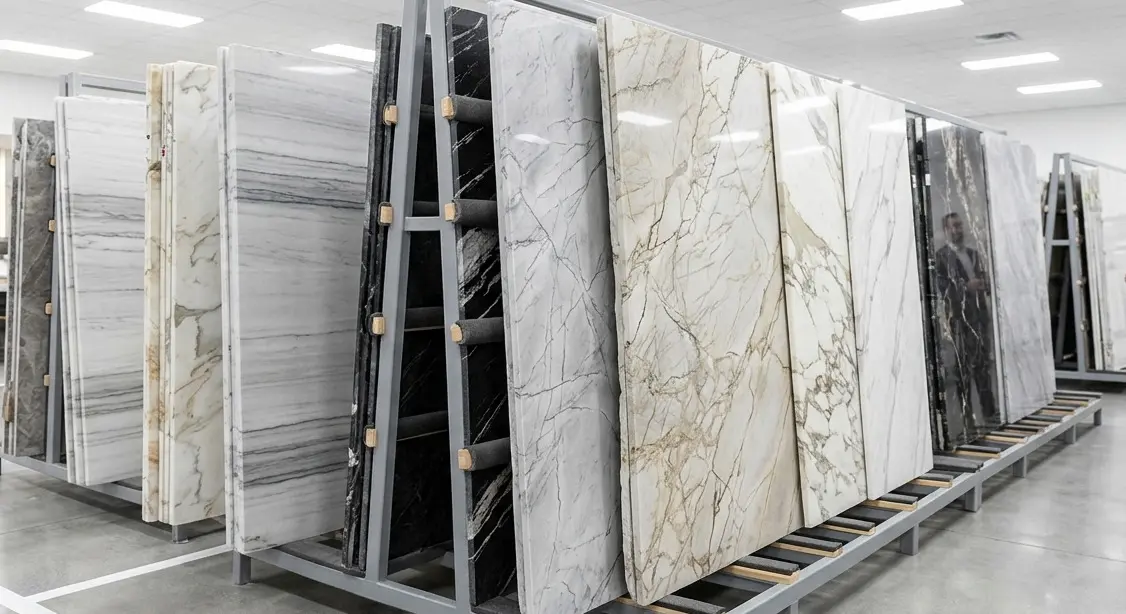
The Slab Yard: What to Expect
The slab yard is where most countertop and feature wall decisions get made. Slabs are typically stored vertically in large A-frame racks, organized by material category. You can browse our slab inventory online before your visit to get a sense of what's available, though seeing full panels in person is where the real selection happens. We carry granite, marble, quartzite, travertine, dolomite, onyx, porcelain slab, sintered stone, and engineered quartz.
A few things to know before you go in:
Slabs look different when pulled. Lighting in a slab yard is generally overhead and industrial, which can flatten the appearance of some stones. Ask to have slabs of interest pulled out and stood upright in open light. This is standard practice.
You're looking at one side. The face you see in the rack is the finished, polished or honed surface. When a slab is pulled, you'll see the full face more clearly and can start imagining how it would lay across a kitchen island or vanity top.
Movement varies within a species. If you're looking at quartzite or marble, two slabs from the same quarry can look quite different. The name tells you the mineral composition and origin, not exactly how this particular slab will look. Bookmatched pairs are pulled and displayed together, but standard slabs are individual. Take your time comparing options within the same material category.
Bring reference materials. A photo of your cabinets, flooring, or hardware will help. Even a paint chip helps. The team can hold samples next to your reference photos to get a read on undertone compatibility.

The Tile Floor: What to Expect
Tile display areas are organized differently than slab yards. Tiles are typically mounted in vignettes or grid displays that show how they look installed rather than stacked in a box. This gives you a better sense of grout joint appearance, pattern repetition, and surface texture at scale. Installation quality matters as much as material selection, and certified tile contractors are trained to meet the industry standards that govern proper setting, substrate preparation, and long-term performance.
Subway tile, large-format porcelain, natural stone mosaic, and specialty tile categories each have different things to evaluate in person. For subway tile, the key variables are glaze finish (matte vs. gloss), edge style (beveled, cushion, or straight), and how the color reads at full wall coverage versus a single tile. A tile that looks very white on its own can read as warm or cool depending on the glaze chemistry.
For large-format tile, standing back from the display matters. A 24x48 tile at arm's length doesn't tell you much. Try to view it from five to ten feet away, which is closer to how you'll experience it as flooring or a feature wall. Large-format porcelain carries its own performance ratings, and products that meet porcelain tile certification standards have been independently tested for consistency, water absorption, and breaking strength.
We carry $1 tile samples for most of our tile products, so you can take home a physical sample and evaluate it under your own lighting conditions before committing.
Questions Worth Asking During Your Visit
Showroom visits are most productive when you come prepared with specific questions. Here are a few that consistently help homeowners make better decisions:
What are the practical differences between these two materials? Natural stone species vary in hardness and acid sensitivity. Your showroom team can explain the differences between quartzite and marble, or granite and dolomite, so you can make a selection that fits your project and household. When evaluating tile for flooring applications, it is also worth asking about slip resistance ratings, as ANSI standards for tile govern dynamic coefficient of friction requirements for wet and dry surfaces, a practical consideration for kitchen and bathroom floors.
What finish options are available on this slab? Polished is the most common, but honed, leathered, and brushed finishes can shift the look and feel of the same stone. Ask if alternate finishes are available on the slabs you're considering.
How many slabs would I need for my project? Bring your rough square footage. A standard slab runs approximately 50 to 65 square feet, but this varies. Knowing how many slabs you need helps you evaluate whether there's enough matching inventory and whether bookmatching is a realistic option.
Is this material in stock or does it need to be ordered? Slab inventory moves. A material you saw on a previous visit may have sold. Confirming availability during your visit saves time later in the process.
What to Bring to Your Showroom Appointment
The more context you bring, the more useful the visit. At minimum:
Photos of your space, including cabinets, flooring, and any fixed elements you're working around. Smartphone photos are fine. The team isn't evaluating your design; they're using your references to guide material suggestions.
Your project dimensions, even rough ones. You don't need exact measurements, but knowing the approximate square footage of countertop or flooring helps the team point you toward slabs with enough yield.
A short list of materials you've already ruled out. Knowing you don't want anything with heavy veining, or that you've already decided against marble, saves time and focuses the conversation.
After the Visit: Next Steps
Most homeowners leave a showroom visit with a shortlist of two or three candidates rather than a final decision. That's a productive outcome. You'll have seen the materials at scale, gotten a feel for what fits your space, and have specific slab numbers or tile SKUs to reference.
If you're moving toward a countertop purchase, the next step is typically a slab quote request, which lets us pull detailed pricing based on your dimensions and material selection. For countertops, you'll also want to coordinate with your fabricator early, since they'll need to view and approve the slab before templating.
For tile, taking home a $1 sample and evaluating it in your space for a few days is worth the small investment before placing a larger order. You can browse our inventory online to shortlist materials before your visit.
One advantage of choosing to shop local is the ability to revisit the showroom if your project scope changes or you want to compare a second material after seeing how the first looks in your space.
Conclusion
A showroom visit is the step that turns research into a real decision. Seeing stone and tile in person, at scale, under local light conditions, removes most of the uncertainty that comes with selecting materials online. Sacramento homeowners can visit us at 6100 Warehouse Way, where our commission-free team is available to walk through the slab yard and tile floor at your pace. You can learn more about our team before booking, or call us at 916-913-6682 to set up your appointment.
Frequently Asked Questions
Appointments are strongly recommended, especially for slab viewing. Booking in advance allows the team to prepare for your project type and pair you with the right person before you arrive. Walk-ins are welcome for tile browsing, but a scheduled consultation generally leads to a more productive visit.
Bring photos of your existing space, including cabinets, flooring, and any fixed elements like hardware or appliances. Your rough project dimensions are also helpful. The more context you bring, the better the team can guide you toward materials that work for your specific space.
We offer $1 tile samples on most tile products, which lets you evaluate the material under your own lighting conditions before committing. Slab samples are not available in the same way, but viewing a full slab in the yard gives you a more accurate read than any small sample could provide.
Polished stone has a high-gloss reflective surface that brings out the depth of color and veining. Honed stone has a matte, flat surface with a softer appearance. Leathered stone has a textured surface created by running diamond-tipped brushes across the slab, which adds dimension and tends to show fewer fingerprints and water spots than polished. The right finish depends on the material, the room, and the look you're after, and seeing samples of each in person is the most reliable way to compare them.
Slab visits are primarily conducted in the slab yard, where full-size stone panels are stored vertically and can be pulled for closer inspection. Tile browsing happens on the showroom floor, where materials are displayed in installed vignettes. Many homeowners are selecting for both during the same visit, which is manageable with a scheduled appointment.