Waterproof flooring has a core designed to resist swelling, warping, or delamination when exposed to water, snowmelt, or humidity. For homes in Tahoe City, CA, this matters because the town sits at roughly 6,250 feet on the shore of Lake Tahoe, at the outlet of the Truckee River, where snowy winters, repeated freeze-thaw cycles, and tracked-in moisture put ordinary flooring materials under real stress. The two most common waterproof options are SPC and WPC vinyl plank. Properly acclimated engineered hardwood can also hold up well in this climate, though it requires more careful humidity control than vinyl. This guide covers how each option performs and how to choose between them for a Tahoe City home.

Why Tahoe City's Climate Puts Flooring to the Test
Tahoe City sits at the junction of Highway 89 and Highway 28, which puts it at the center of a stretch of the North Shore that sees some of the heaviest snowfall in the Tahoe basin. At this elevation, homes experience wide daily temperature swings, especially in shoulder seasons. A floor can go from below freezing overnight to well above it by afternoon, and that constant expansion and contraction is what causes gaps, cupping, and cracking in materials that were not built to move with it.
Add to that the seasonal reality of snow. Boots, skis, and wet gear track in moisture for months at a time, and homes near the lake often see higher ambient humidity than drier valley towns like Truckee to the north. Flooring in entries, mudrooms, kitchens, and lower levels needs to handle repeated wetting and drying without breaking down at the seams.
How Waterproof Flooring Handles Snowmelt and Moisture
SPC stands for stone polymer composite. Its core blends limestone powder with polymer resins, producing a dense, hard plank that resists denting and holds its shape through temperature changes. WPC stands for wood polymer composite. Its core uses a foamed polymer structure that is lighter and softer underfoot, with a bit more give in colder rooms. According to industry composition standards for rigid-core flooring, both constructions are built around a water-resistant rigid core, with the main tradeoffs coming down to density, underfoot feel, and sound dampening rather than moisture performance itself.
For Tahoe City entries, mudrooms, and lower-level spaces where snow gets tracked in daily, either construction will resist water damage. The choice between them usually comes down to comfort underfoot and how the room is used.
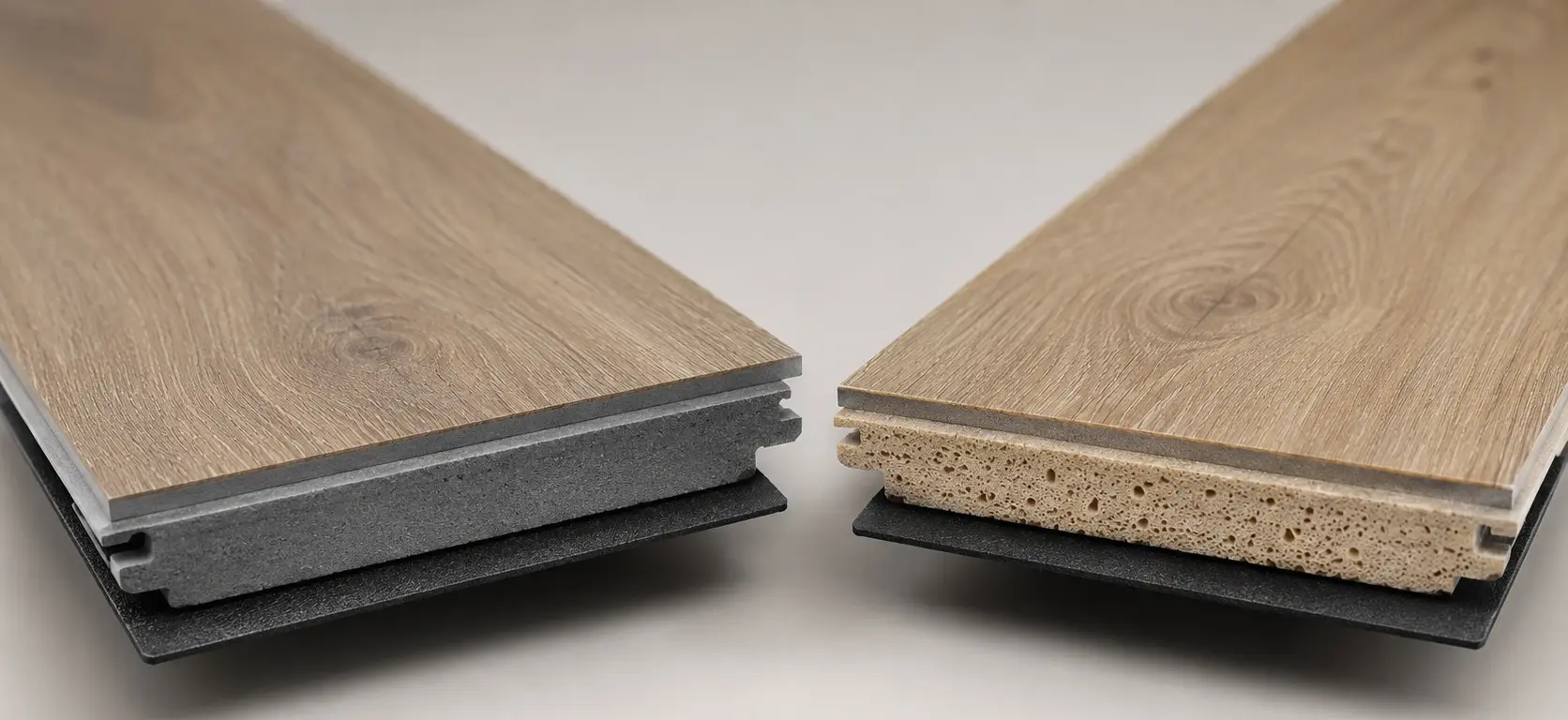
Choosing Between SPC and WPC for a Tahoe City Home
A few practical questions can help narrow the decision:
- Will the space see heavy foot traffic in wet boots for months at a time, as is typical in homes near the West Shore ski access points? SPC's denser core generally holds up well under repeated point loads.
- Is warmth underfoot a priority in bedrooms or living spaces? WPC's foamed core tends to feel less cold than SPC in unheated rooms.
- Is the home on a slab or over a crawlspace? Either construction works over both, though subfloor prep and underlayment needs differ.
- Is sound transmission a concern, such as in a multi-level home or one with living space below a bedroom? This is common in the condos and multi-unit properties found in downtown Tahoe City. WPC's denser attached underlayment typically dampens impact noise a bit more than standard SPC.
Designing Entries for Snow Season
The room that takes the hardest hit from Tahoe City's climate is usually the entry or mudroom, since it absorbs melting snow, sand, and moisture every time someone walks through the door. Architects who design homes in high-alpine environments have noted that entries in snow-heavy climates need to account for snow removal and moisture control from the start of the design process, not as an afterthought once the layout is set. A waterproof floor in this transition zone protects the rest of the home from moisture that would otherwise travel further inside on wet boots and gear, a detail that matters as much in a walkable downtown condo as it does in a larger West Shore property.
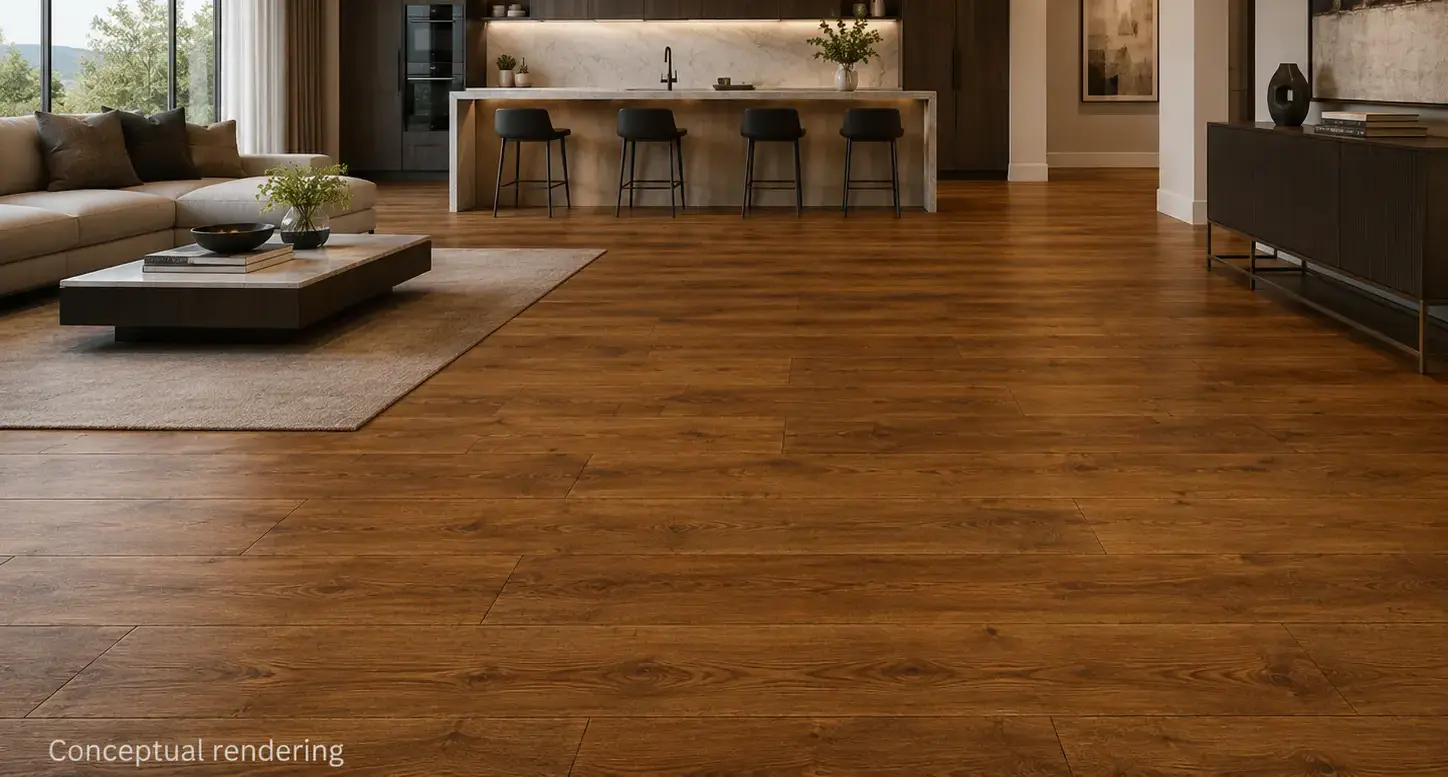
Wood Flooring: What to Know Before You Install It in Tahoe City
Hardwood is still a popular choice for great rooms and living spaces in Tahoe City homes, but it requires more planning in a climate like this one. Wood flooring expands and contracts with changes in the moisture content of the air, which is why a controlled acclimation period before installation matters. This is especially true in the many Tahoe City properties that function as second homes rather than full-time residences, since a house that sits empty for stretches during the off-season, or one that relies on a wood stove for heat, tends to see wider indoor humidity swings. Over concrete subfloors specifically, industry guidance on vapor retarders for wood flooring installation recommends a vapor retarding membrane to keep slab moisture from reaching the wood.
Engineered hardwood, which uses a plywood or cross-ply core under a hardwood veneer, tends to hold up better than solid wood in these conditions because the layered construction resists the seasonal movement that causes gapping.
Seeing Samples in Person
Nova Tile and Stone's Reno showroom, located at 12835 Old Virginia Rd, Suite 24, Reno, NV 89521, is about 47 miles from Tahoe City, roughly an hour's drive along CA-89 and I-80. The showroom carries SPC and WPC flooring alongside natural stone, tile, and hardwood, which makes it possible to compare textures and finishes side by side under the same lighting before deciding what fits a given space.
Tile samples are available to take home for $1 each. Free design consultations are available for anyone working through a flooring decision, whether it is a full remodel or a single room in a Tahoe City property. The showroom can be reached at (775) 331-6682.
Nova Tile and Stone supplies flooring and surface materials only. Installation is handled by separate fabricators and installers, so it is worth lining up an installer before or during the material selection process.
Conclusion
Flooring for a home in Tahoe City has to hold up to conditions most flooring was never designed for. Snow gets tracked in daily, temperatures can swing across freezing within a single day, and many properties in town sit empty for stretches with no one there to catch a small problem early. SPC and WPC waterproof flooring, along with properly acclimated engineered hardwood, give Tahoe City homeowners a way to plan around those realities instead of discovering them after installation. The right choice comes down to how a specific room actually gets used through the winter, whether that is a mudroom absorbing snowmelt every day or a great room that needs to feel warm underfoot. Comparing textures, colors, and underfoot feel in person remains the most reliable way to settle on a material for a specific space. You can explore our offerings and browse additional flooring options on our website before visiting the showroom to compare materials in person.
Frequently Asked Questions
True waterproof flooring, including SPC and WPC rigid-core vinyl, will not swell or break down if water sits on the surface for a period of time. That said, standing water at seams or edges over an extended period can still cause problems if a floor was not installed with the correct expansion gaps, so installation quality matters as much as the material itself.
Many SPC and WPC products are rated for use over radiant heat systems, but manufacturer temperature limits vary by product, and exceeding them can affect the adhesive or locking mechanism over time. Always check the specific product's radiant heat rating before installation rather than assuming all rigid-core flooring performs the same way.
Altitude does not directly damage flooring, but higher elevations like Tahoe City often see faster humidity swings and more intense UV exposure due to thinner atmosphere, which can accelerate fading in materials without UV-resistant wear layers.
Setting a home's heating system to a minimum sustained temperature, rather than shutting it off entirely, helps limit the humidity and temperature extremes that stress flooring seams and finishes while no one is present. A basic water leak sensor near dishwashers, washing machines, and water heaters can also flag a slow leak before it causes damage that goes unnoticed for weeks.
Regular sweeping or dry mopping to remove grit before it gets ground into the surface is the main defense, since sand and rock salt can dull a wear layer over time even though they will not cause water damage. A damp mop with a cleaner made for the specific flooring type handles salt residue without leaving a film, and doormats at every exterior entry point cut down significantly on what gets tracked in to begin with.
Note: Some images on this page may be conceptual renderings created to illustrate design possibilities and may not depict actual installations.