Slab or Prefab: Which Vanity Tops Fit Your Bathroom?
Vanity tops fall into two main categories: stone slabs cut to a custom size, and prefab units manufactured in standard shapes. Slab surfaces offer continuous veining, flexible edge profiles, and material choices such as granite, quartzite, quartz, and porcelain. Prefab units are mass produced in set dimensions, with far fewer finish choices available.
For homeowners across Stagecoach, Fallon, Silver Springs, Wadsworth, and Fernley planning a bathroom refresh, the decision usually comes down to design flexibility against convenience. Slab options allow a vanity surface to match existing countertops or flooring, while prefab pieces prioritize a faster selection process. Understanding how each option performs in a real bathroom, from moisture exposure to daily wear, helps narrow the right fit before any design plan is finalized.
A powder room, a primary suite, and a shared family bathroom each place different demands on a vanity surface. Traffic level, sink style, and how much natural light hits the counter all factor into whether a slab or a prefab unit makes more sense for the space.
Why Slab Surfaces Outperform Prefab Counters
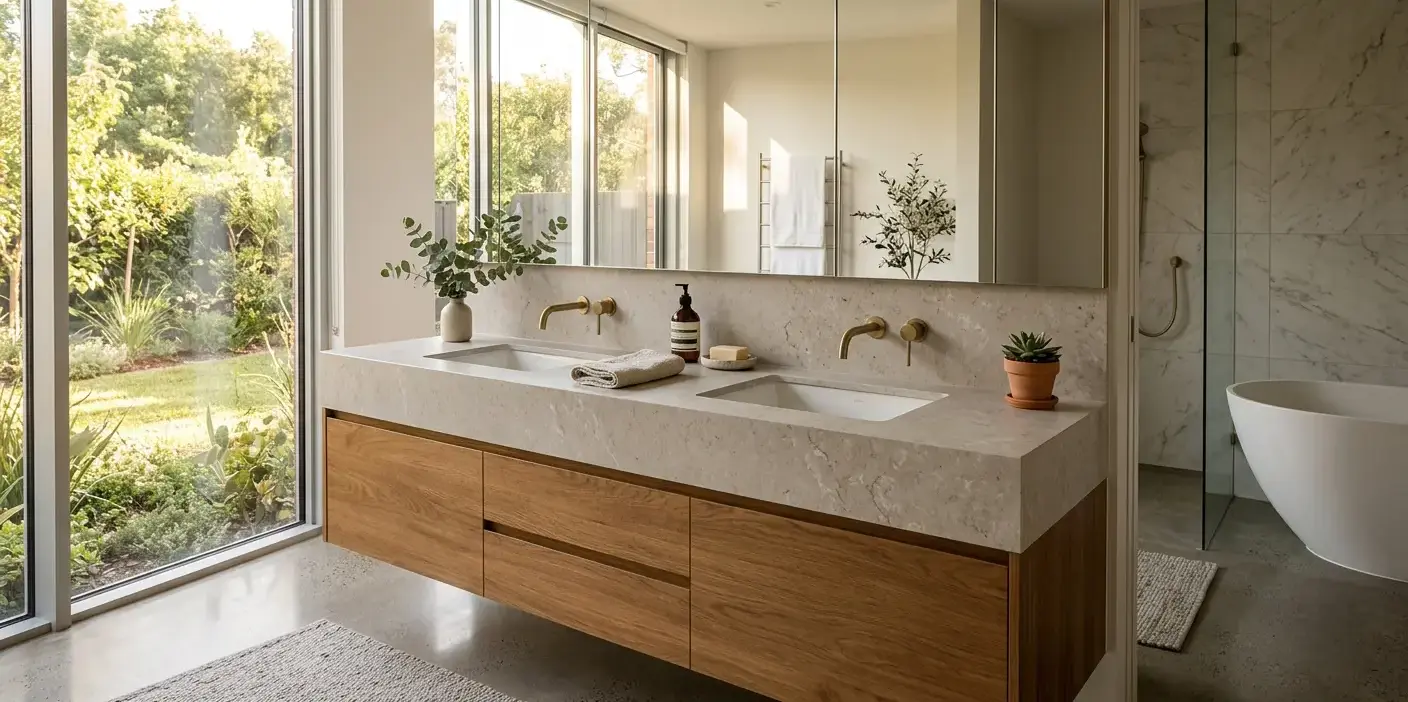
Slab materials bring qualities that prefab manufacturing cannot fully replicate. Each slab is cut from a single piece, so pattern and veining stay continuous across the surface instead of repeating in a factory template. That single distinction shapes most of the practical differences below.
- Continuous veining and pattern flow across sinks and backsplashes, unlike repeating prefab patterns
- A wider material palette, including granite, quartzite, quartz, and porcelain, each with distinct veining and tone
- Custom edge profiles and cutouts sized to the exact vanity footprint rather than a fixed template
- Scratch resistance that varies by material, so cutting boards and trivets are still recommended for nearby surfaces
- Finish choices, such as polished or honed, that influence how the surface handles daily moisture
 Conceptual rendering
Durability claims still need a qualifier. Granite and quartzite are dense materials, but proper sealing and prompt cleanup of spills preserve their appearance over time. Quartz and porcelain typically resist staining well, though avoiding abrasive cleaners on any finish is still recommended. Homeowners can browse the full range of slab options before comparing prefab alternatives side by side.
Prefab units are not without merit. A standard-sized prefab top can suit a rental property, a quick refresh, or a secondary bathroom where matching an exact veining pattern matters less than turnaround time. The tradeoff shows up in fewer size options and a narrower material selection compared to a slab cut for the space.
Design and Application Options for Stagecoach Homes
Once the slab versus prefab decision starts narrowing, material and finish choices shape how the vanity top performs day to day. Each option below fits differently depending on bathroom traffic, moisture levels, and the overall design direction of the room.
Layout also plays a role. A single-sink vanity in a smaller Stagecoach bathroom has different proportion needs than a double-sink layout in a primary suite, and slab cutting allows both configurations to come from a matched piece.
Granite and Quartzite Vanity Surfaces
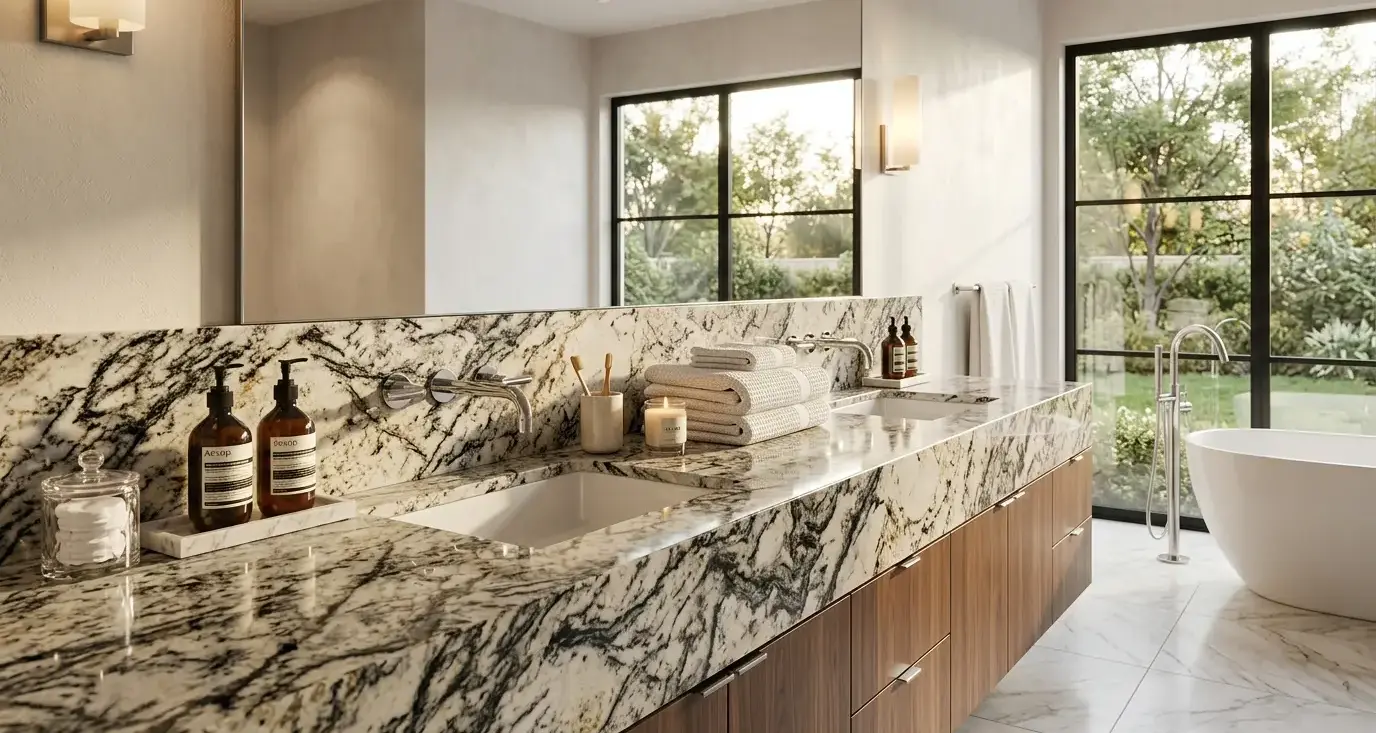
Granite and quartzite are natural stone options prized for density and pattern variety, ranging from subtle speckled tones to bold veining. Both require periodic sealing to help resist moisture absorption around sinks and faucets, and neither should be treated as maintenance-free. A honed finish reduces slip risk near a wet countertop edge compared to a high polish. Homeowners researching current material trends can review this roundup of 2026 interior design trends for context on where natural stone fits into broader bathroom design directions.
Quartzite in particular reads similarly to marble in tone and movement while offering different density characteristics, which is part of why it remains a popular request for vanity projects that want a lighter, veined look without sacrificing material performance.
Quartz and Porcelain Vanity Surfaces
Quartz and porcelain are engineered materials that typically do not require regular sealing, though this should not be treated as an absolute guarantee across every finish and condition. Quartz offers a consistent, uniform pattern, while porcelain slabs can replicate the look of natural stone with added resistance to scratching. Polished finishes on either material become slipperier when wet, so a honed or matte finish is worth considering near a vanity sink. Heat resistance also varies by material, so trivets remain a good habit even at a bathroom vanity.
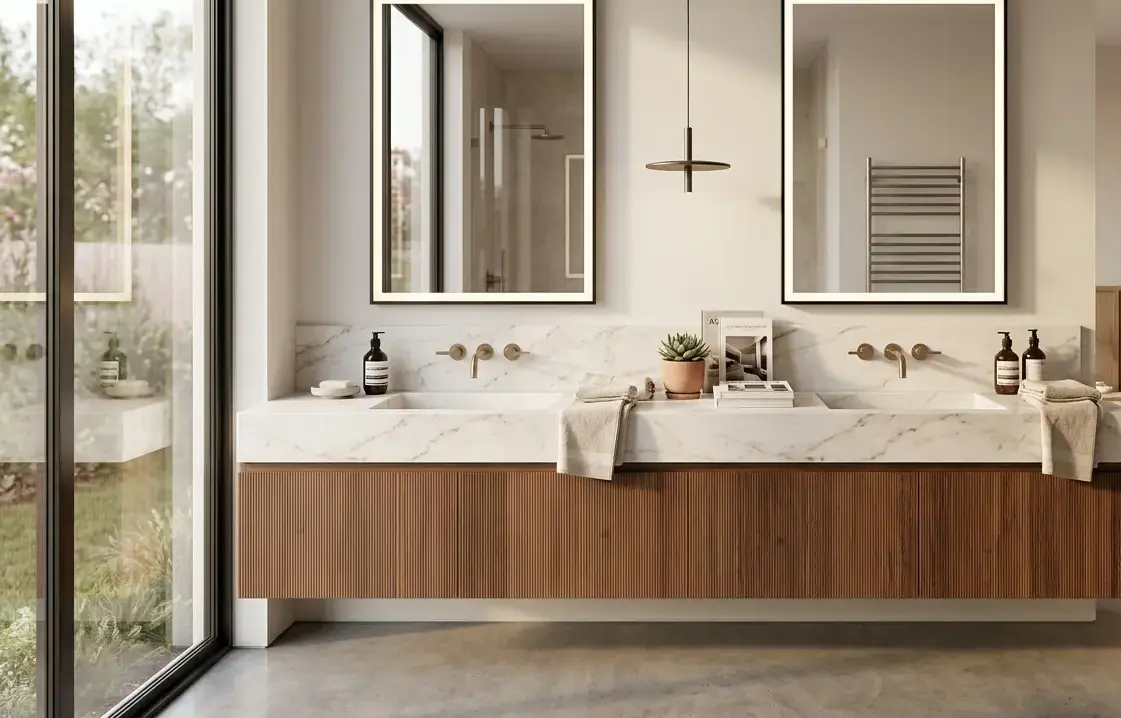
Color consistency is where engineered materials tend to stand out. Because quartz and porcelain slabs are manufactured rather than quarried, batch to batch color matching is generally more predictable, which helps when a vanity top needs to align closely with an adjoining shower wall or backsplash material ordered separately.
 Conceptual rendering
Attribute | Slab Tops | Prefab Tops |
Pattern | Continuous, unique to each slab | Repeating, standardized template |
Material choices | Granite, quartzite, quartz, porcelain | Limited engineered composites |
Edge profiles | Customizable to the exact footprint | Fixed, factory-set edges |
Sizing | Cut to the vanity dimensions | Standard prefabricated widths |
Sealing needs | Varies by material, some require periodic sealing | Typically minimal, but not maintenance-free |
Edge Profiles and Finish Combinations
Slab tops support a range of edge profiles, from a simple eased edge to a rounded bullnose or a more detailed ogee, each shaping how light plays across the surface near a mirror or window. Pairing an edge profile with a polished or honed finish changes both the visual weight of the vanity and how the surface handles everyday moisture around a sink. A honed edge paired with a honed top reduces glare and softens slip risk compared to an all polished combination in a small bathroom. For homeowners and design professionals researching broader surface material standards, the tile council reference guide offers general industry context, even though its primary focus is tile rather than slab fabrication.
Weighing Cost and Long-Term Value
Every homeowner comparing the cost of slab vs. prefab vanity tops for a Stagecoach bathroom should weigh more than the upfront selection. Slab material sourcing, veining rarity, and custom fabrication complexity all influence the overall investment, while prefab units follow standardized manufacturing runs. Rather than assuming one option costs less across the board, it helps to compare the two side by side using a slab quote request for an accurate picture based on the specific project.
Long-term value is part of that picture too. A slab surface that holds its finish and pattern over years of daily use can offset a higher initial selection cost, while a prefab top that needs earlier replacement carries its own long-term consideration.
 Conceptual rendering
Advantages to Consider
- Slab tops offer broader material and pattern variety than prefab manufacturing allows
- Prefab units can shorten the selection timeline for smaller or simpler bathroom layouts
- Slab edge profiles and cutouts adapt to unusual vanity shapes more easily
- Prefab uniformity can make matching multiple bathrooms in one home more predictable
- Slab sealing requirements vary by material, so ongoing care differs between the two options
A Simple Selection Guide
- Measure the vanity footprint and note any existing plumbing clearances in the space.
- Compare slab and prefab material options against durability and style priorities for the room.
- Review finish choices, such as polished or honed, against the bathroom's moisture and traffic level.
- Explore a showroom to see slab veining and prefab uniformity firsthand before deciding.
- Request a slab quote or apply for a trade account before finalizing the design plan.
Working With Nova Tile and Stone
Nova Tile and Stone works with homeowners and design professionals across northern Nevada, offering guidance on material selection for bathroom vanity projects. Slab veining and finish decisions are easier to make in person, where lighting and texture are visible under real conditions rather than a screen.
Service extends across Stagecoach, Fallon, Silver Springs, Wadsworth, and Fernley, with a showroom base that supports both single-vanity refreshes and larger multi-bathroom remodels. Consultants can walk through material tradeoffs specific to a household's traffic patterns and design goals.
The Fernley showroom location gives area homeowners a chance to view granite, quartzite, quartz, and porcelain slabs firsthand before committing to a design direction. Design professionals attending industry gatherings such as the international surface design event often reference similar material trends when specifying slab surfaces for residential projects.
For trade professionals managing multiple projects, Nova offers a streamlined path to request a trade account alongside standard project support. Homeowners ready to move forward can also schedule a design appointment to walk through slab options with a consultant. Homeowners can also browse to learn about Nova's team behind the showroom.
Our latest content
Check out what's new in our company !
Conclusion
Choosing between slab and prefab vanity tops comes down to how much design flexibility a Stagecoach bathroom project needs versus how quickly a decision has to be made. Slab surfaces bring unique veining, custom sizing, and a broader material palette, while prefab units offer a faster, more standardized path. Reviewing the full stone catalog alongside a showroom visit helps clarify which option fits best. The right choice ultimately depends on the space, the budget priorities, and the long-term maintenance routine a household is prepared to keep up with.
Frequently Asked Questions
Slab tops are cut from a single piece of material with continuous veining and custom sizing, while prefab units are manufactured in standard shapes with repeating patterns.
Yes, granite and quartzite typically require periodic sealing to help resist moisture absorption, and proper care helps preserve their appearance over time.
Quartz and porcelain typically do not require regular sealing, though avoiding abrasive cleaners and wiping up spills promptly is still recommended for any finish.
Slab cost depends on material sourcing and fabrication complexity, while prefab units follow standardized manufacturing runs, so a direct quote is the most accurate way to compare.
Nova serves Fernley, Fallon, Silver Springs, Wadsworth, and Stagecoach, Nevada, with showroom access for viewing slab materials in person.
Visit Our Fernley Showroom – Nova Tile and Stone
1855 US Highway 95A North, Fernley, NV 89408
 Google Maps
Store hours this week:
- Mon. - Fri.: 7:30 am - 4:00 pm
- Sat. - Sun.: Closed