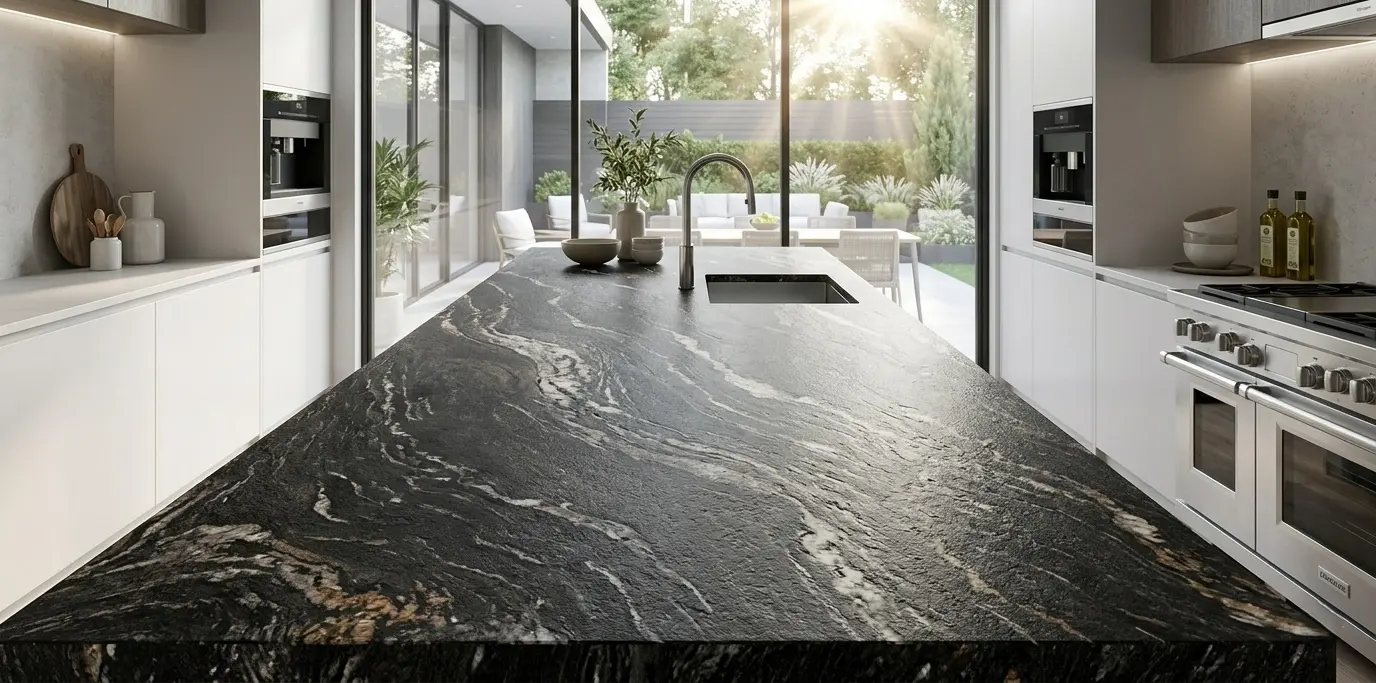
Titanium granite is a natural stone quarried in Brazil, recognized for a dark charcoal or black base threaded with sweeping veins of gray, gold, cream, and ivory. It is sold and installed as a type of granite, sharing the same hardness, heat resistance, and low porosity that make granite a durable countertop material. In Reno, NV, its density holds up well against the region's high desert climate, including freezing winter nights, hot, dry summers, and wide daily temperature swings. Homeowners commonly choose titanium granite for kitchen islands, bathroom vanities, bar tops, and fireplace surrounds, and it also performs well on covered outdoor kitchens and patios. Nova Tile and Stone's Reno showroom carries titanium granite slabs alongside its full range of stone, tile, and flooring options.
This guide breaks down what the stone is made of, how color and finish options vary, how it compares to related titanium granite variants, how it performs in Reno's climate, and how to keep it looking its best over time.
What Titanium Granite Is Made Of
Titanium granite forms deep within the earth's crust through the slow crystallization of molten rock, a process that produces a dense, hard-wearing stone quarried primarily in Brazil. Like most granite, its color comes from a mix of minerals, chiefly feldspar, quartz, and mica, and the balance between them is what produces the stone's range of tones. Because each slab cools and crystallizes differently underground, no two are identical.
Color, Veining, and Finish Options
Most titanium granite slabs show a dark charcoal or black base with movement in gold, cream, ivory, and gray running through it in irregular bands rather than a repeating pattern. Some slabs lean darker with subtle gold threading, while others show broader ivory and gray clouding across the surface. That movement can read as sweeping horizontal bands running the length of the stone, or as a more concentrated, swirling pattern with denser clusters of color in certain sections. Because the placement of veining varies so much from one section of a block to the next, homeowners installing a larger island or an especially long run of countertop often benefit from viewing the full slab in the showroom first, so the fabricator can plan seam placement around the most visually consistent sections rather than cutting through a dramatic swirl.
The stone is available in polished, honed, and leathered finishes, and the choice affects how the veining reads as much as it affects the surface feel. A polished finish brings out the deepest contrast and reflects light across the metallic tones in the veining, which tends to make the pattern feel more dramatic under kitchen lighting. A honed finish keeps that same color range but softens the reflectivity, which some homeowners prefer for a bathroom vanity or a more understated kitchen look. According to Use Natural Stone's guide to stone finishes, a leathered or brushed finish adds texture while muting shine, and this kind of surface also offers more traction in wet or exposed areas, which is useful for a bar top or an outdoor kitchen counter.
Comparing Titanium Granite, Gold, and Black
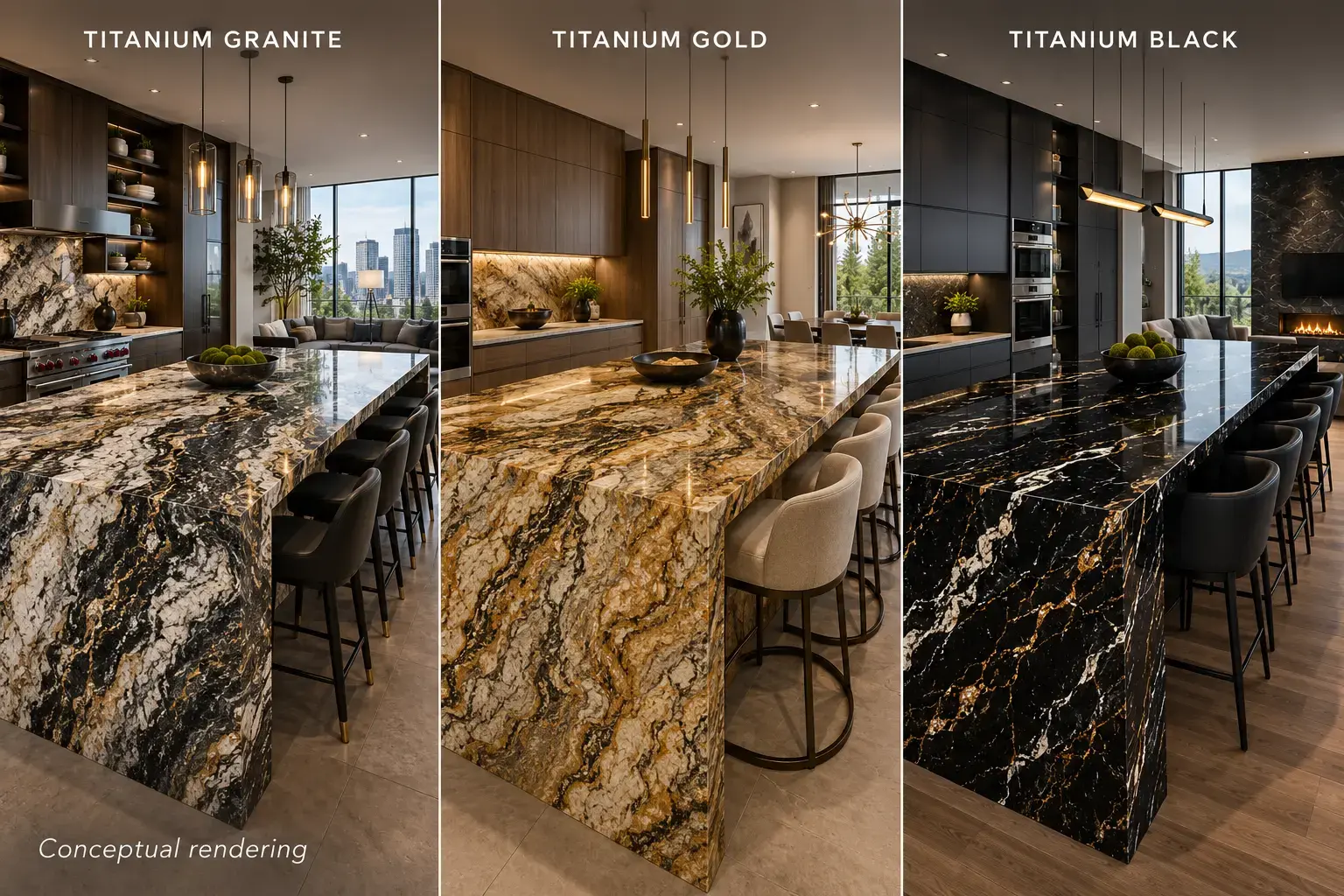
The "titanium" name covers a small family of related Brazilian granites, and it's easy to confuse one for another when comparing photos online. Titanium Granite has the most balanced palette of the three, mixing gray, gold, cream, and ivory in roughly even proportion across a dark base. Titanium Gold leans further into warmth, with a background that reads more copper or caramel toned and gold veining that dominates the slab rather than sharing space with cooler tones. Titanium Black sits at the opposite end, keeping a darker overall base with beige and white veining that shows less gold movement than either of the other two.
The practical difference comes down to how much the slab needs to coordinate with the rest of a room. Titanium Gold works well as a bold anchor piece in a kitchen with warm wood tones or brass fixtures, while Titanium Black tends to blend more easily into a monochrome or cool-toned kitchen since its veining reads quieter from a distance. Titanium Granite's more even mix of warm and cool tones is often the easiest of the three to pair with existing cabinetry, since it doesn't commit as strongly to one color direction. You can explore our offerings to narrow down your options, then visit our Reno showroom to compare the slabs in person.
Standing Up to Reno's High Desert Climate
Whichever of the three catches your eye, the stone still needs to hold up to Reno's climate once it's installed. Reno sits in the Truckee Meadows, a valley basin at the eastern base of the Sierra Nevada, near the Nevada-California border, with the Verdi crossing about ten miles west of downtown. According to the National Weather Service's climate summary for Reno, the city sits in the lee of the Sierra Nevada and experiences large temperature swings on both a daily and seasonal scale, with summer afternoons often above 90°F and nighttime lows dropping into the 50s. Elevation also varies meaningfully across the city, from around 4,400 feet on the valley floor to over 5,500 feet in upper foothill neighborhoods like Caughlin Ranch and south Reno toward Mt. Rose. Homes at those higher elevations see colder nights and more direct sun exposure than homes down in the valley.
Granite is one of the hardest dimension stones used in residential construction, and the Natural Stone Institute notes that granite's absorption rates typically run between 0.05% and 0.40% by weight, leaving very little pore space for staining agents to take hold. That density is why titanium granite holds up consistently across Reno's wide temperature swings, whether a home sits in the valley or up in the higher foothills. Unlike engineered surfaces that rely on resin binders, it isn't sensitive to the region's low humidity or UV exposure at elevation.
Best Uses: Kitchens, Bathrooms, and Outdoor Living Spaces
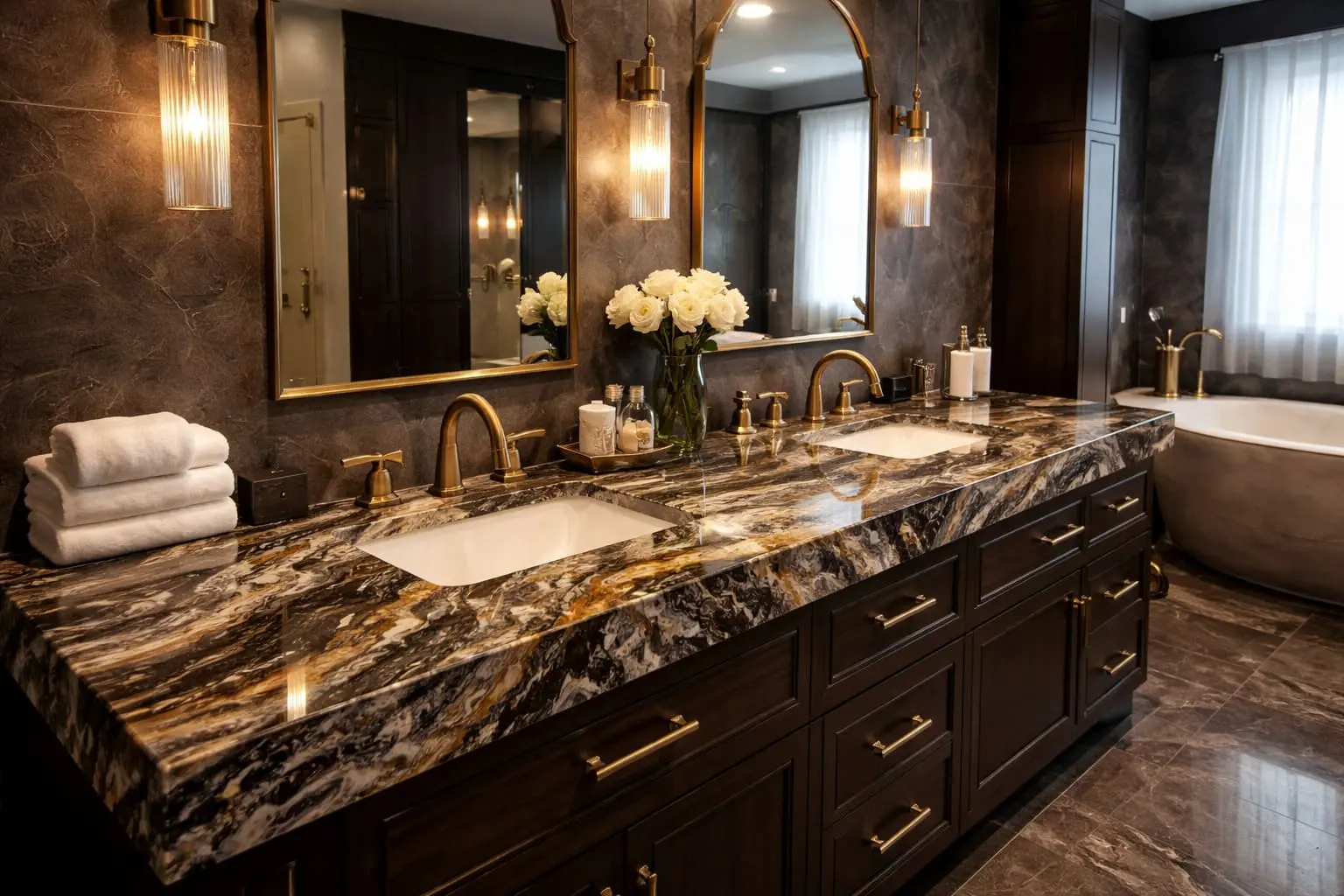
Its bold pattern makes titanium granite a strong choice for a kitchen island paired with a quieter perimeter countertop, since the island becomes a natural focal point without competing against multiple busy surfaces in the same room. In a bathroom, it works well as a vanity top, especially when paired with a simple vessel sink and neutral wall tile that lets the stone's movement stay the visual highlight of the space. As a bar top, its dense, low-porous surface stands up well to regular exposure to drinks, ice, and everyday wear, which matters for homes that entertain often given Reno's proximity to Lake Tahoe and the surrounding ski resorts. It also works as a fireplace surround, where the stone's dramatic veining pairs naturally with the mountain-adjacent, rustic-to-contemporary aesthetic common in many Reno-area homes.
Its durability also makes it a reasonable option for covered outdoor kitchens and patio bar areas, which is worth considering for Reno homes built around outdoor living and entertaining. Reno's dry summers and mild evenings make outdoor kitchens a practical extension of a home's living space for much of the year, and a dense, UV-stable material like titanium granite holds its color and finish under that kind of regular sun exposure better than surfaces that rely on resin or dye. Once you've decided where titanium granite fits best in your home, you can request a slab quote to begin planning your project.
Care and Maintenance Over Time
Mild soap and warm water handle most day to day cleaning. Acidic or abrasive cleaners are best avoided, since they can wear down a sealer over time. Most titanium granite slabs hold up well with resealing every three to five years rather than annually, and according to the Natural Stone Institute's guidance on sealing natural stone, a simple water-bead test on the surface shows whether the existing seal is still doing its job.
Visiting Our Showroom
Our Reno showroom, located at 12835 Old Virginia Rd, Suite 24, Reno, NV 89521, serves homeowners, contractors, and designers throughout Reno, Sparks, Incline Village, and surrounding Northern Nevada communities, with easy access off Old Virginia Road from both I-580 and US-395. You can reach the showroom directly at (775) 331-6682. As a family owned, direct stone importer, Nova Tile and Stone carries titanium granite along with a full range of countertop, tile, and flooring materials, including hardwood, LVP, and carpet.
Our sample program covers tile at $1 per sample. Countertop and slab materials, including granite, aren't available as take-home samples, so viewing full slabs in the showroom is the best way to evaluate a specific slab's color and pattern before purchase. Free design consultations are also available for homeowners who want guidance matching a slab to their project, and trade professionals can apply for a trade account for streamlined ordering on larger jobs.
Conclusion
Titanium granite brings a level of movement and contrast that few other countertop materials can match, and its density holds up well to Reno's climate extremes throughout the year. Choosing between titanium granite and its close relatives, understanding what the stone is made of, and knowing where it performs best in a home all shape the final result. Each decision benefits from seeing a slab in person rather than relying on photos alone.
Our Reno showroom brings titanium granite options together in one place, giving homeowners throughout the region a chance to compare veining, finish, and color for their next project.
Frequently Asked Questions
Most kitchen countertop applications use 3 centimeter (about 1.18 inch) slabs, though thickness can be adjusted based on the edge profile and design preferences.
No single edge profile is required. A bullnose or eased edge tends to soften the stone's already dramatic pattern, while a squared or mitered edge keeps the visual weight consistent with the slab's movement, so the choice comes down to kitchen style rather than a technical requirement of the stone.
Titanium granite is a natural stone, so every slab has one-of-a-kind veining, while quartz is engineered for a consistent, repeatable pattern across a whole kitchen. Granite also needs periodic resealing that quartz doesn't require, but it handles direct heat from hot pans better than most quartz surfaces.
Yes. Its density and low porosity make it suitable for outdoor kitchens, bar tops, and patio surfaces, and it tolerates freezing temperatures well. Outdoor installations still benefit from sealing to protect against moisture penetration during Reno's snow season.
Yes. All three are part of the same granite family, so the same cleaning routine and resealing schedule applies regardless of which one is chosen.
Note: Some images on this page may be conceptual renderings created to illustrate design possibilities and may not depict actual installations.