Patterned porcelain and mosaic tile suit Carson City, NV's ornate Victorian-era homes, while larger-format, simpler tile fits the newer neighborhoods built since the city's 1969 consolidation. Nevada's capital was founded in 1858 by Abraham Curry, and the wealth that later poured in from the Comstock Lode left behind a historic district with a scale of ornamentation Genoa and Stateline never had. That century-old layering of eras is still what shapes a tile decision in Carson City today.
Nevada's Capital, Built On Comstock Money
Carson City started as Eagle Station, a trading post along the California Trail dating to 1851. Abraham Curry bought the site in 1858, surveyed a town, and set aside ten acres for a future capitol before Nevada Territory even existed. Genoa briefly served as the territorial capital first, but when Nevada Territory organized in 1861, officials chose Carson City instead, and the decision stuck through statehood in 1864.
What followed was a silver boom. The Comstock Lode, discovered nearby in 1859, turned Carson City into a freight and milling hub, and the money it generated built a downtown historic district unlike anything in Genoa or Stateline. The Kit Carson Trail, a 2.5-mile self-guided walk through the city's West Side Historic District, passes roughly 50 landmarks built largely in the 1860s through 1880s for territorial officials and Comstock-era wealth. One stop, the Orion Clemens Mansion, briefly housed Orion's younger brother, a struggling writer named Samuel Clemens, in the early 1860s, before he adopted the Mark Twain pen name in 1863.
Despite that history, Carson City remains modest in size. It's an independent city rather than part of any county, a status it's held since consolidating with Ormsby County in 1969, and its population stood at 58,639 as of the 2020 census, smaller than several other Nevada cities and modest for a state capital, even if it's far from the smallest in the country. Curry himself owned a sandstone quarry and brickyard, and prison labor from the nearby Nevada State Prison used that local sandstone to raise many of the city's earliest buildings, a detail that still shows up in the stonework framing some of the district's older storefronts today. Nova Tile and Stone has watched this same layering of old and new play out across Carson Valley since 2005, and how the company got its start still shapes the patient, detail-oriented approach a historic renovation usually needs.
A City Built In Two Distinct Eras
That population has grown steadily outward from the historic core, and the resulting split matters for tile decisions. Homes along the Kit Carson Trail and throughout the surrounding historic district were built for territorial legislators, mine owners, and merchants who could afford elaborate detail: patterned floors, decorative mosaic work, and ornamentation that a simple frontier ranch house in a smaller Nevada town never had. Renovating one of these homes often calls for tile that echoes that level of detail rather than competing with it.
Newer neighborhoods built since the mid-20th century, and especially since the 1969 consolidation accelerated the city's growth, call for a different approach. State government is among the city's largest employers, and that steady base, combined with Carson City's role as a regional healthcare and retail center, has pulled development outward from the historic core for decades. These homes were built with cleaner, simpler lines from the start, and large-format tile, easy to browse by size online, tends to suit them better than a busy pattern would.
Carson City's climate plays a role in both cases. Sitting at roughly 4,700 feet at the base of the Sierra Nevada's Carson Range, the city gets a dry, four-season climate with modest winter snow, typically in the range of 20 inches a year, far less than nearby Lake Tahoe basin towns see. That's still enough moisture tracked through an entryway most winters that porcelain's low absorption rate is worth factoring into a bathroom or entry renovation, historic home or not.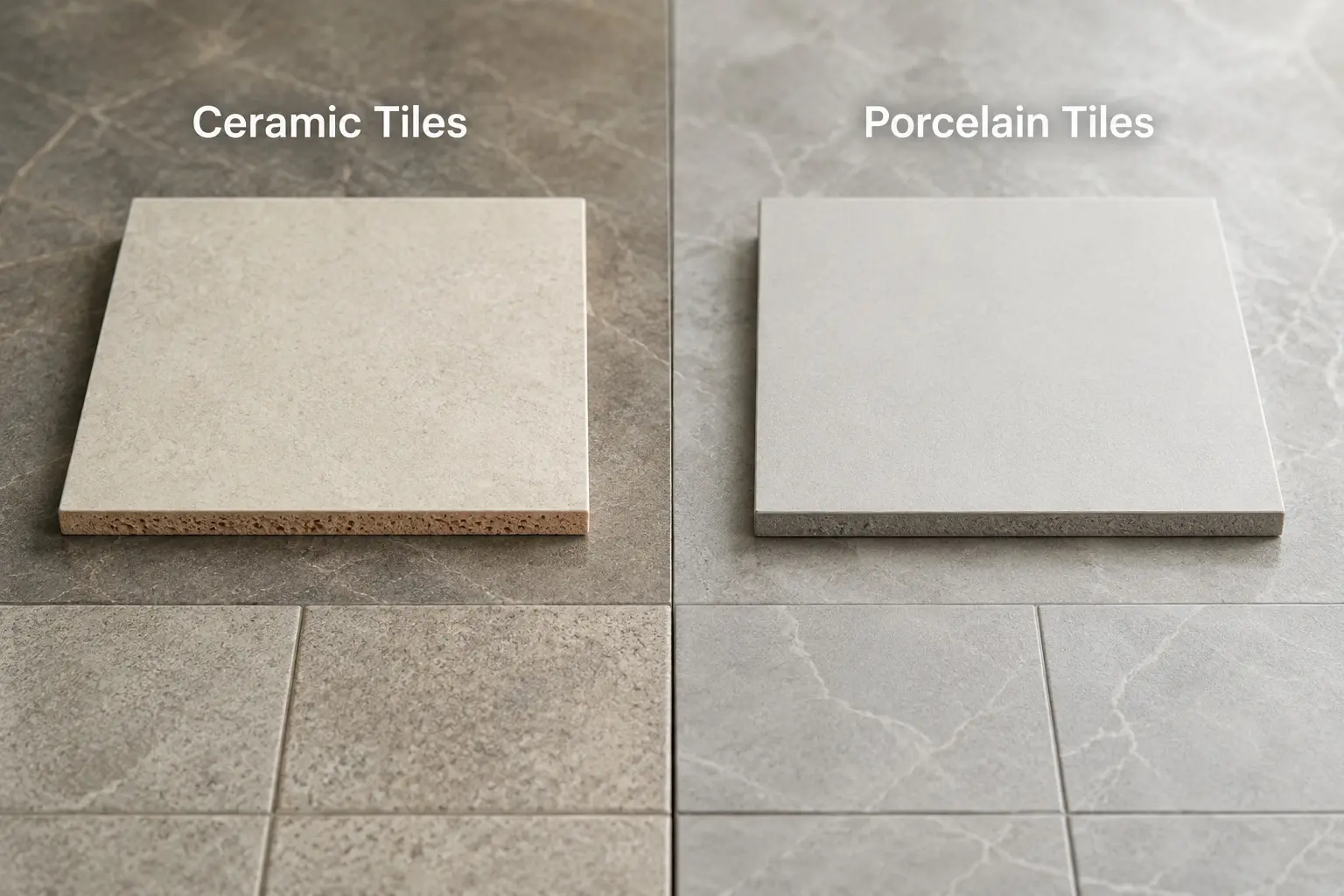
What Actually Separates Porcelain From Ceramic
The difference between porcelain and ceramic tile comes down to one measurable number. According to the Tile Council of North America, industry standards classify a tile as porcelain only if it absorbs 0.5% water or less, tested using the ASTM C373 method. Ceramic tile is allowed to absorb considerably more.
That difference traces back to how each is made. Porcelain starts from a finer, denser clay blend, often including feldspar and silica, fired at a higher temperature than standard ceramic. That extra heat fuses the material more completely, leaving fewer of the tiny air pockets that let water seep in. Ceramic tile uses a coarser clay body fired at a lower temperature, which keeps it more porous underneath its glaze. A ceramic tile's glazed surface can resist water just fine on a wall, but if that surface ever chips, the more absorbent body underneath is exposed.
This is why porcelain tends to show up more often in wet or high-traffic areas, entries, bathroom floors, kitchens, while ceramic still holds its own on walls and in lower-moisture rooms where its lower cost and easier cutting make it a practical choice. Neither porcelain nor ceramic is inherently the better product; the right choice depends on where in the house it's headed and how much moisture that room actually sees, and our full product catalog sorts both types by finish so the difference is easy to see side by side.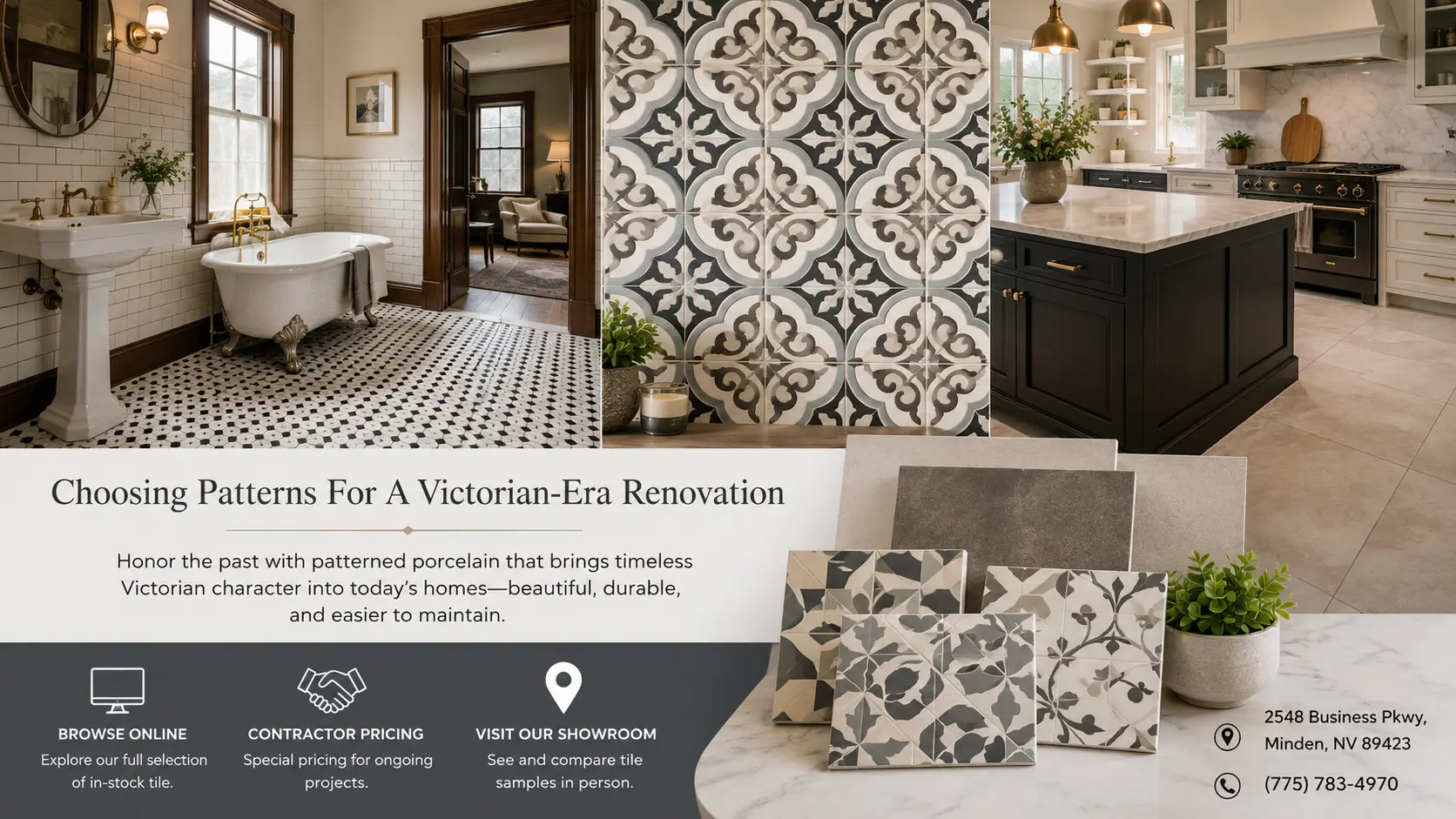
Choosing Patterns For A Victorian-Era Renovation
Homes in Carson City's historic district were often built with patterned floors to begin with, whether encaustic cement tile or intricately laid hexagonal mosaics, and a renovation that ignores that history can end up looking out of place next to original woodwork and window casings. Patterned porcelain that mimics those older encaustic looks has become a common way to bring that detail back into a kitchen or bathroom without relying on the softer, harder-to-maintain cement tile the originals were made from.
Grout choice matters more in these renovations than people often expect. A tighter grout line reads as more historically appropriate in a Victorian-era bathroom, though it also means more grout lines overall to keep clean, a tradeoff worth weighing against a homeowner's tolerance for maintenance versus historical accuracy. Larger, simpler tile formats, by contrast, fit the newer neighborhoods further from downtown just as well as they'd fit a home almost anywhere else in Nevada.
For homeowners still deciding between a patterned or a plain approach, seeing full tile sheets laid out under real light does more than any photo can. Our tile display in Minden keeps a running selection of both patterned and large-format porcelain on hand, and browsing options by style online first can help narrow down what's worth a closer look in person.
Homeowners who want to see everything currently in stock can start browsing online, and contractors handling multiple Carson City renovations at once may want to look into contractor pricing for ongoing projects. Anyone ready to compare tile samples in person can set up a showroom visit in Minden. Mapped out, the drive lands just off Highway 395.
The showroom is located at 2548 Business Pkwy, Minden, NV 89423, and can be reached at (775) 783-4970.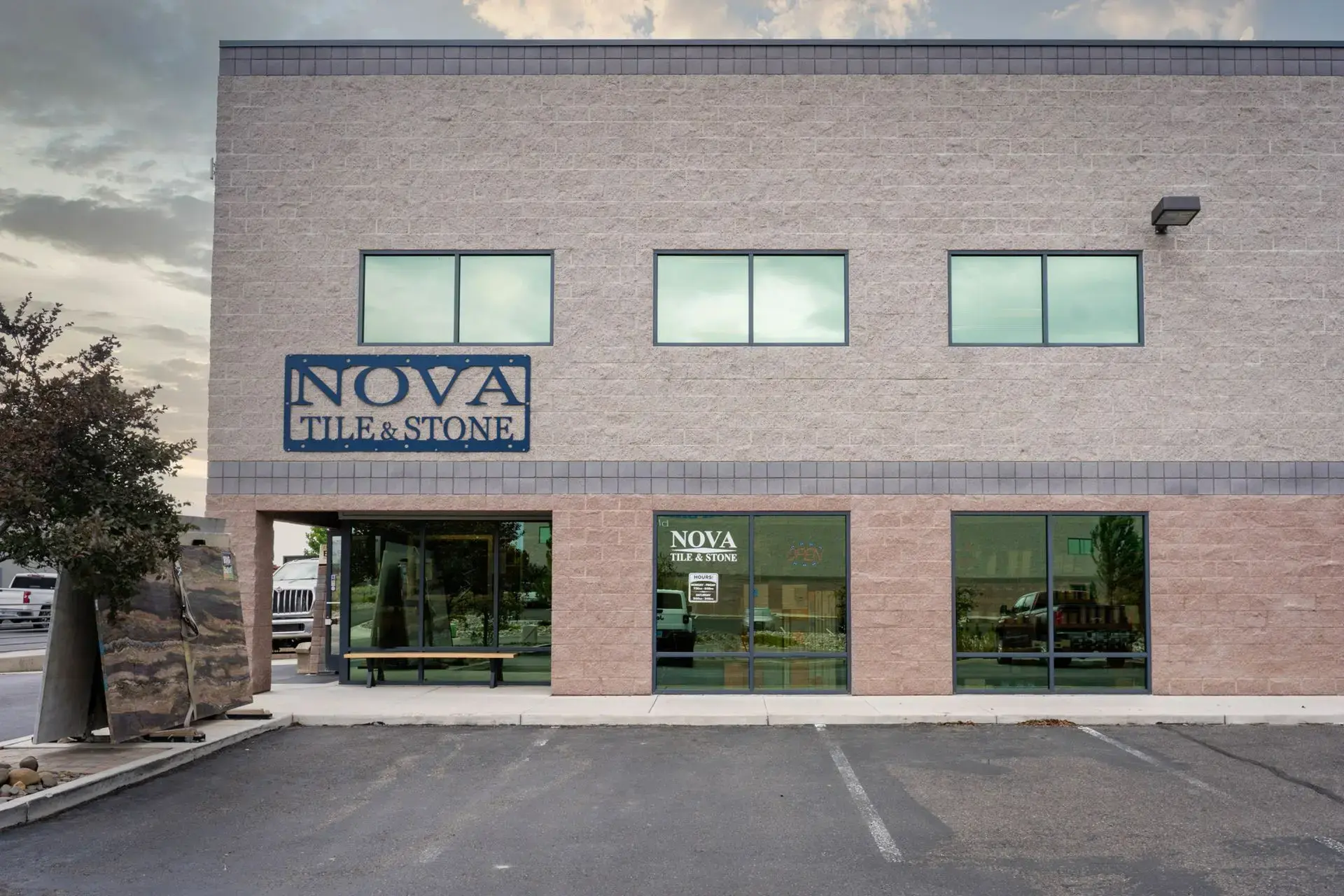
Conclusion
Carson City's tile decisions rarely come down to a single right answer, because the city itself is really two different building eras layered on top of each other. A home along the Kit Carson Trail calls for tile that respects the ornamentation Comstock-era wealth built into the neighborhood, while a home in a newer subdivision usually looks better with something simpler. Understanding the real difference between porcelain and ceramic, and knowing which rooms in a given home actually need porcelain's lower water absorption, makes that choice far more straightforward than it first appears.
Frequently Asked Questions
Both can work well, and the choice often comes down to the room rather than the home's age. Porcelain's low water absorption makes it a strong choice for bathroom floors and entries, while ceramic can still suit walls and lower-moisture rooms, including in a historic renovation, provided the pattern and finish match the home's original character.
Homes in Carson City's historic district were often built with encaustic-style patterned floors or intricate mosaic work, so patterned porcelain that echoes those looks, along with a tighter grout line, tends to read as more historically appropriate than a large plain-format tile would.
Carson City's dry, high-desert climate is easier on tile than the heavier snow seen in nearby Lake Tahoe basin towns, but the city still gets meaningful winter snow most years. That's enough moisture tracked indoors that porcelain's low absorption rate is worth considering for an entry or bathroom, regardless of a home's age.
Porcelain is made from a denser clay blend and fired at a higher temperature, giving it a water absorption rate of 0.5% or less under industry testing standards. Ceramic tile is fired at a lower temperature and allowed to absorb considerably more water, which is why it's more commonly used on walls than in wet, high-traffic areas.
Carson City homeowners can compare both patterned and large-format porcelain tile at our Minden showroom, a short drive from downtown Carson City. Seeing full tile sheets under real lighting remains the most reliable way to judge how a pattern or finish will actually look once installed.
Curious About Something Else?