Blue is widely considered the rarest granite color. Sold commercially as Blue Bahia or Azul Bahia, this vivid blue natural stone gets its color from abundant sodalite and is quarried in Brazil's Bahia state, where the finest material is found in very limited quantities. By comparison, granite's common colors, black, grey, white, tan, and brown, come from quartz, mica, and standard feldspar, minerals abundant enough to appear in granite deposits on nearly every continent. That single-source origin is what makes blue both the rarest and the most expensive granite color on the market, with pink and red granite (colored by concentrated potassium feldspar) ranking as the next rarest, and dramatic "black granite" varieties often being more available than their exotic names suggest.
For homeowners in Stateline, NV working on a kitchen island, wet bar, or vanity with real presence against a mountain or lake view, understanding what actually makes a granite color rare, rather than just expensive-sounding, makes it easier to shop with confidence. This guide covers where the rarest granite colors come from, how rarity affects price and availability, and what to consider before choosing an exotic slab for a South Shore home.
What Determines a Granite Color's Rarity
Granite forms deep underground as molten rock cools slowly over vast geologic time, allowing large mineral crystals to form. The specific minerals present during that cooling process determine the final color. Quartz contributes grey and clear tones. Common feldspars contribute white, cream, and light grey. Mica and hornblende contribute the black flecks and darker background tones seen in most granite.
Because those minerals are abundant in the earth's crust, the colors they produce, black, grey, white, and tan, show up in granite deposits on nearly every continent. Rarity enters the picture when a color depends on a mineral that only concentrates heavily in a handful of locations. A rare granite color isn't necessarily more durable or better performing than a common one. It's rare because the geologic conditions needed to produce it happened in very few places on earth.
It's also worth knowing that the word "granite" is used commercially to cover a broader group of stones than geologists would classify as true granite. The distinction between scientific and commercial stone classification means that rocks such as gabbro, diabase, anorthosite, gneiss, and sodalite-bearing stone are all grouped commercially under "granite" because they perform similarly at the countertop, even though a geologist would identify them as different rock types. That's exactly the case with the rarest blue and black stones discussed below.
Blue Granite: The Rarest Color in the World
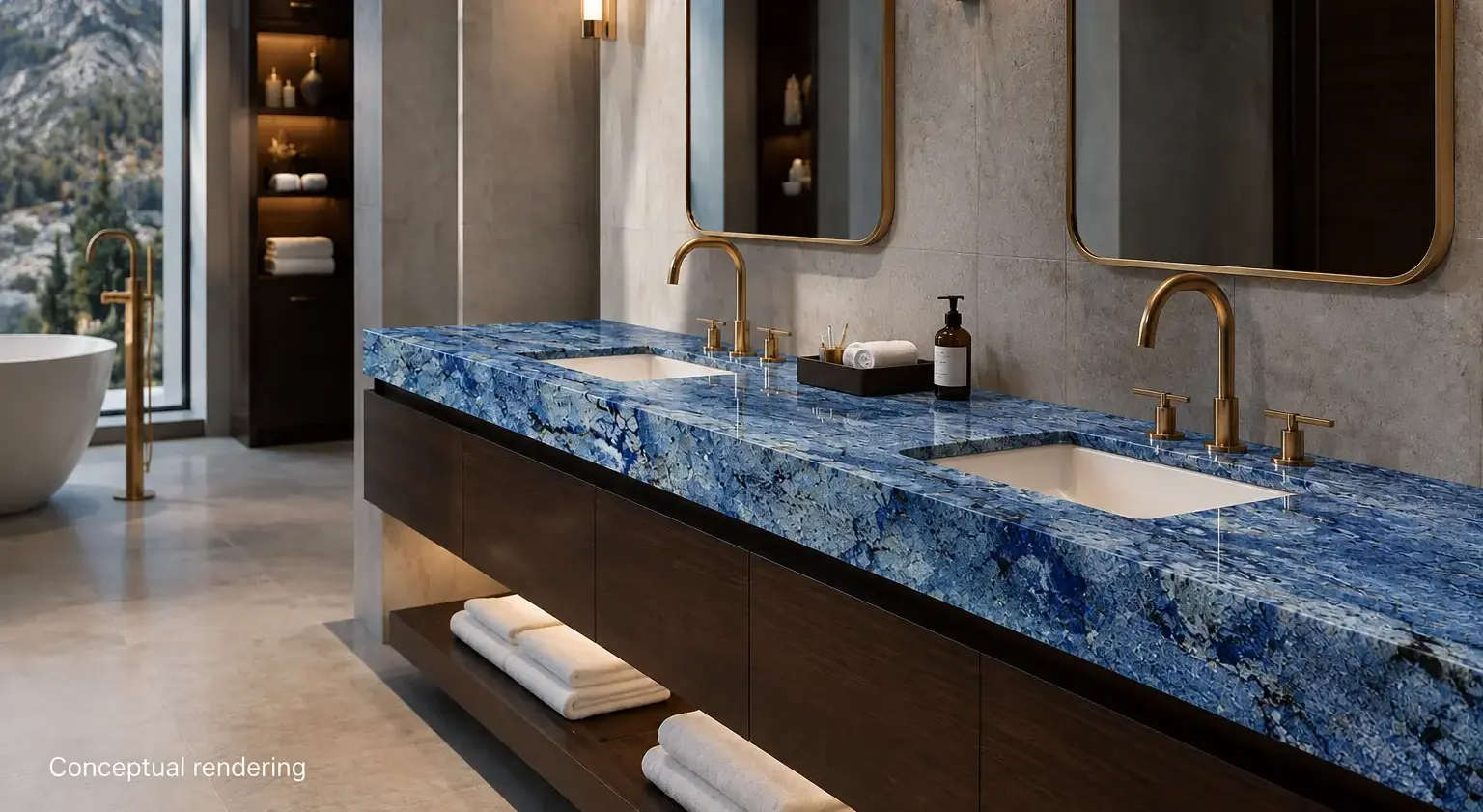
Blue granite is quarried in comparatively small volumes because commercial supply is essentially limited to one part of Brazil, so once a particular block is sold through, that exact pattern and shade often isn't replaceable. Visually, it ranges from deep cobalt to a lighter, cloud-streaked navy, often threaded with white feldspar and black mineral inclusions, which is part of why it reads as a statement material rather than a background one.
Sodalite is also sensitive to acids, including some household cleaners, so blue granite benefits from a pH-neutral cleaning routine and more frequent sealing than harder, more common granites.
Pink and Red Granite: Rare, But More Available Than Blue
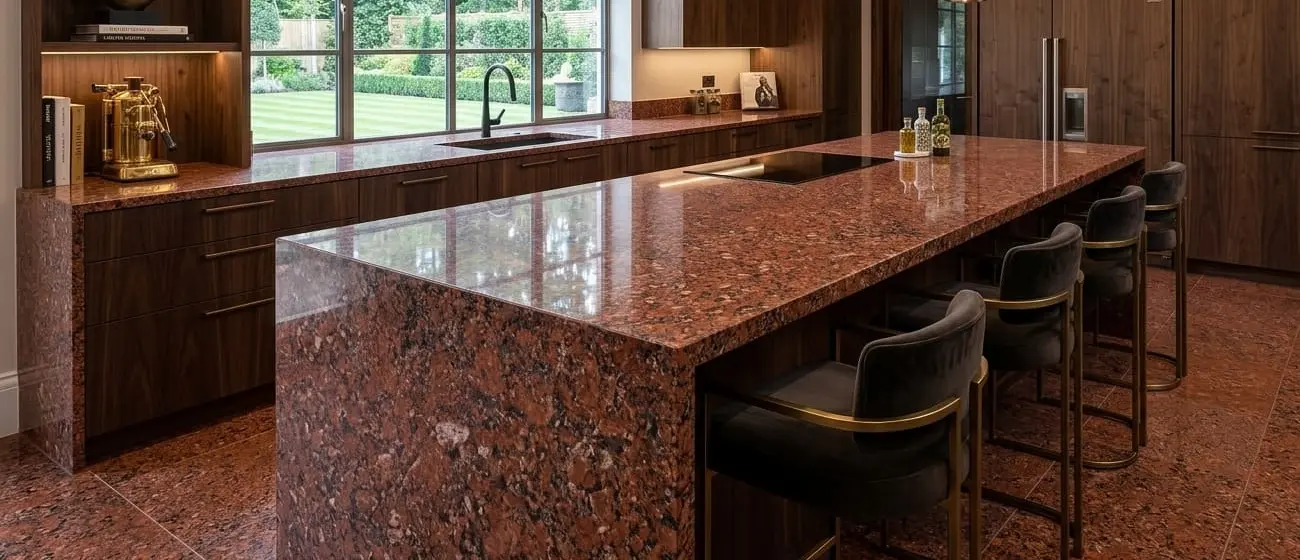
Pink and red granite get their color from potassium feldspar, a mineral that's genuinely common in the earth's crust but only occasionally concentrates enough to dominate a stone's overall color. Most feldspar-rich granite reads as grey, white, or tan because the pink-forming mineral is mixed evenly with darker components. When potassium feldspar is unusually abundant and evenly distributed, the result is a granite with a warm pink, salmon, or red background.
Pink and red granites are quarried in more locations than blue granite, including parts of Europe, Brazil, and North America, which makes them rare but noticeably more available and generally less expensive than true blue stone. They still read as a distinctive, less common choice compared to the grey and black granites that dominate most kitchens.
"Black Granite" and Other Exotic Trade Names
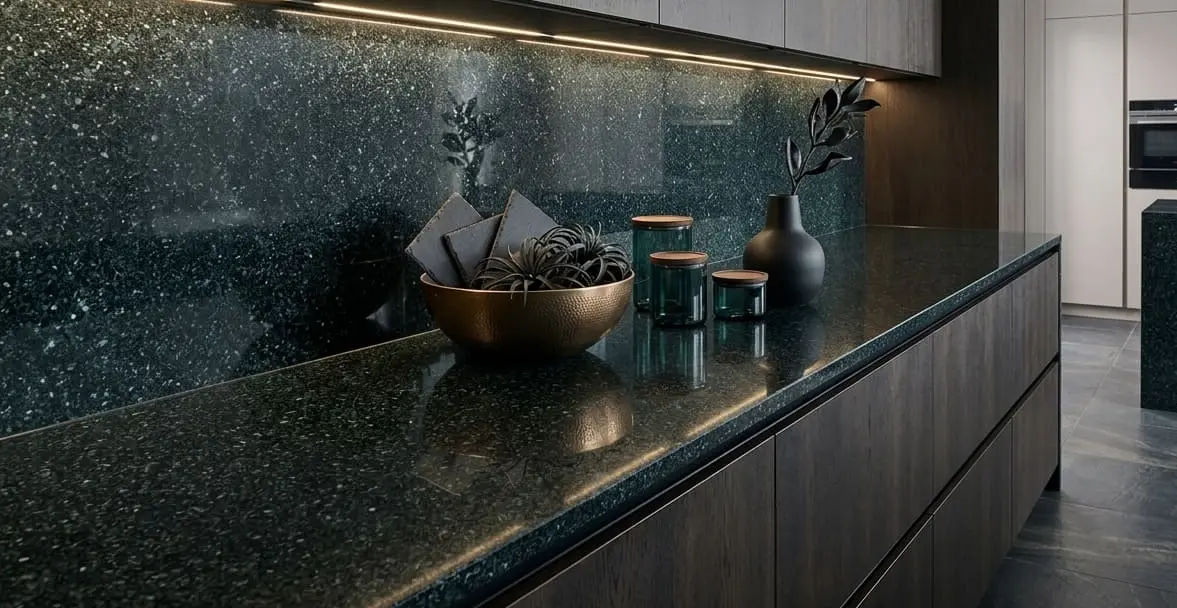
Some of the most dramatic granite colors sold under exotic trade names, deep blacks with gold or silver flecks or cosmic-looking patterns, aren't true granite in the scientific sense at all. Many are gabbro, diabase, or other dark igneous rocks that are simply grouped commercially under the granite category because they behave the same way as a countertop material: hard, dense, and low in water absorption.
This matters for rarity because it means two stones marketed with similarly dramatic names can have very different actual scarcity. A pattern-driven "black granite" might be quarried in large volumes from a well-established deposit, while a color-driven rarity like blue Bahia comes from a genuinely limited source. When rarity and price matter to a buying decision, asking where a specific slab was quarried is more useful than going by the marketing name alone.
Why Rarity Drives Price and Availability
Common granite colors are quarried at scale in many countries, which keeps supply steady and pricing accessible. According to the U.S. Geological Survey's Mineral Commodity Summaries, granite import data by country of origin shows that Brazil, India, and China together account for more than four-fifths of the granite the United States imports by value, a level of concentration that still allows for steady, competitively priced supply because those countries quarry granite in huge volumes across many color varieties in the common range.
Rare colors work differently. When a color depends on a mineral concentration found in only one or two deposits, the total volume of slabs produced in a given year is naturally limited, which leaves fabricators and suppliers with far fewer replacement blocks to draw from if a first-choice slab isn't available. That scarcity typically shows up as higher per-square-foot pricing and longer lead times when a specific slab has to be special-ordered rather than pulled from standard stock. For a homeowner planning a remodel timeline, that's often a more practical consideration than price alone.
Choosing a Rare Granite Color for a Stateline Home
Stateline sits directly on Lake Tahoe's southeastern shore, and most of the homes and condos in the area are built around that view, with large windows, timber and stone exteriors, and interiors that lean on natural materials to match the alpine surroundings. A rare granite slab, particularly a blue or deeply patterned exotic stone, can work well as a focal point in that setting: a kitchen island against warm wood cabinetry, or a wet bar backsplash that plays off a lake or mountain view.
Because rare slabs are limited in supply, it's worth viewing the actual slab in person, since color and veining can vary meaningfully between blocks even within the same named variety. Nova Tile and Stone's Reno showroom, located at 12835 Old Virginia Road, Suite 24, in Reno, NV, and reachable at (775) 331-6682, keeps a rotating selection of natural stone slabs on the floor, including exotic and rare colors when they're available, so Stateline homeowners can see full slabs before committing to a design.
Reno Showroom Hours and What to Expect
The Reno showroom is open Monday through Friday from 7:30 a.m. to 6:00 p.m. and Saturday from 9:00 a.m. to 3:00 p.m., and free design consultations are available for anyone planning a countertop project, including remodels for South Shore homes. As a material supplier, Nova Tile and Stone provides the slabs and guidance on selection; installation is handled by the customer's own fabricator or installer.
Conclusion
Blue granite is the rarest granite color available for countertops, colored by the mineral sodalite and quarried almost exclusively in Brazil's Bahia region, with pink, red, and certain dark exotic stones following as less common but more accessible alternatives. Rarity comes down to geology, not marketing, which is why the most reliable way to evaluate a rare slab is by its actual mineral origin and quarry source rather than its trade name alone. For a Stateline home built around mountain and lake views, a genuinely rare slab can be a striking, one-time design choice, one worth planning for in both budget and timeline before the specific block that caught your eye sells through.
Frequently Asked Questions
Not necessarily by a fixed amount, but blue granite's pricing tends to be the least predictable of the rare colors because supply comes from essentially one region. A particular blue slab's price is often tied to the specific block it was cut from, so two blue slabs from different quarry lots can vary in price more than two black or pink slabs would.
Most granite handles typical kitchen use well, but sodalite-based blue granite is more acid-sensitive than standard feldspar and quartz granite. Wiping up citrus juice, wine, or vinegar promptly and using a pH-neutral stone cleaner helps prevent dulling on blue slabs specifically, more so than on common grey or black granite.
Ask the supplier for the stone's quarry origin and geological classification, not just its trade name. True granite has a visibly speckled, coarse-grained texture from quartz and feldspar crystals, while gabbro and diabase, often sold as "black granite," tend to have a more uniform, fine-grained appearance even though both perform similarly as countertops.
Rare slabs are often cut and matched more carefully because there's less extra material to work with if a mistake happens. It's common for fabricators to plan seam placement and edge cuts around the most dramatic veining in a rare slab, which can add planning time compared to working with a widely available, high-volume granite color.
Granite's color comes from minerals locked into the stone itself, not a surface dye, so the color won't fade the way a stained or dyed material might. What actually changes over time is the sealant on the surface, which wears down with regular use. Sealing needs vary by material, finish, use, and sealer. Follow the supplier's care guidance rather than a fixed interval, and test the surface periodically to see whether it still repels water. On stones where the coloring mineral is more acid-sensitive, thinning sealant can let etching develop, which can look like fading even though the underlying mineral color hasn't changed.
Note: Some images on this page may be conceptual renderings created to illustrate design possibilities and may not depict actual installations.