Taj Mahal quartzite is a natural stone used for kitchen and bathroom countertops in new construction homes throughout the Sacramento area. It is quarried primarily in Brazil. The stone has a cream to warm white background with soft veining in gold, taupe, and gray. Its hardness ranges between 7 and 7.5 on the Mohs scale, which makes it more resistant to scratching than marble. Builders and homeowners commonly choose it for kitchen islands, perimeter counters, and bathroom vanities during new home construction. Its neutral tone pairs with a wide range of cabinet colors, flooring tones, and hardware finishes, which is useful when those choices are still being finalized during a build. For a broader look at how natural stone compares to other countertop materials, This Old House's guide to stone countertops is a useful starting reference.
New construction presents a different set of considerations than a remodel. In a remodel, homeowners are usually working around existing cabinetry, flooring, and wall colors, so the stone choice often needs to fit into a space that is already defined. In new construction, nearly everything is still open. Cabinet colors, flooring, tile, and hardware are frequently being chosen at the same time as the countertop material, which means the stone can act as a starting point rather than a constraint.
Why Taj Mahal Quartzite Works Well in New Builds
One reason this stone shows up often in new construction is its versatility. Because its background ranges from soft cream to warm white with veining in gold, taupe, and gray, it pairs comfortably with both light and dark cabinetry. A builder or homeowner who has not yet finalized every material in the home can select Taj Mahal early in the process and still have flexibility with the surrounding choices made later.
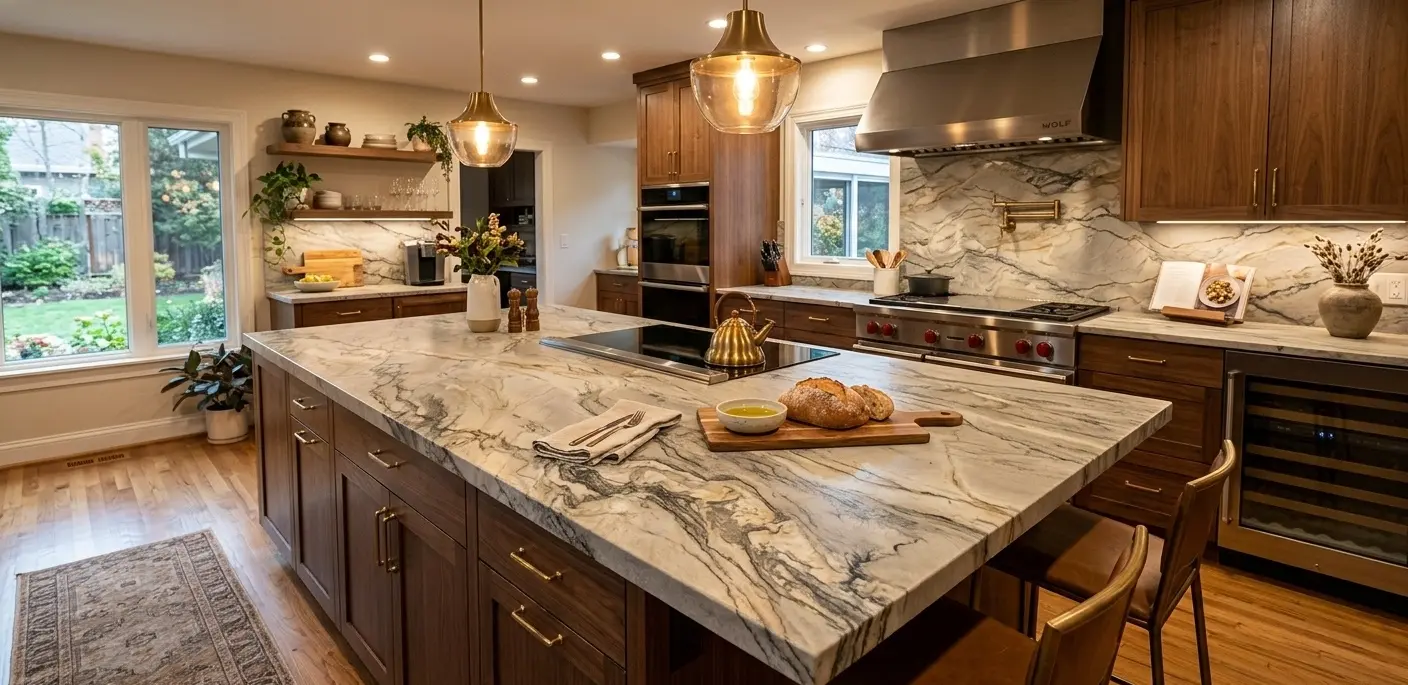
New homes in the Sacramento area often include larger, open kitchen layouts with a central island as a focal point. Taj Mahal quartzite is frequently chosen for these islands because its veining creates visual movement without overwhelming the surrounding cabinetry and finishes. In an open floor plan, where the kitchen is visible from the living and dining areas, a countertop with soft, natural movement tends to read as calm rather than busy, which suits the open sightlines common in newer floor plans.
There is also a practical, performance-related reason this stone is popular in new construction. Quartzite is a metamorphic rock formed from sandstone under heat and pressure, which gives it a hardness rating in the range of 7 to 7.5 on the Mohs scale. This makes it more resistant to scratching and everyday wear than softer natural stones like marble. For families moving into a new home, this level of scratch resistance is often a factor in the decision. Fine Homebuilding's guide to natural stone countertops covers how quartzite compares to granite and marble in more technical detail for anyone weighing the tradeoffs.
Planning for Consistency Across a New Home
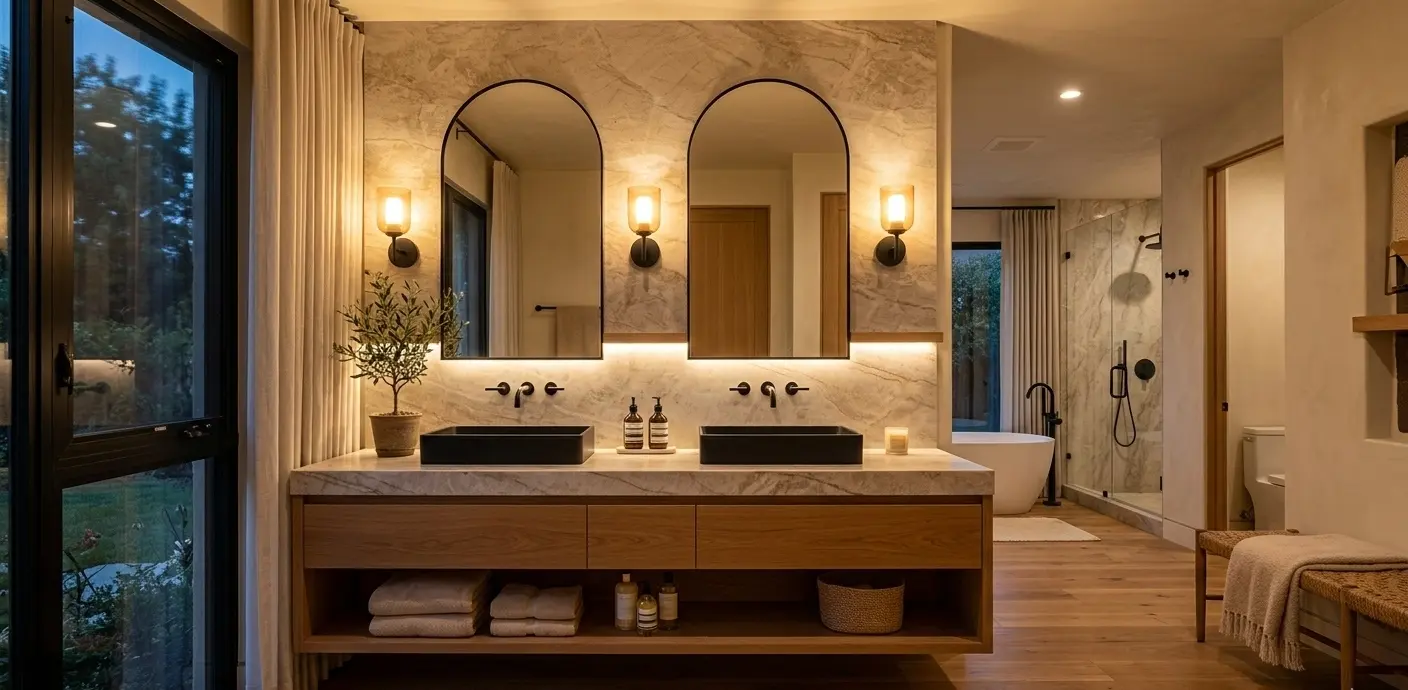
One advantage of selecting stone during new construction, rather than during a piecemeal remodel, is the ability to plan for consistency across multiple rooms at once. Many Sacramento homeowners building a new house choose Taj Mahal quartzite not just for the kitchen, but also for a butler's pantry, a wet bar, or a primary bathroom vanity. Because quartzite is a natural material, each slab carries its own pattern and tone, even when slabs come from the same quarry block. Ordering slabs for multiple rooms early and viewing them together helps homeowners see how the veining and tone will relate from one space to the next, rather than discovering a mismatch after cabinets and other finishes are already installed. Homeowners planning ahead for multiple rooms can submit a slab quote request to start comparing options before finishes are locked in.
This kind of planning matters more in new construction than in a single-room remodel, since new homes often involve coordinating several surfaces within the same timeline. Selecting slabs earlier in the building process, while cabinet and flooring decisions are still being finalized, gives homeowners more room to adjust other elements around the stone if needed.
Pairing Taj Mahal Quartzite with New Construction Finishes
The neutral warmth of Taj Mahal quartzite pairs well with several finish directions that are common in new Sacramento homes right now. White oak and other light wood cabinetry bring out the warm undertones in the stone's veining, while painted cabinets in soft white, cream, or warm gray tend to let the stone's movement stand out as the visual focus of the kitchen. For homeowners leaning toward a more traditional look, the stone also works with painted wood cabinetry in deeper tones, since the lighter background of the slab creates contrast against a darker cabinet color.
Flooring choices in new construction also tend to follow warmer tones these days, including light and mid-tone engineered hardwood or wide-plank luxury vinyl. Taj Mahal quartzite's cream and beige background generally coordinates with these floor tones without requiring an exact color match, since the stone's natural variation gives it flexibility that a single, uniform floor color does not always have on its own.
For hardware and fixtures, brushed brass, matte black, and warm nickel finishes all read well against this stone's warm palette. Since new construction often includes selecting plumbing fixtures and cabinet hardware at the same time as countertop material, homeowners have the opportunity to choose finishes that complement the stone's tone rather than trying to match an existing fixture after the fact.
Slab Selection During the Building Process
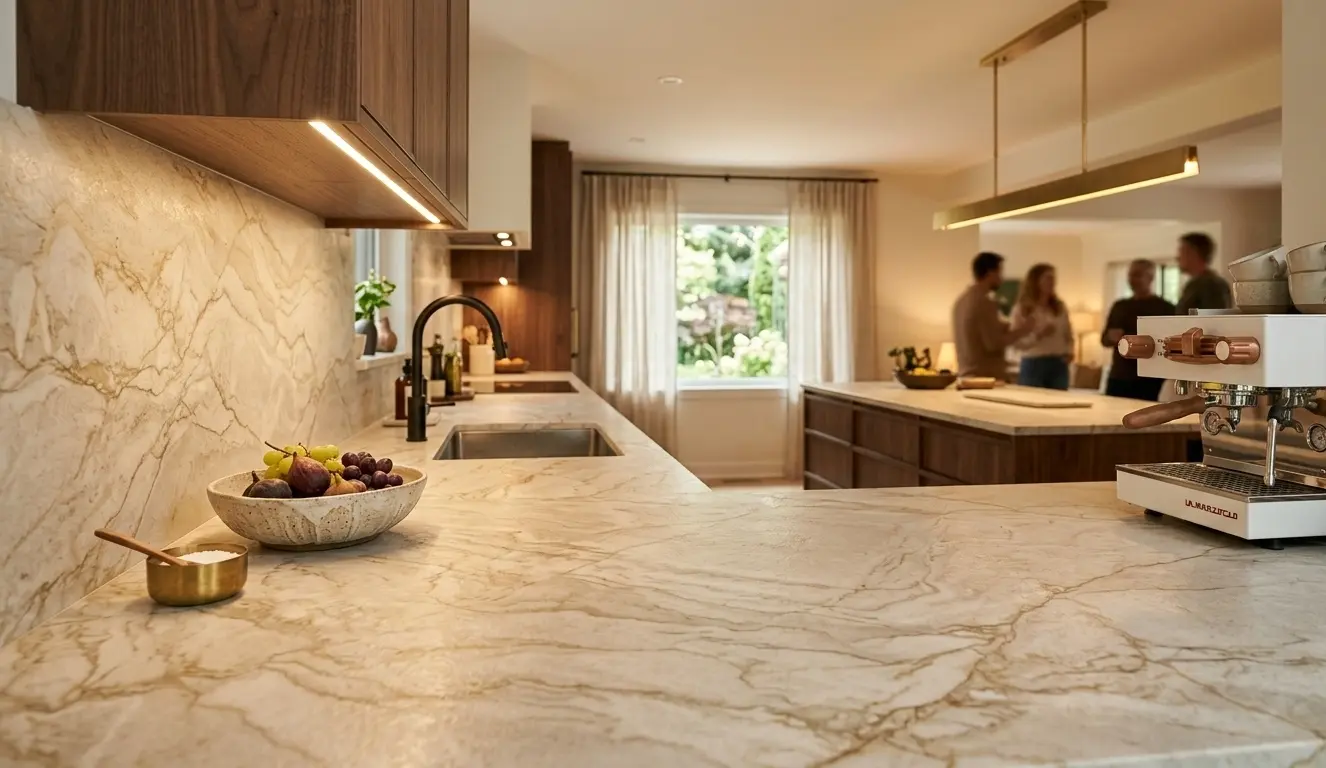
New construction timelines can move quickly once framing and cabinetry are underway, which means stone selection sometimes happens earlier than homeowners expect. Because Taj Mahal quartzite is a natural material with meaningful variation from slab to slab, viewing the actual slabs intended for a project, rather than relying only on a sample chip or a photo, gives a clearer sense of how the veining will look once it is cut for a specific kitchen layout. Homeowners can browse current slab inventory online before visiting in person to narrow down options ahead of time.
This is particularly relevant for larger islands or waterfall-edge applications, where the veining pattern across a single slab needs to be considered as a whole rather than in small sections. Homeowners working with a builder on a new construction project often benefit from visiting a showroom in person during the early stages of the build, so they can view full slabs and get a sense of scale and pattern before cabinet layouts are finalized. This also gives builders time to plan slab quantities and dimensions well ahead of when the countertops are needed on site. Builders and contractors managing multiple projects can also apply for a trade account to streamline ordering across jobs.
Thickness is another consideration during this stage. Most kitchens use a 3cm thickness for strength and a wider range of edge profile options, while some homeowners choose 2cm for vanities or secondary surfaces. Deciding on thickness early, alongside the rest of the stone selection, helps keep the overall project timeline on track.
Why This Matters for Sacramento Homeowners Specifically
Sacramento's new construction market includes a wide range of home styles, from traditional layouts in established neighborhoods to more open, contemporary floor plans in newer developments. Taj Mahal quartzite's neutral warmth works across this range, which is part of why it continues to show up in new builds throughout the region rather than being limited to one particular style of home.
For homeowners building in the Sacramento area, working with a direct stone importer rather than a smaller retailer can also make a difference during the planning stage. A larger inventory of slabs means more options to compare side by side, which is useful when trying to find slabs with similar veining for a kitchen island paired with a matching backsplash, or for coordinating stone across a kitchen and an adjoining bathroom.
Conclusion
Taj Mahal quartzite offers a combination of warm, neutral coloring and natural hardness that fits well into the pace and planning demands of a new construction project. Its ability to pair with a wide range of cabinet colors, flooring tones, and hardware finishes makes it a practical starting point for homeowners who are still finalizing other design decisions, while its hardness makes it well suited to the daily use a kitchen sees. Selecting slabs early in the building process, and viewing them in person before cabinet layouts are locked in, helps ensure the veining and tone work together across every room where the stone will be used. Homeowners building a new home in the Sacramento area are welcome to visit our Sacramento showroom at 6100 Warehouse Way, Sacramento, CA 95826, call us at (916) 913-6682, or schedule a design consultation to view our current selection of Taj Mahal quartzite slabs and discuss how the stone can fit into a new construction timeline.
Note: Some images on this page may be conceptual renderings created to illustrate design possibilities and may not depict actual installations.
Frequently Asked Questions
Yes. Its neutral, warm coloring pairs with a wide range of cabinet and flooring choices, which is useful during new construction when many finishes are still being decided at the same time.
It helps to select slabs as early as possible, ideally while cabinet layouts and flooring are still being finalized. This gives more flexibility to coordinate other finishes around the stone's veining and tone.
Yes. Many homeowners use it for a kitchen island, perimeter counters, a wet bar, and bathroom vanities. Viewing slabs for all these areas together helps confirm the veining and tone relate well from room to room.
Yes. Its warm cream background with gold, taupe, and gray veining provides enough contrast to stand out against dark cabinetry while still complementing light or painted cabinets.
Most kitchen islands use 3cm thickness for added strength and a wider range of edge profile options, while 2cm is sometimes used for vanities or secondary surfaces.