Granite is a quarried natural stone valued for heat resistance and one-of-a-kind veining, while quartz is an engineered surface made from ground natural quartz bound with resin, valued for its non-porous, low-maintenance finish. For Incline Village homeowners, granite generally suits full-time residences where an owner can keep up with periodic sealing, while quartz generally suits seasonal or vacation properties, bathrooms, and anyone who wants to skip the sealing schedule entirely.
Why This Split Matters More in Incline Village
That distinction holds especially true here, given the local housing pattern. The town sits at roughly 6,350 feet on Lake Tahoe's north shore, about 37 miles from Reno by way of the Mount Rose Highway, and a large share of the local housing stock is seasonal or vacation property that sits closed up for stretches of the winter. A granite sealing schedule is easy to keep up with when you're in the kitchen every week. It's much easier to fall behind on when the home is only in use a handful of weekends a season, which is one reason quartz has become a common choice in newer Incline Village construction aimed at buyers who split time between multiple properties.
When Granite Is the Better Choice
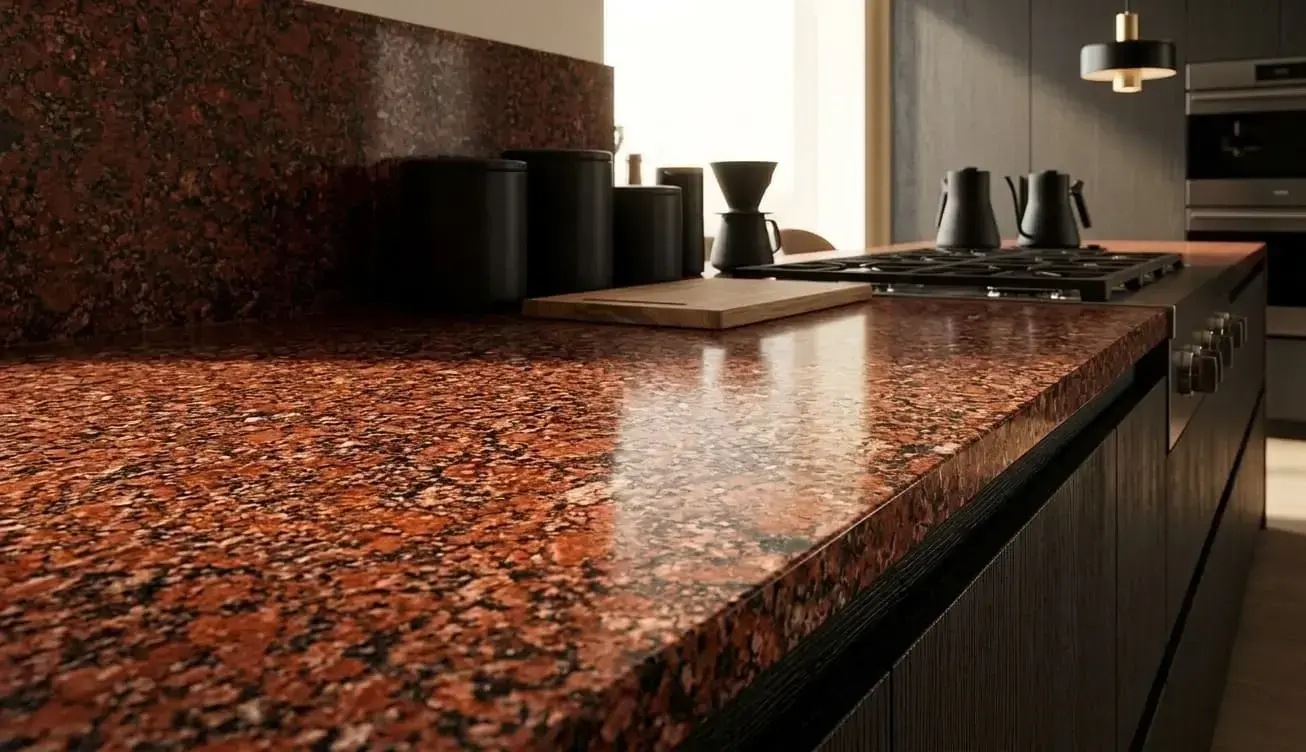
Granite is formed from cooled magma and contains a mix of feldspar, mica, and quartz crystals, which is what gives each slab its distinct pattern. No two granite slabs look alike, which is a genuine selling point for homeowners who want their kitchen to feel unlike anyone else's.
Granite rates roughly 6 to 7 on the Mohs hardness scale, which measures the stone's resistance to scratching and abrasion rather than heat tolerance. Separately, granite offers excellent heat resistance compared to engineered quartz, although using a trivet or hot pad is still recommended to minimize the risk of thermal shock and help protect the sealer. The tradeoff is porosity. Granite requires periodic sealing, typically every one to two years depending on the specific stone, the sealer used, and how the kitchen is used, to help resist staining from oils, wine, coffee, and other common household spills.
Granite's leathered and honed finishes show up frequently in local kitchen remodels as an alternative to a traditional polished look. If you'd like to see these finishes in person, you can visit the Nova Tile and Stone Reno showroom. A leathered finish adds subtle texture and a matte quality that hides fingerprints and water spots more effectively than a high-polish surface, which is a practical advantage in a busy kitchen as well as a design one.
When Quartz Is the Better Choice
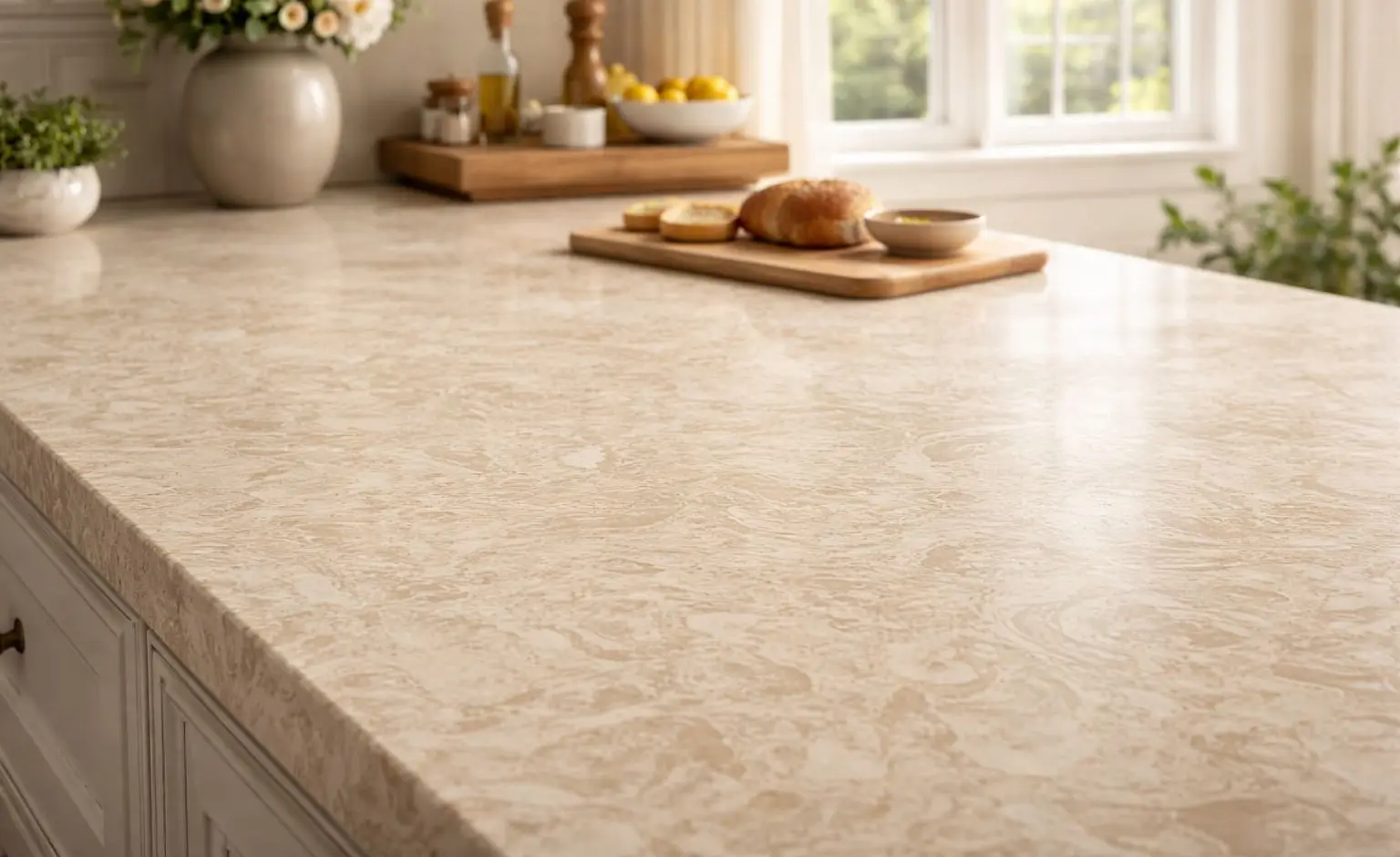
Quartz is manufactured by binding roughly 90 to 93 percent ground natural quartz with polymer resin under heat and pressure, producing a dense, non-porous slab that never needs sealing. Many quartz lines are also certified to NSF/ANSI 51 for food-contact safety, and the material's non-porous surface resists staining without any upkeep beyond routine cleaning.
Quartz's main tradeoff compared to granite is heat sensitivity. In lab testing by Consumer Reports, both materials withstood a 400-degree Fahrenheit pan without visible damage, but most manufacturers still recommend trivets and hot pads as standard practice, since resin-based surfaces can be more vulnerable than fully natural stone to repeated or prolonged heat exposure over time. Quartz is also not recommended for uncovered outdoor applications, since prolonged UV exposure can affect the resin over time.
Resale Value in Incline Village Specifically
Incline Village's real estate market runs at a premium, and both materials show up in listings that emphasize move-in-ready, fully remodeled interiors. Granite, and leathered granite in particular, appears repeatedly as a callout feature in recently sold and updated homes in this market. Quartz shows up less often in listing copy specifically, but is commonly used in newer construction and recent remodels where a consistent, contemporary look is the design goal. Kitchen upgrades consistently rank among the remodeling projects with the highest buyer demand nationally, according to research from the National Association of Realtors, which is part of why countertop material draws so much attention during a sale-focused remodel.
Neither material is a liability for resale in this market. Buyers here are generally reacting to the overall quality and cohesion of a remodel rather than a single material choice, so the stronger consideration is usually how the countertop pairs with cabinetry, flooring, and the home's broader design direction. If you're comparing materials for an upcoming remodel, schedule a design consultation to view full slabs and discuss which option best complements your home's style. A well-chosen quartz surface in a cohesive, updated kitchen will typically outperform a granite countertop in a kitchen that otherwise looks dated, and the reverse holds just as true. Material choice matters most as one piece of a consistent overall look rather than as a standalone selling point.
Cost Comparison
Granite and quartz occupy a similar price range at the mid-to-premium tier, with cost driven more by the specific slab, color, and finish than by the base material category. Exotic granite colors with heavy veining can run higher than mid-range quartz, and premium quartz lines can cost more than standard granite. Neither material is reliably cheaper than the other across the board, so a side-by-side comparison of specific slabs is more useful than a general rule of thumb. You can explore available options on the Nova Tile and Stone website or, if you're a fabricator, contractor, or other industry professional, apply for a trade account to access resources and pricing tailored to trade customers.
Fabrication and Installation
Nova Tile and Stone supplies granite and quartz slabs for Incline Village projects, along with the specs needed for a smooth handoff. Cutting, edge work, and installation are handled by local fabricators and contractors, so material selection is typically the first step in a project timeline rather than the final one. Working out the material choice early, before cabinetry and sink selection are finalized, tends to keep the rest of the project on schedule.
A Quick Decision Guide
Choosing for a bathroom: quartz's non-porous surface handles daily moisture and cosmetic products with less upkeep.
Choosing for a kitchen with heavy cooking and hot cookware: granite's heat tolerance is the more forgiving option.
Choosing based on budget alone: compare specific slabs rather than materials, since price ranges overlap significantly.
Conclusion
Granite and quartz both hold up well in Incline Village kitchens and baths, and neither is the wrong choice on its own. The material that ages better in a specific home usually comes down to how that home actually gets used (full-time or seasonal, high-heat kitchen or moisture-heavy bath) rather than a general preference for natural stone over an engineered surface.
Nova Tile and Stone carries both granite and quartz, along with marble, quartzite, sintered stone, and porcelain slab options, at our Reno showroom serving Incline Village and the greater Lake Tahoe area. Visit Nova Tile and Stone at 12835 Old Virginia Rd, Suite 24, Reno, NV 89521, or call (775) 331-6682 to compare slabs in person.
Frequently Asked Questions
Yes, though in practice this means an occasional sealing step rather than daily upkeep. A simple way to check if a granite countertop needs resealing is to place a few drops of water on the surface: if it beads up, the seal is intact; if it soaks in and darkens the stone within a few minutes, it's time to reseal. Quartz has no equivalent test since it never needs sealing in the first place.
Both hold up well to everyday scratching, but they differ under impact. Granite can chip at a thin edge or corner if struck hard by a heavy pot or a dropped bottle. Quartz's resin binder makes it somewhat more forgiving of small impacts, though a hard enough hit can still crack either material, especially near a sink or cooktop cutout where the slab is thinnest.
Granite is a good fit for both covered and uncovered outdoor kitchens, including in snow country, since it holds up well to freeze-thaw cycling. Quartz is better reserved for a covered outdoor kitchen or bar, since years of direct sun exposure can gradually shift the resin's color even where the surface itself holds up structurally.
Granite is harder to match exactly since each slab is naturally unique, even within the same quarry lot. Quartz offers more consistency across production runs, though exact color matching over time can still vary by manufacturing batch.
Yes. It's common to see granite in a kitchen where an owner wants a natural, one-of-a-kind look, paired with quartz in bathrooms or a wet bar where low maintenance matters more. There's no compatibility issue between the two materials appearing in different rooms of the same house.
Note: Some images on this page may be conceptual renderings created to illustrate design possibilities and may not depict actual installations.