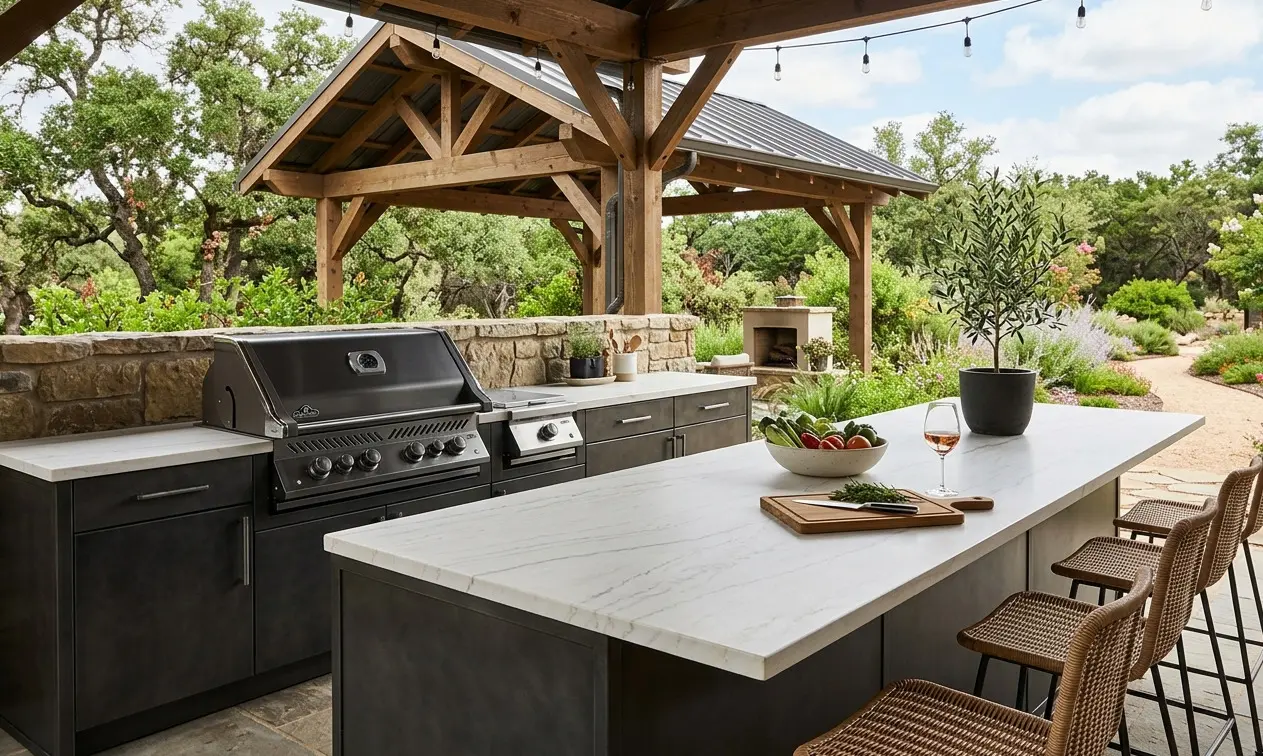
Granite, quartzite, and porcelain slab are the three materials most commonly used for outdoor kitchen countertops in Elk Grove, and homeowners can browse our full slab selection to compare options before visiting in person. Each tolerates sun, heat, and outdoor moisture better than materials designed for indoor use. Elk Grove's Sacramento Valley climate, with hot summers and mild winters, makes all three practical choices for year-round outdoor kitchen use. Here we answer the outdoor kitchen stone questions we hear most often at our Sacramento showroom.
Which Stone Materials Work Best Outdoors?
Each material brings a different set of tradeoffs for an outdoor kitchen project.
Granite is a dense, naturally occurring stone that tolerates sun and heat exposure without significant surface change. It comes in a wide range of colors and patterns, and its mineral composition makes it naturally resistant to fading from UV exposure.
Quartzite is a natural stone known for its hardness, which is even greater than granite in most cases. It also tends to have a lighter, often more uniform look than granite, which some homeowners prefer for an outdoor color palette.
Porcelain slab is a manufactured material made by compressing clay and mineral materials under high heat. Because it's manufactured rather than quarried, porcelain slab has very low porosity and does not require sealing. It's also resistant to UV fading, which makes it a common choice for pool decks, outdoor kitchen countertops, and other sun-exposed surfaces.
Quartz (engineered stone made with resin binders) is generally not recommended for outdoor use, since the resin content can break down with prolonged UV exposure, leading to discoloration over time. For a broader overview of how different stone types compare for kitchen use, This Old House's guide to stone countertops covers additional selection factors.
Does Elk Grove's Climate Affect the Choice?
Elk Grove sits in the Sacramento Valley, where summers regularly bring extended stretches of high heat, and winters are mild with occasional frost but rarely hard freezes. This climate profile matters for outdoor stone selection in a few ways:
- Heat exposure: Granite, quartzite, and porcelain slab all tolerate direct sun and high surface temperatures, which is relevant for countertops near grills or in unshaded patio areas.
- Freeze-thaw cycling: Because Elk Grove rarely experiences deep freezes, the freeze-thaw cracking that can affect porous stone in colder climates is less of a concern here than it would be in a mountain or high-desert region.
- Moisture and irrigation: Sprinkler overspray and seasonal rain are common considerations. Sealed natural stone and porcelain slab both handle occasional moisture exposure, though drainage design around the outdoor kitchen structure still matters.
Do Outdoor Stone Countertops Need to Be Sealed?
Natural stone slabs like granite and quartzite are typically sealed to reduce porosity and make the surface easier to maintain. Sealing frequency for outdoor applications is often more frequent than indoor countertops, since sun and weather exposure can wear down sealant faster than an indoor kitchen would. Homeowners should ask about the specific sealer recommended for their chosen stone and plan for periodic reapplication as part of ongoing outdoor maintenance.
Porcelain slab does not require sealing because its manufacturing process gives it very low porosity from the start. This is one of the more common reasons Elk Grove homeowners choose porcelain slab for outdoor kitchens that will see heavy use.
What Thickness Is Recommended for Outdoor Countertops?
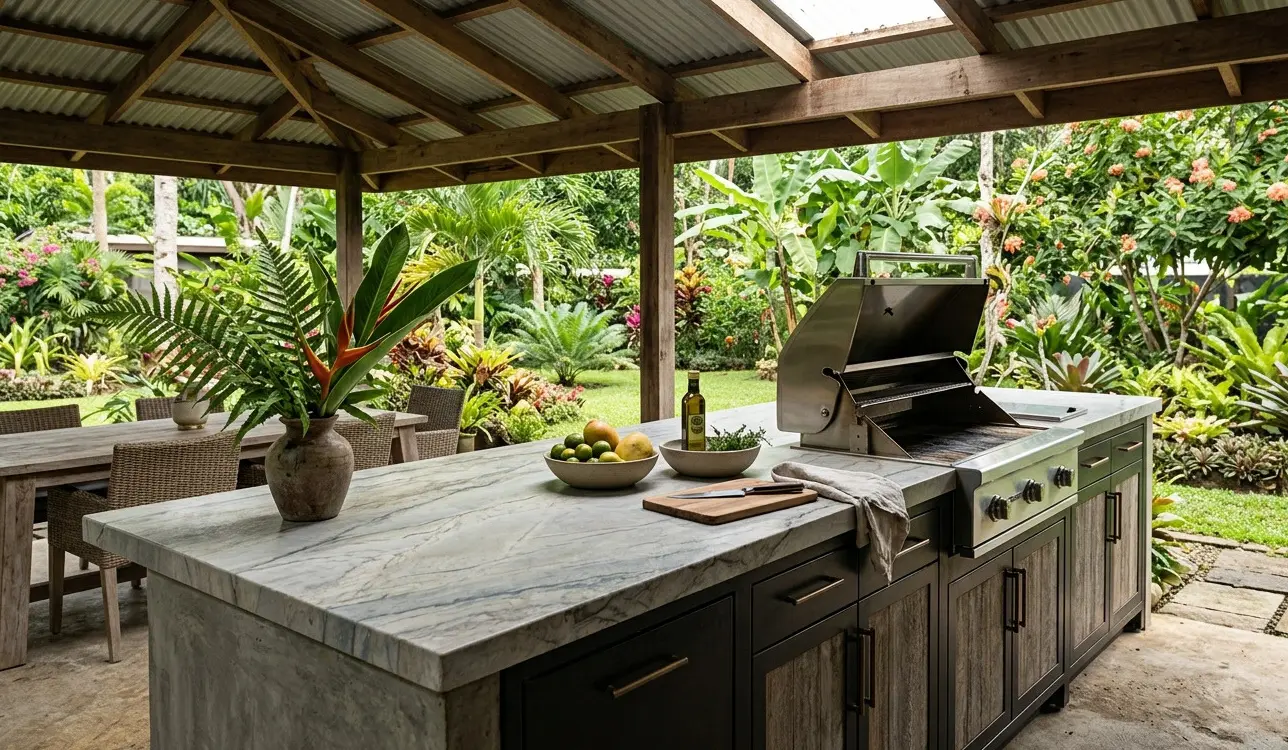
Outdoor kitchen countertops are commonly fabricated from 3cm (roughly 1.25 inch) slabs, since the thicker material provides additional structural support for overhangs and areas without full cabinet support underneath, such as bar seating along an outdoor kitchen island. Some porcelain slab installations use thinner material reinforced with a substrate, so thickness recommendations can vary by material. This is a detail worth confirming with a fabricator based on the specific layout and support structure planned for the space. Contractors and remodelers sourcing material for multiple outdoor kitchen projects can also apply for a trade account for ongoing project needs.
Will the Stone Fade or Change Color Outdoors?
Granite and quartzite are both naturally resistant to UV fading because their color comes from mineral composition rather than added pigments or resins. Porcelain slab is also UV stable for the same reason: its color is fired into the material during manufacturing rather than applied as a surface treatment.
The material most prone to outdoor fading is quartz, since the resin binders used in engineered stone can degrade with prolonged sun exposure. This is the main reason quartz is generally steered toward indoor applications while granite, quartzite, and porcelain slab are favored for outdoor kitchens.
How Do Edge Profiles and Overhangs Work for Outdoor Islands?
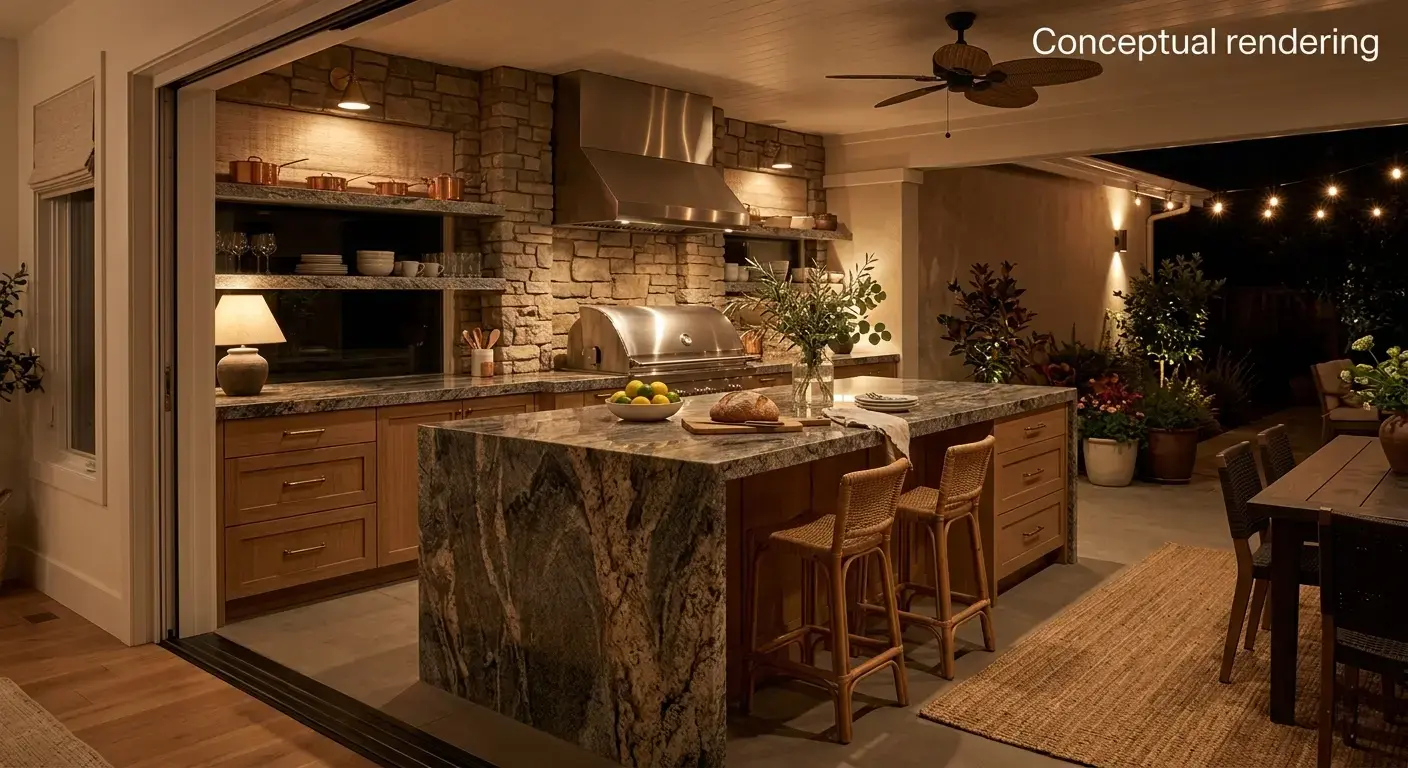
Edge profile selection for outdoor kitchens tends to follow the same options available for indoor countertops, including eased, bullnose, and beveled edges. For overhangs, such as a bar seating area extending beyond the base cabinets, thicker slab material (3cm) is generally used to support the extended span without additional bracing. The exact overhang distance a slab can support without extra support depends on the material and the specific dimensions of the installation, which is a detail to confirm with a fabricator before finalizing the design.
Do Outdoor Countertops Need Cutouts for Sinks and Appliances?
Many Elk Grove outdoor kitchens include a sink, a built-in grill, a side burner, or a small refrigerator, each of which requires a cutout in the slab. Granite, quartzite, and porcelain slab can all be fabricated with cutouts for these fixtures, though the process and equipment used can differ slightly by material. Porcelain slab, for example, is thinner and denser than natural stone in many cases, which calls for specific cutting tools designed for that material. Homeowners planning cutouts for a sink or built-in appliances should confirm fixture dimensions with their fabricator ahead of time, since adjustments after a slab is cut are far more limited than adjustments made during the planning stage.
What Are Waterfall Edges and Full-Height Slab Backsplashes?
Some Elk Grove outdoor kitchen islands use a waterfall edge, where the same slab material extends down the side of the island to the ground rather than stopping at the countertop edge. This creates a continuous look across the top and side of the island using a single slab or matched slabs. A full-height slab backsplash is another option, where slab material covers the wall area behind the cooking surface instead of stopping at a standard four-inch backsplash height. Both options use more material than a standard countertop layout, since waterfall edges and full-height backsplashes require additional square footage cut from the same slab or a coordinating one. Homeowners interested in either look should ask about slab yield, since natural variation in a stone slab means matching veining or color across a waterfall edge or backsplash return works most consistently when the pieces are cut from the same slab.
Can Outdoor Stone Slabs Be Combined with Indoor Countertops for a Cohesive Look?
Many Elk Grove homeowners building an outdoor kitchen want it to visually connect with their indoor kitchen, especially in homes with California rooms or covered patios that function as an extension of the interior living space. Choosing the same slab material and color for both indoor and outdoor countertops, or a closely coordinated color from the same material family, is a common way to create that continuity. Since outdoor use has different performance requirements than indoor use, it's worth confirming that the specific slab chosen performs well in both settings before matching them across indoor and outdoor spaces. Homeowners can explore our full range of product categories to see how slab, tile, and flooring options work together across a whole-home project.
How Should Outdoor Stone Countertops Be Maintained?
Maintenance needs vary by material. Granite and quartzite benefit from routine cleaning with a pH-neutral cleaner and periodic resealing, since outdoor sun and moisture exposure can shorten the effective life of a sealant compared to an indoor application. Homeowners should also watch for mineral buildup near outdoor sinks, which can be addressed with the same type of cleaner recommended for indoor stone. Porcelain slab requires less ongoing maintenance since it does not need sealing, though routine cleaning is still recommended to remove grease, food residue, or mineral deposits from irrigation overspray. Regardless of material, covering an outdoor kitchen when it is not in use, such as with a fitted cover over the cooking and countertop area, can reduce long-term exposure to sun, rain, and debris. Fine Homebuilding's guide to natural stone countertops offers further detail on sealing schedules and stone-specific maintenance.
What Factors Affect the Overall Cost of an Outdoor Kitchen Countertop?
Several factors influence the overall cost of an outdoor kitchen countertop project beyond the price of the slab material itself. The overall size of the countertop layout affects how much slab material is required, and additions such as waterfall edges or backsplash returns increase that amount further. Cutouts for sinks, grills, or other appliances add fabrication steps. Edge profile selection can also be a factor, since some profiles require more shaping than a simple eased edge. Homeowners planning a budget for an outdoor kitchen project should bring their layout dimensions and a list of planned fixtures to a showroom consultation, or request a slab quote online, so that an accurate material estimate can be put together.
Conclusion
Granite, quartzite, and porcelain slab each offer an outdoor-suited option for outdoor kitchen countertops in the Sacramento Valley's climate, with the main differences coming down to appearance, sealing requirements, and how each material is fabricated for overhangs, cutouts, and edge details. We welcome Elk Grove homeowners to visit our showroom at 6100 Warehouse Way, Sacramento, CA 95826, or call us at (916) 913-6682, to see these slabs in person and talk through which material fits the specific layout and look planned for an outdoor kitchen project. Get directions to our showroom or schedule a design consultation ahead of your visit.
Note: Some images on this page may be conceptual renderings created to illustrate design possibilities and may not depict actual installations.
Frequently Asked Questions
Granite, quartzite, and porcelain slab are all suited to outdoor use in Elk Grove's climate. The right choice depends on preferred appearance, sealing preferences, and budget, since each material has different characteristics.
Yes, granite used outdoors is typically sealed, and outdoor applications generally call for more frequent resealing than indoor countertops due to increased sun and weather exposure.
Quartz is generally not recommended for outdoor use because the resin binders in engineered stone can discolor with prolonged UV exposure. Granite, quartzite, and porcelain slab are more common choices for outdoor applications.
Outdoor countertops are commonly made from 3cm slab material, which provides additional support for overhangs such as bar seating areas that extend beyond base cabinetry.
Granite, quartzite, and porcelain slab are all resistant to UV fading because their color comes from natural mineral content or, in porcelain's case, a manufacturing process that fires color into the material rather than applying it as a surface coating.