What Kitchen Remodel Materials Work Best for Nevada Homes?
Choosing the right kitchen remodel materials shapes how a space performs for years. Granite and quartzite offer UV-stable durability for open-plan kitchens; quartz suits sealed indoor environments; porcelain slab and tile handle floors and walls with consistent upkeep. Each option carries distinct trade-offs in finish availability, application suitability, and care.
Fernley's dry climate, hard water exposure, and temperature swings make surface selection especially significant. Whether a remodel targets countertops, backsplashes, bar tops, or bathroom vanities, the material choice sets the foundation for function and long-term value. Following 2026 kitchen trends covered by Elle Decor, natural stone tones and matte finishes lead residential design this year.
Understanding the difference between slabs and tile is essential before comparing options. Slabs typically cover countertops and large vertical surfaces; tile addresses floors, backsplashes, and wet-area walls. Both carry distinct performance standards and care routines worth evaluating before any final decision.
Why the Right Kitchen Remodel Materials Protect Your Investment
Selecting well-matched surfaces reduces premature replacement, provided proper care routines are followed. Prompt spill cleanup and non-abrasive cleaners protect appearance across all material types.
Benefits by material category:
- Granite slab (P, H, L, S): UV-stable for indoor and outdoor kitchens, floors, walls, and fireplaces. Trivets required to prevent thermal shock; cutting boards protect against scratches.
- Quartzite slab (P, H, L, S): UV-stable with the same broad application range as granite. Honed or leathered finishes reduce slip risk in wet zones.
- Quartz slab (P, H, S): Indoor-only for floors and walls. Consistent engineered appearance; no leathered finish available.
- Porcelain slab (P, H, L, S): UV-stable for outdoor use, floors, walls, and fireplaces. Stain resistance holds with non-abrasive maintenance.
- Porcelain tile (residential floors): Requires a PEI rating of III or higher for all residential foot traffic. Wet areas require a DCOF of 0.42 or above. Breaking strength of 250 lbs or higher supports heavy-use floors, per TCNA Handbook specifications.
Slab and Tile Material Comparison
Material | Finish Options | UV-Stable | Indoor/Outdoor | Best Applications |
Granite slab | P, H, L, S | Yes | Both | Countertops, floors, fireplaces, outdoor kitchens |
Quartzite slab | P, H, L, S | Yes | Both | Countertops, bars, floors, walls |
Quartz slab | P, H, S | No | Indoor only | Countertops, floors, walls |
Marble slab | P, H, L, S | No | Shaded outdoor | Vanities, walls, feature surfaces |
Travertine slab | P, H, L, S | No | Shaded outdoor | Floors, walls, accent surfaces |
Porcelain slab | P, H, L, S | Yes | Both | Floors, walls, outdoor, fireplaces |
P=Polished, H=Honed, L=Leathered, S=Specialty. Marble and travertine carry no UV rating; shaded outdoor placement only.
Kitchens, Bathrooms, and Bars: Matching Materials to Each Space
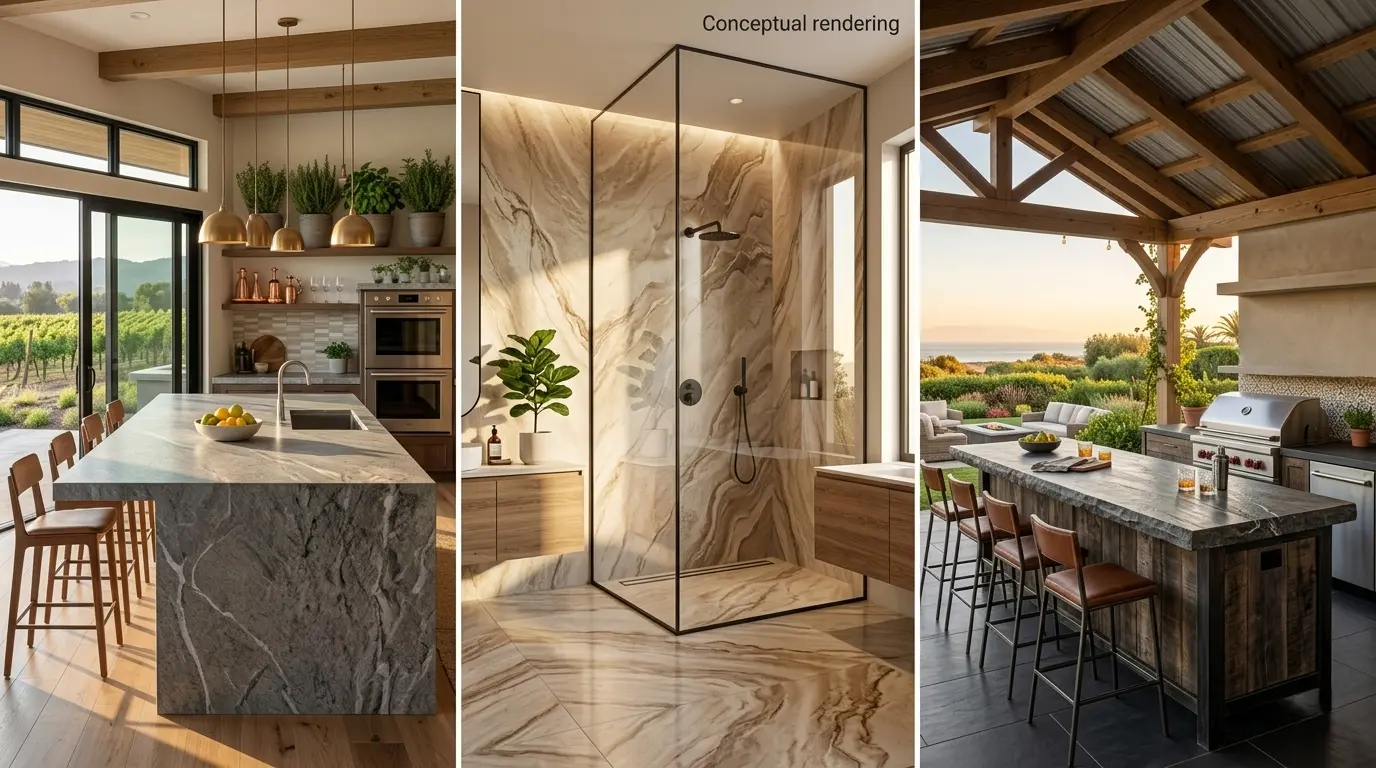
Bar Tops and Entertainment Surfaces
Bar tops face sustained impact from glasses, liquids, and repeated wiping. Granite and quartzite in honed or leathered finishes resist surface wear under high-contact conditions when care routines are followed. Semi-precious stone slabs create a dramatic indoor back-bar feature but are limited to indoor wall-only applications.
Dezeen's 2026 design guide highlights bold material contrasts as a key trend in hospitality and residential entertaining, making stone-and-tile pairings a prominent focus for bar design.
Kitchen Countertops and Backsplashes
Kitchen surfaces handle heat, moisture, cutting contact, and daily cleaning. Granite and quartzite in honed or leathered finishes perform reliably when sealing schedules and trivet use are maintained. Quartz countertops suit indoor kitchens where UV exposure is not a factor.
Backsplashes work with tile or slab cuts. Porcelain tile at PEI I or higher covers wall applications. Rectified-edge tile allows grout joints as narrow as 1/16 inch; non-rectified tile requires wider joints to accommodate natural size variation.
Bathroom Vanities and Shower Walls
Bathrooms combine moisture, cleaning product exposure, and frequent foot traffic. Polished finishes look striking on vanity tops but become slipperier when wet; honed finishes reduce risk in shower floors and wet-area walls. Any tile used in wet areas must carry a DCOF of 0.42 or above.
Marble and travertine suit shaded indoor bathrooms but carry no UV rating for sun-exposed outdoor showers. Porcelain tile with water absorption at or below 0.5% qualifies for frost-proof outdoor applications.
Note: Some images on this page may be conceptual renderings created to illustrate design possibilities and may not depict actual installations.
How to Compare Kitchen Remodel Materials: A 5-Step Guide
- Define the application first. Confirm whether the surface is a countertop, floor, wall, backsplash, or outdoor element. Application determines which materials qualify.
- Match finish to moisture level. Polished finishes suit dry, low-traffic zones. Honed or leathered finishes reduce slip risk in wet areas.
- Verify outdoor suitability. Granite, quartzite, and porcelain are UV-stable for full outdoor use. Marble, dolomite, and travertine are shaded outdoor only. Quartz is strictly indoor.
- Check tile performance ratings. Verify the PEI rating for traffic level, DCOF for wet-area safety, and breaking strength for load-bearing floors.
- Plan care from day one. Natural stone requires periodic sealing and prompt spill cleanup. Porcelain benefits from regular, non-abrasive cleaning routines.
Pros and Cons: Natural Stone vs. Porcelain Surfaces
Natural Stone Slabs
Pros:
- Unique veining; no two slabs are identical
- Granite and quartzite UV-stable for full indoor and outdoor use
- Multiple finish options (Polished, Honed, Leathered, Specialty)
Cons:
- Periodic sealing required to protect porous surfaces
- Marble, dolomite, and travertine limited to shaded outdoor placement
- Polished finishes are slipperier when wet; trivets always required
Porcelain Slabs and Tile
Pros:
- UV-stable; rated for full outdoor use without restriction
- Lower upkeep than natural stone in most applications
- Frost-proof options when water absorption is 0.5% or below
Cons:
- Less organic visual character than natural stone
- Polished porcelain tile requires DCOF verification before wet-area use
- Large-format pieces require careful delivery and handling planning
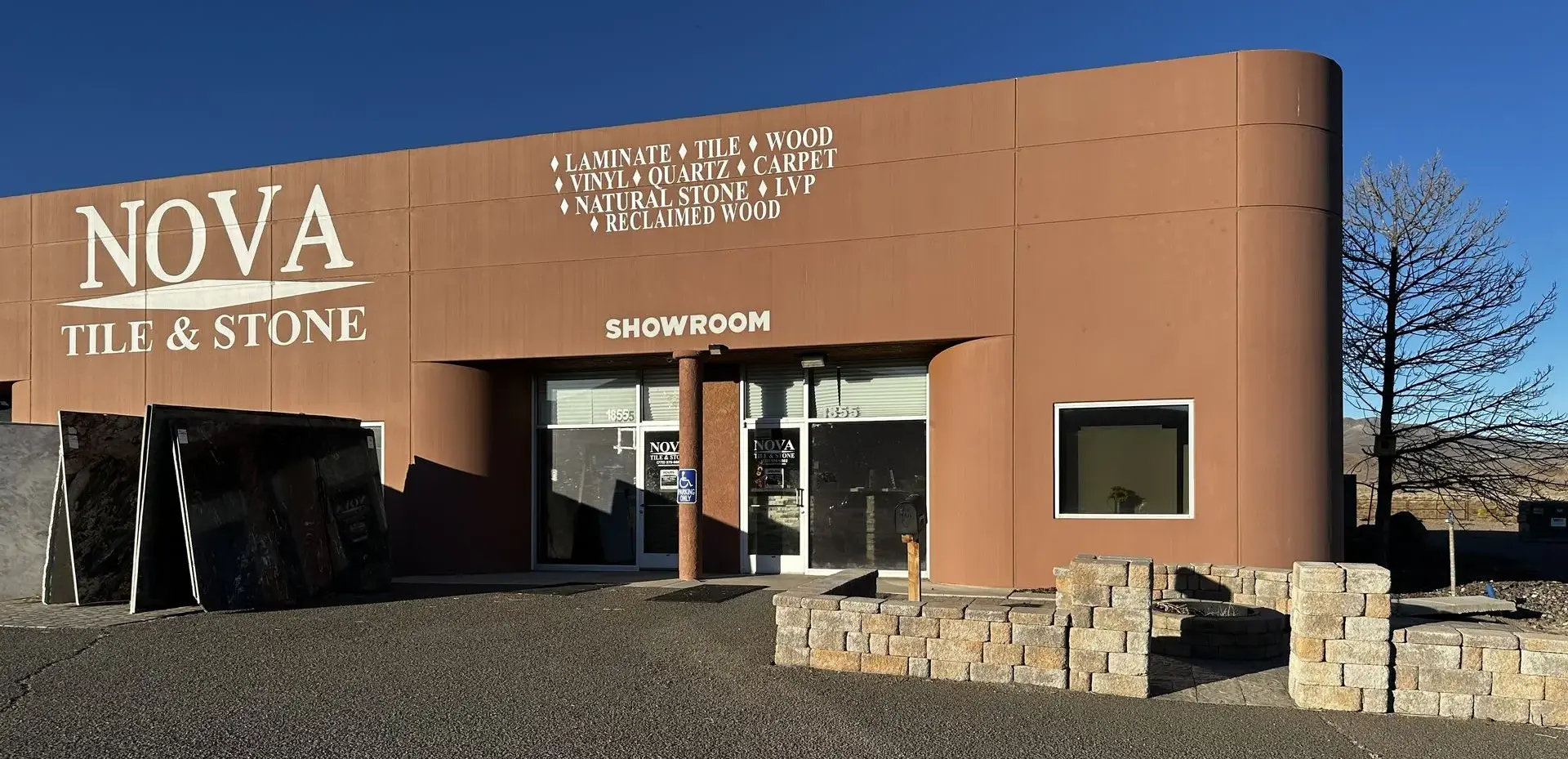
Explore Slab and Tile Materials at Nova Tile and Stone
Nova Tile and Stone supplies slab and tile materials to homeowners across northern Nevada and Northern California. The Fernley showroom carries granite, quartzite, quartz, marble, travertine, porcelain, and semi-precious slabs alongside a full tile selection. Staff match materials to specific applications.
The Reno showroom extends slab access across western Nevada. Carson Valley homeowners can compare options at the Minden showroom. The Sacramento location serves Northern California designers and homeowners. Browse the complete slab inventory through the Nova slabs gallery. The shop local page details Nova's support for the Fernley community. Sourcing and service philosophy are outlined on the about the team page. Free shipping is available on qualifying slab orders.
Conclusion
Selecting the best surface for any Fernley home's kitchen, bathroom, or bar requires balancing application, finish preference, and long‑term maintenance. Granite, quartzite, and porcelain remain the most versatile choices, offering durability and design flexibility across countertops, backsplashes, and flooring. Quartz and specialty stones, meanwhile, serve more focused needs, such as achieving a seamless modern aesthetic or highlighting unique veining patterns. Each material carries distinct performance advantages-granite for heat resistance, quartzite for hardness and natural beauty, porcelain for low maintenance, and engineered quartz for consistency and color range. Specialty stones like marble or dolomite may demand more care but reward homeowners with timeless elegance.
Nova Tile and Stone showrooms across Northern Nevada and Northern California provide direct access to this full material range, allowing you to compare finishes, textures, and slab dimensions in person. Connect with design experts today to book your free consultation and find the right surface for your project.
Frequently Asked Questions
Granite, quartzite, and porcelain slabs are UV-stable and rated for full outdoor use, including countertops and floors. Marble, dolomite, and travertine are suitable for shaded outdoor areas only. Quartz is indoor-only and should not be used in outdoor kitchen applications.
Granite is UV-stable and suitable for both indoor and outdoor kitchens, with polished, honed, leathered, and specialty finishes available. Quartz is engineered for consistent appearance and suits indoor countertops and walls, but is not UV-stable and cannot be used outdoors. The better choice depends on whether outdoor exposure, finish variety, or low natural variation matters most to the project.
Residential kitchen floors require tile with a PEI rating of III or higher for all residential foot traffic. For areas where wet conditions are possible, a DCOF of 0.42 or above is necessary to support safe footing. For heavy-use floors, a breaking strength of 250 lbs or higher provides the load-bearing capacity needed.
Granite and quartzite work across kitchens, bathrooms, floors, and walls, provided the finish is matched to the moisture level of each space. Polished finishes are slipperier when wet and are better suited to dry countertop surfaces. Honed or leathered finishes reduce slip risk in bathroom and wet-zone applications.
Rectified tile is precisely cut to uniform dimensions after firing, which allows grout joints as narrow as 1/16 inch for a tighter look. Non-rectified tile has natural size variation from the kiln process, requiring wider grout joints to accommodate the difference. The edge type determines how close tiles can be set, not the finish or material.
Looking for More Information?