Green onyx is a calcite-based natural stone, closely related to marble and travertine, valued mainly for a trait most countertop materials don't have: translucency. Backlit, it glows; even without backlighting, it shows deep, shifting veining that changes from one panel to the next. In an Incline Village home already built around timber, stone, and lake views, that visual quality is exactly why green onyx tends to show up as a bar top, a vanity, or a feature wall rather than a full countertop.
It's also considerably softer than the stones it usually gets compared to. On the Mohs hardness scale, green onyx generally falls between 3 and 4, while granite sits at 6 to 7, which means it scratches, chips, and etches more easily and needs more attentive sealing. That makes it a strong choice for lower-traffic, decorative applications, and a weak one for a full working kitchen counter, a distinction worth knowing before the slab goes in.
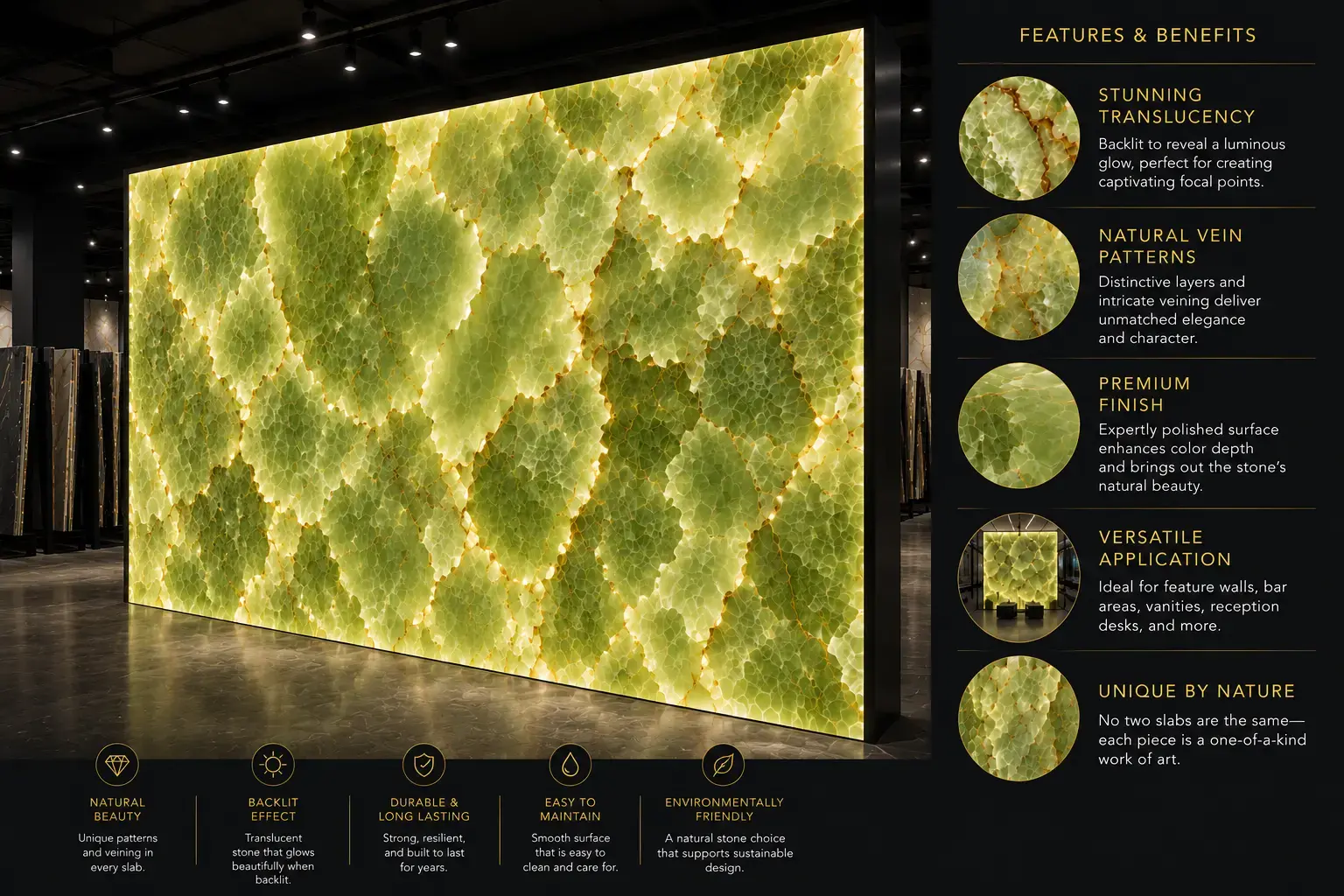
What Makes Green Onyx Different from Other Countertop Stone
That difference in hardness comes down to how the stone actually forms. Onyx develops in thin, banded layers of calcite. Unlike granite or quartzite, which forms deep within the earth's crust, onyx forms from mineral-laden groundwater at or near the surface, which is what produces its distinct translucency. Green onyx gets its color from chlorite mineral inclusions running through those bands, which is why a single slab can move from deep forest green to pale moss to cream in one continuous sweep. No two slabs read the same way, which is part of the appeal for a one-of-a-kind bar top or island.
Where Green Onyx Actually Works Well
This is the part that matters most for a mountain home that sees real use. A full kitchen perimeter in green onyx, especially one that handles three meals a day, cutting boards, hot pans, and the occasional dropped wine glass, is asking a delicate stone to do a durable stone's job. Most fabricators and designers steer that application toward accent roles instead: a waterfall-edge island end, a wet bar top, a wine room counter, or a powder room vanity that gets light daily use rather than constant traffic.
Those lower-traffic settings are also where the backlighting really pays off. A green onyx bar top or a backlit wall panel behind a home bar catches ambient light differently throughout the day and again after dark, which is a look a lot of Incline Village builds are already set up for given how much glass and evening lighting design goes into lake-view rooms. If backlighting is part of the plan, it's worth knowing that thinner onyx panels typically need a resin or fiberglass backing for strength, along with LED lighting matched to the stone's color. Neutral white LEDs in the 3500 to 4000 Kelvin range often provide balanced lighting that complements the natural tones of green onyx.
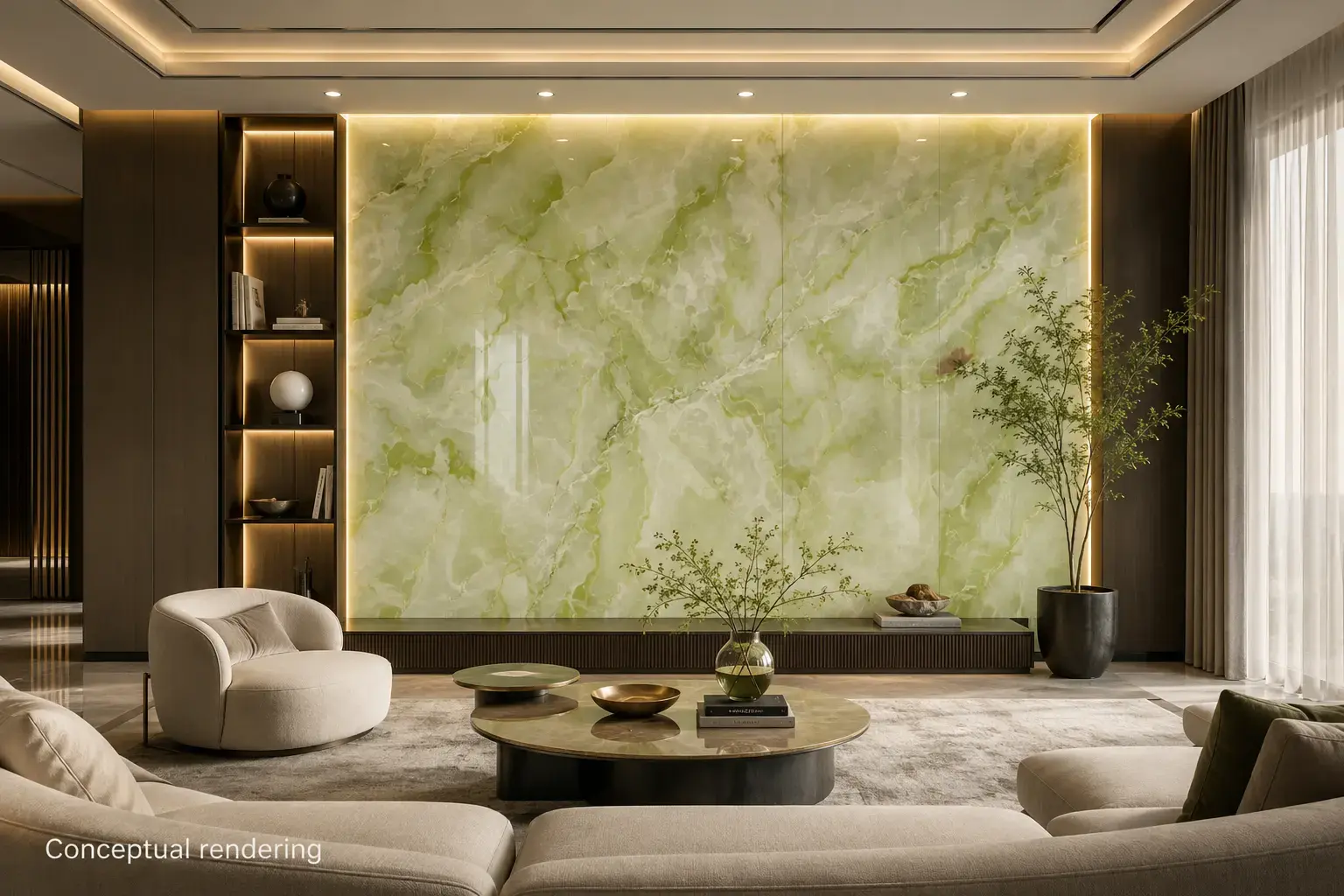
Pairing Green Onyx with the Rest of a Mountain Home
Choosing the right spot for it is only half the decision; how it sits alongside everything else in the room is the other half. Green onyx's organic, almost botanical coloring pairs naturally with the materials already common in Incline Village interiors: reclaimed or natural-finish wood, blackened or brass metal fixtures, and stacked or leathered natural stone elsewhere in the room. Rather than fighting for attention against a lake view or a timber ceiling, it tends to sit alongside those elements as one more natural material in the mix, which is part of why it shows up so often as a feature piece instead of a wall-to-wall surface.
Living With Green Onyx at Elevation
Getting the placement and the pairing right is one part of the decision; keeping it looking good in this particular climate is the other. Incline Village sits at lake level in the high Sierra, and its elevation is part of why summers here run noticeably cooler than nearby Reno, with real seasonal swings between dry winter heat indoors and humid bursts from steam showers, hot tubs, and holiday cooking. None of that is unique to onyx, but a softer, more porous stone shows the effects of neglect faster than granite or quartz would.
The maintenance routine itself isn't complicated. Onyx needs a pH-neutral cleaner and a soft cloth, never anything abrasive. Spills from wine, citrus, or anything acidic should get wiped up right away rather than left to sit, since etching happens quickly on a softer stone. Sealing is typically recommended every six to twelve months, more often in a bar or vanity setting that sees regular splashes. Trivets and hot pads are worth keeping nearby too, since sudden temperature changes can stress the stone. For a part-time Tahoe property, it's worth having the stone resealed before closing the house up for the season, since long stretches without attention are when small issues turn into bigger ones.
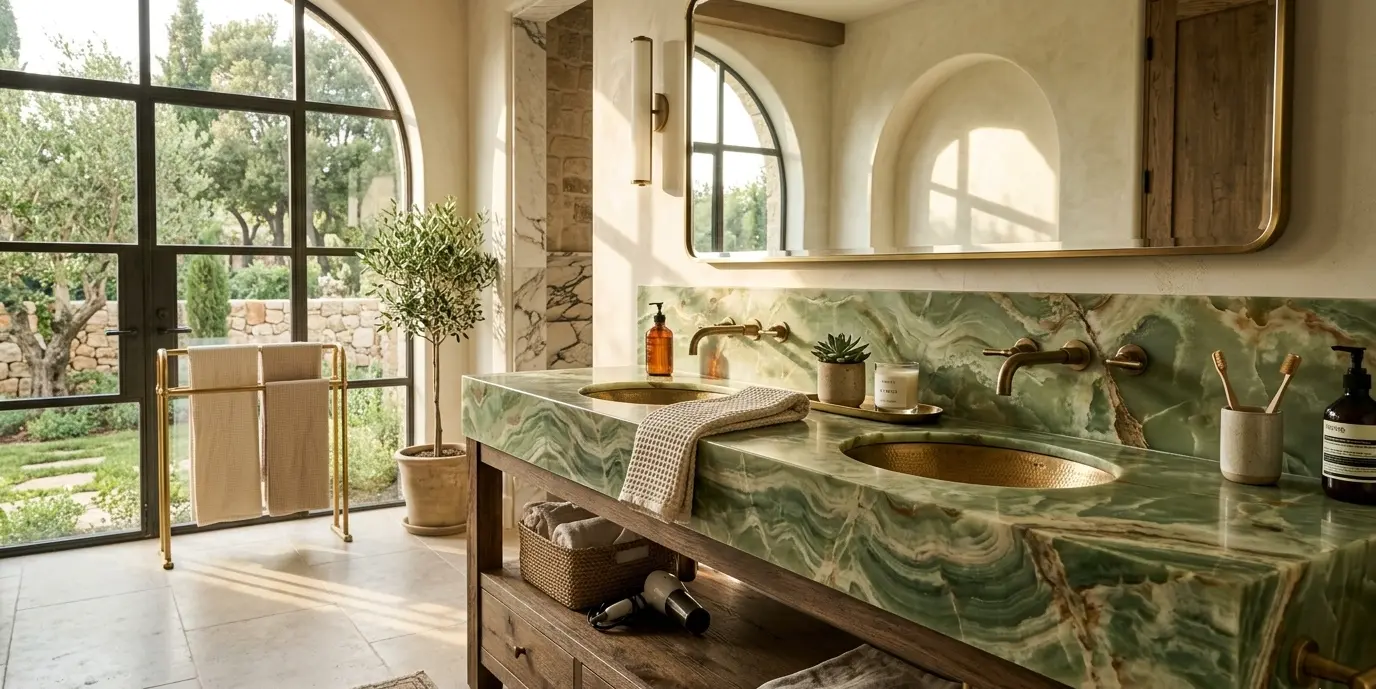
What Affects the Cost
Onyx pricing varies more than most countertop stones because color plays such a large role. Saturated, sought-after colors like green tend to sit toward the higher end of what onyx typically costs, while grays and lighter tones tend to be more affordable. Edge detail, underlayment for structural support, and any backlighting work all add to the total, so a small accent application, like a bar top or vanity, is a very different budget conversation than trying to cover an entire kitchen island. Because pricing can vary significantly from one slab to another, it's worth requesting a slab quote for the specific material and application you have in mind rather than assuming costs are consistent across colors and cuts. If you'd like to view available slabs in person before making a decision, you can also visit the Reno showroom.
Conclusion
The decision on green onyx really comes down to matching the material to the right spot in the house rather than asking it to do everything. Used as an accent, where its glow and one-of-a-kind veining can actually be appreciated, it earns its place. Used as a full working surface, its softness works against it. Getting that placement right, and pairing it with a hardier stone wherever the daily wear is heaviest, is most of what separates a green onyx installation homeowners love from one they regret.
Seeing a slab in person changes the decision more than almost any other stone, since the color and translucency vary so much from one piece to the next. Nova Tile and Stone's Reno showroom, at 12835 Old Virginia Rd, Suite 24, Reno, NV 89521, (775) 331-6682, carries natural stone slabs and offers free design consultations for homeowners working through exactly this kind of material decision. You can also explore our complete offerings while you're there to compare green onyx with other natural stone options that may better suit different areas of your home. The showroom is roughly 35 to 40 miles from Incline Village, about a 45 to 50-minute drive via Mt. Rose Highway, and the team there can walk through where an accent application like this makes sense in your specific layout.
Frequently Asked Questions
Technically it can be installed there, but it's less about whether it's possible and more about whether the household is willing to build extra habits around it, like always using a cutting board and a trivet, and wiping up spills the moment they happen rather than after the meal. For most busy kitchens, that day-to-day vigilance is harder to sustain than the accent-placement approach described above.
Yes, and it's worth planning for the long term, not just the install day. A fabricator experienced with backlit stone will account for how the LED strip gets accessed if it ever needs replacing, since a fully sealed panel can turn a simple bulb swap into a much bigger job. Asking about that access point up front is worth doing before the piece is cut.
It can be, though the bigger risk for a seasonal property often isn't neglect between visits; it's temperature swings in an empty house. Leaving the heat on a low, steady setting through the off season, rather than shutting it off entirely, helps avoid the kind of rapid temperature changes that can stress a bonded or backlit onyx panel.
Warm, natural-finish wood and matte black or brass fixtures tend to complement green onyx's coloring particularly well, since both echo the same organic, unpolished feel that already runs through a lot of Tahoe-area interiors.
Not for a spot that sees a real winter. Onyx's porosity and softness make it vulnerable to freeze-thaw cracking as moisture works into the stone and expands with each freeze, and prolonged sun exposure can fade its color over time. Most fabricators steer it away from exterior use entirely in snow country, reserving it for the indoor side of a space and choosing a denser, freeze-rated stone for anything left exposed outside.
Note: Some images on this page may be conceptual renderings created to illustrate design possibilities and may not depict actual installations.