Choosing materials for a Reno kitchen remodel means making decisions across three surfaces: the countertop, the backsplash tile, and the floor. Each one has a different job, a different performance profile, and a different set of trade-offs. For most kitchens, the practical sequence is to choose the countertop first, since it anchors the room and sets the maintenance expectations, then select a backsplash that responds to it, and finally choose flooring that can handle daily kitchen use while working with the rest of the home.
Reno's high desert climate adds a specific consideration that affects flooring in particular. Indoor air during the heating season can drop well below the 30% humidity threshold, which influences how wood-based materials perform over time. This guide covers all the main material options for kitchen countertops, backsplash, and flooring in Reno, with the trade-offs that matter for this climate and this type of home.
A Material That Holds Its Value for Decades
The countertop takes the most direct daily punishment in a kitchen: heat, cutting, moisture, and impact. It also sets the visual direction for the rest of the space. Homeowners shopping for kitchen countertops in Reno, NV have four main options: natural stone, engineered quartz, sintered stone, and porcelain, each with a meaningfully different performance and maintenance profile.
 Conceptual rendering
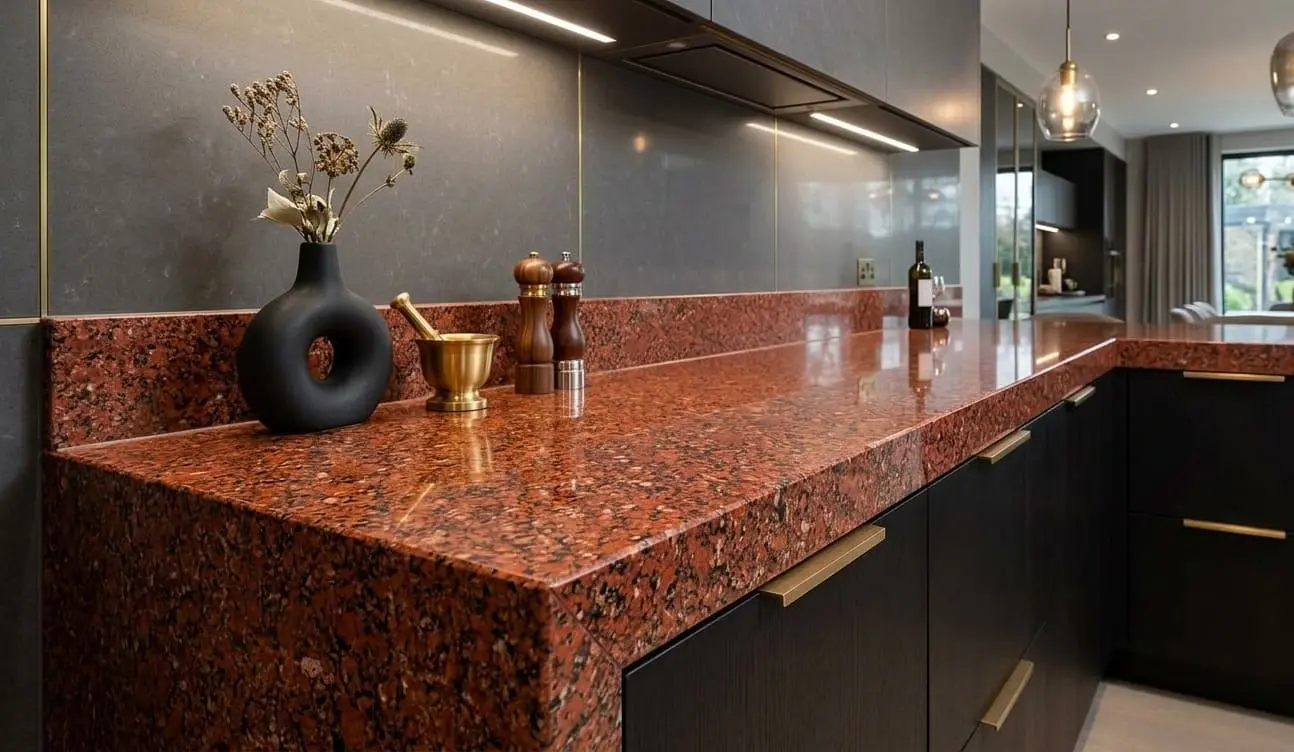
Natural stone (marble, quartzite, granite, and dolomite) is valued for the depth and individuality that comes from a material formed over millions of years. The practical side varies by stone type. Granite and quartzite are hard, dense, and relatively resistant to staining. Marble and dolomite are softer and more porous, which means they require sealing and will etch or stain if acidic liquids such as wine, lemon juice, or tomato are left sitting on the surface. That is not necessarily a reason to avoid them; many homeowners consider the patina part of the character. But it is worth knowing before choosing marble for a heavy-use prep kitchen.
Quartz countertops are manufactured from ground quartz bound with resin, producing a consistent, non-porous surface that requires no sealing and resists staining well. The uniformity that makes it low-maintenance also means it lacks the movement and depth of natural stone, which is a visual trade-off worth considering. The more critical functional limitation is heat sensitivity. The polymer resin binders that hold engineered quartz together begin to soften and discolor at temperatures above roughly 150 to 300 degrees Fahrenheit depending on the product, which is well within the range of a pan straight off the stove. Damage from direct heat contact is typically permanent and is excluded from most manufacturer warranties, so trivets are not optional on quartz.
Sintered stone and porcelain slabs are produced by subjecting raw minerals to extreme heat and pressure, resulting in a fully vitrified surface with very low porosity. Both materials are harder and more heat-resistant than quartz, contain no polymer binders, and are available in large-format stone-look and concrete-look finishes that are difficult to distinguish from natural material at a glance.
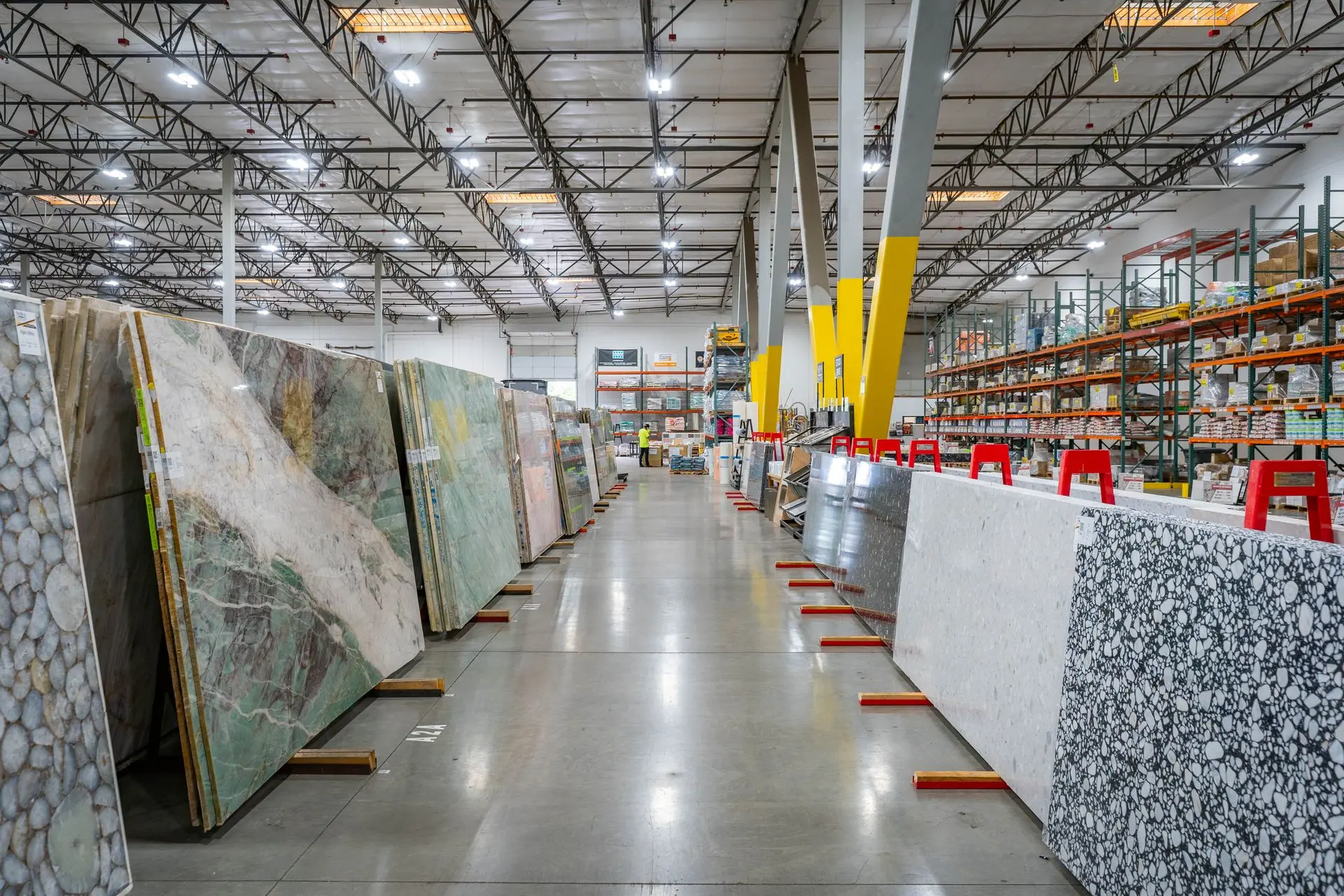
Whichever material you are leaning toward, see a full slab rather than a small sample before deciding; color and veining vary significantly across the full piece.
Backsplash Tile: Matching the Countertop
The backsplash has less functional pressure than the countertop: it needs to be washable and moisture-resistant, but it does not take direct heat or impact. That freedom makes it the surface where most kitchens get their visual detail.
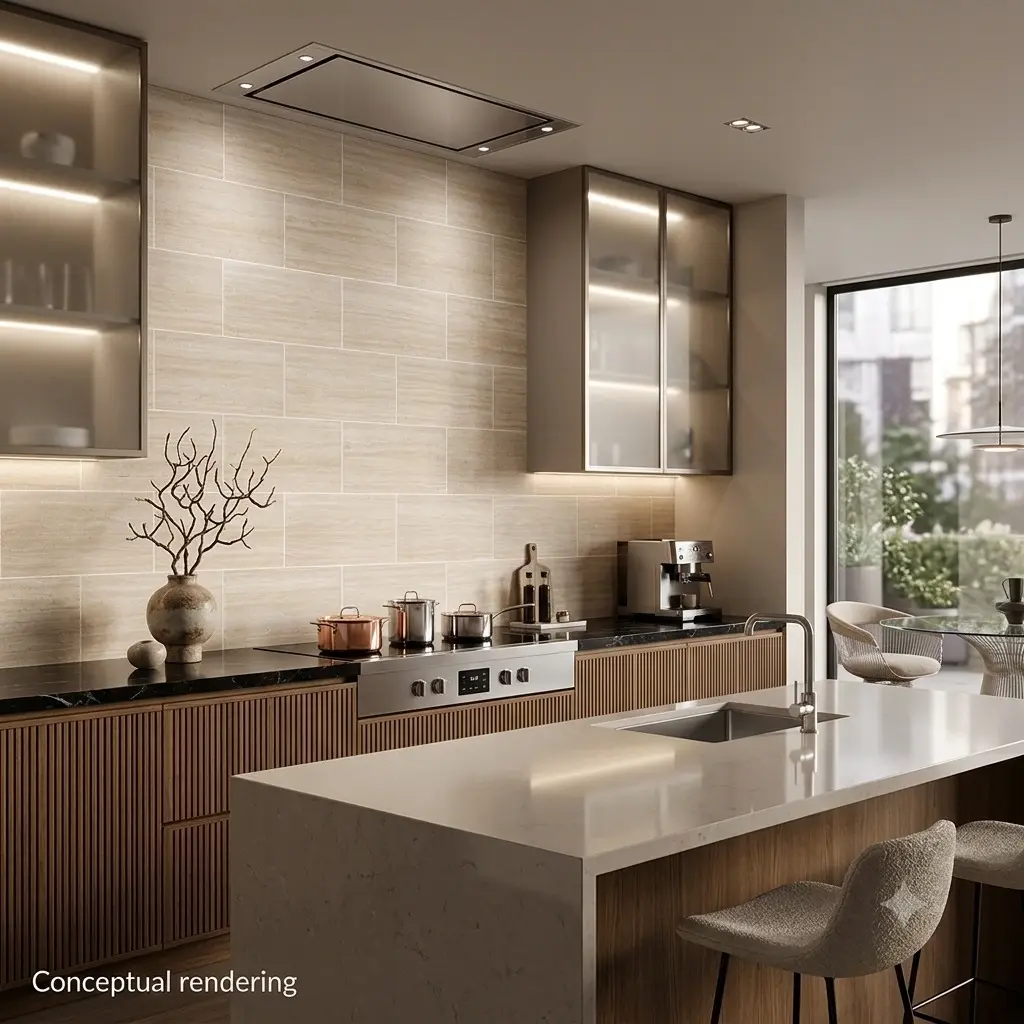
The relationship between countertop and backsplash tile is worth thinking about. A slab with strong veining generally does better with a backsplash that stays quiet: a simple ceramic subway tile, a honed stone mosaic, or a solid field tile that lets the countertop lead. A more uniform countertop gives the backsplash more room to carry interest. One format gaining ground with backsplash tile in Reno kitchens is the slab backsplash, a continuous piece of stone or porcelain running countertop to upper cabinets with no grout lines.
Grout color is a decision worth making deliberately. A joint tone close to the tile recedes and reads as a continuous field; a contrasting tone emphasizes the grid. Neither is wrong, but it is hard to reverse cheaply. Once the backsplash is settled, attention can turn to the floor, the surface most affected by Reno's climate.
 Conceptual rendering
Kitchen Flooring in Reno: What to Consider
Kitchen floors take consistent daily use: spills, dropped items, foot traffic, and the friction of chairs at any adjacent dining area. In Reno specifically, dimensional stability is worth adding to that list. Heated indoor air in winter falls below the 35-55% humidity range that wood-based flooring products need to remain stable, which means kitchen flooring in Reno that expands and contracts with moisture changes can gap, buckle, or delaminate over time if not chosen carefully.
Porcelain Tile
From a pure performance standpoint, porcelain tile is difficult to beat in a kitchen. It is fully waterproof, dimensionally stable regardless of humidity or temperature changes, and hard enough to resist scratching from everyday grit and dropped items. A standard note on hardness: glazed porcelain typically rates at Mohs 6-7 on the scratch-resistance scale depending on glaze type, with matte and crystalline finishes generally reaching the higher end of that range. Large-format tiles (24x24 and above) have become common in Reno kitchen renovations, partly because fewer grout lines make the floor easier to clean and partly because the scale suits the open-plan layouts typical of newer construction in South Reno and the surrounding suburbs.
The honest trade-off is comfort. Tile is hard underfoot and stays cold in winter unless there is in-floor heating beneath it. Radiant heating is a worthwhile consideration in Reno homes given how cold the floors can get from November through March. Grout lines also require periodic cleaning, and depending on the width and product used, occasional resealing.
Hardwood Flooring
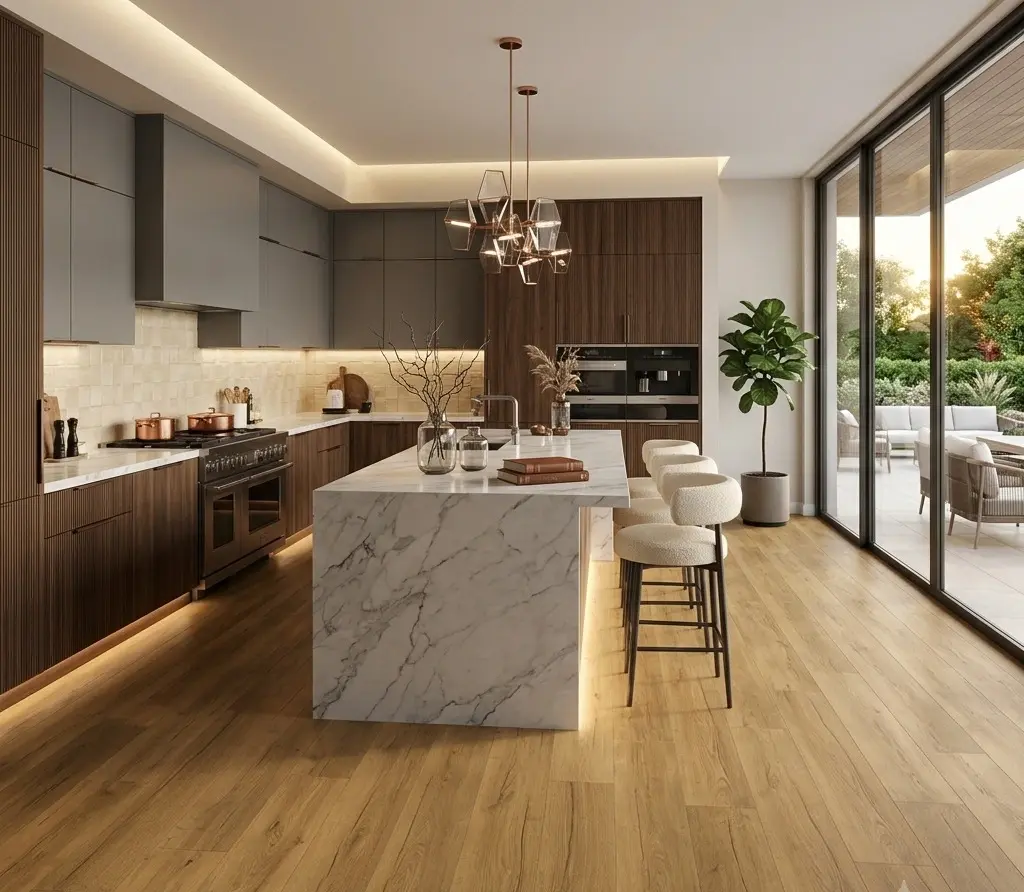
Hardwood in a kitchen is a material decision that prioritizes the feeling of the space over maximum practicality. It reads as warm in a way that tile and vinyl do not, and in open-plan homes it can tie the kitchen and living area together without a hard material transition.
The climate consideration for hardwood flooring in Reno is real. Solid hardwood is hygroscopic, meaning it absorbs and releases moisture with the surrounding air, and in a high desert environment with dry winter air, solid floors can shrink and develop visible gaps between boards. Staying within the stable humidity range generally requires a humidifier running through the heating season. Engineered hardwood handles humidity swings considerably better than solid and is the more practical recommendation for most Reno kitchen applications.
Luxury Vinyl Plank (LVP)
LVP flooring has become one of the most common kitchen flooring choices in Northern Nevada, and the reasons are straightforward: it is fully waterproof, unaffected by humidity swings, comfortable underfoot, and installs as a floating floor over most existing subfloors. The key specification is wear layer thickness, measured in mils. For kitchens, 20 mils is the standard recommendation; 12 mils is adequate for lighter-use rooms. Core thickness at 6mm and above also improves underfoot feel and sound absorption.
Laminate Flooring
Laminate is the most affordable wood-look flooring option and has improved in realism and durability over the past decade. For kitchens, the main limitation is moisture resistance. Standard laminate uses a high-density fiberboard core that will swell and delaminate if water gets beneath the surface and sits, which is a real risk around a sink or dishwasher. Waterproof laminate products exist and address this to a degree, though their moisture resistance still falls short of LVP. Laminate makes most sense for kitchens with moderate use and a budget that does not stretch to LVP.
Carpet is not recommended for kitchen floors, where grease, moisture, and food debris work into the fibers in ways that are difficult to fully clean. It is, however, well suited to the dining nook or breakfast area that often adjoins a kitchen, as well as bedrooms, living rooms, and stairs.
Putting It All Together
Each surface decision in a kitchen affects the others, and the order matters. The countertop sets the room's visual tone and maintenance expectations. The backsplash responds to it. The floor connects the kitchen to the rest of the home.
A countertop with strong veining calls for a floor that stays neutral, a solid tone or subtle texture that lets the slab lead. A more uniform countertop leaves room for the floor to introduce warmth or weight. In open-plan homes, the flooring decision often needs to cover the kitchen and the adjacent living area in the same material, so it is worth making before any individual surface is ordered.
Take physical samples home before finalizing any material. Showroom lighting flatters; natural light in a real kitchen does not. A tile or plank that reads warm on the showroom floor can read cool or grey once it is in your space.
Visit Nova Tile and Stone in Reno
Nova Tile and Stone's tile and stone showroom in Reno is at 12835 Old Virginia Road in South Reno, off the I-580/US-395 corridor. As a tile and stone store serving Reno, Nevada and the wider Truckee Meadows area, the showroom carries countertop slabs in natural stone, quartz, sintered stone, and porcelain, alongside tile, hardwood, LVP, laminate, carpet, and exterior stone. Whether you are planning a full kitchen remodel in Reno or simply finalizing a material selection, our design consultations are available at no charge and are provided on a non-commission basis.
Store hours are Monday through Friday from 7:30 a.m. to 6:00 p.m. and Saturday from 9:00 a.m. to 3:00 p.m. Visit our showroom or book an appointment today to explore materials and discuss your project with our design team.
Conclusion
Selecting materials for a kitchen renovation involves a series of interconnected choices rather than a single decision. Countertops often serve as the foundation of the design, influencing both the overall aesthetic and the level of maintenance required. From there, the backsplash should complement the countertop, while the flooring helps create a cohesive transition between the kitchen and the surrounding living spaces.
For homeowners in Reno, material selection deserves even greater consideration because local environmental conditions can affect long-term performance. The region's dry winters and seasonal temperature fluctuations can influence how certain flooring materials behave, how grout joints wear over time, and how natural stone surfaces mature with age. Taking the time to evaluate these factors before installation can help ensure that your chosen materials deliver both the appearance and durability you expect for years to come.
Note: Some images on this page may be conceptual renderings created to illustrate design possibilities and may not depict actual installations.
Frequently Asked Questions
For heavy daily use, quartzite, granite, sintered stone, and porcelain slab are the strongest options. All four are fully mineral surfaces with no polymer binders, so they handle heat without risk of resin damage. Engineered quartz is durable in most respects but will discolor or crack if hot pans are placed directly on it.
Yes. Winter heating drops indoor humidity below the 35-55% range that wood-based flooring needs to remain stable. Solid hardwood is most affected and can gap or crack. Engineered hardwood handles the swings better. LVP and porcelain tile are unaffected by humidity entirely, which is why both are widely used in Reno kitchens.
In most cases, yes. Running engineered hardwood or LVP continuously through the kitchen and living area avoids a visual break and makes the space feel larger. Porcelain tile works well in kitchens but can feel hard and cold in a living area. LVP and engineered hardwood carry both zones comfortably.
It can be, but marble is a calcium carbonate-based stone: marble will etch (develop dull spots in the finish) when acidic substances like lemon juice, vinegar, or wine sit on the surface. It also needs sealing to reduce staining, and sealing does not prevent etching. In a busy prep kitchen, those limitations recur regularly. In a lighter-use kitchen, marble is a beautiful choice. Honed finishes show etching less noticeably than polished.
Moisture resistance. LVP is 100% waterproof; its core will not swell. Standard laminate has a fiberboard core that swells when water sits beneath it, which happens near dishwashers and sinks. Waterproof laminate narrows the gap somewhat. Laminate costs less, but for most active kitchens, LVP is the more reliable specification.