Countertop selection tends to come down to three materials, and the choice between them is rarely obvious. Granite, quartzite, and quartz each behave differently in a kitchen, require different levels of care, and perform differently under the conditions specific to Reno's high desert climate. Granite is a natural igneous stone with strong heat resistance and broad color variety, best suited for active kitchens and outdoor applications. Quartzite is a natural metamorphic stone with marble-like veining and a harder surface than granite, making it a durable alternative to marble that resists kitchen acids without etching. Quartz is an engineered stone made from ground quartz crystals and polymer resin, offering a non-porous, low-maintenance surface that requires no sealing but is sensitive to heat and UV exposure, limiting its use in outdoor settings.
Choosing between them depends on how the kitchen is used, what maintenance commitment is realistic, and where in the home the countertop will be installed. In Reno specifically, the dry climate, high UV intensity, and wide temperature range between seasons all affect which material performs best where.
What You Are Actually Choosing Between
Before comparing performance, it helps to understand what these three materials are at a fundamental level, because one of the most common purchasing mistakes in this category starts with a naming confusion between quartzite and quartz.
Granite is an igneous rock formed from magma that cooled slowly beneath the earth's surface. It is composed of multiple minerals, primarily quartz, feldspar, and mica, which produce its characteristic speckled appearance.
Quartzite is a metamorphic rock that begins as sandstone subjected to heat and pressure underground until the quartz grains recrystallize into a dense, interlocking structure. The result is a hard, silica-based stone with the veined appearance of marble but a fundamentally different mineral composition.
Quartz is an engineered material made by combining ground natural quartz crystals, typically 90 to 93 percent by weight, with polymer resins and pigments. The resin is what makes it non-porous and also creates its main vulnerability: heat.
With those distinctions in place, here is how each material holds up in practice.
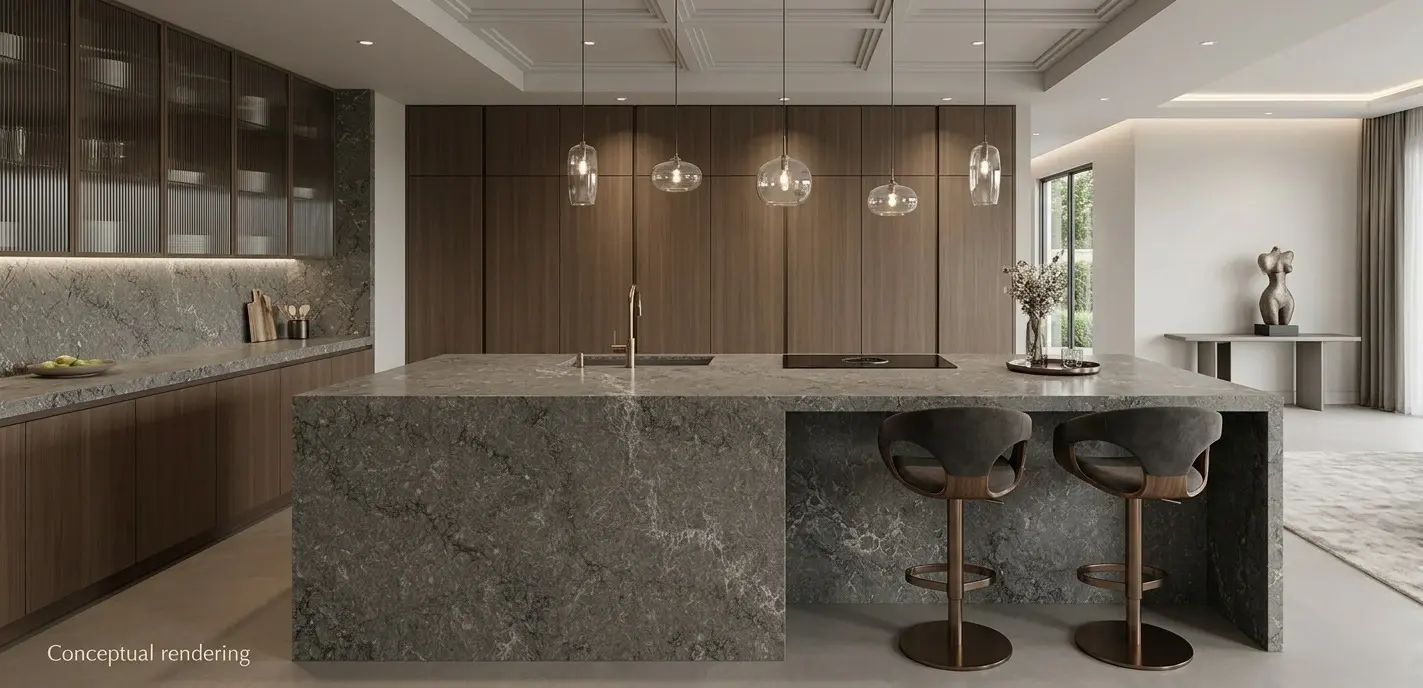
Granite
Granite handles heat from cookware well and resists scratches at 6 to 7 on the Mohs scale, making it a durable surface for active kitchens. Trivets are still a reasonable habit, but occasional contact with a hot pan is unlikely to cause damage. Its natural strength and resistance to everyday wear have made granite a long-standing choice for homeowners seeking a countertop material that can withstand years of regular use.
The primary maintenance consideration is porosity. Cooking oils, red wine, and acidic spills can stain unsealed granite, so applying a sealer once a year is generally recommended. A simple water bead test, which involves placing a few drops of water on the surface for several minutes, can help determine whether the existing seal remains effective. Reno's low ambient humidity makes moisture absorption less of a daily concern than it would be in wetter climates, and granite's ability to tolerate temperature fluctuations gives it an advantage over quartz for outdoor kitchen applications.
Granite's color range runs from creamy whites and warm tans to deep charcoals and blacks, with patterns that range from subtle movement to dramatic veining. Because each slab is unique, granite offers a one-of-a-kind appearance that appeals to homeowners who want natural variation rather than a uniform look. These characteristics fit naturally with mountain-adjacent homes in areas like Somersett and Caughlin Ranch, as well as the mid-century ranch properties common throughout Reno's older neighborhoods.
Quartzite
Quartzite offers something marble cannot reliably deliver: a similar visual character with greater hardness and a silica-based composition that does not react with common kitchen acids. Acidic substances such as lemon juice, vinegar, and tomato sauce can etch a marble surface. True quartzite, however, is naturally resistant to etching and typically will not be affected by these common household acids.
A common issue in the market is mislabeling. Many white and light-veined stones from Brazil, including the well-documented Super White, are actually dolomite or dolomitic marble and behave like marble rather than quartzite. An acid test on an inconspicuous edge before installation is a reliable way to confirm the stone is genuine.
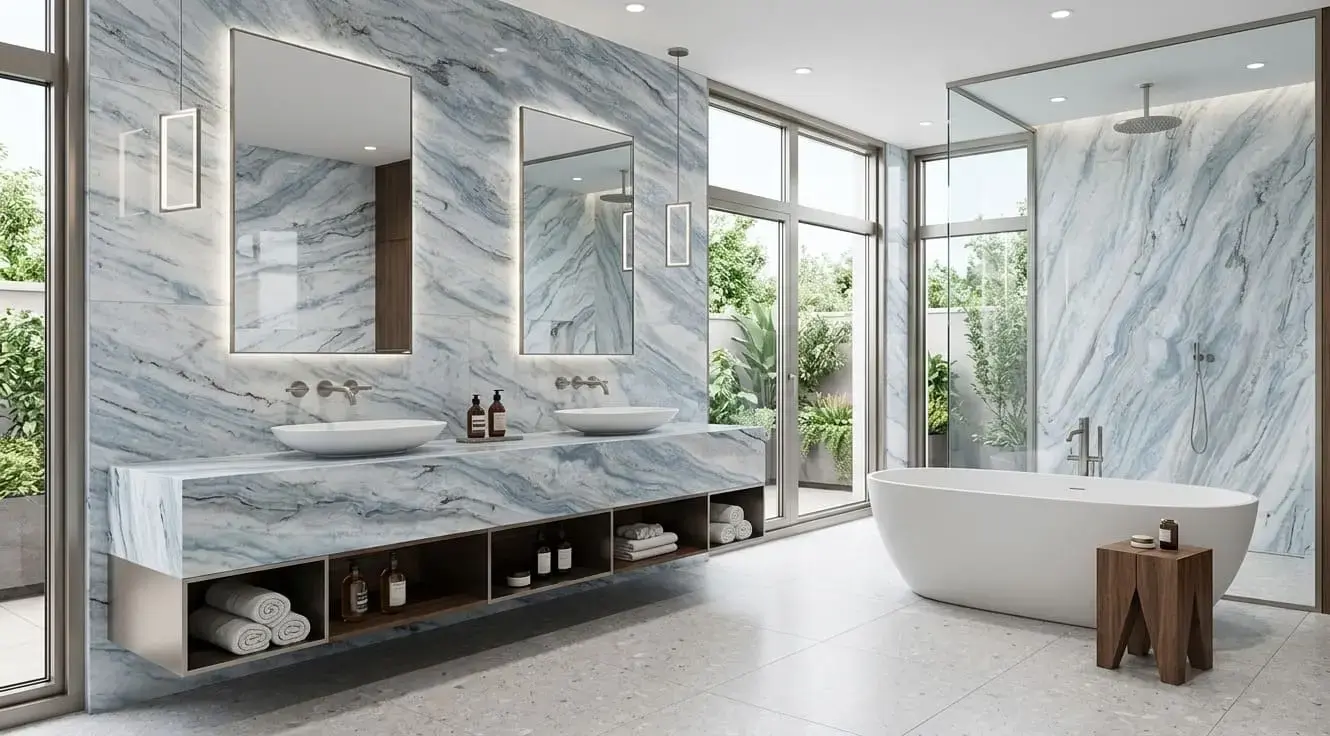
Like granite, quartzite is porous and needs periodic sealing. Dense varieties like Taj Mahal may rarely need attention, while more porous types benefit from annual sealing. Its visual profile tends toward whites and soft grays with flowing veining, which suits kitchens where the goal is a marble-like surface without marble's acid sensitivity.
Quartz
Engineered quartz eliminates the sealing requirement entirely. Its non-porous surface does not absorb liquids, cleans with mild soap and water, and works well in bathrooms and laundry rooms where moisture exposure is constant.
There are two real limitations. The polymer resin is sensitive to heat above roughly 150°F, meaning a slow cooker, hot pan, or griddle placed directly on the surface can cause permanent discoloration. Trivets are not optional. The resin also degrades under sustained UV exposure, making quartz unsuitable for outdoor countertops. In Reno, with approximately 252 sunny days a year and high UV intensity at elevation above 4,500 feet, any exterior countertop application should use natural stone.
A Few Reno-Specific Considerations
Hard water. Reno's moderately hard water can leave mineral deposits on stone surfaces. Quartz handles this with standard cleaners. For granite and quartzite, acidic descalers should be avoided since they can degrade the sealer; pH-neutral stone cleaners are the right choice.
Outdoor kitchens. Reno's dry climate makes outdoor cooking practical for much of the year. Granite and quartzite hold up well to temperature variation and direct sun. Quartz should not be used in these settings.
Resale. Reno continues to attract buyers relocating from California markets with high expectations for finish quality. At the upper end of the local market, natural stone tends to read distinctively. In mid-range homes, quartz's low-maintenance appeal is a genuine selling point.
Which Material Suits Which Situation
The right choice depends on how the kitchen is used, how much maintenance feels realistic, and what the rest of the space looks like. None of these materials is a poor choice in the right context. Each one becomes the wrong choice in the wrong one.
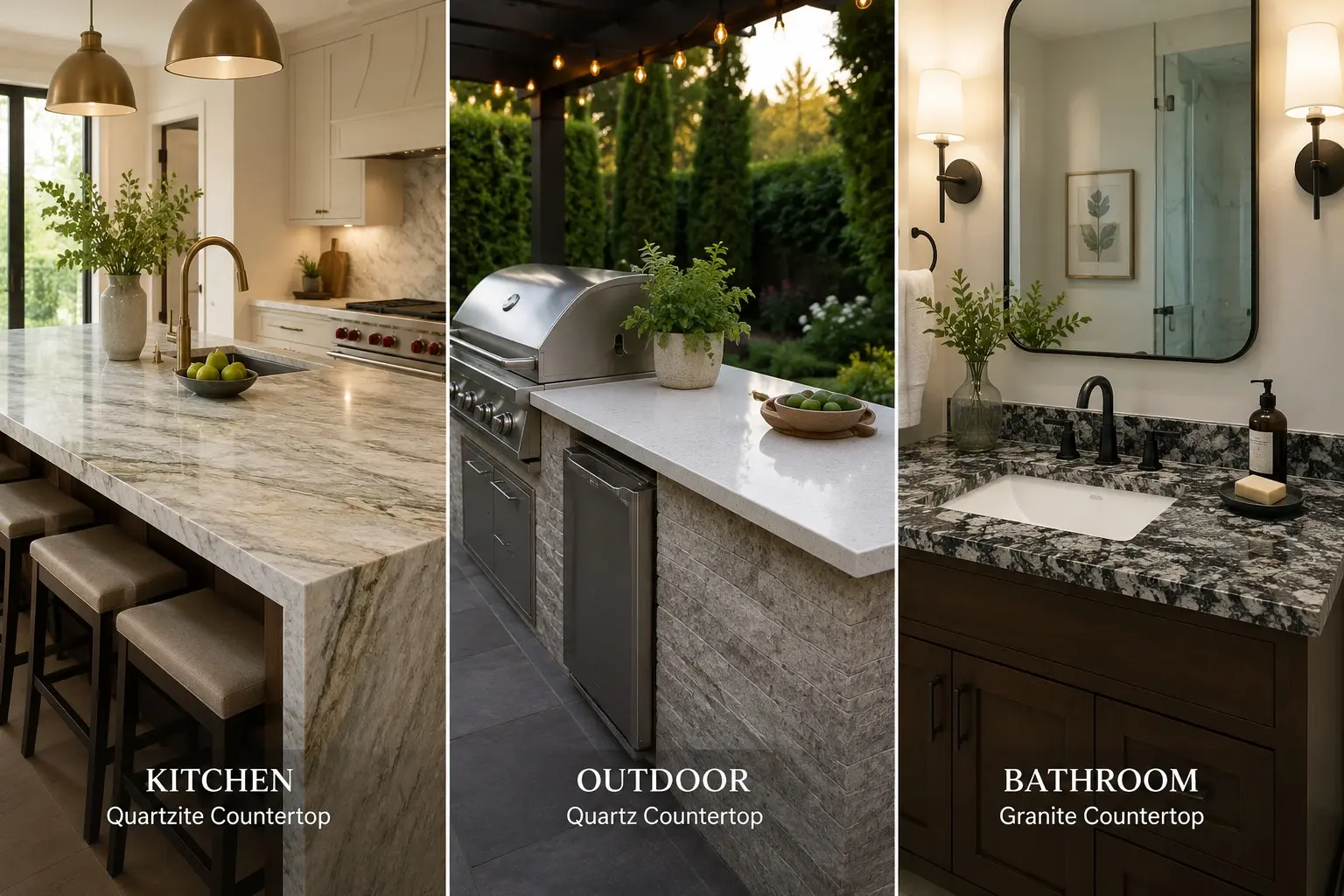
For someone who cooks frequently with high heat, granite and quartzite are the more practical surfaces. Both tolerate the kind of thermal stress that comes from an active kitchen better than quartz does, and both age naturally without the risk of resin damage. Granite offers broader color variety, from deep charcoals and dramatic movement to quieter, earthy tones. Quartzite delivers a marble-adjacent look with stronger acid resistance, which matters in a kitchen where vinegar-based cleaners or citrus spills are routine.
For someone who wants minimal maintenance, nothing more than a quick wipe-down and no sealing schedule, quartz is a reasonable choice for indoor applications. It suits households where the kitchen sees moderate use, where the primary concern is easy cleaning, and where heat management with trivets is a straightforward habit rather than an inconvenience.
Bathrooms and laundry rooms are where quartz often makes the clearest case for itself. Moisture exposure is constant in those spaces, the heat sensitivity that limits quartz in kitchens is largely irrelevant, and the non-porous surface handles the cleaning products typically used in those rooms without issue.
For outdoor countertops anywhere in Reno, granite or quartzite are the appropriate choices regardless of other preferences. The UV intensity at elevation and the temperature swings between seasons rule out quartz for any exterior application.
Contractors and designers working across multiple projects in the Reno area can apply for a trade account at Nova Tile and Stone's Reno showroom, which provides access to trade pricing, job site delivery, and commercial estimating support.
Conclusion
None of the three materials is universally better. Granite and quartzite suit active kitchens, outdoor applications, and homes where natural stone character matters. Quartz suits interior spaces where low maintenance is the priority and heat exposure is controlled. In Reno, the dry climate, long outdoor cooking season, and mix of home styles across the area all shape which material is the right fit for a given space.
A countertop also does not exist in isolation. It sits alongside flooring, backsplash, and cabinetry, and those surfaces interact visually. A light quartzite reads differently next to wide-plank hardwood than it does next to large-format porcelain tile. Getting those combinations right is easier when the materials are evaluated together rather than separately.
Nova Tile and Stone's Reno showroom carries tile, hardwood, luxury vinyl plank, laminate, carpet, and exterior stone in addition to countertop slabs, making it possible to assess combinations in person. Design consultations are available at no charge.
Nova Tile and Stone, Reno address is at 12835 Old Virginia Road, Reno, NV 89521 (775) 331-6682 Monday through Friday: 7:30 am to 6:00 pm | Saturday: 9:00 am to 3:00 pm Visit our Reno showroom or browse our slab inventory online.
Note: Some images on this page may be conceptual renderings created to illustrate design possibilities and may not depict actual installations.
Frequently Asked Questions
Quartzite is a natural stone; quartz countertops are engineered from ground quartz crystals and polymer resin. Quartzite is porous and needs sealing; quartz is non-porous and does not. Quartzite handles heat well; quartz can be permanently damaged by sustained heat due to its resin content.
Granite and quartzite are both appropriate for outdoor countertops in Reno. Quartz should not be used outdoors because the polymer resin discolors under sustained UV exposure, and Reno receives around 252 sunny days a year with high UV intensity above 4,500 feet elevation.
Both are porous and benefit from annual sealing in most kitchen applications. To check the current seal, leave a few drops of water on the surface for a few minutes; if it soaks in and darkens the stone, resealing is due.
True quartzite will not etch when exposed to lemon juice or white vinegar. Place a small drop on an inconspicuous area, wait a minute, then wipe clean. If a dull mark remains, the stone is calcium carbonate-based and has been mislabeled, likely as dolomite or marble.
Yes, for most bathroom and laundry applications. Quartz's non-porous surface handles moisture without sealing and cleans easily. Heat sensitivity is less of a concern in those spaces, though UV exposure near direct-sun windows is still worth considering.
Nova Tile and Stone is a family-owned direct stone importer with showrooms in Reno, Sacramento, Minden, and Fernley. The Reno showroom is located at 12835 Old Virginia Road, Reno, NV 89521, and can be reached at (775) 331-6682. The Reno location carries natural stone slabs, engineered stone, tile, hardwood, luxury vinyl plank, laminate, carpet, and exterior stone.