Which Countertop Options Work Best for Fernley Kitchens?
Selecting among granite, quartzite, or quartz countertops shapes how a Fernley kitchen performs and looks for years. Each material carries distinct finish options, application boundaries, and care requirements that affect both durability and design outcomes. Granite and quartzite are natural stones available in polished, honed, leathered, and specialty finishes. Quartz is an engineered surface limited to polished, honed, and specialty finishes.
Granite and quartzite handle kitchens, bathrooms, bars, outdoor surfaces, and fireplace surrounds. Quartz suits indoor kitchens, bathrooms, and bar tops but cannot be used outdoors, in UV-exposed areas, or adjacent to a fireplace. Those application limits narrow the field before design decisions begin. Fernley's warm climate and access to outdoor living areas make UV-rated material selection relevant for projects that may extend to covered patio or outdoor kitchen surfaces.
Heat resistance does not equal thermal-shock resistance. Trivets are required near heat sources at all three surface types, and cutting boards are recommended regardless of scratch-resistance ratings. Benefit claims for any countertop material require real-world qualifiers to hold meaning over time.
Nova's Fernley showroom carries full slabs across all three material categories, and staff there can walk through finish options and application suitability for any project before a selection is finalized.
Performance Profile: Granite, Quartzite, and Quartz Compared
Understanding how these materials compare across key performance categories speeds specification and reduces costly mismatches at the project stage. The comparison below covers criteria most relevant to kitchen, bathroom, and bar countertop decisions. Reviewing the full slab gallery alongside this guide connects performance data to real available inventory.
Feature | Granite | Quartzite | Quartz |
Finish Options | Polished, Honed, Leathered, Specialty | Polished, Honed, Leathered, Specialty | Polished, Honed, Specialty |
Outdoor and UV Use | Yes | Yes | No |
Fireplace Surround | Yes | Yes | No |
Sealing Required | Yes | Yes | No |
Heat Resistance | High | Yes | Moderate |
Scratch Resistance | High | Very High | Moderate |
Granite's UV stability makes it reliable for outdoor kitchen countertops and projects that cross indoor-outdoor thresholds. Quartzite adds hardness to that profile, offering extra protection on high-traffic surfaces and bar tops where daily contact intensity is high. Quartz fills a distinct niche in bathrooms and indoor kitchens where consistent patterning and a sealing-free maintenance routine are the priority.
Each material's benefits require real-world context to be useful. Granite provides durable heat resistance and a full four-finish range, but periodic sealing and prompt spill cleanup sustain that performance. Quartzite matches granite's application profile while adding hardness, provided sealing discipline is maintained. Quartz eliminates sealing entirely but introduces firm limits: no outdoor use, no fireplace surrounds, and greater sensitivity to sustained heat exposure. Trivets are non-negotiable even on engineered surfaces.
The TCAA trade body supports industry professionals applying material performance standards across residential and commercial surface categories.
 Conceptual rendering
Pros and Cons at a Glance
Granite
- Pros: UV-stable and outdoor-rated; full four-finish range; wide color selection across slab inventories; fireplace surround compatible
- Cons: Periodic sealing required; polished finish shows fingerprints and wear faster than honed or leathered options
Quartzite
- Pros: Hardest natural stone countertop option; UV-stable; full finish range including leathered; fireplace surround rated
- Cons: Periodic sealing required; color palette leans neutral and light compared to granite's broader variety
Quartz
- Pros: Non-porous construction with no sealing required; consistent color and pattern; low-maintenance daily routine
- Cons: Indoor use only; heat and UV sensitive; leathered finish is not available in engineered quartz
Kitchen, Bathroom, and Bar Applications by Material
Application context shapes countertop selection as much as aesthetics does. Kitchens, bathrooms, and bar tops each impose distinct performance demands, and the right material reflects how a surface functions in daily use over time.
Which material for which space?
Kitchen Countertops and Islands
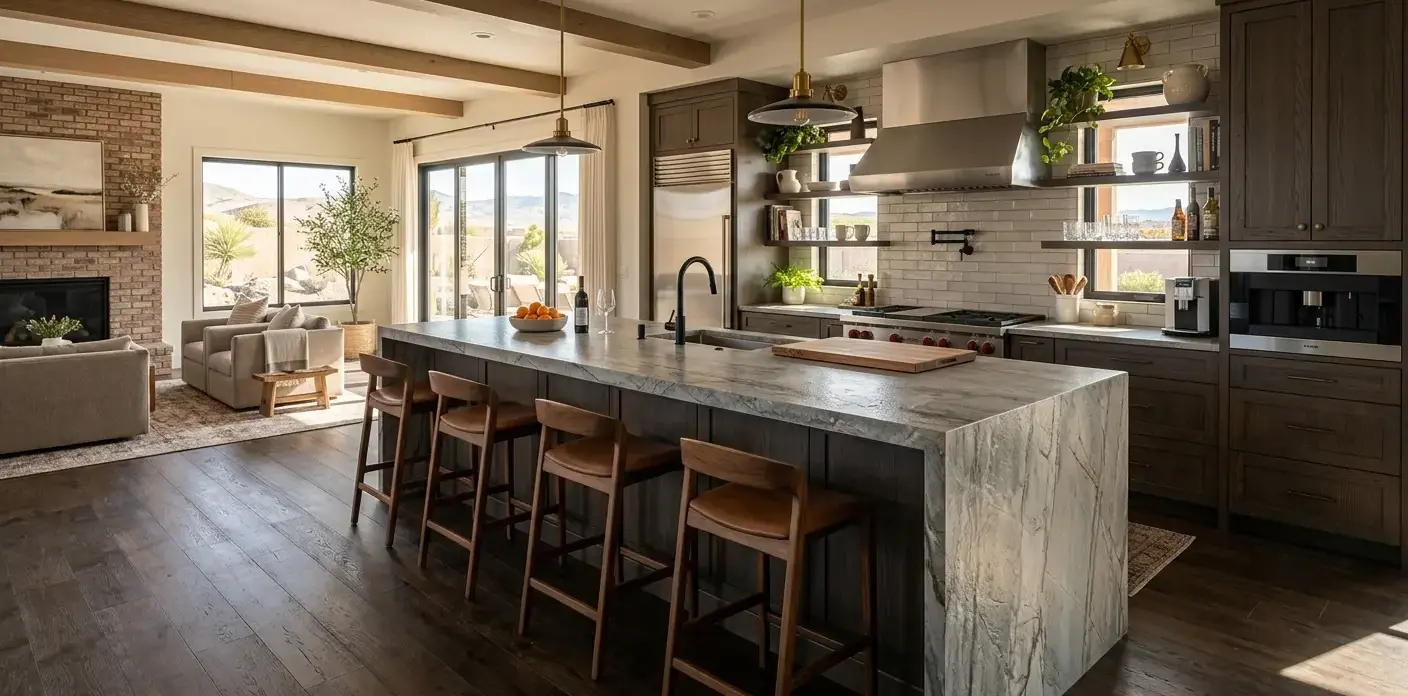
Granite handles heat, prep, and daily cleaning well - choose honed or leathered to reduce glare and fingerprints in busy kitchens. Quartzite matches that performance with added hardness, making it the stronger pick where scratch resistance is a daily priority. Use trivets and cutting boards on both.
Quartz suits kitchen islands and perimeter surfaces positioned away from range tops, offering clean, consistent color that coordinates well with high-contrast tile and cabinet schemes.
Color coordination across countertops, cabinetry, and backsplash materials plays a meaningful role in the final design result. Hotter summer temperatures in the Fernley area also reinforce the case for UV-stable granite or quartzite in any kitchen layout that incorporates an adjacent semi-covered prep surface. Editorial resources like Better Homes and Gardens offer current kitchen color palette references for homeowners working through material combinations.
Bar Tops and Entertainment Surface Applications
Bar tops absorb concentrated spill traffic, repeated wiping, and occasional heat from chafing dishes or warming elements used during entertaining. Honed or leathered granite conceals minor surface marks and wear better than polished finishes in a bar setting, making it a practical choice for entertainment-focused kitchens and dedicated bar areas. The four-finish range granite offers gives designers and homeowners more flexibility when matching bar surfaces to surrounding cabinetry and decor.
Quartzite's hardness suits surfaces where high contact frequency and regular cleaning intensity are the norm; leathered quartzite hides daily wear particularly effectively. Quartz performs well in indoor bars without embedded heat elements, delivering low-maintenance consistency in contemporary design schemes. The Nova Minden showroom lets customers compare slab thickness and finish options side by side before committing to a bar surface material.
Outdoor Kitchens
Quartz is off the table entirely for outdoor use - prolonged UV exposure degrades both its color and finish over time, often irreversibly. For Fernley projects that extend beyond the interior, granite and quartzite are the only viable options. Both materials are UV-stable and fully rated for outdoor and UV-exposed applications, making them the right call for covered patio prep surfaces, outdoor kitchen countertops, and alfresco bar areas.
Fernley's warm, sun-heavy climate accelerates UV wear on incompatible surfaces, so getting this right at the specification stage matters. Granite brings a broad color palette to outdoor settings, while quartzite adds exceptional hardness for surfaces that take daily contact and frequent cleaning. Either way, viewing full slabs in person before committing remains important - natural stone moves differently in outdoor light than it does inside a showroom.
Bathroom Vanities and Wet Zone Applications
Bathroom vanity tops face water, cosmetics, cleaning products, and temperature fluctuation on a daily basis. Quartz suits bathroom countertops particularly well because its non-porous surface resists moisture penetration without sealing and handles most cleaning products when surfaces are wiped promptly. Granite and quartzite both work in bathroom settings provided sealing schedules are maintained and spills are addressed quickly. Polished finishes suit dry countertop zones; honed or specialty finishes reduce surface glare and provide a more forgiving texture in zones with consistent water contact.
Design-forward bathroom approaches, including slab continuity from vanity tops to wall surrounds, appear regularly in publications like Elle Decor. TheNova Reno showroom carries bathroom-suitable slab options across granite, quartzite, and quartz categories for vanity top and tub surround applications.
Selecting Your Slab at Nova Tile and Stone
Nova Tile and Stone carries granite, quartzite, and quartz slabs at showrooms in Fernley, Reno, Minden, and Sacramento, serving northern Nevada and northern California. Staff at each location guide material and finish decisions based on application-specific requirements rather than catalog images. The Nova Sacramento showroom extends access for California customers planning kitchen, bathroom, or bar countertop projects south of the Nevada state line.
How to Choose the Right Countertop Slab: 4 Steps
1 Define the application zone
2 Narrow the finish category
3 Compare performance against priorities
4 View full slabs in person
Nova operates as a locally owned supplier rather than a national chain, which means showroom staff carry hands-on knowledge of current inventory. Tile samples ship free for customers coordinating kitchen or bathroom tile choices alongside slab selections. More about Nova's regional approach and background is on the about Nova page.
The shop local program reflects a commitment to serving northern Nevada and northern California communities directly. Booking a free consultation before visiting a showroom allows staff to prepare relevant slabs and finish options in advance.
Conclusion
Granite and quartzite remain versatile choices for outdoor kitchens, fireplace surrounds, and UV‑exposed installations, offering durability and natural beauty. Quartz, by contrast, provides a sealing‑free indoor alternative with uniform patterning and dependable performance. Aligning application requirements, finish preferences, and maintenance expectations with the comparison table in this post ensures a practical foundation for decision‑making. This structured approach helps homeowners prepare before visiting Nova showrooms, where they can explore the complete range of stone surfaces and design possibilities firsthand.
Frequently Asked Questions
Quartzite is a natural stone formed from sandstone under heat and pressure. It requires periodic sealing and is rated for outdoor and UV-exposed applications. Quartz is an engineered surface made from ground quartz mineral combined with resin binders. It requires no sealing but is limited to indoor use and should not be placed near direct heat sources or in areas with prolonged UV exposure.
Quartz countertops are not rated for outdoor use. Prolonged UV exposure causes color and finish degradation in engineered quartz surfaces. Granite and quartzite are both UV-stable and appropriate for outdoor kitchen applications in the Fernley area.
Granite countertops require periodic sealing to maintain stain resistance in kitchen environments. Sealing frequency depends on the specific stone, finish type, and usage level. Prompt spill cleanup is recommended on all granite surfaces regardless of seal status.
Honed and leathered finishes tend to perform better in high-traffic kitchen environments than polished finishes. They show fewer fingerprints, conceal minor surface wear more effectively, and provide a more forgiving texture in zones with frequent contact. Polished finishes suit lower-traffic areas or design-focused spaces where visual impact is the priority.
Cutting boards are recommended on all countertop surfaces, including granite and quartzite. While both materials carry high scratch resistance ratings, cutting directly on any stone surface can mark the finish over time and dull knife blades. Using cutting boards is a straightforward habit that preserves both the surface and kitchen tools long-term.