Granite is a natural igneous stone formed from cooled magma, quarried into large blocks and cut into slabs. It typically rates 6 to 7 on the Mohs hardness scale, making it resistant to scratches from everyday kitchen use. Unlike non-porous materials such as quartz, granite is porous and generally requires periodic sealing to resist staining. In Carson City, NV, granite performs well in the area's high desert climate, in Eagle Valley at the base of the Carson Range, where dry summers and cold winters don't affect the stone's mineral structure the way they can affect other materials.
What Makes Granite Durable
Granite forms deep underground as molten rock cools slowly over thousands of years, allowing large mineral crystals of quartz, feldspar, and mica to develop and interlock. That interlocking crystalline structure is what gives the stone its density and hardness. It tolerates heat well enough to set a hot pan on briefly without damage, and it's hard enough to resist scratches from normal kitchen use, though cutting directly on the surface will dull knives over time rather than harm the stone.
Granite also performs well from a hygiene standpoint. Independent testing of countertop materials found granite ranked first in cleanability, providing the greatest reduction in bacteria counts of all the materials tested after washing and rinsing, according to the Natural Stone Institute's technical bulletin on countertop sanitation. That combination of hardness, heat tolerance, and cleanability is a large part of why granite has remained a leading choice for kitchens for decades, even as engineered alternatives have entered the market.
Granite Finishes
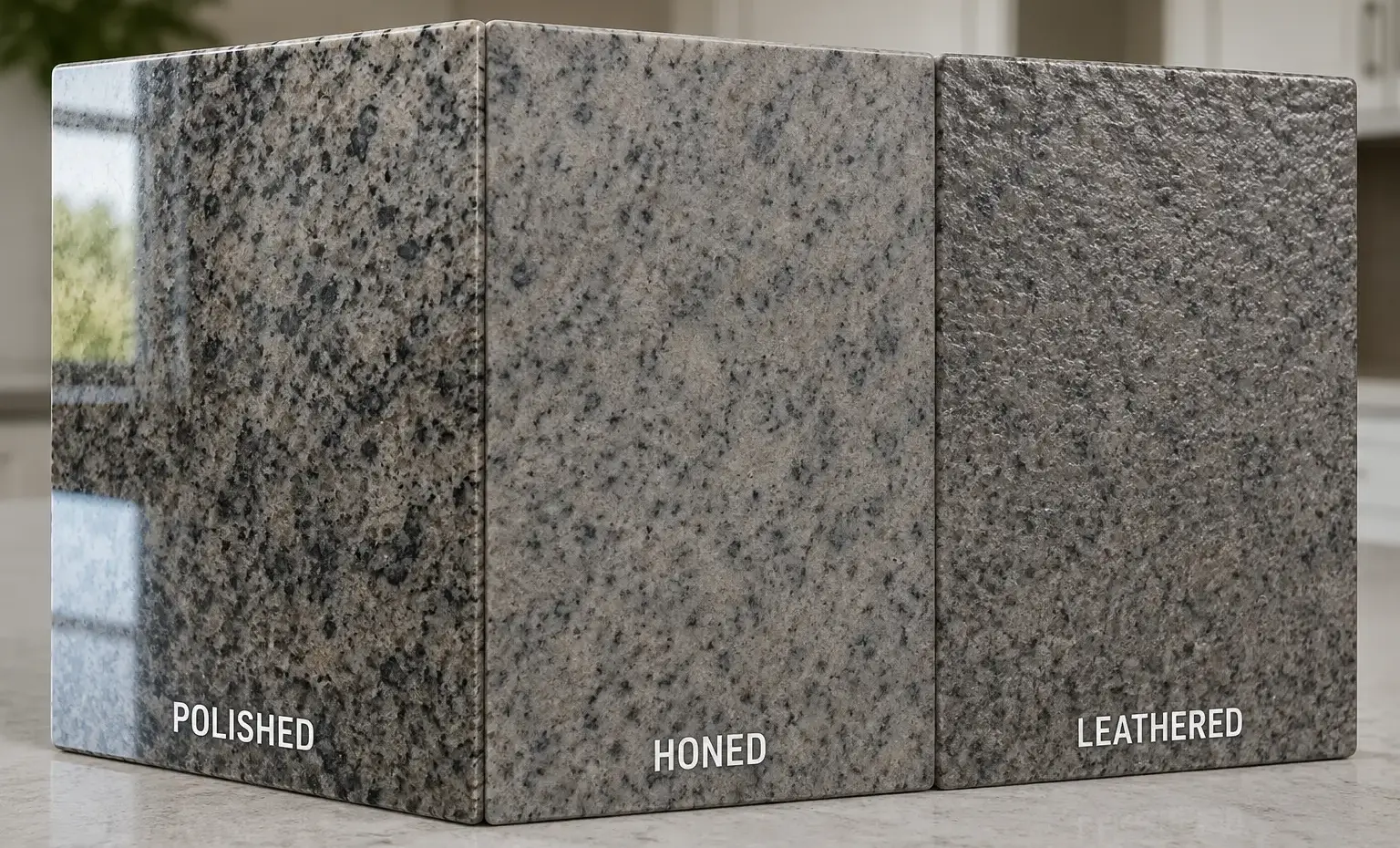
Granite countertops are available in a few different finishes, and the choice affects both look and everyday performance. Polished granite has a glossy surface that reflects light and shows off color and veining most vividly, and its smoother texture makes it the easiest finish to keep clean, since fewer surface irregularities exist for residue to collect in. Honed granite has a matte, satin-like surface produced by stopping the polishing process earlier, which tends to hide small scratches and etching better than a polished finish, though it can show fingerprints and water spots more easily since there's no glossy sheen to distract the eye. Leathered granite has a textured surface, created by brushing the stone with diamond-tipped tools after honing, that adds visible depth to the stone's natural pattern. That texture helps mask fingerprints and water spots, making it a practical choice for heavily used kitchen surfaces or busy households.
Choosing a finish often comes down to how the space will be used day to day. A polished finish suits a kitchen where the countertop's visual impact matters most and cleaning is frequent. A honed or leathered finish can be a better fit for households that want a lower-maintenance look that doesn't show every water spot or fingerprint between cleanings, including many of the historic homes along Carson City's Kit Carson Trail, where owners often prefer a finish that reads as more period-appropriate than a high-gloss surface.
Popular Granite Colors and Patterns
Granite is available in a wide range of color families, and the mineral composition of each slab determines its final appearance. Black and dark gray granites tend to have a more uniform, subtle pattern and pair well with lighter cabinetry for contrast. White and light gray granites often feature more visible veining and mineral flecking, giving a brighter look that can make smaller kitchens feel more open. Warm-toned granites, in browns, golds, and reds, bring more movement and pattern variation, and tend to complement wood cabinetry and traditional kitchen designs, a common pairing in the Victorian-era homes found throughout Carson City's West Side Historic District. Because granite is a natural material, no two slabs of the same named color are identical, which is why viewing available granite slabs in person before fabrication, rather than relying solely on a small sample chip, is the most reliable way to know what will end up in a finished kitchen. You can browse our current slab inventory or schedule a showroom appointment to compare full-size slabs and discuss your project with our team.
Granite Compared to Other Countertop Materials
Granite is often compared to quartz, an engineered material made from crushed quartz crystal bound with resin, and to quartzite, a natural metamorphic stone. Engineered stone carries the highest silica content among common countertop materials, at more than 90 percent, compared to under 45 percent in granite and under 20 percent in porcelain, according to reporting on the countertop industry, though this distinction matters more for fabrication safety than for a finished countertop in a home. Quartz's non-porous surface skips sealing entirely, which appeals to homeowners who want the lowest possible maintenance routine, though it can be more sensitive to prolonged direct heat than granite. Quartzite offers a look similar to marble with a hardness close to granite, though as a natural stone education resource notes, its sealing needs vary by slab and porosity, just as granites do. None of these materials is a universal best choice. The right one depends on how much natural variation a homeowner wants to see, how much sealing upkeep they're willing to take on, and where the countertop will be used.
Cost Factors
Granite pricing varies based on the specific slab's origin, rarity, color, and pattern, along with slab thickness and finish. More common colors sourced from widely available quarries typically cost less than rarer patterns imported from a limited number of locations. Fabrication costs, including cutting, edge profiles, and cutouts for sinks or cooktops, are generally a separate line item from the material cost itself, so it's worth budgeting for both when comparing options. Edge profiles range from a simple eased edge to more detailed options like bullnose or ogee, and more elaborate profiles typically add to the fabrication cost. Templating, the process of measuring the exact dimensions of cabinets and openings before the slab is cut, usually happens after cabinets are installed, since it ensures sink and cooktop cutouts line up precisely. As a direct stone importer, Nova Tile and Stone carries a wide range of granite options at competitive prices, and our design team can help match a slab to your project and budget. Get directions to our showroom to see current slab selection and pricing in person.
Granite in Carson City's Setting
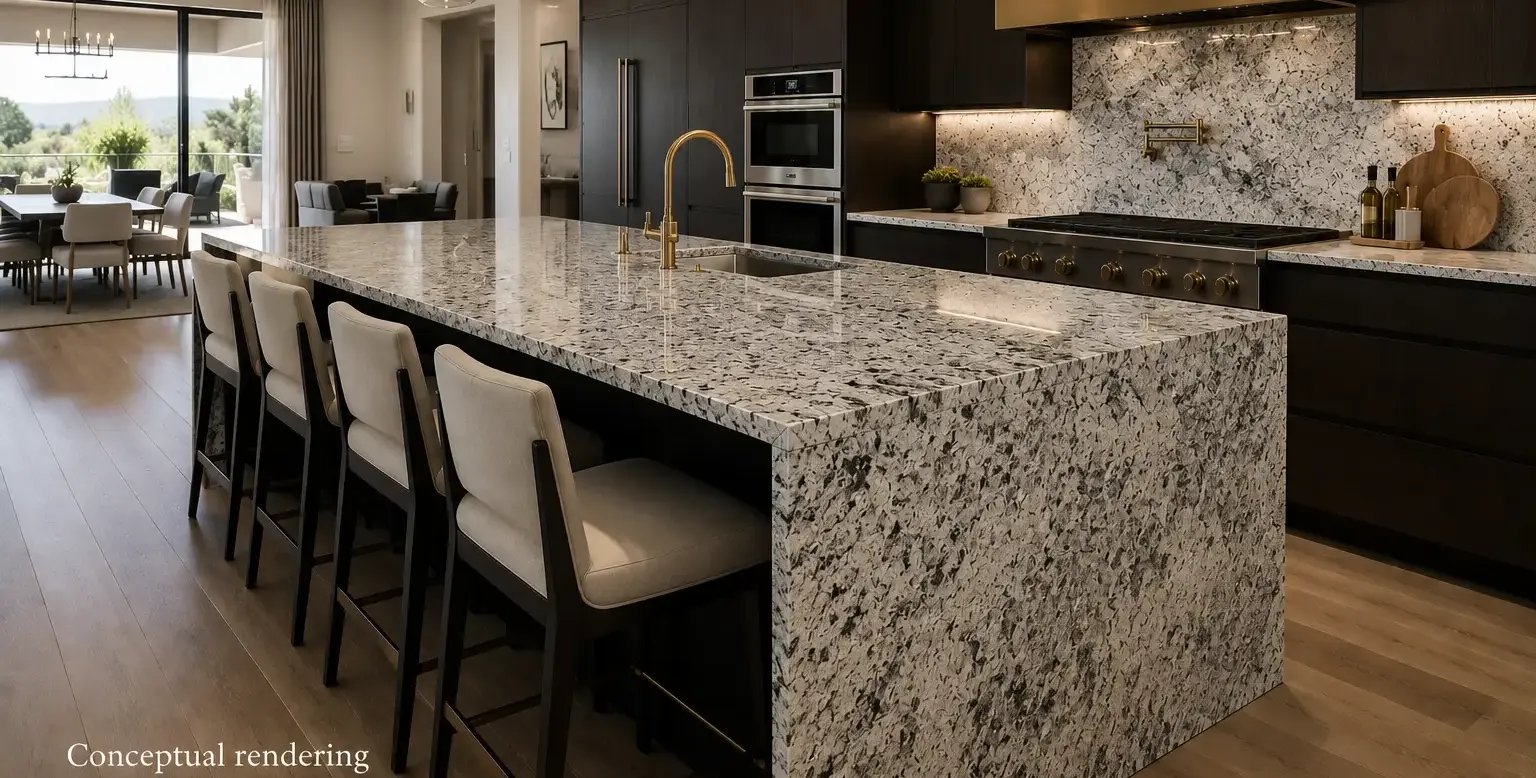
Carson City sits at the northern edge of the broader Carson Valley, which also includes Minden, Gardnerville, and Genoa. Dry summers, cold winters, and notable seasonal temperature swings define the area's high desert setting, and granite remains a common choice both downtown, in the historic homes near the Nevada State Capitol and Kit Carson Trail, and in newer construction further from the historic core. Dry indoor air during winter heating season doesn't affect granite the way it can affect some woods and other porous materials, since the stone's density limits how much moisture it absorbs or releases as indoor humidity changes.
Sealing and Everyday Care
Daily cleaning is straightforward: a soft cloth, warm water, and a mild, pH-neutral cleanser, with abrasive pads, acidic cleaners, bleach, and ammonia avoided, since these can dull the finish or affect the sealer over time. Coasters and trivets help prevent water rings and heat marks, and spills should be blotted rather than wiped to avoid spreading the mess across the surface. Cutting boards are recommended not because granite is easily damaged by knives, but because the stone's hardness will dull blades faster than a softer surface would.
Because granite is porous, most slabs also benefit from periodic sealing, though porosity varies by the specific stone, so there's no fixed schedule the way there might be for a manufactured material. Sealing products used in the stone industry are impregnators that act as a repellent rather than a true seal, and while sealing does not make stone stain-proof, it does make it more stain-resistant, according to the Natural Stone Institute's guidance on stone care and cleaning. A simple water test, letting a few drops sit on the surface to see whether they bead or absorb, is a reliable way to check whether resealing is due. If water darkens the stone within a few minutes rather than beading on the surface, that's typically a sign the sealer has worn down.
If a stain does occur despite sealing, most everyday spills can be addressed by cleaning the area promptly with a mild, non-acidic cleaner. For more stubborn or set-in stains, a poultice, a paste that draws the staining material back out of the stone's pores, is the standard approach recommended by stone care professionals, and it's worth consulting a stone supplier or fabricator before attempting a poultice on a stain that hasn't responded to regular cleaning. With periodic resealing as needed and consistent day-to-day care, a granite countertop can perform well for decades, making it a long-term investment rather than a material that needs frequent replacement or refinishing.
Conclusion
Choosing a countertop material comes down to a handful of practical questions: how much natural variation you want to see, how much sealing upkeep fits your routine, and how the finish and color will work with the cabinetry, flooring, and overall style already in the space. Granite answers those questions well for a lot of Carson City households, offering solid heat resistance, long-term durability, and a range of finishes and colors that can suit both the historic homes near downtown and newer construction further out.
As a direct stone importer, Nova Tile and Stone sources granite slabs directly from quarries rather than through additional distributors, which typically means a larger in-stock selection to view in person and fewer steps between the quarry and the showroom floor. Alongside granite, Nova Tile and Stone carries quartz, sintered stone, and porcelain slabs, so homeowners comparing materials can look at several options side by side in one visit rather than researching each material through a different supplier. This matters for a decision like a countertop, since color and veining vary slab to slab, and photos or small samples rarely capture how a stone will actually look in a specific kitchen under specific lighting.
Nova Tile and Stone's design team can walk through finish options, color families, and how a given slab is likely to perform based on where it will be installed, whether that's a kitchen island that sees daily use or a bathroom vanity with lighter traffic. Getting those decisions right up front, rather than after a slab is already cut, is what makes the difference between a countertop that looks good on installation day and one that continues to hold up and look right for decades to come.
Nova Tile and Stone is located at 12835 Old Virginia Rd, Suite 24, Reno, NV 89521, and can be reached at (775) 331-6682.
Free design consultations are available for Carson City homeowners planning a kitchen or bathroom project. It's helpful to bring rough measurements of the space along with any cabinet or paint colors you're working around, so the team can point you toward slabs that will actually complement the room rather than just look good in isolation. Visit our Reno showroom page to browse our full range of granite and countertop materials and book a consultation.
Frequently Asked Questions
Granite is highly resistant to cracking under normal household use. Cracks typically result from improper installation support, such as inadequate cabinet bracing, rather than everyday kitchen activity.
Granite is harder than most knife blades, so cutting directly on the surface will dull your knives faster than using a cutting board, though it generally won't damage the stone itself.
Pour a few drops of water on the surface and watch what happens. If the water beads up, the seal is still effective. If it absorbs and darkens the stone, it's time to reseal.
Pricing depends on the specific slab and brand rather than the category alone. Granite and quartz both span a wide price range depending on origin, rarity, and finish.
Nova Tile and Stone supplies materials rather than performing installation. Our team can help you select the right granite slab and connect you with fabrication and installation resources for your project.
Note: Some images on this page may be conceptual renderings created to illustrate design possibilities and may not depict actual installations.