Flooring options for Reno homes include porcelain tile, natural stone, hardwood, engineered hardwood, luxury vinyl plank (LVP), laminate, and carpet. The right choice depends on the room, how it is used, and how each material holds up in Northern Nevada's high desert climate, a factor that distinguishes Reno from most other U.S. markets.
Reno sits at roughly 4,400 feet elevation on the edge of the Great Basin. The city averages around 300 days of sunshine per year, has very low year-round humidity, and experiences cold winters with hard freezes. Those conditions directly affect how wood-based flooring behaves, where tile and LVP have an advantage, and why moisture management matters even in a dry climate.
This guide covers each flooring type room by room: entryways, kitchens, bathrooms, living areas, and bedrooms, matching recommendations to the actual conditions in each space.
Entryways and Mudrooms
These are the hardest-working floors in a Reno home. They absorb everything that comes in from outside: grit, dust, mud, snowmelt in winter, and the general residue of an active outdoor lifestyle. Homes in Sparks, Spanish Springs, and other Truckee Meadows communities face the same conditions.
Porcelain tile is one of the most practical choices for this zone. It is dense, nearly impervious to water, and easy to mop or sweep. The key specification is the dynamic coefficient of friction (DCOF), the measure of slip resistance. Under ANSI A326.3, the minimum wet DCOF for interior wet areas is 0.42; textured and matte-finish tiles meet that threshold more comfortably than polished surfaces.
Natural stone works here too, with some conditions. Honed or brushed travertine and quartzite hold up well under foot traffic and carry a warmth that polished tile sometimes lacks. Polished finishes are worth avoiding in entry areas because they show every footprint and can become slippery when wet. Stone in these zones should be sealed at installation and resealed periodically.
LVP is a lower-maintenance alternative that handles moisture and foot traffic equally well. Its main drawback is that it feels different underfoot. It does not have the mass or thermal quality of stone or tile, and a hollow sound underfoot is common unless a quality underlayment is used.
What to avoid in entryways and mudrooms: carpet, solid hardwood, and laminate. All three are vulnerable to sustained moisture, and entryways are exactly where that moisture appears.
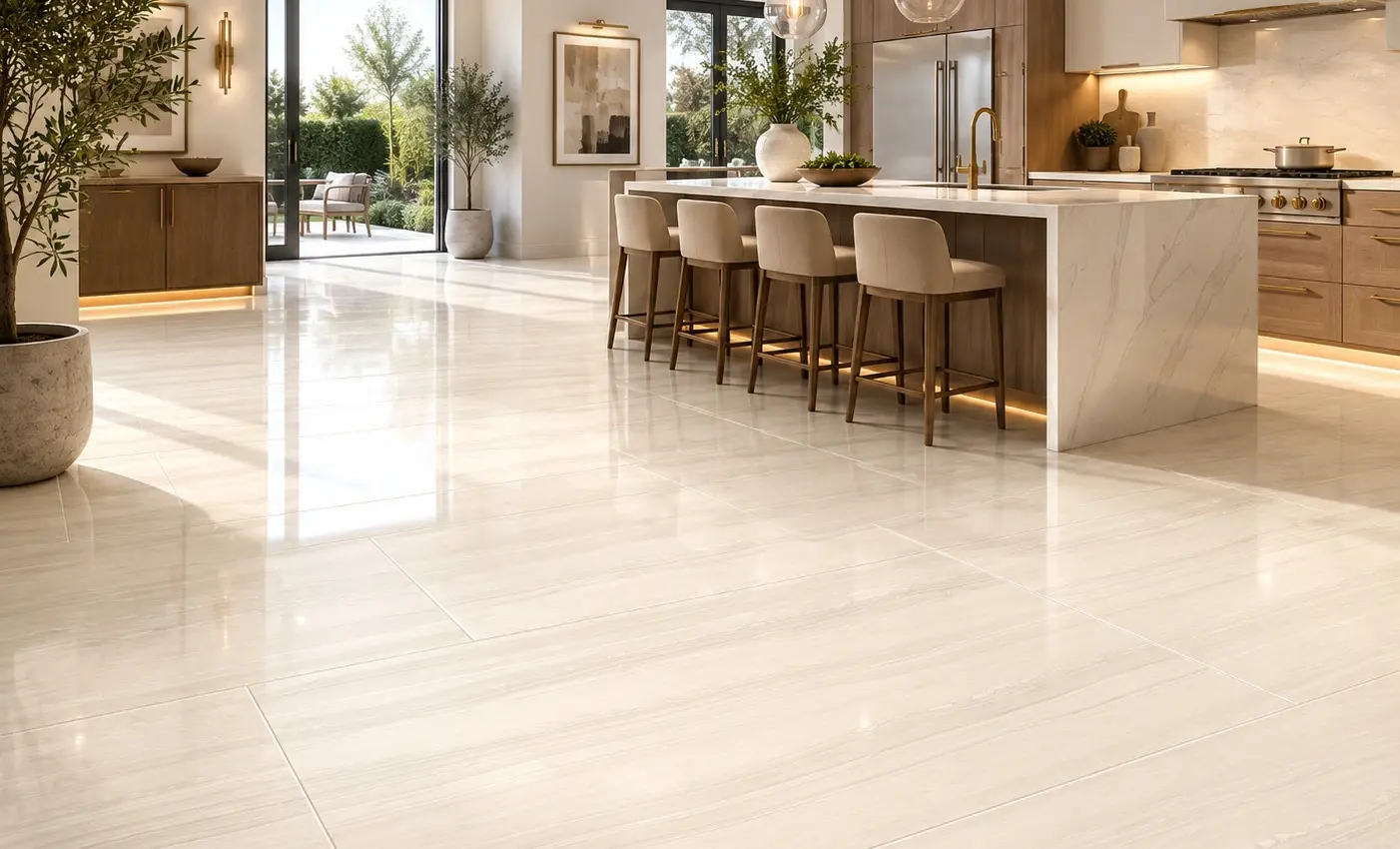
Kitchen Flooring in Reno, NV
Kitchen floors take spills, dropped items, and cooking grease, and bear sustained foot traffic. In Reno, dimensional stability is an added consideration: heated indoor air drops below the humidity range wood-based products need to remain stable, so materials that move with moisture changes can cause problems over time.
Porcelain tile handles all of it. It does not absorb liquids, resists stains, and holds up to the cleaning a kitchen floor requires. Large-format tiles have become common in Reno kitchen renovations because fewer grout lines make maintenance easier and suit the open-plan layouts typical of newer construction in South Reno and surrounding suburbs.
LVP is fully waterproof, comfortable underfoot, and unaffected by Reno's dry winter air, making it one of the most practical kitchen flooring choices in Northern Nevada. Engineered hardwood is the right call for households that want a wood floor, handling humidity swings considerably better than solid. Standard laminate is the most affordable option but is vulnerable to water intrusion near sinks and dishwashers.
Bathroom Flooring Options
Bathrooms simplify the choice considerably: the floor needs to be fully waterproof, slip-resistant, and easy to clean. That points to porcelain tile as the default, and for most bathrooms it is hard to argue against.
For shower floors specifically, surface texture and finish choice matter considerably. ANSI A326.3 defines a higher "Interior Wet Plus" category, covering public showers, pool decks, and locker rooms, with a minimum wet DCOF of 0.50. Residential shower floors fall under the standard Interior Wet category at 0.42, though many designers recommend targeting higher values for barefoot wet surfaces.
For the broader bathroom floor outside the shower, the material choices open up. Natural stone delivers a look and feel that tile often cannot match, though it requires more maintenance. The practical requirements are a honed or textured finish rather than polished, regular sealing, and a grout joint sealed against water intrusion.
LVP is an appropriate choice for bathroom floors outside the shower: the main floor, vanity area, and toilet area. Most quality LVP products are rated for wet areas and handle bathroom moisture without difficulty. Installing LVP inside a shower is not recommended.
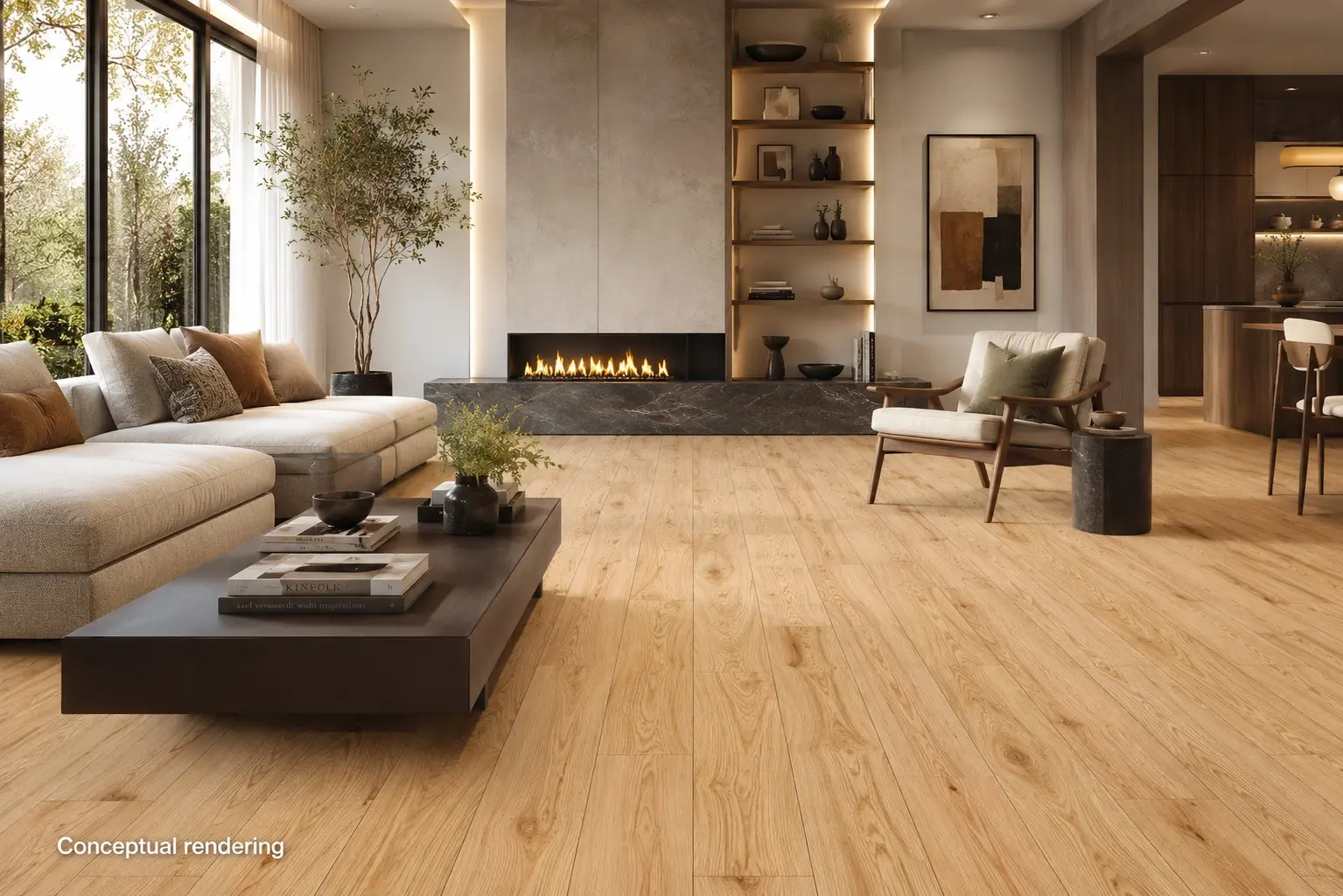
Living Room and Main Area Flooring in Northern Nevada
Living rooms are where the aesthetic stakes are highest and the functional requirements are most relaxed: no standing water, less grit than an entry, fewer spills than a kitchen.
Hardwood flooring brings a warmth and material quality that is difficult to replicate. In Reno's dry climate, though, solid hardwood requires more management than it would in a humid city. Wood is hygroscopic, meaning it absorbs and releases moisture from the surrounding air, and Northern Nevada's low humidity during heating season can cause solid planks to gap noticeably.
Engineered hardwood addresses this directly. Its construction, a real wood veneer bonded over a plywood or HDF core, is significantly more dimensionally stable than solid hardwood because the cross-ply layers resist movement. Most engineered hardwood products are indistinguishable from solid wood once installed.
How many times engineered hardwood can be refinished depends on veneer thickness: thinner veneers (around 2mm) may allow one light refinish, while 3mm and thicker veneers support multiple cycles.
Acclimating hardwood in the home for several days before installation lets it adjust to ambient humidity before it is fastened down. The NWFA's installation guidelines recommend maintaining indoor humidity between 30 and 50% year-round. Indoor humidity in Reno drops well below that range during heating season, making a whole-home humidifier a practical necessity rather than a precaution.
Large-format porcelain tile and natural stone work well in living areas, particularly in homes with an open floor plan where the kitchen and living room share a continuous floor.
LVP and laminate are both practical options for living areas, particularly in homes with active use from children or pets. Laminate works well in living rooms as long as moisture is not a concern. It is not appropriate for a room that connects to a covered patio where tracked-in moisture is common.
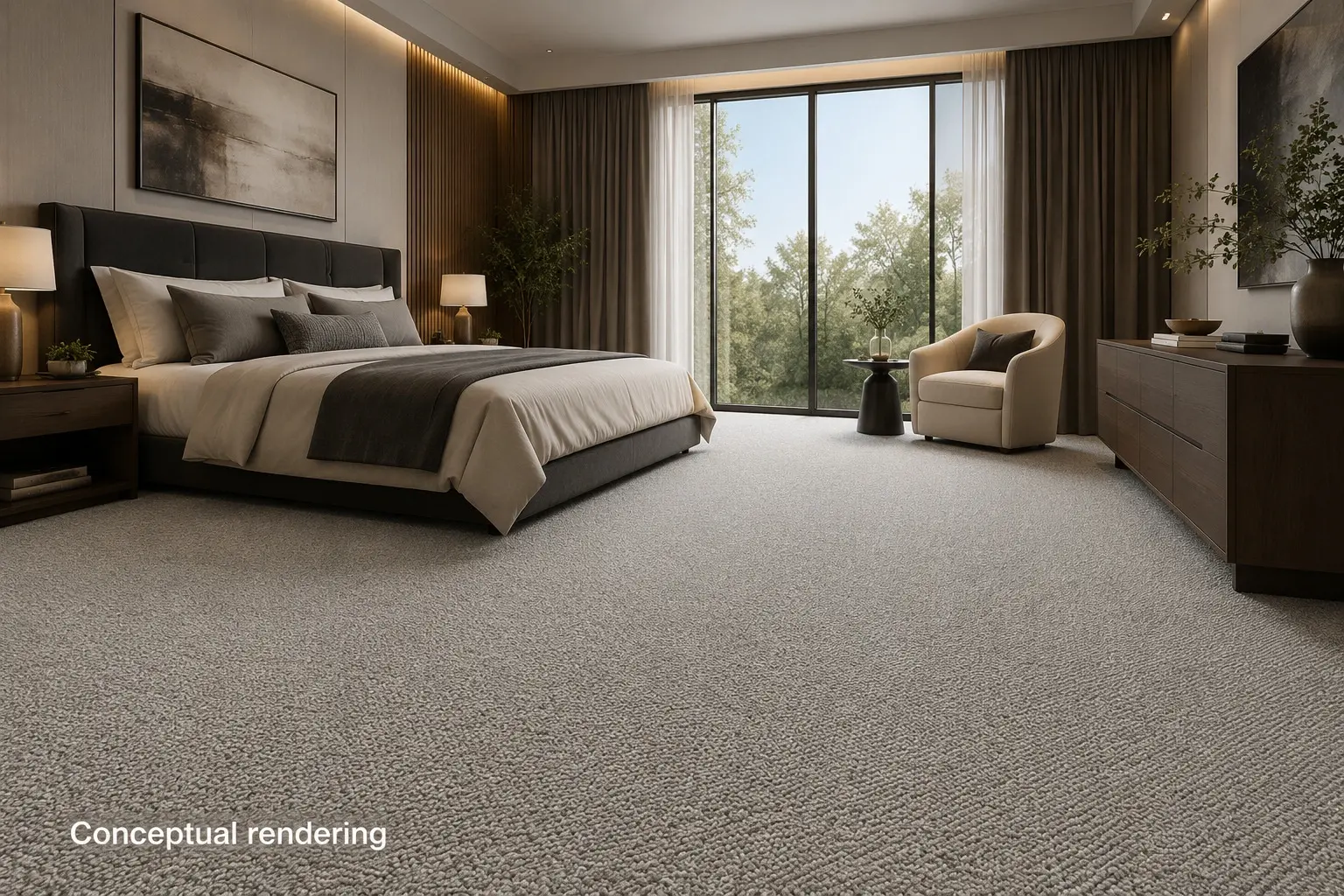
Bedroom Flooring for Reno's Cold Winters
Bedrooms have different priorities from the rest of the house. The main factors are comfort underfoot, acoustic softness, and warmth, especially in the morning when the floor is cold.
Carpet remains the most comfortable option for bedrooms. It performs well in a room with low foot traffic and no moisture exposure, and its thermal insulation is a real benefit during Reno's cold winters.
When choosing carpet, fiber type affects long-term performance. Polyester resists stains well; nylon offers greater durability and resilience under heavy use. A quality pad underlayment adds softness and extends the carpet's lifespan.
Hardwood and engineered hardwood in bedrooms are quieter and warmer than tile and give a room a finished quality that is hard to match.
LVP and laminate work in bedrooms without issue. Neither is the most luxurious option, but with a good underlayment the difference in comfort is less noticeable.
Conclusion
When a renovation touches multiple rooms, the floors have to work together. Tonal consistency matters more than material matching. Floors that share a similar color temperature read as cohesive even when the materials differ. Where two materials meet, placing the transition at a doorway rather than mid-room produces a cleaner result.
Reno-Tahoe interiors have moved toward what local designers describe as a High Sierra aesthetic: materials that echo the surrounding landscape rather than contrast with it. Warm stone in sandy and terracotta tones, hardwood in oak and hickory finishes, and carpet in natural, heathered textures fit that sensibility naturally. This holds true across the region, from homes in Washoe Valley and Verdi to lakeside properties in Incline Village.
Seeing materials together in person is worth the time before finalizing selections. Colors shift under different light conditions, and the tactile difference only becomes apparent when you are standing on them.
Nova Tile and Stone carries all of the flooring categories covered in this guide at the Reno showroom at 12835 Old Virginia Road, Reno, NV 89521. The team serves homeowners throughout Washoe County, including Sparks, Spanish Springs, Washoe Valley, Verdi, Incline Village, and surrounding communities. Reach them at (775) 331-6682.
Frequently Asked Questions
Porcelain tile and LVP are unaffected by humidity, while solid hardwood requires maintaining indoor humidity in the range the NWFA recommends (generally 30 to 50%), which typically means running a humidifier through the heating season.
Quartzite and granite handle high-traffic floors well, marble is better suited to lower-traffic areas, and all natural stone floorings should be sealed at installation and resealed periodically.
LVP has a waterproof vinyl core suitable for wet areas, while laminate uses a high-density fiberboard core that swells with prolonged moisture exposure and is best reserved for dry rooms.
Tile in wet zones, hardwood or LVP in living areas, and carpet in bedrooms is a common and functional approach. Transitions read best when materials share a similar color undertone and meet at doorways.
Carpet is well-suited to bedrooms and lower-level family rooms for warmth and comfort, but hard surfaces are more practical in entryways, kitchens, and bathrooms where moisture and heavy cleaning take a toll.
Note: Some images on this page may be conceptual renderings created to illustrate design possibilities and may not depict actual installations.